
1 · SNAPSHOT
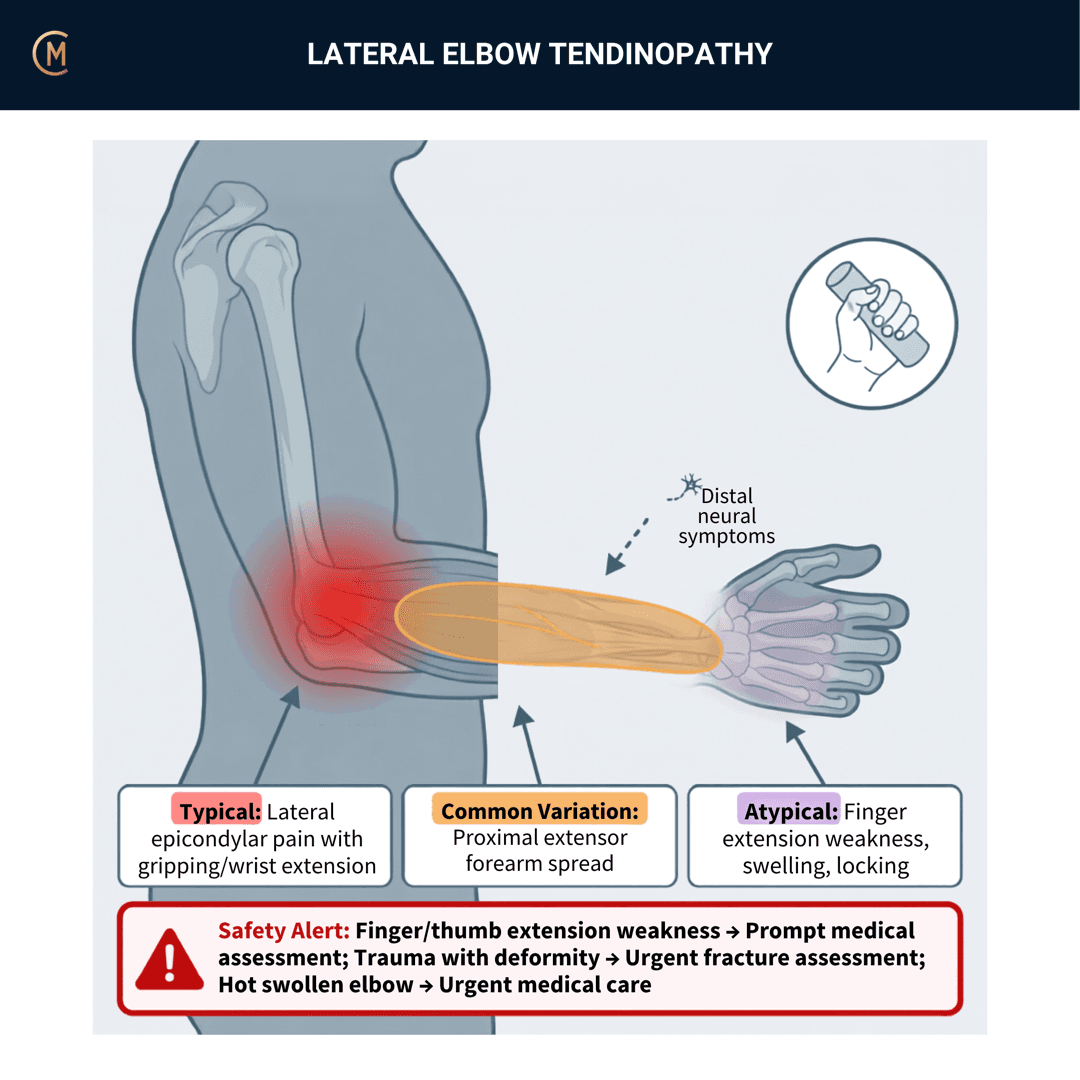
Who: Working-age adults. Manual workers, tradies, keyboard-and-mouse jobs, racquet players, anyone whose grip volume stepped up. Peak 45–54.
What: Gradual-onset pain right on the common extensor origin, no trauma.
How it behaves: Aggs: gripping, lifting palm-down, wrist extension with the elbow extended (that's ECRB on stretch), kettles, doorknobs, tools, a keyboard, a racquet. Eases: putting the thing down, forearm strap, elbow flexed.
The illness script in one line: lateral elbow pain in someone whose gripping load recently changed, reproduced by grip and resisted wrist extension, with full elbow range and normal neurology.
The one thing to take from this page — and it goes first, not last:
Most of these people get better without you. Wait-and-see success was 83% at 52 weeks [1]. 96% of the placebo-injection arm reported complete recovery or much improvement at one year [2]. 83% improved at one year across 266 consecutive GP cases with no relation to treatment type [3]. Every effect size on this page sits on top of that number. Say it to the patient in week one.
| Figure | Number |
|---|---|
| Population prevalence, definite lateral epicondylitis, ages 30–64 | 1.3% (medial 0.4%) |
| Age peak | 45–54, no sex difference |
| Repetitive and forceful arm work vs neither | OR 5.6 (95% CI 1.9–16.5) |
| Prospective occupational exposure, pooled | OR 2.6 (1.9–3.5), 5 studies, 256 incident cases |
| Wait-and-see success at 52 weeks | 83% |
| Placebo-injection arm, recovered or much improved at 1 year | 96% |
| Recurrence within 2 years | 8.5% |
| Still symptomatic at 6 months → went to surgery | about 1 in 10 |
([4] [5]; Smidt et al. 2002; Coombes et al. 2013 [6].)
⚠️ No Australian guideline for this presentation; anchored to the JOSPT 2022 Clinical Practice Guideline — Lateral Elbow Pain and Muscle Function Impairments [7]. Neither ACSQHC nor RACGP publishes one. And here's the irony worth carrying into a tutorial: the two strongest primary trials on this pattern anywhere in the world are Australian — Coombes 2013 in JAMA and Bisset et al. 2006 in the BMJ [8], both out of Brisbane — and nobody here has built a guideline on them. The CPG is 111 pages; only its abstract has been read, so no graded recommendation is quoted from it.
Patterns > Labels. "Lateral epicondylitis" names an inflammation that isn't there. A grip-load tolerance problem at the common extensor origin names what you're actually treating.
2 · SE — THE SUBJECTIVE PATTERN (the 70%)
Five stages, in order. On this pattern the S/E does nearly all of it — the P/E confirms a hypothesis you already hold, and on the numbers below it barely earns the right to do that.
MAIN PROBLEM
"It's this spot on the outside of my elbow. I can't hold the kettle."
Onset gradual, no trauma, and there is almost always a load story sitting behind it. Ask about the job before you ask about the elbow.
BODY CHART
Chart interpretation: The primary distribution is lateral epicondylar/proximal extensor-region pain. Distal tingling or finger/thumb-extension weakness suggests an alternative explanation requiring separate assessment.
- P1: a fingertip-sized area directly on the lateral epicondyle / common extensor origin. Ask them to point with one finger, not to wave at it.
- P2: a spread down the extensor mass of the proximal forearm. Non-dermatomal, no distal march.
- Mark 3–5 cm distal separately. Maximal tenderness there, along the radial tunnel, is a different pattern (see §3).
- φp elsewhere. No pins and needles, no numbness, no neck symptoms — and check that rather than assume it.
- Note the side. Dominant side carried OR 3.1 (95% CI 1.4–6.8) for a <50% pain reduction at one year (Haahr & Andersen 2003).
BEHAVIOUR
- Coding: In early — intermittent, load-linked, provoked by grip. It becomes P (present) as it drags on, and that shift is a prognosis signal, not a new diagnosis.
- Aggs: grip, lifting palm-down, screwdriver, kettle, doorknob, mouse, racquet, carrying shopping. Worse with the elbow extended.
- Eases: stopping the task, elbow flexed, forearm strap during gripping.
- 24-hr pattern: morning stiffness or an ache after activity, usually M at under 30 minutes; grip through the day is the Aggs.
- Severity: VAS 0–10 at best / at worst / right now.
- Morning stiffness or ache after activity. Under UniSA coding, <30 min = M; >30 min = In. This pattern is usually M.
- Irritability, all three parts: resting symptoms present or not · how vigorous the provoking task has to be · how long it takes to settle. That triad sets your starting load, and on this pattern the third part is the one that decides whether you load today.
HISTORY
The work questions are the strongest thing in the whole subjective. Prospective cohorts, not recall.
| Ask | Why it matters |
|---|---|
| "What changed in your gripping in the last few months?" | New tool, new job task, new racquet or grip size, a return to work after leave, a volume spike |
| "Is your job manual? How physically hard is it?" | Manual job OR 3.0 (95% CI 1.0–8.7) and high physical strain OR 8.5 (1.0–74.7) for poor overall improvement at one year — look at that confidence interval before you quote it |
| "How bad is it at its worst?" | High baseline pain OR 2.3 (1.0–5.3); high baseline distress OR 1.9 (1.0–4.0) |
| "Have you had an injection into it?" | Prior injection OR 5.6 for eventual surgery — association, and confounding by indication is at least as good an explanation [9] |
| "Is there a workers' compensation claim?" | OR 8.1, the largest single predictor of eventual surgery in that series |
| "How long has it been?" | Duration >12 months OR 2.5 |
Combined repetitive and forceful arm activity carries OR 5.6 against neither (Shiri et al. 2006); the prospective pooled figure is OR 2.6 (Descatha et al. 2016). Current smoking OR 3.4 (1.4–8.3) in the same population sample.
SPECIAL / SCREENING QUESTIONS
- Neurological screen in words first: any weakness opening the hand or extending the fingers? Any numbness or pins and needles? Any night symptoms? Then test it (§5).
- Screen the neck on everybody, even when they don't mention it. 36% of 165 people with unilateral lateral elbow pain and NO neck or upper-limb symptoms had cervical palpation dysfunction, and 41% had a positive radial neurodynamic test [10].
- The subgrouping prompts — neck pain, tendon tears, features of central sensitisation — come from Coombes et al. 2015 [11], whose own authors call the algorithm preliminary and untested. Use them as questions to ask, not as a pathway to follow.
- Screening questions as taught: general health, unexplained weight change, medications including steroids, previous surgery, imaging already done.
Jones' hypothesis categories that actually change your plan here: contributing factors (the occupational load — it is the strongest evidence for this pattern), prognosis (manual work, baseline pain, baseline distress, duration), and precautions (motor weakness, and the skeletally immature elbow).
70/30 is a working heuristic, not a statistic. On this pattern it's close to literal: the S/E gives you the pattern, and the P/E has almost no measured accuracy to add.
Assessing this region? Download the Elbow assessment template →
3 · HYPOTHESIS RANKING
Top three, one discriminating feature each. Rank them, then rule out the dangerous one first.
| Rank | Competing pattern | The one discriminating feature |
|---|---|---|
| 1 | Radial tunnel syndrome (PIN compression) | Maximal tenderness 3–5 cm DISTAL to the epicondyle along the radial tunnel, with the epicondyle itself non-tender or only mildly so. Deep, vaguer forearm ache. Pain — not weakness — on resisted supination and resisted middle-finger extension. It is the pattern most often sitting under a "tennis elbow that won't respond": its presence at first visit carried OR 3.1 for eventual surgery (Knutsen et al. 2015). Anatomy and framing from Wolf et al. 2023 [12], which carries no accuracy statistics — so don't quote one from it. |
| 2 | Cervical referral / C6–C7 radicular pain | Symptoms reproduced or altered by cervical movement, cervical compression, or ULNT. Then the trap: 36% cervical palpation dysfunction and 41% positive radial neurodynamics show up in lateral elbow pain without neck symptoms (Coombes et al. 2014), so a positive cervical finding is a contributor to screen, not automatically the source. Cross-sectional data — it cannot tell you direction. |
| 3 | Posterolateral elbow joint / capitellar pathology | Locking, catching, effusion, or loss of elbow ROM. This pattern has full, pain-free elbow range. In a skeletally immature thrower or gymnast with lateral pain plus swelling plus ROM loss, think osteochondritis dissecans of the capitellum and image [13]. That one is in §4. |
And the variant that isn't a rehab plan at all: PIN entrapment with motor involvement — weak finger and thumb extension. PIN is a motor branch, so sensation stays intact. Normal sensation does not rule it out. Any true extensor lag is a referral.
Where's the number for the top differential? There is essentially one, and it needs a warning. In a prospective double-blinded pilot [14], palpation separating radial tunnel syndrome from lateral epicondylitis ran sensitivity 75.7%, specificity 50.0%; neuromuscular ultrasound ran 92.6% / 80.0%. 68 elbows in 34 people, and the published results paragraph describes the same 68 nerves as both patients and healthy controls. Take the direction — your thumb is close to a coin-toss at telling these two apart — and treat every digit as provisional.
Consistency = confidence. Three or four features pointing the same way beats any single test on this pattern, because the single tests here have almost never been measured.
4 · RED FLAGS — DON'T MISS THIS
Free forever. Safety is never gated on CliniStudy, on this page or any other.
This is a low-risk pattern, so the list is short. Short is not the same as optional.
1. Motor weakness — the PIN check
- Weak finger and thumb extension is posterior interosseous nerve, not tendinopathy.
- PIN is a pure motor branch. Sensation is normal. Do not let intact sensation reassure you.
- Any true extensor lag, or progressive weakness → refer, don't rehab.
2. The skeletally immature elbow
- Adolescent thrower or gymnast, lateral elbow pain + swelling + loss of ROM → osteochondritis dissecans of the capitellum until proven otherwise [13].
- The ROM loss is the discriminator. This pattern does not lose elbow range.
- Screening radiographs often detect it; MRI defines size, location and stability. Unstable lesions, loose bodies and failed conservative care go to surgery. Not your call to make — make the referral.
3. Clear the neck before you call it a tendon
- Cervical movement, cervical compression, ULNT — and a neurological examination recording power, reflexes AND sensation, bilaterally.
- If you're building a case for cervical radiculopathy, the validated cluster now has independent numbers: 85 people, 27 with radiculopathy, MRI reference standard, blinded examiner. A three-test cluster — passive shoulder abduction + cervical compression reproducing arm pain + ≥2 of 4 ULNTs — gave an infinite +LR and 100% post-test probability when all three were positive, identifying 37.0% of cases against 17.9% for the original four-of-four [15].
- Read that honestly. An infinite +LR means zero false positives in 85 people, not zero in the world.
4. The iatrogenic one — and it's the biggest on this page
Corticosteroid injection is the highest-quality harm signal in musculoskeletal physiotherapy. It is not a catastrophe risk; it is a worse-outcome risk, and students are rarely taught it that way.
| Outcome at 1 year | Corticosteroid | Placebo |
|---|---|---|
| Complete recovery or much improved | 83% | 96% |
| RR 0.86 (99% CI 0.75–0.99), P = .01 | ||
| Recurrence | 54% | 12% |
| RR 0.23 (99% CI 0.10–0.51), P < .001 |
([2], n = 165, Brisbane, 2×2 factorial, placebo-controlled.)
Pooled across 41 trials and 2,672 participants, the effect reverses: SMD +1.44 (95% CI 1.17–1.71) short term, −0.40 (−0.67 to −0.14) intermediate, −0.31 (−0.61 to −0.01) long term. Serious adverse events were rare — 1 tendon rupture in 991 injected participants (0.1%) [16].
5. The ordinary ones, still
- No meaningful change by 6 months, or symptoms beyond 12 months → review the whole formulation, then refer.
- Elbow ROM loss or locking at any age.
- Progressive neurological signs.
Safety is free. If your placement educator tells you the red flag layer is behind a paywall somewhere, it isn't ours.
5 · OE — THE OBJECTIVE (the 30%)
Members
Sections 5 to 7 are for members
The objective exam, management and pearls, plus the six-minute lesson and the debrief. Free with an account.
Sign in or join free6 · MX — MANAGEMENT ESSENTIALS
Members
Sections 5 to 7 are for members
The objective exam, management and pearls, plus the six-minute lesson and the debrief. Free with an account.
Sign in or join free7 · CLINICAL PEARLS + RETRIEVAL CHECK
Members
Sections 5 to 7 are for members
The objective exam, management and pearls, plus the six-minute lesson and the debrief. Free with an account.
Sign in or join freeMembers
The 4-minute lesson is for members
Twelve slides on this pattern: what you'll hear, what to examine, what to do. Free with an account.
Sign in or join freeGuideline anchor
No Australian guideline for this presentation.
More
Anchored to JOSPT Clinical Practice Guideline — Lateral Elbow Pain and Muscle Function Impairments (Lucado et al. 2022, PMID 36453071, doi 10.2519/jospt.2022.0302)
No Australian guideline exists for lateral elbow tendinopathy. Neither ACSQHC nor RACGP publishes a clinical care standard for this presentation. The anchor is American. Note the irony and say it on the page: the two strongest primary trials in the world on this pattern are Australian — Coombes 2013 (JAMA) and Bisset 2006 (BMJ), both out of Brisbane — and there is still no Australian guideline built on them.
Members
The evidence summary is for members
Verified diagnostic accuracy, where the evidence stands and what it doesn't settle. Free with an account.
Sign in or join freeSources · 27
ShowHide
Every source on this page resolves and title-verifies against PubMed. Newest first.
- 2002Smidt et al. (2002). Corticosteroid injections, physiotherapy, or a wait-and-see policy for lateral epicondylitis: a randomised controlled trial. Lancet (London, England), 359(9307), 657-62. https://doi.org/10.1016/S0140-6736(02)07811-X
- 2013Coombes et al. (2013). Effect of corticosteroid injection, physiotherapy, or both on clinical outcomes in patients with unilateral lateral epicondylalgia: a randomized controlled trial. JAMA, 309(5), 461-9. https://doi.org/10.1001/jama.2013.129
- 2003Haahr & Andersen (2003). Prognostic factors in lateral epicondylitis: a randomized trial with one-year follow-up in 266 new cases treated with minimal occupational intervention or the usual approach in general practice. Rheumatology (Oxford, England), 42(10), 1216-25. https://doi.org/10.1093/rheumatology/keg360
- 2006Shiri et al. (2006). Prevalence and determinants of lateral and medial epicondylitis: a population study. American journal of epidemiology, 164(11), 1065-74. https://doi.org/10.1093/aje/kwj325
- 2016Descatha et al. (2016). Lateral Epicondylitis and Physical Exposure at Work? A Review of Prospective Studies and Meta-Analysis. Arthritis care & research, 68(11), 1681-1687. https://doi.org/10.1002/acr.22874
- 2015Sanders TL et al. (2015). The epidemiology and health care burden of tennis elbow: a population-based study. The American journal of sports medicine, 43(5), 1066-71. https://doi.org/10.1177/0363546514568087
- 2022Lucado et al. (2022). Lateral Elbow Pain and Muscle Function Impairments. The Journal of orthopaedic and sports physical therapy, 52(12), CPG1-CPG111. https://doi.org/10.2519/jospt.2022.0302
- 2006Bisset et al. (2006). Mobilisation with movement and exercise, corticosteroid injection, or wait and see for tennis elbow: randomised trial. BMJ (Clinical research ed.), 333(7575), 939. https://doi.org/10.1136/bmj.38961.584653.AE
- 2015Knutsen et al. (2015). Factors associated with failure of nonoperative treatment in lateral epicondylitis. The American journal of sports medicine, 43(9), 2133-7. https://doi.org/10.1177/0363546515590220
- 2014Coombes et al. (2014). Bilateral cervical dysfunction in patients with unilateral lateral epicondylalgia without concomitant cervical or upper limb symptoms: a cross-sectional case-control study. Journal of manipulative and physiological therapeutics, 37(2), 79-86. https://doi.org/10.1016/j.jmpt.2013.12.005
- 2015Coombes et al. (2015). Management of Lateral Elbow Tendinopathy: One Size Does Not Fit All. The Journal of orthopaedic and sports physical therapy, 45(11), 938-49. https://doi.org/10.2519/jospt.2015.5841
- 2023Wolf et al. (2023). Radial Tunnel Syndrome: Review and Best Evidence. The Journal of the American Academy of Orthopaedic Surgeons, 31(15), 813-819. https://doi.org/10.5435/JAAOS-D-23-00314
- 2026Tramer et al. (2026). Osteochondritis Dissecans of the Capitellum in the Young Athlete. The Journal of the American Academy of Orthopaedic Surgeons, 34(11), e1495-e1502. https://doi.org/10.5435/JAAOS-D-25-00800
- 2024Kerasnoudis et al. (2024). Neuromuscular ultrasound for the differential diagnosis of radial tunnel syndrome and lateral epicondylitis. Journal of neuroimaging : official journal of the American Society of Neuroimaging, 34(6), 799-803. https://doi.org/10.1111/jon.13244
- 2026Grondin et al. (2026). An independent validation of a clinical prediction rule for the diagnosis of cervical radiculopathy with radicular pain. Brazilian journal of physical therapy, 30(3), 101581. https://doi.org/10.1016/j.bjpt.2026.101581
- 2010Coombes et al. (2010). Efficacy and safety of corticosteroid injections and other injections for management of tendinopathy: a systematic review of randomised controlled trials. Lancet (London, England), 376(9754), 1751-67. https://doi.org/10.1016/S0140-6736(10)61160-9
- 2022Karanasios et al. (2022). Diagnostic accuracy of examination tests for lateral elbow tendinopathy (LET) - A systematic review. Journal of hand therapy : official journal of the American Society of Hand Therapists, 35(4), 541-551. https://doi.org/10.1016/j.jht.2021.02.002
- 2021Heales et al. (2021). An Investigation of Maximal Strength of the Upper Limb Bilaterally in Individuals With Lateral Elbow Tendinopathy: A Systematic Review With Meta-Analysis. Physical therapy, 101(12). https://doi.org/10.1093/ptj/pzab230
- 2026Crema et al. (2026). Prevalence of ultrasound-detected changes in the common extensor tendon of the elbow in asymptomatic amateur senior tennis players: associations with dominant arm and backhand technique. Skeletal radiology, 55(10), 2495-2502. https://doi.org/10.1007/s00256-026-05253-9
- 2021Karanasios et al. (2021). Exercise interventions in lateral elbow tendinopathy have better outcomes than passive interventions, but the effects are small: a systematic review and meta-analysis of 2123 subjects in 30 trials. British journal of sports medicine, 55(9), 477-485. https://doi.org/10.1136/bjsports-2020-102525
- 2024Wallis et al. (2024). Manual therapy and exercise for lateral elbow pain. The Cochrane database of systematic reviews, 5(5), CD013042. https://doi.org/10.1002/14651858.CD013042.pub2
- 2024Lowdon et al. (2024). Comparison of Interventions for Lateral Elbow Tendinopathy: A Systematic Review and Network Meta-Analysis for Patient-Rated Tennis Elbow Evaluation Pain Outcome. The Journal of hand surgery, 49(7), 639-648. https://doi.org/10.1016/j.jhsa.2024.03.007
- 2026Antunes Júnior et al. (2026). Platelet-Rich Plasma Does Not Improve Pain or Function in Patients With Lateral Epicondylitis as Compared With Placebo: A Meta-analysis of Randomized Clinical Trials. The American journal of sports medicine, 54(5), 1247-1257. https://doi.org/10.1177/03635465251383039
- 2022Karanasios et al. (2022). Low-Load Resistance Training With Blood Flow Restriction Is Effective for Managing Lateral Elbow Tendinopathy: A Randomized, Sham-Controlled Trial. The Journal of orthopaedic and sports physical therapy, 52(12), 803-825. https://doi.org/10.2519/jospt.2022.11211
- 2020Heales et al. (2020). Evaluating the immediate effect of forearm and wrist orthoses on pain and function in individuals with lateral elbow tendinopathy: A systematic review. Musculoskeletal science & practice, 47, 102147. https://doi.org/10.1016/j.msksp.2020.102147
- 2016Coombes et al. (2016). Isometric Exercise Above but not Below an Individual's Pain Threshold Influences Pain Perception in People With Lateral Epicondylalgia. The Clinical journal of pain, 32(12), 1069-1075. https://doi.org/10.1097/AJP.0000000000000365
- 2015Bisset & Vicenzino (2015). Physiotherapy management of lateral epicondylalgia. Journal of physiotherapy, 61(4), 174-81. https://doi.org/10.1016/j.jphys.2015.07.015
Mapped to this pattern
Generic measures that also apply
- Borg RPE
Borg Rating of Perceived Exertion Scale (6-20)
perceived exertion · 1 items · 1 min
- DASH
Disabilities of the Arm, Shoulder and Hand
upper limb disability · 30 items · 8 min
- GROC
Global Rating of Change Scale
perceived change since baseline · 1 items · 1 min
- NPRS
Numeric Pain Rating Scale
pain intensity · 1 items · 1 min
- PGIC
Patient Global Impression of Change
perceived change since baseline · 1 items · 1 min
- PSFS
Patient-Specific Functional Scale
patient-generated function · 3 items · 2 min
- QuickDASH
QuickDASH
upper limb disability, short form · 11 items · 4 min
- SANE
Single Assessment Numeric Evaluation
patient-rated function as a percentage of normal · 1 items · 1 min
- UEFI
Upper Extremity Functional Index
upper limb function · 20 items · 5 min
- VAS
Visual Analogue Scale
pain intensity · 1 items · 1 min
- Borg CR10
Borg Category Ratio 10 Scale
perceived exertion or symptom intensity, ratio scale · 1 items · 1 min
- GAS
Goal Attainment Scaling
individualised goal achievement · 10 min
Did this page do its job?
CliniStudy is in beta. One tap is enough — it decides what gets fixed first.