
1 · SNAPSHOT
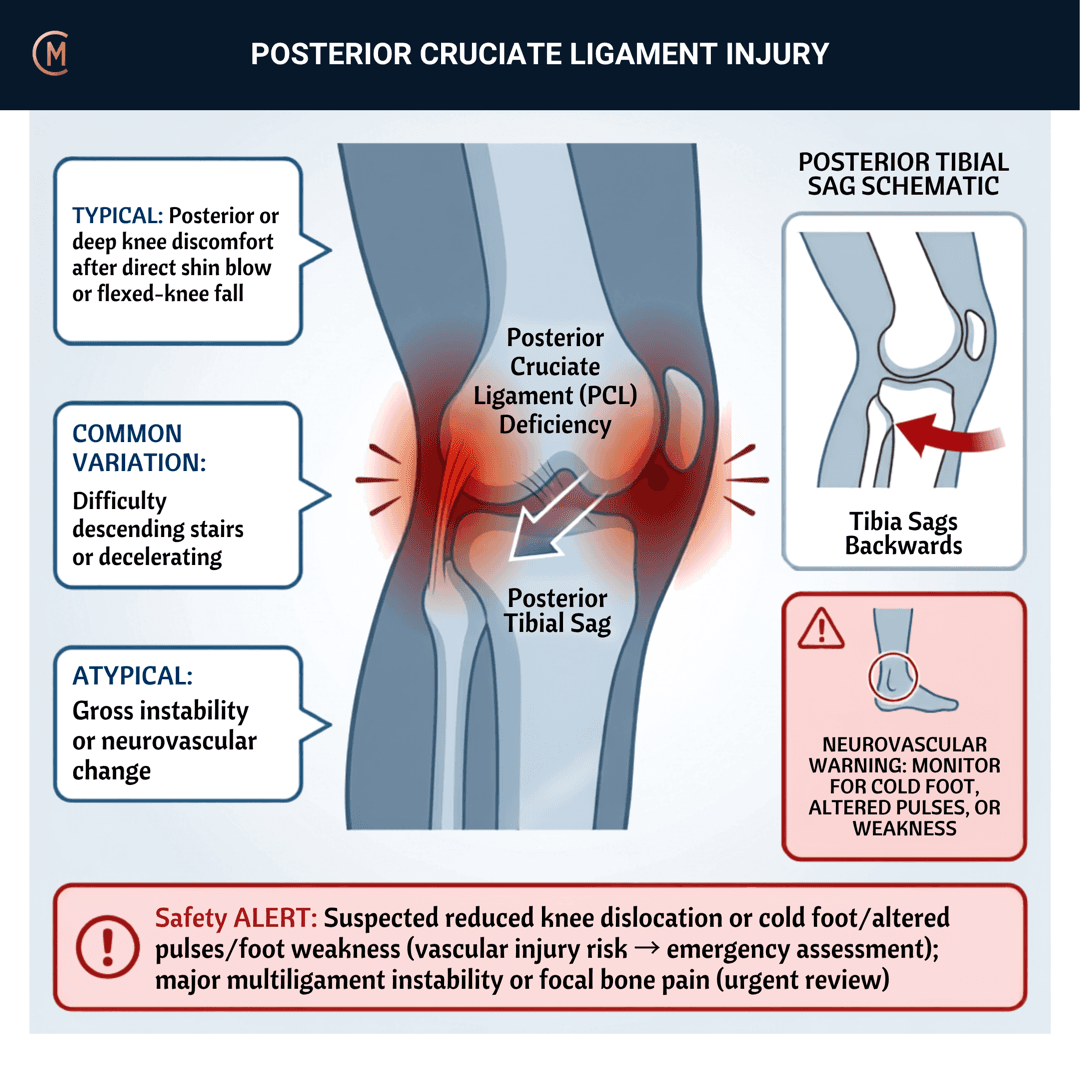
Who: Fall onto a flexed knee. Dashboard injury. Contact sport, motorbike, tackle.
What: Posterior cruciate ligament injury, isolated or as part of a multiligament pattern.
How it behaves: Posterior knee ache. Instability decelerating or going down stairs. Often minimal swelling compared with an ACL — which is precisely why it gets missed.
The one thing to take from this page:
"Quad is your functional PCL." That single line explains the whole plan — why you bias quadriceps, why you avoid early hamstring loading, and why restoring extension early matters.
The safety split
| Uncomplicated — yours | Escalate |
|---|---|
| Isolated, low-grade | High-grade laxity |
| Clean varus and external-rotation testing | Posterolateral corner signs |
| One ligament | Multiligament pattern |
| No neurovascular symptoms | Any neurovascular symptom — think knee dislocation |
| Improving with quad-led rehab | Persistent instability despite well-run rehab |
| Low-energy mechanism | Bony avulsion, high-energy mechanism |
⚠️ No guideline exists for PCL injury anywhere. The mechanical principles on this page are well reasoned; the protocols — bracing, post-operative progression — are explicitly variable across the literature.
2 · SE — THE SUBJECTIVE PATTERN (the 70%)
Five stages. This is an acute or traumatic presentation, so the order shifts: main problem → body chart → history → behaviour → screening.
MAIN PROBLEM
"I went down on my knee and it's ached at the back ever since."
"Stairs feel unsafe going down."
"It doesn't hurt much, it just doesn't feel right."
Low complaint volume is characteristic. Take the mechanism seriously even when the presentation is mild.
BODY CHART
- Posterior knee. A deep ache rather than a sharp point.
- Not a lateral joint-line point → meniscus.
- Mark anterior knee pain if present — quadriceps inhibition and patellofemoral overload arrive quickly here.
- Mark any paraesthesia or foot symptoms. With a high-energy mechanism that is a neurovascular question.
HISTORY — take it before behaviour
- Exactly how? A fall onto the flexed knee, or a dashboard. Those are the two.
- How much force? High energy changes the whole page.
- How much swelling, and how fast? Less than an ACL is normal here — record it, don't be reassured by it.
- Could they keep going? Often yes. That is not reassurance either.
- Any previous knee injury?
BEHAVIOUR
| Fits PCL | Points elsewhere | |
|---|---|---|
| Aggs | Descending stairs, deceleration, squatting deep, kneeling | Twisting and pivoting giving way → ACL |
| Severity | VAS 0–10 at best / at worst / right now | — |
| Symptom | Instability without a dramatic story | Immediate large effusion + a pop → ACL |
| Pain | Posterior ache, often modest | Sharp, localised joint line + locking → meniscus |
| Later | Anterior knee pain from PFJ overload | — |
SPECIAL / SCREENING QUESTIONS
- Any numbness, pins and needles, coldness or colour change in the foot?
- Did the knee visibly deform or relocate? Suspected dislocation is an emergency pathway.
- Any sense of the knee rotating outwards or the leg bowing? That is the posterolateral corner question in patient language.
Assessing this region? Download the Knee assessment template →
3 · HYPOTHESIS RANKING
| Competing pattern | The one discriminating feature |
|---|---|
| ACL injury | Twisting or pivoting with a "pop", immediate swelling, positive Lachman and pivot shift. |
| MCL injury | Valgus mechanism, medial joint-line tenderness, positive valgus stress at 30°. |
| Meniscal tear | Joint-line point tenderness, catching or locking, a twisting rather than a direct-blow mechanism. |
| Patellofemoral pain | Anterior, load-related, no traumatic mechanism — though PFJ overload follows PCL injury and can coexist. |
The one you screen for every single time
Posterolateral corner injury. Unrecognised PLC instability is the classic miss alongside PCL [1], and it undermines both rehabilitation and reconstruction [2]. Varus and external-rotation testing belongs in every PCL assessment, not just the interesting ones.
And the two that outrank the table
Multiligament knee injury. Outcomes are worse over time [3], which raises the cost of calling something isolated when it isn't. The combined-ligament reasoning applies across patterns [4].
Knee dislocation with a vascular injury. Same mechanism, different urgency. Any neurovascular symptom after a high-energy knee injury is an emergency question, not a rehabilitation one.
4 · RED FLAGS — DON'T MISS THIS
This section is free, on every pattern, forever. Safety is never gated.
| Finding | What it suggests | What you do |
|---|---|---|
| Absent or reduced foot pulses, cold or pale foot | Vascular injury after knee dislocation | Emergency |
| Foot drop, numbness, paraesthesia | Common peroneal nerve injury | Urgent medical review |
| Reported deformity or spontaneous relocation | Knee dislocation | Emergency assessment — even with normal foot pulses. Abnormal pedal pulses alone aren't sensitive enough to detect a surgical arterial injury (Barnes et al. 2002) [21] |
| Gross multidirectional laxity | Multiligament injury | Urgent orthopaedic review |
| Inability to weight bear, bony tenderness | Fracture or bony avulsion | Image |
| High-energy mechanism | Occult multiligament or vascular injury | Low threshold to escalate |
| Marked varus opening or external rotation asymmetry | Posterolateral corner injury | Orthopaedic review |
| Hot, swollen knee with fever | Septic arthritis | Emergency |
The rule: a low-energy fall onto a flexed knee with isolated posterior laxity and a clean neurovascular exam is yours. A high-energy mechanism, gross laxity, or anything neurovascular is not.
Cross-links: ACL injury (acute) · Meniscus tear · Patellofemoral pain · Knee osteoarthritis
5 · OE — THE OBJECTIVE (the 30%)
Members
Sections 5 to 7 are for members
The objective exam, management and pearls, plus the six-minute lesson and the debrief. Free with an account.
Sign in or join free6 · MX — MANAGEMENT ESSENTIALS
Members
Sections 5 to 7 are for members
The objective exam, management and pearls, plus the six-minute lesson and the debrief. Free with an account.
Sign in or join free7 · CLINICAL PEARLS + RETRIEVAL CHECK
Members
Sections 5 to 7 are for members
The objective exam, management and pearls, plus the six-minute lesson and the debrief. Free with an account.
Sign in or join freeMembers
The 5-minute lesson is for members
Twelve slides on this pattern: what you'll hear, what to examine, what to do. Free with an account.
Sign in or join freeGuideline anchor
No Australian guideline covers PCL injury, and there is no formal clinical practice guideline for it anywhere.
More
Anchored to the two-part evolving-evidence review (Winkler et al. 2021, PMID 33201271 and PMID 33125531) for anatomy, diagnostics and the surgical pathway; to the non-operative management review (Wang et al. 2018, PMID 29721691) for the rehabilitation principles; and to the return-to-play review (Kew et al. 2022, PMID 36447081) for criteria-driven return.
None of these is an Australian document and none is a guideline. The rehabilitation literature is reviews, cohorts and one prospective follow-up study, not controlled comparison, and the reviews themselves note that bracing and post-operative protocols vary. Treat the mechanical principles as well reasoned and the protocols as unsettled.
Members
The evidence summary is for members
Verified diagnostic accuracy, where the evidence stands and what it doesn't settle. Free with an account.
Sign in or join freeSources · 20
ShowHide
Every source on this page resolves and title-verifies against PubMed. Newest first.
- 2017Shon et al. (2017). Current Concepts of Posterolateral Corner Injuries of the Knee. Knee surgery & related research, 29(4), 256-268. https://doi.org/10.5792/ksrr.16.029
- 2020Weiss et al. (2020). Posterolateral corner of the knee: a systematic literature review of current concepts of arthroscopic reconstruction. Archives of orthopaedic and trauma surgery, 140(12), 2003-2012. https://doi.org/10.1007/s00402-020-03607-z
- 2025Klasan et al. (2025). Outcomes after multiligament knee injury worsen over time: A systematic review and meta-analysis. Knee surgery, sports traumatology, arthroscopy : official journal of the ESSKA, 33(4), 1281-1298. https://doi.org/10.1002/ksa.12442
- 2014Bonanzinga et al. (2014). Management of Combined Anterior Cruciate Ligament-Posterolateral Corner Tears: A Systematic Review. The American journal of sports medicine, 42(6), 1496-503. https://doi.org/10.1177/0363546513507555
- 2014James et al. (2014). Stress radiography for the diagnosis of knee ligament injuries: a systematic review. Clinical orthopaedics and related research, 472(9), 2644-57. https://doi.org/10.1007/s11999-014-3470-8
- 2023Rasmussen et al. (2023). Patient-reported Outcomes and Muscle Strength after a Physiotherapy-led Exercise and Support Brace Intervention in Patients with Acute Injury of the Posterior Cruciate Ligament: A Two-year Follow-up Study. International journal of sports physical therapy, 18(4), 807-819. https://doi.org/10.26603/001c.83214
- 2018Wang et al. (2018). Nonoperative Treatment of PCL Injuries: Goals of Rehabilitation and the Natural History of Conservative Care. Current reviews in musculoskeletal medicine, 11(2), 290-297. https://doi.org/10.1007/s12178-018-9487-y
- 2013Pierce et al. (2013). Posterior cruciate ligament tears: functional and postoperative rehabilitation. Knee surgery, sports traumatology, arthroscopy : official journal of the ESSKA, 21(5), 1071-84. https://doi.org/10.1007/s00167-012-1970-1
- 1999Shelbourne et al. (1999). The natural history of acute, isolated, nonoperatively treated posterior cruciate ligament injuries. A prospective study. The American journal of sports medicine, 27(3), 276-83. https://doi.org/10.1177/03635465990270030201
- 1995Shino et al. (1995). Conservative treatment of isolated injuries to the posterior cruciate ligament in athletes. The Journal of bone and joint surgery. British volume, 77(6), 895-900. PubMed 7593102
- 2017Shelbourne et al. (2017). Optimal management of posterior cruciate ligament injuries: current perspectives. Orthopedic research and reviews, 9, 13-22. https://doi.org/10.2147/ORR.S113617
- 2022Kew et al. (2022). Return to Play after Posterior Cruciate Ligament Injuries. Current reviews in musculoskeletal medicine, 15(6), 606-615. https://doi.org/10.1007/s12178-022-09794-z
- 2022Krott et al. (2022). Single and double bundle posterior cruciate ligament reconstruction yield comparable clinical and functional outcomes: a systematic review and meta-analysis. Knee surgery, sports traumatology, arthroscopy : official journal of the ESSKA, 30(7), 2388-2399. https://doi.org/10.1007/s00167-022-06907-6
- 2017Lee & Park (2017). Single-Bundle versus Double-Bundle Posterior Cruciate Ligament Reconstruction: A Meta-Analysis of Randomized Controlled Trials. Knee surgery & related research, 29(4), 246-255. https://doi.org/10.5792/ksrr.17.050
- 2017Lee et al. (2017). Biomechanical Comparison of Single-Bundle and Double-Bundle Posterior Cruciate Ligament Reconstruction: A Systematic Review and Meta-Analysis. JBJS reviews, 5(10), e6. https://doi.org/10.2106/JBJS.RVW.17.00008
- 2018Belk et al. (2018). Autograft Versus Allograft for Posterior Cruciate Ligament Reconstruction: An Updated Systematic Review and Meta-analysis. The American journal of sports medicine, 46(7), 1752-1757. https://doi.org/10.1177/0363546517713164
- 2021Winkler et al. (2021). Evolving evidence in the treatment of primary and recurrent posterior cruciate ligament injuries, part 2: surgical techniques, outcomes and rehabilitation. Knee surgery, sports traumatology, arthroscopy : official journal of the ESSKA, 29(3), 682-693. https://doi.org/10.1007/s00167-020-06337-2
- 2021Simhal et al. (2021). Postoperative Rehabilitation of Posterior Cruciate Ligament Surgery: A Systematic Review. Sports medicine and arthroscopy review, 29(2), 81-87. https://doi.org/10.1097/JSA.0000000000000307
- 2018Pache et al. (2018). Posterior Cruciate Ligament: Current Concepts Review. The archives of bone and joint surgery, 6(1), 8-18. PubMed 29430489
- 2021Winkler et al. (2021). Evolving evidence in the treatment of primary and recurrent posterior cruciate ligament injuries, part 1: anatomy, biomechanics and diagnostics. Knee surgery, sports traumatology, arthroscopy : official journal of the ESSKA, 29(3), 672-681. https://doi.org/10.1007/s00167-020-06357-y
Mapped to this pattern
Generic measures that also apply
- Borg RPE
Borg Rating of Perceived Exertion Scale (6-20)
perceived exertion · 1 items · 1 min
- GROC
Global Rating of Change Scale
perceived change since baseline · 1 items · 1 min
- NPRS
Numeric Pain Rating Scale
pain intensity · 1 items · 1 min
- PGIC
Patient Global Impression of Change
perceived change since baseline · 1 items · 1 min
- PSFS
Patient-Specific Functional Scale
patient-generated function · 3 items · 2 min
- SANE
Single Assessment Numeric Evaluation
patient-rated function as a percentage of normal · 1 items · 1 min
- VAS
Visual Analogue Scale
pain intensity · 1 items · 1 min
- Borg CR10
Borg Category Ratio 10 Scale
perceived exertion or symptom intensity, ratio scale · 1 items · 1 min
- GAS
Goal Attainment Scaling
individualised goal achievement · 10 min
Did this page do its job?
CliniStudy is in beta. One tap is enough — it decides what gets fixed first.