
1 · SNAPSHOT
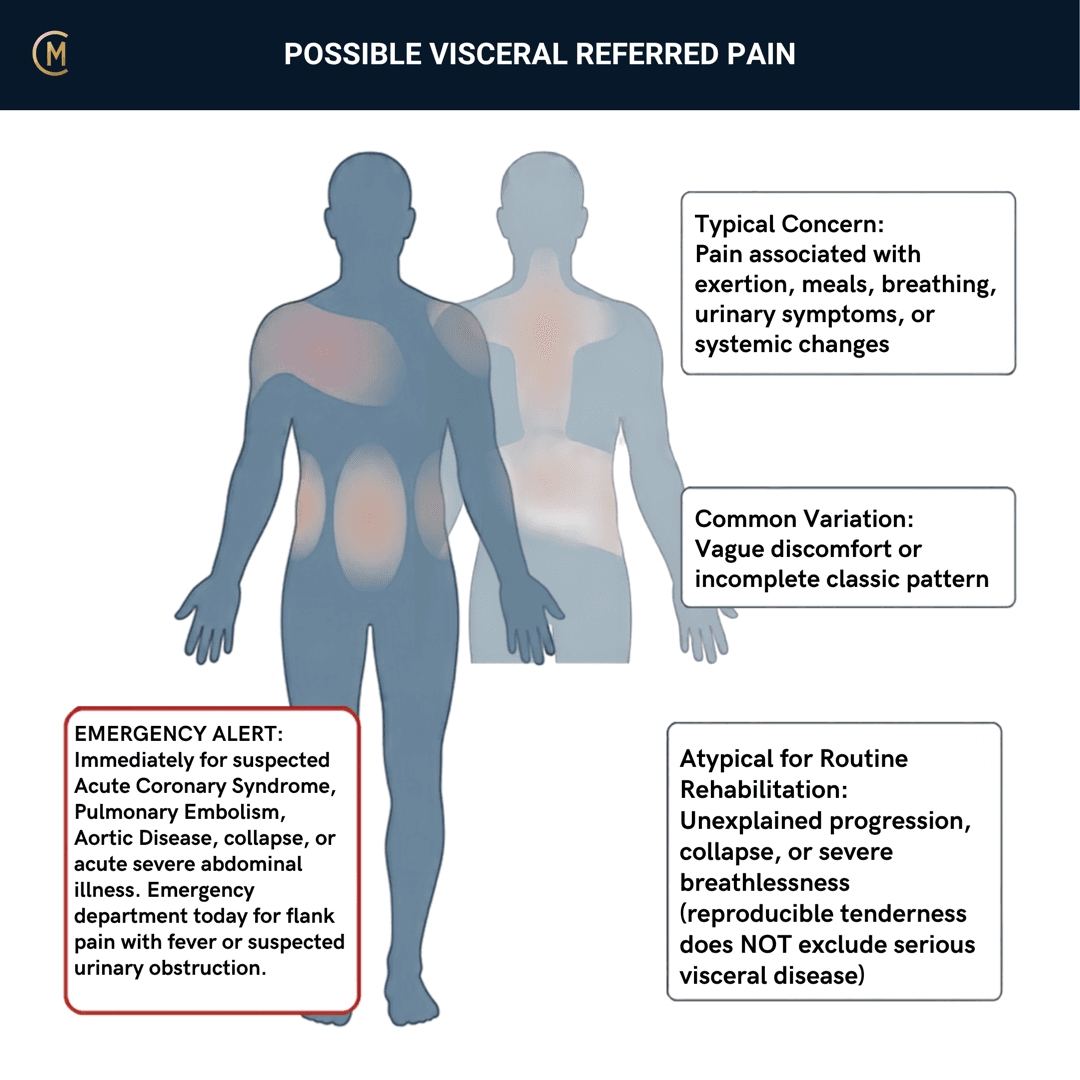
This entire page is free, permanently — all seven sections. Red flag content is never gated in CliniStudy.
Who: Anyone. History of cardiac, gastrointestinal, renal or gynaecological conditions raises it; the absence of that history does not lower it much.
What: Pain referred to a musculoskeletal region from an organ.
How it behaves: Deep, poorly localised, non-mechanical. Varies with meals, exertion, urination, bowel or menstrual pattern — not with movement. Unchanged by rest, position or manual therapy.
The one thing to take from this page:
Your job is not to name the organ. It is to notice that the pain behaviour does not fit local musculoskeletal tissue — and to act on that.
Why it refers at all, in one line
Visceral afferents converge on the same spinal segments as somatic ones, and the central representation is imprecise — so the brain localises the signal to the body wall rather than the organ [1][2][3]. That's the leading theory, not a settled one — convergence is one of two proposed mechanisms, and referred pain is less studied than radicular or neuropathic pain (Jin et al. 2023) [3]. That is also why it can sensitise somatic tissue — which is how a visceral problem ends up tender under your hand.
⚠️ No Australian guideline covers visceral screening in musculoskeletal practice — and the international position is itself unsettled. Red flags are defined inconsistently across clinical practice guidelines [4]. That inconsistency is itself the finding. For the cardiac mimic, the Australian anchor is the NHFA/CSANZ ACS guideline 2025 [21].
2 · SE — THE SUBJECTIVE PATTERN (the 70%)
Five stages, in your course's order. The special/screening questions are the pattern — and on this one they are organised by system, not by a generic list.
MAIN PROBLEM
"It's a deep ache and I can't put my finger on it."
"It comes on after I eat, not when I move."
"It's in my shoulder, but it's nothing like when I hurt my shoulder before."
BODY CHART
- Draw it, and note how well they can outline it. A patient who cannot localise the pain with one finger is telling you something.
- Mark referral zones — right shoulder and scapula, mid-back, flank and groin, jaw and teeth, chest and arm.
- Draw the abdomen and chest on the chart too. If you have not drawn them, you have not asked about them.
BEHAVIOUR
This is the section, and the finding is an absence.
| Mechanical | Visceral referral | |
|---|---|---|
| Aggs | A movement, a position, a load | A meal, exertion, urination, a bowel motion, the menstrual cycle |
| Eases | A position, rest, offloading | Nothing reliably |
| Manual therapy | Changes something | Changes nothing |
| Localisation | They can point to it | Deep, vague, "somewhere in there" |
HISTORY
- Known cardiac, gastrointestinal, renal or gynaecological conditions.
- Vascular risk — smoking, diabetes, hypertension, cholesterol, family history.
- Has this been investigated before, and what was found? And remember the mimicry runs both ways: spinal disease masquerades as abdominal disease and abdominal disease masquerades as spinal (Mirbagheri et al. 2023).
SPECIAL / SCREENING QUESTIONS — by system
- Cardiac: exertional chest, neck, jaw, shoulder or arm symptoms · shortness of breath · nausea · sweating · a sense of doom. Coronary pain is not always classic (Abdullatef et al. 2024), and craniofacial pain has been the sole warning sign of an acute coronary syndrome (Fazlyab et al. 2015; López-López et al. 2012).
- Respiratory: pain worse on breathing or coughing · shortness of breath · calf swelling.
- Gastrointestinal: relationship to meals, and to fatty meals · nausea · vomiting · bowel change · reflux (Drewes et al. 2006).
- Renal / urinary: flank or groin pain · haematuria · fever · urinary symptoms · colic (Pedersen et al. 2010).
- Gynaecological: menstrual pattern, pelvic pain, cyclical symptoms — endometriosis can present as non-specific low back, buttock, abdominal or thigh pain (Troyer et al. 2007).
- Constitutional: fever · night sweats · unexplained weight loss · fatigue.
3 · HYPOTHESIS RANKING
| Competing pattern | The one discriminating feature |
|---|---|
| Cardiac — angina or myocardial infarction | Central chest, neck, jaw, shoulder or arm pain triggered by exertion, not by palpation. Urgent medical review. |
| Pulmonary — PE or pleurisy | Upper thoracic or shoulder pain worse on breathing or coughing, with shortness of breath. |
| Gallbladder / GI / renal | Right shoulder or scapular pain after fatty meals · mid-back with nausea · flank with haematuria or fever. |
The one that outranks the ranking
Cardiac goes first, every time. Not because it is most likely, but because it is the one where a delay of hours matters. An acute myocardial infarction has presented as shoulder pain in physiotherapy direct access (Storari et al. 2021), coronary pain is frequently at non-classic sites (Abdullatef et al. 2024), and craniofacial pain has been the sole prodromal sign (Fazlyab et al. 2015).
And nothing here is excluded by your examination. The ranking tells you which phone call to make first.
4 · RED FLAGS — DON'T MISS THIS
This section is free, on every pattern, forever. Safety is never gated.
The escalation set
| Finding | System | What you do |
|---|---|---|
| Chest, jaw, neck, shoulder or arm pain on exertion ± breathlessness, nausea, sweating | Cardiac | 🚑 Emergency, now. Do not send them home to think about it |
| Pain worse on breathing + breathlessness ± calf swelling | Pulmonary | 🚑 Emergency, now |
| Severe abdominal or back pain + systemic illness | GI / vascular | 🚑 Emergency, now |
| Flank pain + fever, or urinary obstruction | Renal | 🚑 Emergency, today |
| Deep constant pain + vascular risk, unchanged by anything | Vascular — see also AAA | Same-day medical review |
| Cyclical pelvic or low back pain, progressive | Gynaecological | Medical referral |
| Constitutional symptoms — fever, sweats, weight loss | Systemic | Same-day or next-day medical review |
The three rules that survive everything else
1. A pain that doesn't behave mechanically doesn't get treated mechanically. Not one trial. Not "let's see how it responds."
2. A normal musculoskeletal examination is evidence, not frustration. It is pointing away from local tissue, which is exactly what you needed to know.
3. Say it as safety, not alarm. "This pattern isn't matching a local muscle or joint problem, so medical review is the safest next step." That sentence does the whole job without frightening anyone.
Cross-links: Abdominal aortic aneurysm · Non-specific low back pain · Mechanical neck pain
5 · OE — THE OBJECTIVE (the 30%)
Members
Sections 5 to 7 are for members
The objective exam, management and pearls, plus the six-minute lesson and the debrief. Free with an account.
Sign in or join free6 · MX — MANAGEMENT ESSENTIALS
Members
Sections 5 to 7 are for members
The objective exam, management and pearls, plus the six-minute lesson and the debrief. Free with an account.
Sign in or join free7 · CLINICAL PEARLS + RETRIEVAL CHECK
Members
Sections 5 to 7 are for members
The objective exam, management and pearls, plus the six-minute lesson and the debrief. Free with an account.
Sign in or join freeMembers
The 4-minute lesson is for members
Twelve slides on this pattern: what you'll hear, what to examine, what to do. Free with an account.
Sign in or join freeGuideline anchor
No Australian guideline covers visceral screening in musculoskeletal practice.
More
The Australian anchor for the cardiac mimic is the NHFA/CSANZ Australian Clinical Guideline for Diagnosing and Managing Acute Coronary Syndromes 2025 (Brieger et al. 2025, PMID 40180468), which the ACSQHC ACS Clinical Care Standard uses as its evidence base. Otherwise anchored to the comprehensive review of red flag definitions across clinical practice guidelines (Storari et al. 2025, PMID 40572690) for the screening position, and to the acute chest pain and acute coronary syndrome review (Ng et al. 2024, PMID 38343125) for the most time-critical mimic. Prevalence is calibrated against the systematic review and meta-analysis of serious spinal and non-spinal conditions in low back pain (Reginato et al. 2026, PMID 40581763). All non-Australian apart from the ACS guideline.
There is no Australian guideline for visceral screening, and the international position is itself unsettled — red flags are defined inconsistently across guidelines, which is the finding rather than a gap in this page's research. What is anchored here is the reasoning: pain behaviour that does not fit local musculoskeletal tissue, screened by system, documented, and referred.
Members
The evidence summary is for members
Verified diagnostic accuracy, where the evidence stands and what it doesn't settle. Free with an account.
Sign in or join freeSources · 19
ShowHide
Every source on this page resolves and title-verifies against PubMed. Newest first.
- 1988Cervero (1988). Neurophysiology of gastrointestinal pain. Bailliere's clinical gastroenterology, 2(1), 183-99. https://doi.org/10.1016/0950-3528(88)90027-9
- 2012Sikandar & Dickenson (2012). Visceral pain: the ins and outs, the ups and downs. Current opinion in supportive and palliative care, 6(1), 17-26. https://doi.org/10.1097/SPC.0b013e32834f6ec9
- 2023Jin et al. (2023). Referred pain: characteristics, possible mechanisms, and clinical management. Frontiers in neurology, 14, 1104817. https://doi.org/10.3389/fneur.2023.1104817
- 2025Storari et al. (2025). Standardized Definition of Red Flags in Musculoskeletal Care: A Comprehensive Review of Clinical Practice Guidelines. Medicina (Kaunas, Lithuania), 61(6). https://doi.org/10.3390/medicina61061002
- 2006Drewes & Gregersen (2006). Multimodal pain stimulation of the gastrointestinal tract. World journal of gastroenterology, 12(16), 2477-86. https://doi.org/10.3748/wjg.v12.i16.2477
- 2007Troyer (2007). Differential diagnosis of endometriosis in a young adult woman with nonspecific low back pain. Physical therapy, 87(6), 801-10. https://doi.org/10.2522/ptj.20060141
- 2010Pedersen et al. (2010). Visceral pain originating from the upper urinary tract. Urological research, 38(5), 345-55. https://doi.org/10.1007/s00240-010-0278-1
- 2012López-López et al. (2012). Orofacial pain of cardiac origin: review literature and clinical cases. Medicina oral, patologia oral y cirugia bucal, 17(4), e538-44. https://doi.org/10.4317/medoral.17636
- 2013Collett (2013). Visceral pain: the importance of pain management services. British journal of pain, 7(1), 6-7. https://doi.org/10.1177/2049463713480138
- 2015Fazlyab et al. (2015). Craniofacial Pain as the Sole Sign of Prodromal Angina and Acute Coronary Syndrome: A Review and Report of a Rare Case. Iranian endodontic journal, 10(4), 274-80. https://doi.org/10.7508/iej.2015.04.013
- 2019Oliva-Pascual-Vaca et al. (2019). Visceral Origin: An Underestimated Source of Neck Pain. A Systematic Scoping Review. Diagnostics (Basel, Switzerland), 9(4). https://doi.org/10.3390/diagnostics9040186
- 2021Myers (2021). The receptive field for visceral pain referred orofacially by the vagus nerves. Clinical anatomy (New York, N.Y.), 34(1), 24-29. https://doi.org/10.1002/ca.23604
- 2021Storari et al. (2021). An unusual presentation of acute myocardial infarction in physiotherapy direct access: findings from a case report. Archives of physiotherapy, 11(1), 5. https://doi.org/10.1186/s40945-021-00099-x
- 2022Myers (2022). Review of visceral throat and chest disorders causing nonodontogenic orofacial pain. Journal of the American Dental Association (1939), 153(8), 769-775. https://doi.org/10.1016/j.adaj.2022.01.007
- 2023Mirbagheri et al. (2023). Lumbar Spondylodiscitis Mimicking Cholecystitis: A Case Report and Review of Literature. Journal of neurological surgery. Part A, Central European neurosurgery, 84(1), 95-102. https://doi.org/10.1055/a-1811-7393
- 2024Ng et al. (2024). Approach to acute chest pain and acute coronary syndrome in adults. Singapore medical journal, 65(2), 111-118. https://doi.org/10.4103/singaporemedj.SMJ-2023-039
- 2024Ferdinandov et al. (2024). Common differential diagnosis of low back pain in contemporary medical practice: a narrative review. Frontiers in medicine, 11, 1366514. https://doi.org/10.3389/fmed.2024.1366514
- 2024Abdullatef et al. (2024). Prevalence of classic and non-classic pain sites of coronary artery disease: a cross-sectional study. BMC cardiovascular disorders, 24(1), 445. https://doi.org/10.1186/s12872-024-04127-z
- 2026Reginato et al. (2026). Prevalence of serious spinal pathologies and nonspinal conditions in low back pain: a systematic review and meta-analysis. Pain medicine (Malden, Mass.), 27(1), 43-52. https://doi.org/10.1093/pm/pnaf078
Generic measures that also apply
- Borg RPE
Borg Rating of Perceived Exertion Scale (6-20)
perceived exertion · 1 items · 1 min
- GROC
Global Rating of Change Scale
perceived change since baseline · 1 items · 1 min
- NPRS
Numeric Pain Rating Scale
pain intensity · 1 items · 1 min
- PGIC
Patient Global Impression of Change
perceived change since baseline · 1 items · 1 min
- PSFS
Patient-Specific Functional Scale
patient-generated function · 3 items · 2 min
- SANE
Single Assessment Numeric Evaluation
patient-rated function as a percentage of normal · 1 items · 1 min
- VAS
Visual Analogue Scale
pain intensity · 1 items · 1 min
- Borg CR10
Borg Category Ratio 10 Scale
perceived exertion or symptom intensity, ratio scale · 1 items · 1 min
- GAS
Goal Attainment Scaling
individualised goal achievement · 10 min
Did this page do its job?
CliniStudy is in beta. One tap is enough — it decides what gets fixed first.