
1 · SNAPSHOT
This entire page is free, permanently — all seven sections. Red flag content is never gated in CliniStudy.
Who: Anyone. There is no demographic that protects them, though the risk sets differ for each of the three.
What: Infection in a joint · a clot in a deep vein · a primary or secondary bone or soft-tissue tumour.
How it behaves: Too hot, too swollen, too painful for what happened to it — or too persistent at night, in a limb nothing mechanical explains.
The one thing to take from this page:
You are not deciding which of the three it is. You are deciding whether this behaves like load-sensitive musculoskeletal pain — and if it doesn't, it gets seen today.
| The three doors | The feature that opens it |
|---|---|
| Septic arthritis | Hot, red, swollen joint, exquisitely painful on minimal movement, systemic features |
| DVT | Unilateral calf or whole-leg swelling, girth asymmetry, and a risk set |
| Tumour / metastasis | Persistent night and rest pain, weight loss, prior cancer, unexplained mass |
All three doors open onto the same corridor: same-day medical assessment. You do not have to know which one it was before you refer.
⚠️ No Australian guideline governs the septic-joint decision. The DVT limb has the THANZ guideline [22], and the bone-tumour limb has the national optimal care pathway for sarcoma (Cancer Australia), which lists the warning symptoms and sends suspected bone sarcoma for an X-ray and to a specialist sarcoma team. Anchored to the Scandinavian SANJO guideline for septic arthritis [1], the American Society of Hematology VTE diagnosis guideline [2] with CHEST for management [3], and the GEIS soft-tissue sarcoma guideline [4] alongside the UK bone sarcoma guidelines (Gerrand et al. 2025, not sighted). All are written for the team that receives your referral, not for you making it.
2 · SE — THE SUBJECTIVE PATTERN (the 70%)
Five stages, in your course's order — with the special/screening questions doing most of the work, as they do on every red flag pattern.
MAIN PROBLEM
"My knee blew up overnight and I can't move it at all."
"My calf's been aching and this leg looks bigger than the other one."
"It's the night that's the problem. It wakes me and it doesn't matter what I do."
BODY CHART
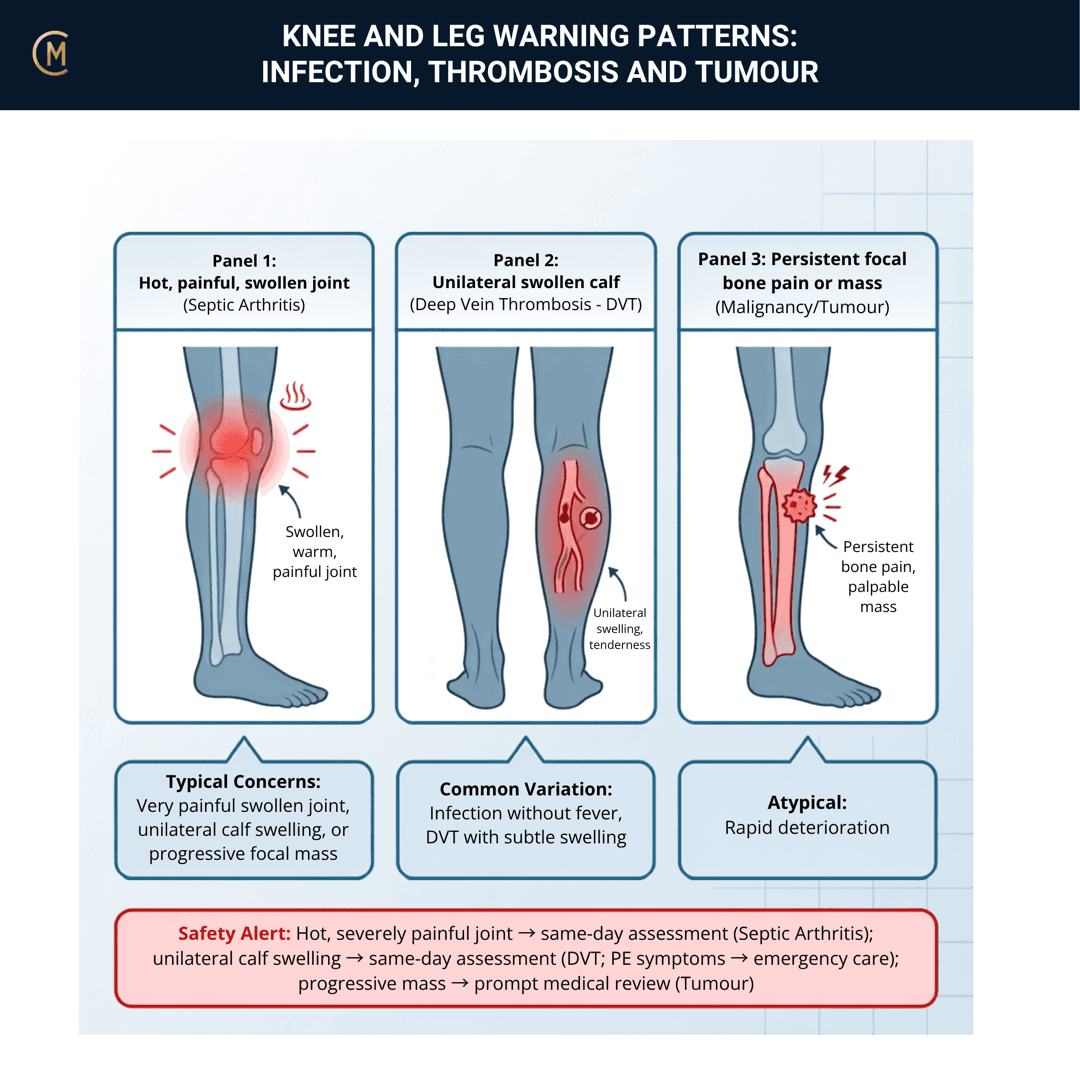
Chart interpretation: This is a screening framework: labels mean possible septic arthritis, possible DVT and possible tumour. Appearance alone does not establish any of these diagnoses.
- Outline the whole limb, not the painful joint. Calf swelling that stops at the knee looks different from a knee effusion, and you will only see that if you drew both.
- Mark erythema and warmth as areas, not points.
- If there is a mass, draw it, measure it, and date the drawing.
BEHAVIOUR
This is where a septic joint separates itself. Ask what happens on the smallest possible movement.
| Mechanical knee | The answer that should stop you | |
|---|---|---|
| Small range movement | Uncomfortable, tolerable | Exquisite. They won't let you. |
| Night | Wakes on turning, settles | Wakes and stays. Nothing helps. |
| Rest | Eases | No change, or worse |
| Onset | A mechanism | None, or trivial and disproportionate |
HISTORY
- Sudden, atraumatic onset, or a trivial mechanism with a wildly disproportionate response.
- Recent injection, aspiration, surgery or procedure to that joint.
- A skin breach — cellulitis, an ulcer, a wound, a bite.
- Immobilisation, long travel, recent surgery, pregnancy or postpartum, hormone or oral contraceptive use, previous VTE, active malignancy.
- Previous cancer of any kind, at any time. Ask it plainly. Patients do not volunteer it.
SPECIAL / SCREENING QUESTIONS
These are the pattern, not the last box.
- New breathlessness or chest pain. In someone with a swollen calf or leg, that is a possible pulmonary embolism: ambulance, not a referral letter.
- Fever, sweats, rigors, feeling generally unwell. Ask about all four — patients under-report the vague ones.
- Unexplained weight loss. How much, over how long.
- Immunosuppression — medication, treatment, or a condition their doctor manages.
- Night pain that is not positional.
Assessing this region? Download the Knee assessment template →
3 · HYPOTHESIS RANKING
Three dangerous patterns, and the one feature that opens each door. Rank them — but note that the ranking changes nothing about where the patient goes.
| Competing pattern | The one discriminating feature |
|---|---|
| Septic arthritis | Hot, red, swollen joint, painful on minimal movement, with fever or malaise. Hot, red, swollen = septic until proven otherwise. |
| DVT | Calf pain with unilateral swelling and girth asymmetry, in someone with a risk set — immobilisation, travel, surgery, hormone therapy, pregnancy, previous VTE, malignancy. |
| Tumour / metastasis | Persistent night and rest pain, unexplained weight loss, prior cancer, a progressive non-mechanical course, or an unexplained mass. |
The benign patterns that look similar — and why they don't clear it
- Acute gout or crystal arthropathy. Also hot, red, swollen and agonising. It is a genuine differential, and it is a medical diagnosis made on aspiration, not by you. A history of gout does not clear a septic joint; the two coexist.
- A large post-traumatic effusion. Has a mechanism, and the joint moves further before pain stops it.
- Calf strain. Has a mechanism, a moment, and localised tenderness — not a whole-limb size difference.
None of these three clears anything. The ranking tells you what to say in the referral. It does not tell you to keep the patient.
4 · RED FLAGS — DON'T MISS THIS
This section is free, on every pattern, forever. Safety is never gated.
The escalation set
| Finding | Door | What you do |
|---|---|---|
| Hot, red, swollen joint + pain on minimal movement | Septic | Same-day ED or medical review |
| Any of the above + fever, rigors, unwell, immunosuppressed | Septic | ED today |
| Recent injection / procedure / surgery to that joint + new hot joint | Septic | ED today |
| Unilateral calf or whole-leg swelling + a risk factor | DVT | Same-day medical review |
| Calf or leg swelling + new breathlessness or chest pain | Possible pulmonary embolism | Ambulance now |
| Night and rest pain, unremitting, non-positional | Tumour | Same-day medical review, imaging |
| Unexplained weight loss, prior cancer, unexplained mass | Tumour | Same-day medical review, imaging |
| Soft-tissue lump over 5 cm, deep-seated or fast-growing · a palpable bone lump · deep persisting bone pain — the sarcoma alarm set (Dyrop et al. 2014) [21] | Tumour | Same-day medical review, imaging. A third of sarcomas were found accidentally rather than on alarm symptoms — absence clears nothing |
| Sudden severe unexplained bone pain ± inability to weight-bear | Pathological fracture | ED, protect weight-bearing |
The four rules that survive everything else
1. Hot, red, swollen = septic until proven otherwise. That is the classic line, and the evidence has not moved it.
2. Absence of fever clears nothing. Neither does a normal X-ray, a negative Homans', or a limb that "looks alright" to you.
3. If you suspect any of the three, you stop. No manual therapy. No aggressive load testing. No "let's see how it settles."
4. Document vitals and referral details. Temperature, heart rate, general appearance, who you contacted, when, what was advised, the transport plan, and the safety net you gave.
Cross-links: Knee osteoarthritis · Meniscus tear · Infection / malignancy
5 · OE — THE OBJECTIVE (the 30%)
Members
Sections 5 to 7 are for members
The objective exam, management and pearls, plus the six-minute lesson and the debrief. Free with an account.
Sign in or join free6 · MX — MANAGEMENT ESSENTIALS
Members
Sections 5 to 7 are for members
The objective exam, management and pearls, plus the six-minute lesson and the debrief. Free with an account.
Sign in or join free7 · CLINICAL PEARLS + RETRIEVAL CHECK
Members
Sections 5 to 7 are for members
The objective exam, management and pearls, plus the six-minute lesson and the debrief. Free with an account.
Sign in or join freeMembers
The 5-minute lesson is for members
Twelve slides on this pattern: what you'll hear, what to examine, what to do. Free with an account.
Sign in or join freeGuideline anchor
No Australian guideline covers the septic-joint limb of this triage decision.
More
The bone-tumour limb has the national optimal care pathway for sarcoma (Cancer Australia, 2020), which lists the warning symptoms, including persistent non-mechanical bone pain and nocturnal bone pain, and sends suspected bone sarcoma for an X-ray and to a specialist sarcoma team. The DVT limb has the Thrombosis and Haemostasis Society of Australia and New Zealand VTE guideline (Tran et al. 2019, PMID 30739331), which excludes DVT with a clinical prediction rule plus D-dimer and confirms it with imaging. The septic and sarcoma limbs also keep their non-Australian anchors: SANJO for native-joint septic arthritis (Ravn et al. 2023, PMID 36756304) and the UK bone sarcoma guidelines (Gerrand et al. 2025) with the GEIS soft-tissue sarcoma guideline (García Del Muro et al. 2016, PMID 26563256). ASH 2018 (Lim et al., PMID 30482764) and CHEST (Kearon et al. 2016, PMID 26867832) stay as the international DVT references.
There is no Australian clinical care standard for the hot swollen joint presenting to physiotherapy. The sarcoma optimal care pathway is written for the whole pathway, from first symptoms to specialist care. THANZ covers DVT diagnosis but is written for the doctor receiving the referral. Every anchor here is written for the medical team that receives the referral, not for the clinician making it. What the physiotherapy decision is anchored to — recognise, stop, escalate, document — comes from the primary evidence and is labelled as such.
Members
The evidence summary is for members
Verified diagnostic accuracy, where the evidence stands and what it doesn't settle. Free with an account.
Sign in or join freeSources · 19
ShowHide
Every source on this page resolves and title-verifies against PubMed. Newest first.
- 2023Ravn et al. (2023). Guideline for management of septic arthritis in native joints (SANJO). Journal of bone and joint infection, 8(1), 29-37. https://doi.org/10.5194/jbji-8-29-2023
- 2018Lim et al. (2018). American Society of Hematology 2018 guidelines for management of venous thromboembolism: diagnosis of venous thromboembolism. Blood advances, 2(22), 3226-3256. https://doi.org/10.1182/bloodadvances.2018024828
- 2016Kearon et al. (2016). Antithrombotic Therapy for VTE Disease: CHEST Guideline and Expert Panel Report. Chest, 149(2), 315-352. https://doi.org/10.1016/j.chest.2015.11.026
- 2016Garcia del Muro et al. (2016). Clinical practice guidelines for the diagnosis and treatment of patients with soft tissue sarcoma by the Spanish group for research in sarcomas (GEIS). Cancer chemotherapy and pharmacology, 77(1), 133-46. https://doi.org/10.1007/s00280-015-2809-5
- 1997Wells et al. (1997). Value of assessment of pretest probability of deep-vein thrombosis in clinical management. Lancet (London, England), 350(9094), 1795-8. https://doi.org/10.1016/S0140-6736(97)08140-3
- 2003Schutgens et al. (2003). The usefulness of five D-dimer assays in the exclusion of deep venous thrombosis. Journal of thrombosis and haemostasis : JTH, 1(5), 976-81. https://doi.org/10.1046/j.1538-7836.2003.00148.x
- 2006Scarvelis & Wells (2006). Diagnosis and treatment of deep-vein thrombosis. CMAJ : Canadian Medical Association journal = journal de l'Association medicale canadienne, 175(9), 1087-92. https://doi.org/10.1503/cmaj.060366
- 2007Mathews et al. (2007). Management of septic arthritis: a systematic review. Annals of the rheumatic diseases, 66(4), 440-5. https://doi.org/10.1136/ard.2006.058909
- 2007Margaretten et al. (2007). Does this adult patient have septic arthritis?. JAMA, 297(13), 1478-88. https://doi.org/10.1001/jama.297.13.1478
- 2008Mathews & Coakley (2008). Septic arthritis: current diagnostic and therapeutic algorithm. Current opinion in rheumatology, 20(4), 457-62. https://doi.org/10.1097/BOR.0b013e3283036975
- 2011Carpenter et al. (2011). Evidence-based diagnostics: adult septic arthritis. Academic emergency medicine : official journal of the Society for Academic Emergency Medicine, 18(8), 781-96. https://doi.org/10.1111/j.1553-2712.2011.01121.x
- 2014Geersing et al. (2014). Exclusion of deep vein thrombosis using the Wells rule in clinically important subgroups: individual patient data meta-analysis. BMJ (Clinical research ed.), 348, g1340. https://doi.org/10.1136/bmj.g1340
- 2015Crago & Brennan (2015). Principles in Management of Soft Tissue Sarcoma. Advances in surgery, 49(1), 107-22. https://doi.org/10.1016/j.yasu.2015.04.002
- 2016Cheville et al. (2016). Imaging and Clinical Characteristics Predict Near-Term Disablement From Bone Metastases: Implications for Rehabilitation. Archives of physical medicine and rehabilitation, 97(1), 53-60. https://doi.org/10.1016/j.apmr.2015.09.011
- 2016Plant & Cannon (2016). Diagnostic work up and recognition of primary bone tumours: a review. EFORT open reviews, 1(6), 247-253. https://doi.org/10.1302/2058-5241.1.000035
- 2019Lunkiewicz et al. (2019). Practical Input on Bone Tumor Imaging: Pathological Fracture, Risk Features, and When to Contact Orthopaedics. Seminars in musculoskeletal radiology, 23(1), 19-25. https://doi.org/10.1055/s-0038-1675804
- 2020Elsissy et al. (2020). Bacterial Septic Arthritis of the Adult Native Knee Joint: A Review. JBJS reviews, 8(1), e0059. https://doi.org/10.2106/JBJS.RVW.19.00059
- 2020Chan et al. (2020). Septic Arthritis: An Evidence-Based Review of Diagnosis and Image-Guided Aspiration. AJR. American journal of roentgenology, 215(3), 568-581. https://doi.org/10.2214/AJR.20.22773
- 2023Gotta et al. (2023). Unveiling the diagnostic enigma of D-dimer testing in cancer patients: Current evidence and areas of application. European journal of clinical investigation, 53(10), e14060. https://doi.org/10.1111/eci.14060
Mapped to this pattern
Generic measures that also apply
- Borg RPE
Borg Rating of Perceived Exertion Scale (6-20)
perceived exertion · 1 items · 1 min
- GROC
Global Rating of Change Scale
perceived change since baseline · 1 items · 1 min
- NPRS
Numeric Pain Rating Scale
pain intensity · 1 items · 1 min
- PGIC
Patient Global Impression of Change
perceived change since baseline · 1 items · 1 min
- PSFS
Patient-Specific Functional Scale
patient-generated function · 3 items · 2 min
- SANE
Single Assessment Numeric Evaluation
patient-rated function as a percentage of normal · 1 items · 1 min
- VAS
Visual Analogue Scale
pain intensity · 1 items · 1 min
- Borg CR10
Borg Category Ratio 10 Scale
perceived exertion or symptom intensity, ratio scale · 1 items · 1 min
- GAS
Goal Attainment Scaling
individualised goal achievement · 10 min
Did this page do its job?
CliniStudy is in beta. One tap is enough — it decides what gets fixed first.