
1 · SNAPSHOT
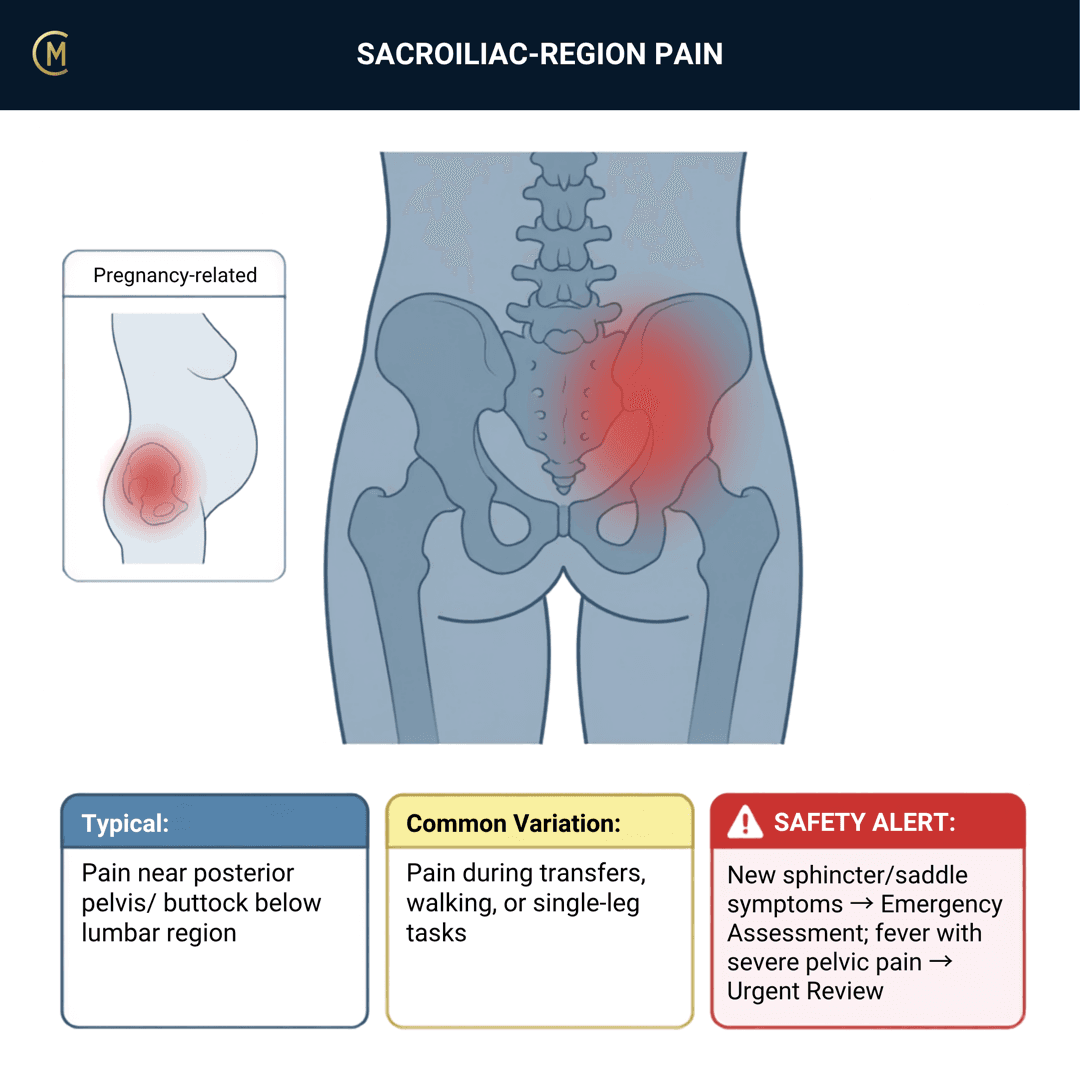
The naming, first, because it decides what the numbers mean. SIJ pain is a response to an anaesthetic block. SIJ dysfunction is an aberrant position or movement — and it has no reference standard at all, which is why "validity of the tests for this disorder is unknown" [1]. Every accuracy number on this page belongs to PAIN. None of it belongs to DYSFUNCTION. Type "SIJ dysfunction" into PubMed and you will surface treatment trials that never defined the diagnosis; search sacroiliac joint pain, sacroiliac provocation and pelvic girdle pain instead.
Then split the branch, in the first thirty seconds of the subjective.
| Branch 1 — non-pregnancy SIJ pain | Branch 2 — pregnancy-related pelvic girdle pain |
|---|---|
| Uncommon, hard to confirm, defined against a needle | Common, better evidenced, has an actual guideline |
| No natural-history study exists | 83% substantially recover within 6 weeks of delivery |
| No RCT in a block-confirmed population | A positive RCT with no dropouts, held to 1 year |
Who: Someone with unilateral buttock or posterior pelvic pain — postpartum, after a fall onto the buttock, or insidious.
What: Paramidline, below L5, unilateral, ± groin, ± posterior thigh. Not midline. Nothing below the knee, no dermatomal band, no neurological deficit.
How it behaves: Aggs: standing, walking, stairs, single-leg stance, rolling in bed, sit-to-stand. Eases: rest, external compression.
The illness script in one line:
A joint that hurts when it is loaded asymmetrically, in someone who will tell you it feels "stuck" or "out" — so the pain sits off the midline below L5, external compression helps, and the only way anyone has ever confirmed it is by injecting it.
The one thing to take from this page:
The cluster crosses the joint off. It does not write it in. Three or more positive pain provocation tests moves you from 20% to about 35% certainty. All of them negative moves you to about 92% certainty the SIJ is not the source. Use it in the direction that works.
| Figure | Number |
|---|---|
| Chronic LBP maximal below L5-S1, single controlled block | 13/43 = 30% |
| Same question, most stringent double-block protocol | 10/54 = 18.5% |
| Pooled across settings | 10%–62%, most studies near a ~25% point prevalence |
| 2025 multispecialty consensus, axial pain predominantly below L5 | 15%–30% |
| False-positive rate of a single uncontrolled block | ~20% |
| Pregnancy-related PGP and/or LBP | ~45% pregnant · ~25% postpartum |
| Point prevalence of PGP in pregnancy | ~20% |
| ≥3 of SIX provocation tests vs single intra-articular block | sens 94% · spec 78% |
| ≥3 of FIVE vs fluoroscopic double blocks | sens 0.85 · spec 0.79 · +LR 4.02 · −LR 0.19 |
| Pooled clusters, 5 studies, GRADE very low | +LR 2.13 (1.2–3.9) · −LR 0.33 (0.11–0.72) |
| Post-test probability at 20% prevalence | positive 35% · negative 8% |
| Absence of midline low back pain | +LR 2.41 (1.89–3.07) |
| Palpation vs pain provocation, same patients, same day | κ −0.06 vs κ 0.43–0.84 |
| RCTs of conservative care that did no thoracolumbar screen | 32/43 = 74.4% |
| Substantial recovery within 6 weeks of delivery | 83% |
| Still in pain 2 years after delivery | 8.6% |
[2][3][4][5][6][7][8][9][10][11][12][13][14][15][16]
No Australian guideline exists for this presentation. There is no Australian guideline for sacroiliac joint pain; for pregnancy-related pelvic girdle pain, the Australian Pregnancy Care Guidelines carry a weak recommendation that pregnancy-specific exercises, physiotherapy, acupuncture or a support garment may provide some pain relief. Anchored to the European guidelines for the diagnosis and treatment of pelvic girdle pain [9] for the conservative and pregnancy pathway, and to the multispecialty consensus practice guidelines on sacroiliac joint complex pain [15] for the block and interventional half. The European guideline is eighteen years old, consensus-based, and nothing has replaced it — a live search on 2 Sep 2026 returned no later physiotherapy guideline in this pattern.
Australia's only lumbopelvic standard is the ACSQHC Low Back Pain Clinical Care Standard (2022) [17]. It was read live on 2 Sep 2026: eight quality statements covering assessment and the focused neurological examination, imaging reserved for suspected serious pathology, education, self-management and physical activity, physical and psychological interventions, medicines, and review and referral. A string search of that text returns zero occurrences of "sacroiliac", "SIJ" and "pelvic girdle". It is the right safety anchor and it is not a pattern anchor. Say both halves.
And the other half, which is this pattern's own. The absence of an Australian guideline is not an absence of Australian evidence. Schwarzer, Aprill and Bogduk built the first prevalence figure at the University of Newcastle. Laslett published the reasoning-plus-tests validity study in the Australian Journal of Physiotherapy. Hancock, Maher and Han built both cross-structure systematic reviews at the University of Sydney. We wrote a large share of this literature and then never wrote the standard.
Patterns > Labels. "SIJ dysfunction" names a position nobody can measure. Unilateral, paramidline, below L5, worse on single-leg loading, eased by compression, with the lumbar spine cleared and the inflammatory questions asked names the problem you can work with on Monday. Check it with your educator.
2 · SE — THE SUBJECTIVE PATTERN (the 70%)
Five stages, in order. And the honest opening, because it is a finding rather than a failure: in the most direct test of this question — 85 patients, 12 tests chosen by a multidisciplinary expert panel, two examiners, intra-articular block with ≥90% relief as the criterion standard — "no historical feature, none of the 12 sacroiliac joint tests, and no ensemble of these 12 tests demonstrated worthwhile diagnostic value" [18].
So the subjective here does what a subjective is actually for. It splits the branch, generates the hypothesis, sets your dosage and rules out the dangerous neighbours. One historical feature has a number attached and you will meet it in the body chart.
MAIN PROBLEM
"It's right here, one side, in my backside. Started after I had the baby / after I came down the stairs badly. Standing in the queue kills it and I can't roll over in bed. It feels like it's out of place."
Two things to catch in that sentence. One side, one region, below the belt line — and "out of place", which is a patient's report of what it feels like, not a finding. Write it down as their words. You'll have been taught that the joint does not go out — control over correction. That one holds up, and it is the first thing you will say back to them.
Ask the branch question now: "Has this been there since a pregnancy?" Everything downstream turns on the answer.
BODY CHART
- P1: unilateral, paramidline, below L5, over the buttock or posterior pelvis. P2 commonly into the groin or the posterior thigh. Mark P+ / P++ where they show you the worst of it, and mark the side.
- Ask them to point with one finger. Provocative injection into the SIJ produced buttock hypoaesthesia running about 10 cm caudally and 3 cm laterally from the PSIS, matching the area of maximal pain — in 10 asymptomatic volunteers [2]. That is a ten-person map. It generates a hypothesis. It confirms nothing.
- Then do the one thing on this page that has a likelihood ratio attached: establish midline versus paramidline explicitly. Absence of midline low back pain: +LR 2.41 (95% CI 1.89–3.07), −LR 0.35 (0.12–1.01) [13]. Midline pain was reported by 95.8% of patients with internal disc disruption versus 12.9% of those with SIJ pain (χ²=101.4, P<.0001) [19]. Midline points away from this pattern and towards the disc.
- Groin pain earns its own mark. In the original Australian prevalence study it was the only referral pattern associated with a positive block [3].
- Nothing below the knee. No dermatomal band. If there is, you are on the lumbar radicular pain page.
BEHAVIOUR
- Aggs: standing, walking, stairs, single-leg stance, rolling over in bed, sit-to-stand, getting out of the car.
Eases: rest, and external compression — which is the pattern's own SE line and the reason a belt is a reasonable trial rather than a gimmick. - 24-hr pattern: standing, walking and stairs build it; the transitions — rolling over in bed, sit-to-stand, out of the car — are in the Aggs; rest and external compression ease it.
- Night: rolling over in bed is in the Aggs. Pain at night is a §4 flag, and morning stiffness over 30 minutes in a young adult sends you to §4.
- Severity: VAS 0–10 at best / at worst / right now.
- Coding: usually In or Is — position- and load-driven, settling when unloaded — moving to P when irritable. Morning stiffness <30 min = M; >30 min = In, and >30 min in a young adult sends you straight to section 4.
- Irritability decides your dosage, and it has three parts. Resting symptoms + the vigour of the activity that provokes it + how long it takes to settle. In pregnancy and early postpartum, irritability is usually the limiting factor, not range.
- Asymmetrical, painful functional movements — sit-to-stand, stairs, single-leg tasks — are worth recording because you can re-test them. They have never been measured against any reference standard in this pattern. Use them as asterisk signs, not as evidence.
HISTORY
- Onset: during or after a pregnancy, a fall onto the buttock, a fall onto one leg, or insidious. Date it and date what it has done since.
- Read the prevalence literature knowing where it came from. 13/43 (30%) of consecutive patients with chronic LBP maximal below L5-S1 obtained gratifying relief from a single fluoroscopically guided block (Schwarzer et al. 1995). In a pre-selected cohort taken to double blocks, only 10/54 (18.5%) survived the confirmatory injection [4]. Pooled, the range is 10% to 62% depending on setting, most studies near ~25%, with an uncontrolled-block false-positive rate of ~20% [10]. The 2025 consensus lands on 15–30% of patients with axial pain predominantly below L5 [15]. In the tertiary accuracy studies the median proportion testing positive is 53% — because those patients were referred for the block (Han et al. 2023).
Read that spread the way you read the facet literature: the higher figures come from populations selected to have the condition. A student's placement caseload sits at the low end. - Pregnancy is a different scale entirely. About 45% of all pregnant women and 25% postpartum report pelvic girdle pain and/or pregnancy-related low back pain; serious pain in ~25% during pregnancy, severe disability in ~8%, still serious postpartum in ~7%. Of all patients, about half have PGP, a third have pregnancy-related LBP and a sixth have both — and PGP and LBP are distinct entities, not one thing [6]. Point prevalence of PGP in pregnancy is ~20% [9].
- Ask what makes it centralise, because it changes the answer. Adding a McKenzie evaluation to the provocation tests took the clinical examination to sensitivity 91% (95% CI 62–98), specificity 83% (68–96), +LR 6.97 (2.70–20.27) against double blocks [20]. Specificity of ≥3 positive provocation tests rises from 78% to 87% in patients whose symptoms cannot be made to centralise [1]. If you can centralise their pain, stop testing the SIJ and go to non-specific low back pain.
- Previous episodes, previous imaging, what they have been told, and what helped last time. If they have been told a joint is "out", find out who told them and what they now believe.
SPECIAL / SCREENING QUESTIONS
Every patient. Every time. On this page the screening questions are the highest-yield part of the subjective, because the miss here is a disease, not a structure.
- Inflammatory back pain / axial spondyloarthritis. Age at onset <40, insidious onset, night pain, better with exercise, not better with rest, morning stiffness >30 min (coding In), good response to NSAIDs. Then the company axSpA keeps: uveitis, inflammatory bowel disease, psoriasis, enthesitis, dactylitis, family history. Section 4.
- Fracture. Training spike, running volume, RED-S or low energy availability, amenorrhoea, osteoporosis, long-term corticosteroids, prior pelvic radiotherapy. Pain that does not ease with relative rest.
- Infection. Fever, rigors, night sweats, feeling unwell, recent instrumentation, immunosuppression, IV drug use, unremitting non-mechanical pain.
- Cauda equina. Bilateral leg symptoms, saddle anaesthesia, bladder or bowel change, sexual dysfunction. Buttock pain is not a reason to skip the question. Cauda equina syndrome.
- The ordinary serious ones: unexplained weight loss, cancer history, night pain that is progressive and constant.
Assessing this region? Download the Lumbar Spine & SIJ assessment template →
3 · HYPOTHESIS RANKING
Rank the mechanical patterns — one discriminating feature each, and that is all you need to move between them. Then rule out the dangerous ones in section 4, which comes before any of this in practice.
| # | Competing pattern | The one discriminating feature |
|---|---|---|
| 1 | Lumbar disc / discogenic pain and non-specific low back pain | Midline. Midline low back pain was reported by 95.8% of internal disc disruption cases versus 12.9% of SIJ pain cases (χ²=101.4, P<.0001) [19], and absence of midline pain is the SIJ's one informative historical feature at +LR 2.41 (1.89–3.07) [13]. Add centralisation: it points at the disc, and when it is present it lifts SIJ cluster specificity from 78% to 87% by taking those patients out of the pool [1]. Non-specific low back pain. |
| 2 | Lumbar radicular pain | Dermatomal leg pain below the knee, ± paraesthesia, numbness, myotomal weakness, positive neurodynamic testing. SIJ pain refers into the buttock and posterior thigh and carries no neurological deficit. Lumbar radicular pain — do not restate its numbers here. |
| 3 | Deep gluteal syndrome / proximal hamstring tendinopathy | Sitting. Deep buttock pain worse with sitting, driving and hip flexion, or point tenderness at the ischial tuberosity with pain on stretch and on resisted hip extension. SIJ pain is a standing, walking, stairs and rolling-in-bed problem. No verified accuracy data exists in our library for the FAIR test against any reference standard — the discriminator here is the history, not a test. |
Two more that sit beside the ranking rather than inside it.
- Gluteal tendinopathy / GTPS is lateral — over the greater trochanter, worse lying on that side. Lateral, not posterior. Gluteal tendinopathy.
- Pubic symphysis pain is central pubic pain on walking, rolling in bed and stairs, and it commonly coexists. It matters prognostically: in a 1,789-woman pregnancy cohort, none of the women classified as symphysiolysis still had pain at 6 months, versus 21% of those with pelvic girdle syndrome — all three pelvic joints — still in pain at two years [5].
And the branch, which is not a competitor. Pregnancy-related pelvic girdle pain is a separate pattern with its own prevalence, its own guideline, its own test, its own trial and its own prognosis [6][9][21][22][11]. Do not merge the two on a page or in your reasoning.
Clear the lumbar spine first, and write down that you did. Across 43 RCTs of conservative management for SIJ pain, only 2 (4.7%) performed a reasonable thoracolumbar screen before making the diagnosis, 9 (20.9%) partially, and 32 (74.4%) did none at all [16]. More than 95% of the trials that generated this pattern's treatment evidence skipped the step you are about to do. That is not a formality — it is the reason section 3 exists.
4 · RED FLAGS — DON'T MISS THIS
This section is free, on every pattern, forever. Safety is never gated, and it never will be.
And on this page the flag is a disease, not a structure. The joint you are thinking about is the joint axial spondyloarthritis attacks first.
Inflammatory sacroiliitis / axial spondyloarthritis — the one that gets missed
Buttock and posterior pelvic pain in a young adult, in the same joint, and it is the one thing here that changes a life. axSpA "primarily affect[s] the sacroiliac joints and spine", and carries enthesitis, arthritis and dactylitis peripherally with uveitis, inflammatory bowel disease and psoriasis beyond the musculoskeletal system [23].
The ASAS inflammatory back pain criteria, with their numbers:
| Feature | Odds ratio for inflammatory back pain |
|---|---|
| Improvement with exercise | 23.1 |
| Pain at night | 20.4 |
| Insidious onset | 12.7 |
| Age at onset <40 years | 9.9 |
| No improvement with rest | 7.7 |
≥4 of 5 → sensitivity 77.0% / specificity 91.7% in the expert workshop, and 79.6% / 72.4% in the validation cohort of 648 patients [24]. Note the specificity falling 19 points on validation, and note what the gold standard was: expert opinion, not imaging. Use it to raise suspicion and refer. Never to diagnose.
Add morning stiffness >30 min (coding In) and a good response to NSAIDs, which remain first-line medical treatment (Navarro-Compán et al. 2025).
And do not expect your provocation cluster to sort this out. In early active sacroiliitis on MRI, clusters of provocation tests reached an AUC of only 0.693 (95% CI 0.489–0.897) for 4-of-5 and 0.697 (0.484–0.910) for 2-of-3 — the authors' verdict was that "the discriminating capacity of these tests is poor" [25]. Different reference standard, different disease. Your cluster will not find this.
Sacral and pelvic stress or insufficiency fracture — the other one
A load story or a bone story.
- The athlete. Acute lumbosacral pain in the setting of running or jogging; in the largest case series, mean age 28.0, 9/13 (69.2%) female and 7 of those 9 premenopausal; all managed non-operatively for a mean of 3.8 months; return to sport 83.3%, with most reporting ongoing running-performance deficits [26]. n=13, single institution, Level 4 — use it for the presentation shape, not for a rate.
- The older adult. Sacral insufficiency fractures carry high morbidity and mortality and are becoming increasingly prevalent with osteoporosis [27]. Minimal or no trauma, corticosteroids, prior pelvic radiotherapy.
- The shape of it: focal sacral pain, painful single-leg hop, constant weight-bearing pain that is worse, not better, with graded loading. Image, do not mobilise.
Infection
Fever, rigors, night sweats, feeling unwell, recent IV drug use, recent instrumentation, immunosuppression, unremitting non-mechanical pain. Rare in this joint and catastrophic when missed. Same-day medical review.
Cauda equina
Bilateral leg symptoms, saddle anaesthesia, bladder or bowel change, sexual dysfunction. Ask every time and document the answer. Cauda equina syndrome.
What to do
| Trigger | Urgency |
|---|---|
| Bladder or bowel change · saddle anaesthesia · bilateral leg symptoms | Emergency |
| Fever, systemic features, unremitting non-mechanical pain | Same-day medical review |
| Inflammatory back pain features with onset <40 | Medical referral this week — HLA-B27 and SIJ MRI |
| Training spike, RED-S, osteoporosis, corticosteroids + focal sacral pain | Imaging before loading |
| Progressive constant pain, night pain, weight loss, cancer history | Medical review |
Bladder + saddle = surgical emergency.
Night pain + onset under 40 + >30 min morning stiffness + better with movement = rheumatology, not a stability programme.
5 · OE — THE OBJECTIVE (the 30%)
Members
Sections 5 to 7 are for members
The objective exam, management and pearls, plus the six-minute lesson and the debrief. Free with an account.
Sign in or join free6 · MX — MANAGEMENT ESSENTIALS
Members
Sections 5 to 7 are for members
The objective exam, management and pearls, plus the six-minute lesson and the debrief. Free with an account.
Sign in or join free7 · CLINICAL PEARLS + RETRIEVAL CHECK
Members
Sections 5 to 7 are for members
The objective exam, management and pearls, plus the six-minute lesson and the debrief. Free with an account.
Sign in or join freeMembers
The 4-minute lesson is for members
Twelve slides on this pattern: what you'll hear, what to examine, what to do. Free with an account.
Sign in or join freeGuideline anchor
No Australian guideline exists for sacroiliac joint pain. For pregnancy-related pelvic girdle pain, the Australian Pregnancy Care Guidelines carry a weak recommendation that pregnancy-specific exercises, physiotherapy, acupuncture or a support garment may provide some pain relief.
More
Anchored to the European guidelines for the diagnosis and treatment of pelvic girdle pain (Vleeming et al. 2008, PMID 18259783) for the conservative and pregnancy pathway, with the multispecialty consensus practice guidelines on sacroiliac joint complex pain (McCormick et al. 2025, PMID 41320235) for the diagnostic-block and interventional half. The ACSQHC Low Back Pain Clinical Care Standard (2022) governs the safety screen only.
CORRECTION TO THE CARD, made on the build. The card recorded that the ACSQHC resource page redirected and the standard's PDF 404'd on 2 Sep 2026, so it asserted existence and scope only. Re-checked live in the browser on 2 Sep 2026 and the standard's full web text WAS readable: eight quality statements, 67,641 characters. A string search of that text returned ZERO occurrences of 'sacroiliac', 'sacro-iliac', 'SIJ', 'pelvic girdle' and 'pregnan'. So the card's conclusion is confirmed by direct reading rather than by inference: the standard is Australia's low back pain standard, it is the right safety anchor, and it does not name this joint or this pattern. has_au_guideline stays false. The PDF itself was still not opened; only the web version of the quality statements was read, and nothing beyond the assessment, imaging, self-management and review statements is paraphrased on this page.
Members
The evidence summary is for members
Verified diagnostic accuracy, where the evidence stands and what it doesn't settle. Free with an account.
Sign in or join freeSources · 35
ShowHide
Every source on this page resolves and title-verifies against PubMed. Newest first.
- 2008Laslett (2008). Evidence-based diagnosis and treatment of the painful sacroiliac joint. The Journal of manual & manipulative therapy, 16(3), 142-52. https://doi.org/10.1179/jmt.2008.16.3.142
- 1994Fortin et al. (1994). Sacroiliac joint: pain referral maps upon applying a new injection/arthrography technique. Part I: Asymptomatic volunteers. Spine, 19(13), 1475-82. PubMed 7939978
- 1995Schwarzer et al. (1995). The sacroiliac joint in chronic low back pain. Spine, 20(1), 31-7. https://doi.org/10.1097/00007632-199501000-00007
- 1996Maigne et al. (1996). Results of sacroiliac joint double block and value of sacroiliac pain provocation tests in 54 patients with low back pain. Spine, 21(16), 1889-92. https://doi.org/10.1097/00007632-199608150-00012
- 2001Albert et al. (2001). Prognosis in four syndromes of pregnancy-related pelvic pain. Acta obstetricia et gynecologica Scandinavica, 80(6), 505-10. PubMed 11380285
- 2004Wu et al. (2004). Pregnancy-related pelvic girdle pain (PPP), I: Terminology, clinical presentation, and prevalence. European spine journal : official publication of the European Spine Society, the European Spinal Deformity Society, and the European Section of the Cervical Spine Research Society, 13(7), 575-89. https://doi.org/10.1007/s00586-003-0615-y
- 2005Laslett et al. (2005). Diagnosis of sacroiliac joint pain: validity of individual provocation tests and composites of tests. Manual therapy, 10(3), 207-18. https://doi.org/10.1016/j.math.2005.01.003
- 2006van der Wurff et al. (2006). A multitest regimen of pain provocation tests as an aid to reduce unnecessary minimally invasive sacroiliac joint procedures. Archives of physical medicine and rehabilitation, 87(1), 10-4. https://doi.org/10.1016/j.apmr.2005.09.023
- 2008Vleeming et al. (2008). European guidelines for the diagnosis and treatment of pelvic girdle pain. European spine journal : official publication of the European Spine Society, the European Spinal Deformity Society, and the European Section of the Cervical Spine Research Society, 17(6), 794-819. https://doi.org/10.1007/s00586-008-0602-4
- 2012Simopoulos et al. (2012). A systematic evaluation of prevalence and diagnostic accuracy of sacroiliac joint interventions. Pain physician, 15(3), E305-44. PubMed 22622915
- 2020Gausel et al. (2020). Subjective recovery from pregnancy-related pelvic girdle pain the first 6 weeks after delivery: a prospective longitudinal cohort study. European spine journal : official publication of the European Spine Society, the European Spinal Deformity Society, and the European Section of the Cervical Spine Research Society, 29(3), 556-563. https://doi.org/10.1007/s00586-020-06288-9
- 2021Saueressig et al. (2021). Diagnostic Accuracy of Clusters of Pain Provocation Tests for Detecting Sacroiliac Joint Pain: Systematic Review With Meta-analysis. The Journal of orthopaedic and sports physical therapy, 51(9), 422-431. https://doi.org/10.2519/jospt.2021.10469
- 2023Han et al. (2023). Low back pain of disc, sacroiliac joint, or facet joint origin: a diagnostic accuracy systematic review. EClinicalMedicine, 59, 101960. https://doi.org/10.1016/j.eclinm.2023.101960
- 2007Robinson et al. (2007). The reliability of selected motion- and pain provocation tests for the sacroiliac joint. Manual therapy, 12(1), 72-9. https://doi.org/10.1016/j.math.2005.09.004
- 2025McCormick et al. (2025). Consensus practice guidelines on sacroiliac joint complex pain from a multispecialty, international working group. Regional anesthesia and pain medicine. https://doi.org/10.1136/rapm-2025-107387
- 2026Schumacher et al. (2026). Screening of the thoracolumbar spine is almost completely absent in trials evaluating conservative management for sacroiliac joint pain: a systematic review of 43 randomized controlled trials. The Journal of manual & manipulative therapy, 34(2), 118-127. https://doi.org/10.1080/10669817.2025.2539783
- 2023Maher et al. (2023). Introducing Australia's clinical care standard for low back pain(1). Journal of physiotherapy, 69(4), 205-207. https://doi.org/10.1016/j.jphys.2023.07.011
- 1996Dreyfuss et al. (1996). The value of medical history and physical examination in diagnosing sacroiliac joint pain. Spine, 21(22), 2594-602. https://doi.org/10.1097/00007632-199611150-00009
- 2011Depalma et al. (2011). Does the location of low back pain predict its source?. PM & R : the journal of injury, function, and rehabilitation, 3(1), 33-9. https://doi.org/10.1016/j.pmrj.2010.09.006
- 2003Laslett et al. (2003). Diagnosing painful sacroiliac joints: A validity study of a McKenzie evaluation and sacroiliac provocation tests. The Australian journal of physiotherapy, 49(2), 89-97. https://doi.org/10.1016/s0004-9514(14)60125-2
- 2001Mens et al. (2001). Reliability and validity of the active straight leg raise test in posterior pelvic pain since pregnancy. Spine, 26(10), 1167-71. https://doi.org/10.1097/00007632-200105150-00015
- 2004Stuge et al. (2004). The efficacy of a treatment program focusing on specific stabilizing exercises for pelvic girdle pain after pregnancy: a randomized controlled trial. Spine, 29(4), 351-9. https://doi.org/10.1097/01.brs.0000090827.16926.1d
- 2025Navarro-Compán et al. (2025). Axial spondyloarthritis. Lancet (London, England), 405(10473), 159-172. https://doi.org/10.1016/S0140-6736(24)02263-3
- 2009Sieper et al. (2009). New criteria for inflammatory back pain in patients with chronic back pain: a real patient exercise by experts from the Assessment of SpondyloArthritis international Society (ASAS). Annals of the rheumatic diseases, 68(6), 784-8. https://doi.org/10.1136/ard.2008.101501
- 2008Ozgocmen et al. (2008). The value of sacroiliac pain provocation tests in early active sacroiliitis. Clinical rheumatology, 27(10), 1275-82. https://doi.org/10.1007/s10067-008-0907-z
- 2024Shankar et al. (2024). Clinical Presentation and Outcomes of Sacral Stress Fractures in Athletes: A Case Series of 13 Patients. Sports health, 16(5), 759-765. https://doi.org/10.1177/19417381231190580
- 2025Collins et al. (2025). Sacral Insufficiency Fractures: Pathology, Management, and Outcomes. The Journal of bone and joint surgery. American volume, 107(23), 2627-2635. https://doi.org/10.2106/JBJS.25.00482
- 2022Vraa (2022). Concerns About the Methodology and Data Collection in a Systematic Review. The Journal of orthopaedic and sports physical therapy, 52(1), 49-50. https://doi.org/10.2519/jospt.2022.0201
- 2009Szadek et al. (2009). Diagnostic validity of criteria for sacroiliac joint pain: a systematic review. The journal of pain, 10(4), 354-68. https://doi.org/10.1016/j.jpain.2008.09.014
- 2015Liddle & Pennick (2015). Interventions for preventing and treating low-back and pelvic pain during pregnancy. The Cochrane database of systematic reviews, 2015(9), CD001139. https://doi.org/10.1002/14651858.CD001139.pub4
- 2025Lauridsen et al. (2025). The effect of pelvic belts to manage low back and pelvic pain during pregnancy a systematic review and meta-analysis. Midwifery, 148, 104529. https://doi.org/10.1016/j.midw.2025.104529
- 2024Trager et al. (2024). Efficacy of manual therapy for sacroiliac joint pain syndrome: a systematic review and meta-analysis of randomized controlled trials. The Journal of manual & manipulative therapy, 32(6), 561-572. https://doi.org/10.1080/10669817.2024.2316420
- 2025Senol et al. (2025). Effect of Muscle Energy Technique on Pain and Disability in People With Sacroiliac Joint Dysfunction: A Systematic Review and Meta-Analysis. Journal of manipulative and physiological therapeutics, 48(1-5), 460-472. https://doi.org/10.1016/j.jmpt.2025.10.026
- 2017Juch et al. (2017). Effect of Radiofrequency Denervation on Pain Intensity Among Patients With Chronic Low Back Pain: The Mint Randomized Clinical Trials. JAMA, 318(1), 68-81. https://doi.org/10.1001/jama.2017.7918
- 2007Hancock et al. (2007). Systematic review of tests to identify the disc, SIJ or facet joint as the source of low back pain. European spine journal : official publication of the European Spine Society, the European Spinal Deformity Society, and the European Section of the Cervical Spine Research Society, 16(10), 1539-50. https://doi.org/10.1007/s00586-007-0391-1
Mapped to this pattern
Generic measures that also apply
- Borg RPE
Borg Rating of Perceived Exertion Scale (6-20)
perceived exertion · 1 items · 1 min
- GROC
Global Rating of Change Scale
perceived change since baseline · 1 items · 1 min
- NPRS
Numeric Pain Rating Scale
pain intensity · 1 items · 1 min
- PGIC
Patient Global Impression of Change
perceived change since baseline · 1 items · 1 min
- PSFS
Patient-Specific Functional Scale
patient-generated function · 3 items · 2 min
- SANE
Single Assessment Numeric Evaluation
patient-rated function as a percentage of normal · 1 items · 1 min
- VAS
Visual Analogue Scale
pain intensity · 1 items · 1 min
- Borg CR10
Borg Category Ratio 10 Scale
perceived exertion or symptom intensity, ratio scale · 1 items · 1 min
- GAS
Goal Attainment Scaling
individualised goal achievement · 10 min
Did this page do its job?
CliniStudy is in beta. One tap is enough — it decides what gets fixed first.