
1 · SNAPSHOT
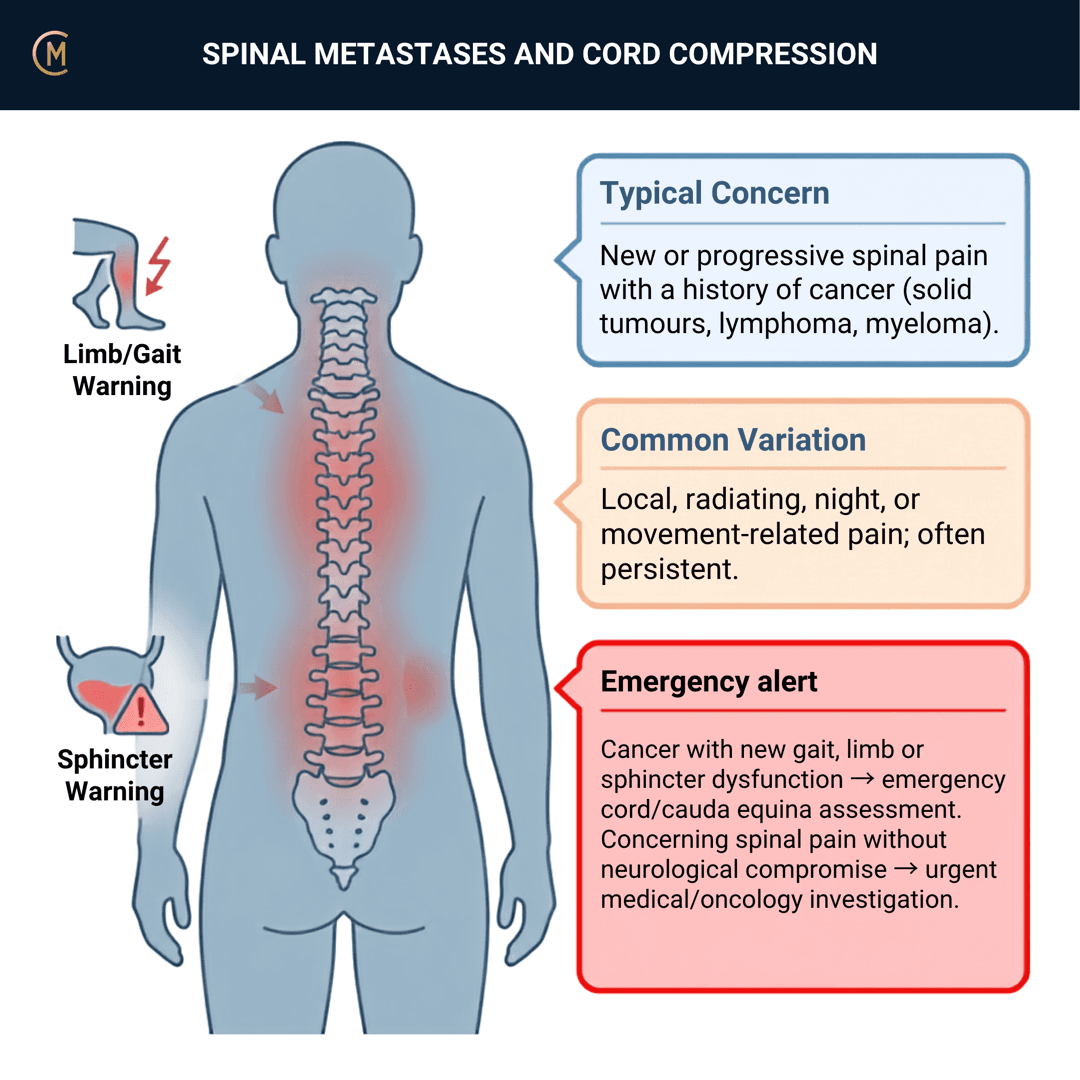
Who: Anyone with a history of cancer, and sometimes someone who doesn't yet know they have one. Not excluded by age — it has been described in children.
What: Metastatic deposit in the spine. The emergency is what it does to the cord.
How it behaves: Constant, deep, unremitting back pain. Worse at night or lying down. History of cancer. Unexplained weight loss or fatigue. Non-mechanical — position and rest don't change it.
The one thing to take from this page:
"Night pain + history of cancer = image immediately."
Why that pearl is right and the rest of the checklist isn't
| The habit | What the evidence says |
|---|---|
| Run through a long red-flag list and tick boxes | Most individual red flags perform poorly (Downie et al. 2013, BMJ), and the flags in current guidelines are inconsistent with each other (Verhagen et al. 2016) |
| Night pain means cancer | Weak on its own. Night pain in a healthy 30-year-old is not night pain in someone with breast cancer |
| It's rare, so relax | Prevalence is genuinely low — studied in Australian primary care — and that is exactly why single flags screen badly. Low base rate, poor test, false alarms |
| A history of cancer | The one that carries weight. Ask it every time. |
Screening isn't a checklist you tick. It's a probability you update — and a cancer history moves it more than anything else on the list.
2 · SE — THE SUBJECTIVE PATTERN (the 70%)
On this page the subjective is essentially the whole assessment. Five stages, in your course's order.
MAIN PROBLEM
"It's there all the time and nothing shifts it."
"It's worse when I lie down, which makes no sense to me."
"I had breast cancer eight years ago — but that's finished."
That last sentence is the one. "Finished" is not a clearance.
BODY CHART
- Where, and does it stay there? Non-mechanical pain doesn't move with position.
- Any band of pain around the trunk? A cord level.
- Both legs? Mark them.
- Saddle area — any change in sensation?
BEHAVIOUR — this is where it declares itself
| Mechanical | This | |
|---|---|---|
| Position | Changes it | Doesn't |
| Rest | Helps | Doesn't, or makes it worse |
| Night | Position-related | Worse lying down. Gets them up and pacing |
| Course | Fluctuates, better days | Constant. Progressive |
| Movement | Reproduces it | Often doesn't |
HISTORY — and one question outranks everything
- "Have you ever been treated for cancer?" Ask it directly, ask it of everyone, and don't accept "years ago" as a no.
- If yes: which cancer, when, what treatment, are they still under review, and when was the last scan?
- Unexplained weight loss? How much, over how long, and were they trying?
- Fatigue that's new and not explained by sleep or load?
- Age, and general health.
- Any recent fall, or pain after minimal trauma? Pathological fracture.
SPECIAL / SCREENING QUESTIONS — every time, on every non-mechanical back pain
- Any change in walking, balance, or how the legs feel? This is the question that matters most.
- Any numbness or heaviness in both legs?
- Any bladder or bowel change? Any numbness in the saddle area?
- Any fever, night sweats?
- Is it getting worse week on week?
Assessing this region? Download the Lumbar Spine & SIJ assessment template →
3 · HYPOTHESIS RANKING
Inverted, as on every red-flag page: you are not ranking towards a diagnosis, you are ranking what you cannot miss.
| What you must not miss | The feature that raises it |
|---|---|
| Metastatic spinal cord compression | Any change in walking, bilateral leg symptoms, a sensory level, UMN signs. This is the emergency. |
| Cauda equina syndrome | Bladder or bowel change, saddle anaesthesia, bilateral leg symptoms. |
| Pathological fracture | Sudden severe pain after minimal or no trauma, especially with a cancer history. |
| Spinal infection / discitis | Fever, systemic illness, immunosuppression, IV drug use, recent procedure. |
| Undiagnosed primary malignancy | Weight loss, fatigue, night pain, and no cancer history yet. |
| Abdominal aortic aneurysm | Pulsatile mass, non-mechanical pain, older male with vascular risk. |
| Then, and only then: non-specific low back pain, discogenic, radicular, stenosis | Mechanical behaviour. Reproducible. Fluctuating. |
The reframe that matters
The title says "spinal metastases." The emergency is metastatic spinal cord compression — and what decides the outcome is whether they are still walking when someone acts. Functional status in this population has been studied [1], gait has been correlated with life expectancy [2], and the timing of surgery has been examined against function [3]. The direction is the whole point.
4 · RED FLAGS — DON'T MISS THIS
This section is free, on every pattern, forever. On this page the whole thing is.
Ambulatory status is the clock
The question is not how bad the pain is. It is whether they are still walking — and whether that has changed this week.
| Finding | What it suggests | What you do |
|---|---|---|
| New difficulty walking, unsteadiness, or falls | MSCC | EMERGENCY — now. This is the one |
| Bilateral leg weakness, heaviness or numbness | Cord or cauda equina | EMERGENCY |
| Bladder or bowel change, saddle anaesthesia | Cauda equina | EMERGENCY |
| A band of altered sensation around the trunk | A cord level | EMERGENCY |
| Hyperreflexia, clonus, upgoing plantars | UMN — cord | EMERGENCY |
| Known cancer history with new spinal pain | Metastasis until proven otherwise | Urgent medical review and imaging |
| Constant, unremitting, non-mechanical pain | Serious pathology | Medical review |
| Night pain that gets them out of bed | With a cancer history: image. Without: still investigate | Medical review |
| Unexplained weight loss, fever, night sweats | Malignancy, infection | Urgent medical review |
| Severe pain after minimal or no trauma | Pathological fracture | Urgent medical review and imaging |
| Progressive worsening week on week | Whatever the cause | Medical review |
What to do, in order
- Stop. Do not treat.
- Neurological examination — power, reflexes, sensation, plantars, gait and tandem gait. Record all of it.
- Decide the tier: emergency department today · urgent same-day GP · urgent medical review this week.
- Write it down: the features present, the features absent, the neurological findings with values, the cancer history in full, and whether their walking has changed.
- Ring. Don't hand a letter to someone and hope.
- Say the words "I'm worried about their spinal cord." Vague referrals get triaged as back pain.
Cross-links: Cauda equina syndrome · Infection / malignancy · Non-specific low back pain · Abdominal aortic aneurysm
5 · OE — THE OBJECTIVE (the 30%)
Members
Sections 5 to 7 are for members
The objective exam, management and pearls, plus the six-minute lesson and the debrief. Free with an account.
Sign in or join free6 · MX — MANAGEMENT ESSENTIALS
Members
Sections 5 to 7 are for members
The objective exam, management and pearls, plus the six-minute lesson and the debrief. Free with an account.
Sign in or join free7 · CLINICAL PEARLS + RETRIEVAL CHECK
Members
Sections 5 to 7 are for members
The objective exam, management and pearls, plus the six-minute lesson and the debrief. Free with an account.
Sign in or join freeMembers
The 4-minute lesson is for members
Twelve slides on this pattern: what you'll hear, what to examine, what to do. Free with an account.
Sign in or join freeGuideline anchor
No Australian guideline covers spinal metastases beyond the lumbar screen in the ACSQHC Low Back Pain Clinical Care Standard (2022), which screens for serious pathology and reserves imaging for suspected serious pathology; it does not cover managing the cancer.
More
The two anchors that matter here are both about the screening itself — the BMJ systematic review of red flags to screen for malignancy and fracture in low back pain (Downie et al. 2013, PMID 24335669) and the Australian primary-care prevalence and screening study (Henschke et al. 2009, PMID 19790051). Red flags as they appear in current guidelines have been reviewed (Verhagen et al. 2016, PMID 27376890). Imaging is anchored to the ACR Appropriateness Criteria for low back pain, 2021 update (Hutchins et al. 2021, PMID 34794594).
These are not management guidelines — they are studies of how well the screening you are doing actually performs. That is the right anchor for a physiotherapist, because your role here is recognition and referral, not treatment.
Members
The evidence summary is for members
Verified diagnostic accuracy, where the evidence stands and what it doesn't settle. Free with an account.
Sign in or join freeSources · 20
ShowHide
Every source on this page resolves and title-verifies against PubMed. Newest first.
- 2018Santos et al. (2018). Functional status of patients with metastatic spinal cord compression. Supportive care in cancer : official journal of the Multinational Association of Supportive Care in Cancer, 26(9), 3225-3231. https://doi.org/10.1007/s00520-018-4182-5
- 2022Sugita et al. (2022). Correlation Between Gait and Life Expectancy in Patients with Spinal Metastases. World neurosurgery, 163, e156-e161. https://doi.org/10.1016/j.wneu.2022.03.079
- 2022Meyer et al. (2022). Surgery in Acute Metastatic Spinal Cord Compression: Timing and Functional Outcome. Cancers, 14(9). https://doi.org/10.3390/cancers14092249
- 2021Hutchins et al. (2021). ACR Appropriateness Criteria® Low Back Pain: 2021 Update. Journal of the American College of Radiology : JACR, 18(11S), S361-S379. https://doi.org/10.1016/j.jacr.2021.08.002
- 2022Kuah et al. (2022). State-of-the-Art Imaging Techniques in Metastatic Spinal Cord Compression. Cancers, 14(13). https://doi.org/10.3390/cancers14133289
- 1997Helweg-Larsen et al. (1997). Radiologic features compared to clinical findings in a prospective study of 153 patients with metastatic spinal cord compression treated by radiotherapy. Acta neurochirurgica, 139(2), 105-11. https://doi.org/10.1007/BF02747189
- 2024Kovarik et al. (2024). Metastatic spinal cord compression: the Spinal Instability Neoplastic Score and early surgical intervention. BMJ supportive & palliative care. https://doi.org/10.1136/spcare-2023-004537
- 2023Pérez-Romasanta et al. (2023). The Management of Metastatic Spinal Cord Compression in Routine Clinical Practice. Cancers, 15(10). https://doi.org/10.3390/cancers15102821
- 2023Esperança-Martins et al. (2023). Multidisciplinary Approach to Spinal Metastases and Metastatic Spinal Cord Compression-A New Integrative Flowchart for Patient Management. Cancers, 15(6). https://doi.org/10.3390/cancers15061796
- 2022Rispoli et al. (2022). Multidisciplinary Approach to Patients With Metastatic Spinal Cord Compression: A Diagnostic Therapeutic Algorithm to Improve the Neurological Outcome. Frontiers in oncology, 12, 902928. https://doi.org/10.3389/fonc.2022.902928
- 2022Hershkovich et al. (2022). Acute Metastatic Spinal Cord Compression: Urgent Surgery versus Radiotherapy and Treatment Result Prediction versus Actual Results. Current oncology (Toronto, Ont.), 29(10), 7420-7429. https://doi.org/10.3390/curroncol29100583
- 2023Quraishi et al. (2023). Malignant spinal cord compression in the paediatric population-a systematic review, meta-analysis. European spine journal : official publication of the European Spine Society, the European Spinal Deformity Society, and the European Section of the Cervical Spine Research Society, 32(12), 4306-4313. https://doi.org/10.1007/s00586-023-07820-3
- 2022Giglio et al. (2022). Incidence and risk factors associated with the development of metastatic spinal cord compression due to bone metastasis in women with cervical cancer. European spine journal : official publication of the European Spine Society, the European Spinal Deformity Society, and the European Section of the Cervical Spine Research Society, 31(11), 3139-3145. https://doi.org/10.1007/s00586-022-07314-8
- 2024Shakil et al. (2024). Contemporary trends in the incidence and timing of spinal metastases: A population-based study. Neuro-oncology advances, 6(1), vdae051. https://doi.org/10.1093/noajnl/vdae051
- 2009Henschke et al. (2009). Prevalence of and screening for serious spinal pathology in patients presenting to primary care settings with acute low back pain. Arthritis and rheumatism, 60(10), 3072-80. https://doi.org/10.1002/art.24853
- 2013Downie et al. (2013). Red flags to screen for malignancy and fracture in patients with low back pain: systematic review. BMJ (Clinical research ed.), 347, f7095. https://doi.org/10.1136/bmj.f7095
- 2016Verhagen et al. (2016). Red flags presented in current low back pain guidelines: a review. European spine journal : official publication of the European Spine Society, the European Spinal Deformity Society, and the European Section of the Cervical Spine Research Society, 25(9), 2788-802. https://doi.org/10.1007/s00586-016-4684-0
- 2020Galliker et al. (2020). Low Back Pain in the Emergency Department: Prevalence of Serious Spinal Pathologies and Diagnostic Accuracy of Red Flags. The American journal of medicine, 133(1), 60-72.e14. https://doi.org/10.1016/j.amjmed.2019.06.005
- 2020DePalma (2020). Red flags of low back pain. JAAPA : official journal of the American Academy of Physician Assistants, 33(8), 8-11. https://doi.org/10.1097/01.JAA.0000684112.91641.4c
- 2022Chu & Trager (2022). Prevalence of Serious Pathology Among Adults with Low Back Pain Presenting for Chiropractic Care: A Retrospective Chart Review of Integrated Clinics in Hong Kong. Medical science monitor : international medical journal of experimental and clinical research, 28, e938042. https://doi.org/10.12659/MSM.938042
Mapped to this pattern
Generic measures that also apply
- Borg RPE
Borg Rating of Perceived Exertion Scale (6-20)
perceived exertion · 1 items · 1 min
- GROC
Global Rating of Change Scale
perceived change since baseline · 1 items · 1 min
- NPRS
Numeric Pain Rating Scale
pain intensity · 1 items · 1 min
- PGIC
Patient Global Impression of Change
perceived change since baseline · 1 items · 1 min
- PSFS
Patient-Specific Functional Scale
patient-generated function · 3 items · 2 min
- SANE
Single Assessment Numeric Evaluation
patient-rated function as a percentage of normal · 1 items · 1 min
- VAS
Visual Analogue Scale
pain intensity · 1 items · 1 min
- Borg CR10
Borg Category Ratio 10 Scale
perceived exertion or symptom intensity, ratio scale · 1 items · 1 min
- GAS
Goal Attainment Scaling
individualised goal achievement · 10 min
Did this page do its job?
CliniStudy is in beta. One tap is enough — it decides what gets fixed first.