
1 · SNAPSHOT
Who: Peak 40–65, more often women. Diabetes is the big one. It also happens in older adults, where glenohumeral OA is the competing pattern.
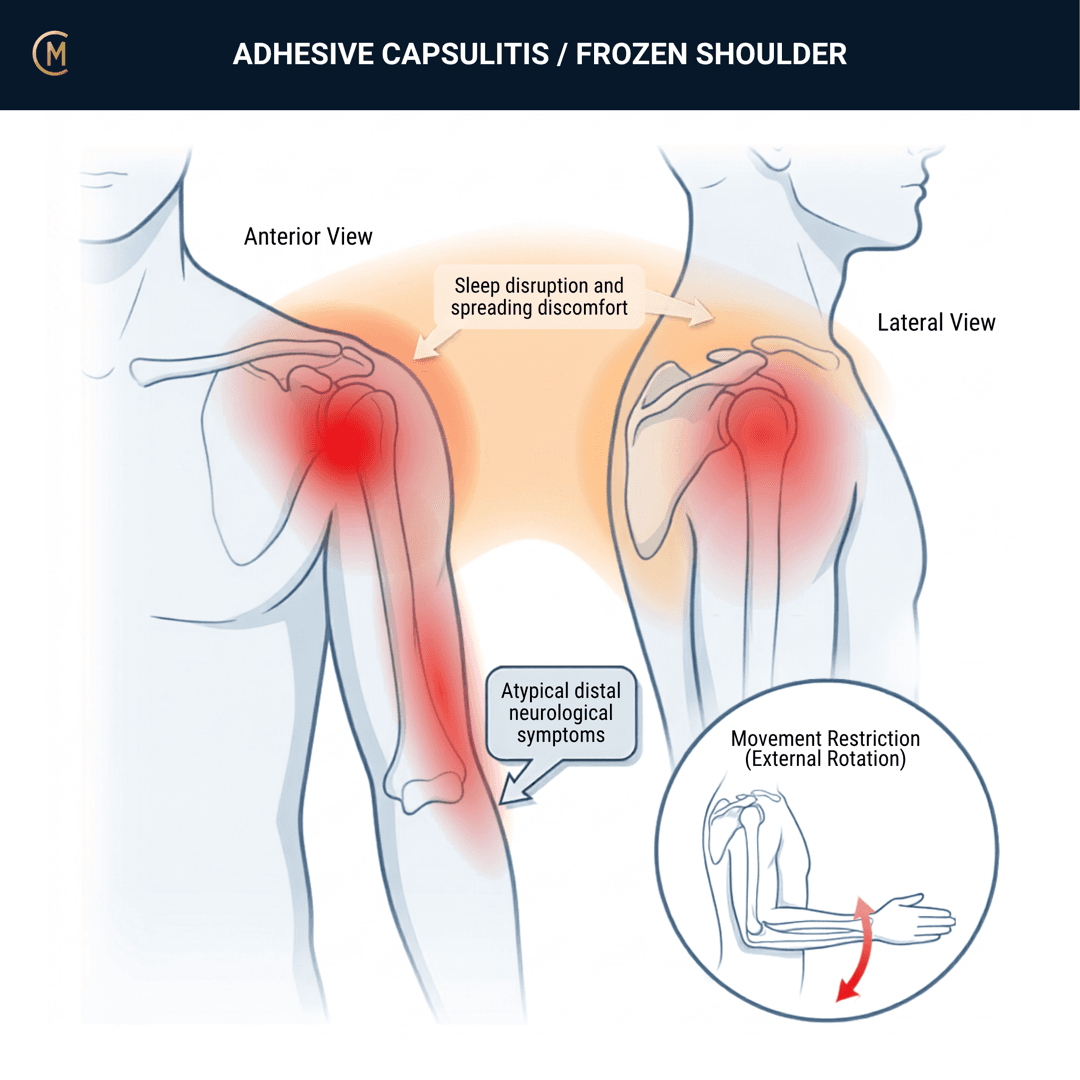
What: Deep ache in the shoulder and upper arm, may refer to the neck or biceps region. Rarely below the elbow.
How it behaves: Pain first, stiffness second. Everything hurts at end range, there's no comfortable position, and night pain is prominent early.
The illness script in one line: progressive loss of active and passive range, external rotation worst, with a firm end-feel — in a shoulder that hurt before it stiffened.
The numbers that matter:
| Figure | |
|---|---|
| One-year prevalence, adults 65+ | 0.4% |
| Lifetime prevalence, adults 65+ | 2.4% |
| Odds of frozen shoulder with diabetes | 3.69× (95% CI 2.99–4.56) |
(Prevalence: [1], German general practice, 1,207 practices. Diabetes: [2], six case-control studies, 5,388 people.)
It's much less common than rotator cuff-related shoulder pain — but you will meet it on a five-week block, and it's the one students most often mislabel as a cuff.
⚠️ No Australian guideline exists for this presentation, and the guideline situation is worse than that. Anchored to the JOSPT Adhesive Capsulitis CPG [3] — still the only physio-facing guideline, and now thirteen years old. The 2025 international Delphi consensus [4] exists precisely because the available guidelines are few and outdated. Quote both.
Pattern > Label. The whole diagnosis is one comparison: does the passive range go too?
2 · SE — THE SUBJECTIVE PATTERN (the 70%)
Five stages, in the order your course teaches them. Insidious onset, so run BEHAVIOUR before HISTORY.
MAIN PROBLEM
Listen for the function, because it's specific and it's brutal: hair washing, bra strap, back pocket, seatbelt, reaching into the back seat, and sleep. If they lead with "I can't sleep on it and I can't do my hair", you're already most of the way there.
BODY CHART
- Deep, poorly localised ache over the deltoid and upper arm. They rub it with a whole hand.
- May refer to the neck or the biceps region. Rarely below the elbow — symptoms into the hand are a cervical question until cleared.
- Clear the cervical and thoracic spine, the elbow, and both upper limbs for neurological symptoms.
BEHAVIOUR
- Aggs: every end-range movement. Reaching behind, overhead, across the body, quick unguarded movements, and lying on it.
- Eases: arm supported and still. Note what's different from a cuff — there often isn't a good easing position, especially early.
- 24-hr pattern: stiff and sore first thing, loosens a little with movement, worse again by evening.
- Night: prominent, early, and a major driver of why they've come. Don't skip past it — sleep loss is what makes this presentation feel unbearable, and patients describe exactly that [5].
- Severity: VAS 0–10 at best / at worst / right now.
- Irritability: vigour of the provoking activity, severity provoked, and time to settle. All three. In this pattern irritability doesn't just set your O/E depth — it sets whether stretching is treatment or provocation.
HISTORY
- Insidious onset over weeks. Pain came first; the stiffness crept in after.
- Ask about diabetes, every time. Odds of frozen shoulder are 3.69× higher with diabetes (Dyer 2023). Also ask about thyroid disease, and about a previous frozen shoulder on the other side (Kelley 2013).
- Recent immobilisation, shoulder or upper arm injury, thoracic injury, or surgery — in the 65+ data the strongest associations after OA were injury to the shoulder and upper arm (OR 1.85) and to the thorax (OR 1.47) (Jacob 2023).
- What have they been told, and what do they believe? Fear matters here more than most patterns — see below.
SPECIAL / SCREENING QUESTIONS
General health, weight loss, night sweats, fever, malignancy history (including breast and any axillary surgery or radiotherapy), inflammatory features, medications, and neurological symptoms in the arm. See §4.
The bit most students skip
Fear and expectation are prognostic here, not just pleasant to ask about. In a 120-patient cohort on 12 weeks of multimodal care, baseline kinesiophobia predicted shoulder-specific disability afterwards, baseline DASH predicted upper-limb disability, and comorbidities predicted quality of life [6]. Across the wider prognostic literature, pain-related fear, depression and catastrophising track with outcome [7].
So the question "what are you most worried this is?" is doing diagnostic and prognostic work at the same time.
On the three phases
Freezing → frozen → thawing is a useful teaching model and you should know it. Treat the boundaries as fuzzy: they're a description, not a staging system with criteria, and nobody will grade you on declaring a phase. What matters clinically is irritability today.
Assessing this region? Download the Shoulder assessment template →
3 · HYPOTHESIS RANKING
Top competing patterns, one discriminating feature each.
| Competing pattern | The one discriminating feature |
|---|---|
| Rotator cuff-related shoulder pain | Painful arc with near-full passive range. Frozen shoulder loses passive range — see the RCRSP page |
| Massive rotator cuff tear | Can't lift actively, but passive range is preserved. Pseudoparalysis, scapular hitch, atrophy |
| Glenohumeral OA | Also a capsular pattern — but bony end-feel and crepitus with passive movement, usually >50 yrs, OA on plain film |
| Calcific tendinopathy | Sudden, severe, guarded. Restriction is pain-limited, not truly capsular — and measurably so: see below |
| Not the shoulder at all | Doesn't behave mechanically, or symptoms below the elbow → §4 |
The discriminator that does the most work: passive external rotation with the arm by the side. Frozen shoulder loses it, and it's the direction it loses first (ER > ABD > flexion). A cuff keeps it. A big tear keeps it. Test it before you test anything else.
And measure it against the other shoulder, because that comparison has numbers behind it. In 77 adhesive capsulitis and 57 calcific tendinitis patients, passive glenohumeral range was compared with the contralateral unaffected side [8]:
| Versus the other shoulder | Adhesive capsulitis | Calcific tendinitis |
|---|---|---|
| External rotation | restricted by a median 40° (IQR −60 to −30) | not restricted at all — median 0° (IQR 0 to 0) |
| Abduction | restricted by a median 40° (IQR −50 to −30) | restricted by a median 10° (IQR −20 to −5) |
Read the right-hand column twice. Calcific tendinitis loses a bit of abduction and keeps its external rotation completely. That is the cleanest separation on this page, and it takes one movement on each side.
(Retrospective, level 3, single surgical-referral institution — but the effect is large and the test is free.)
Jones' hypothesis categories that change your plan here: sources of symptoms (capsule vs cuff vs joint surface), pathophysiology (this one genuinely matters — see §6), precautions (irritability decides whether you stretch at all), and patient perspectives (fear is prognostic).
Same end-feel, different story. Firm and capsular = capsule. Hard and grating = the joint. Guarded and pain-limited = neither.
4 · RED FLAGS — DON'T MISS THIS
This section is free, on every pattern, forever.
The honest position
There's no shoulder equivalent of the low back red flag accuracy data, and none specific to a stiff shoulder. What we have is a pathway: red flag presentations and acute injuries go to urgent specialist referral, and the rest is managed non-surgically [9]. Screen by behaviour and combination.
The specific trap in this pattern is that "frozen shoulder" is a comfortable label. It explains stiffness, it explains pain, it explains a slow course — which makes it a very easy place to park something else.
What to actually screen
| Signs / symptoms | Implication |
|---|---|
| Stiffness without a painful phase before it | Not this pattern. Re-examine — think OA, post-surgical, neurological |
| Fever, hot swollen joint, recent injection or surgery, systemically unwell | Septic arthritis — same-day referral |
| Malignancy history (especially breast), axillary surgery or radiotherapy | Secondary stiffness or recurrence — needs medical review, not just rehab |
| Unexplained weight loss, night sweats, unremitting night pain unchanged by position | Malignancy |
| Trauma, then inability to elevate, or marked weakness | Fracture · dislocation · full-thickness tear |
| Progressive weakness, wasting, or symptoms below the elbow | Cervical radiculopathy · peripheral nerve lesion |
| Multiple joints, prolonged morning stiffness, systemic features | Inflammatory arthropathy |
Act on
A plain radiograph is the sensible first investigation if you're not certain — its job here is to exclude glenohumeral osteoarthritis and calcific tendinopathy, not to confirm a capsulitis [10].
Undiagnosed diabetes is a finding, not a footnote. Given a 3.69× odds ratio (Dyer 2023), a middle-aged patient with a classic frozen shoulder and no recent bloods is worth a GP conversation. That's not overreach — that's the referral that makes you useful.
Stiff but never painful = not this. Re-examine.
Hot, swollen, unwell = same-day referral, not a stretching program.
If it isn't slowly improving on a reasonable plan, question the diagnosis before you question the patient.
5 · OE — THE OBJECTIVE (the 30%)
Members
Sections 5 to 7 are for members
The objective exam, management and pearls, plus the six-minute lesson and the debrief. Free with an account.
Sign in or join free6 · MX — MANAGEMENT ESSENTIALS
Members
Sections 5 to 7 are for members
The objective exam, management and pearls, plus the six-minute lesson and the debrief. Free with an account.
Sign in or join free7 · CLINICAL PEARLS + RETRIEVAL CHECK
Members
Sections 5 to 7 are for members
The objective exam, management and pearls, plus the six-minute lesson and the debrief. Free with an account.
Sign in or join freeMembers
The 5-minute lesson is for members
Twelve slides on this pattern: what you'll hear, what to examine, what to do. Free with an account.
Sign in or join freeGuideline anchor
No Australian guideline for this presentation.
More
Anchored to Shoulder Pain and Mobility Deficits: Adhesive Capsulitis — JOSPT Clinical Practice Guideline (Kelley et al.)
No Australian clinical care standard exists for adhesive capsulitis. Closest Australian reference point is Crookes et al., Aust J Gen Pract 2023 (PMID 37935145) — a general practice review, not a standard.
Members
The evidence summary is for members
Verified diagnostic accuracy, where the evidence stands and what it doesn't settle. Free with an account.
Sign in or join freeSources · 19
ShowHide
Every source on this page resolves and title-verifies against PubMed. Newest first.
- 2023Jacob et al. (2023). Prevalence of and Risk Factors for Adhesive Capsulitis of the Shoulder in Older Adults from Germany. Journal of clinical medicine, 12(2). https://doi.org/10.3390/jcm12020669
- 2023Dyer et al. (2023). Diabetes as a risk factor for the onset of frozen shoulder: a systematic review and meta-analysis. BMJ open, 13(1), e062377. https://doi.org/10.1136/bmjopen-2022-062377
- 2013Kelley et al. (2013). Shoulder pain and mobility deficits: adhesive capsulitis. The Journal of orthopaedic and sports physical therapy, 43(5), A1-31. https://doi.org/10.2519/jospt.2013.0302
- 2025Salamh et al. (2025). An international consensus on the etiology, risk factors, diagnosis and Management for individuals with Frozen Shoulder: a Delphi study. The Journal of manual & manipulative therapy, 33(4), 309-320. https://doi.org/10.1080/10669817.2025.2470461
- 2023Bilsborough Smith et al. (2023). Living with frozen shoulder. 'Here are the risks. I want the injection'. An interpretative phenomenological analysis. Musculoskeletal science & practice, 65, 102755. https://doi.org/10.1016/j.msksp.2023.102755
- 2025Brindisino et al. (2025). Prognostic factors for upper limb and shoulder-specific disability and quality of life in participants suffering from frozen shoulder. A multicentric prospective single-cohort study. Musculoskeletal science & practice, 80, 103417. https://doi.org/10.1016/j.msksp.2025.103417
- 2024Brindisino et al. (2024). Does the psychological profile of a patient with frozen shoulder predict future outcome? A systematic review. Physiotherapy research international : the journal for researchers and clinicians in physical therapy, 29(1), e2056. https://doi.org/10.1002/pri.2056
- 2018Jungwirth-Weinberger et al. (2018). Restriction of Passive Glenohumeral Abduction Combined With Normal Passive External Rotation Is a Diagnostic Feature of Calcific Tendinitis. Orthopaedic journal of sports medicine, 6(2), 2325967117752907. https://doi.org/10.1177/2325967117752907
- 2023Crookes et al. (2023). Chronic shoulder pain. Australian journal of general practice, 52(11), 753-758. https://doi.org/10.31128/AJGP-04-23-6790
- 2024Kuhn et al. (2024). [Adhesive capsulitis]. Radiologie (Heidelberg, Germany), 64(2), 119-124. https://doi.org/10.1007/s00117-023-01217-5
- 2020Abrassart et al. (2020). 'Frozen shoulder' is ill-defined. How can it be described better?. EFORT open reviews, 5(5), 273-279. https://doi.org/10.1302/2058-5241.5.190032
- 2022Millar et al. (2022). Frozen shoulder. Nature reviews. Disease primers, 8(1), 59. https://doi.org/10.1038/s41572-022-00386-2
- 2016Ryan et al. (2016). The pathophysiology associated with primary (idiopathic) frozen shoulder: A systematic review. BMC musculoskeletal disorders, 17(1), 340. https://doi.org/10.1186/s12891-016-1190-9
- 2020Challoumas et al. (2020). Comparison of Treatments for Frozen Shoulder: A Systematic Review and Meta-analysis. JAMA network open, 3(12), e2029581. https://doi.org/10.1001/jamanetworkopen.2020.29581
- 2018Ahn et al. (2018). Early Intra-articular Corticosteroid Injection Improves Pain and Function in Adhesive Capsulitis of the Shoulder: 1-Year Retrospective Longitudinal Study. PM & R : the journal of injury, function, and rehabilitation, 10(1), 19-27. https://doi.org/10.1016/j.pmrj.2017.06.004
- 1995Bunker & Anthony (1995). The pathology of frozen shoulder. A Dupuytren-like disease. The Journal of bone and joint surgery. British volume, 77(5), 677-83. PubMed 7559688
- 2023Schiltz et al. (2023). The diagnostic value of physical examination tests in adhesive capsulitis: a systematic review. European journal of physical and rehabilitation medicine, 59(6), 724-730. https://doi.org/10.23736/S1973-9087.23.07940-6
- 2020Wu et al. (2020). The role of grey-scale ultrasound in the diagnosis of adhesive capsulitis of the shoulder: a systematic review and meta-analysis. Medical ultrasonography, 22(3), 305-312. https://doi.org/10.11152/mu-2430
- 2025Xiang et al. (2025). Magnetic resonance imaging features for diagnosing adhesive capsulitis of the shoulder: a systematic review and meta-analysis. BMC musculoskeletal disorders, 26(1), 368. https://doi.org/10.1186/s12891-025-08592-1
Mapped to this pattern
Generic measures that also apply
- Borg RPE
Borg Rating of Perceived Exertion Scale (6-20)
perceived exertion · 1 items · 1 min
- DASH
Disabilities of the Arm, Shoulder and Hand
upper limb disability · 30 items · 8 min
- GROC
Global Rating of Change Scale
perceived change since baseline · 1 items · 1 min
- NPRS
Numeric Pain Rating Scale
pain intensity · 1 items · 1 min
- PGIC
Patient Global Impression of Change
perceived change since baseline · 1 items · 1 min
- PSFS
Patient-Specific Functional Scale
patient-generated function · 3 items · 2 min
- QuickDASH
QuickDASH
upper limb disability, short form · 11 items · 4 min
- SANE
Single Assessment Numeric Evaluation
patient-rated function as a percentage of normal · 1 items · 1 min
- UEFI
Upper Extremity Functional Index
upper limb function · 20 items · 5 min
- VAS
Visual Analogue Scale
pain intensity · 1 items · 1 min
- Borg CR10
Borg Category Ratio 10 Scale
perceived exertion or symptom intensity, ratio scale · 1 items · 1 min
- GAS
Goal Attainment Scaling
individualised goal achievement · 10 min
Did this page do its job?
CliniStudy is in beta. One tap is enough — it decides what gets fixed first.