
1 · SNAPSHOT
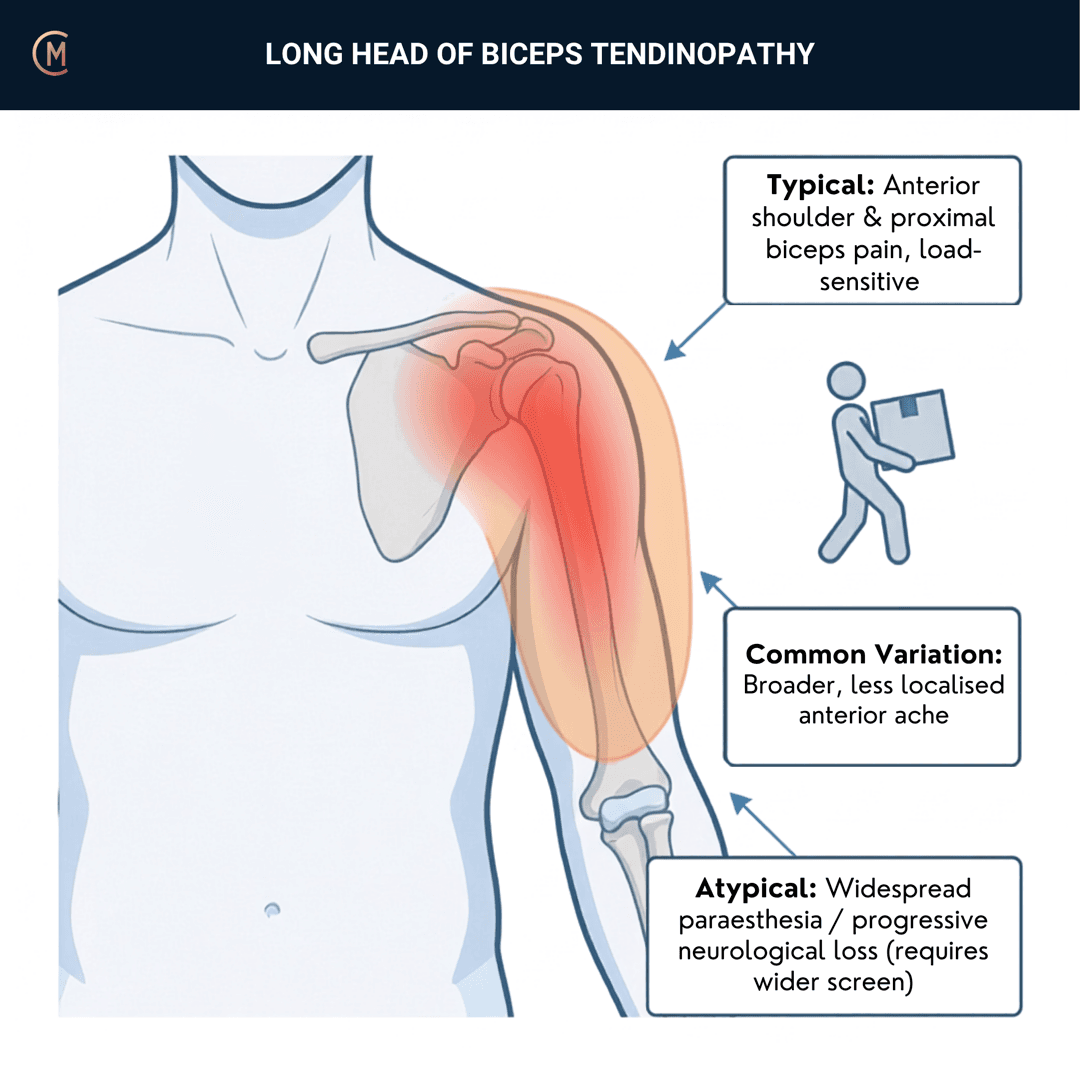
Who: Overhead athletes, lifters, and middle-aged adults with a cuff problem they haven't been told about yet.
What: Anterior shoulder pain, often described as running down into the biceps.
How it behaves: Load-related. Worse overhead, worse with resisted elbow flexion and supination, worse carrying.
The one thing to take from this page:
Isolated long head of biceps pathology is close to a rarity. In every arthroscopic series it sits inside a pulley, cuff and labral complex rather than beside it.
The numbers behind that, and they are the spine of everything below:
| Finding | Figure |
|---|---|
| Pathologic LHB with an intact pulley complex | 11% (25/218) — and 92% of those still had a torn medial sheath wall |
| Pulley tear in consecutive shoulder arthroscopies | 32.4% (67/207) |
| Pulley torn in cases of biceps dislocation | 27 of 27 — all of them |
| LHB pathology found during surgery for a cuff tear | 22.4% (124/554) |
| LHB lesions accompanying supraspinatus pathology | 22% to 78.5% across studies |
[1][2][3][4]
Read the denominators. Every one of those figures comes from a shoulder already booked for surgery. Nobody has reported what proportion of anterior shoulder pain on a placement caseload is isolated biceps — that number does not exist.
⚠️ No dedicated guideline exists for this presentation, Australian or international. The closest is the Dutch Orthopaedic Association subacromial pain syndrome guideline, Part 2 [5], which names biceps tendon pathology in scope and whose entire biceps recommendation is one sentence: avoid tenotomy or tenodesis on a healthy tendon unless it is at risk during cuff repair. For conservative management the best available is an expert Delphi at Level of evidence 5.
Pattern > Label. "Biceps tendinopathy" should leave your mouth as a hypothesis, not a diagnosis.
2 · SE — THE SUBJECTIVE PATTERN (the 70%)
Five stages, in your course's order. Usually insidious, so BEHAVIOUR before HISTORY.
MAIN PROBLEM
The loaded task: bench press, overhead press, throwing, carrying shopping, lifting a toddler.
BODY CHART
- Anterior shoulder, at or just below the front of the joint, often described as travelling down the front of the arm into the biceps belly.
- Ask whether it goes past the elbow — that's a cervical question.
- Clear the ACJ, the cuff and the neck. In this pattern that isn't a formality: the anterior shoulder is crowded, and the odds that the biceps is the sole problem are low.
BEHAVIOUR
- Aggs: overhead, resisted elbow flexion and supination, throwing, carrying, sleeping on it, and long-lever biceps work.
- Eases: unloading the arm, avoiding overhead.
- 24-hr pattern: stiff and sore first thing, easing with movement, building again after a day of lifting or overhead work — the same load-sensitive shape as the cuff it sits beside.
- Night: wakes on rolling onto it, settles once they move off it. Position-easable night pain is mechanical. Unremitting night pain is not — see §4.
- Severity: VAS 0–10 at best / at worst / right now.
- Clicking or catching anteriorly — worth asking about, because tendon instability is one of the few things imaging is genuinely good at (§5).
- Irritability: vigour, severity, time to settle.
HISTORY
- Load change: a new programme, a return to throwing, a volume spike.
- Previous shoulder problems, and what they were told. If a cuff tear or a SLAP lesion is already on the record, the biceps is far more likely to be part of a picture than the picture.
- The three associations with a pathologic biceps in 361 patients with a supraspinatus tear: higher age (p < .0001), higher BMI (p = .018), diabetes (p = .009) [6]. No odds ratios or effect sizes are reported — treat these as associations, not risk figures.
SPECIAL / SCREENING QUESTIONS
General health, diabetes, fever, malignancy history, weight loss, medications, neurological symptoms. See §4.
The subjective's job here is not to confirm the biceps. It is to work out what else is going on.
Assessing this region? Download the Shoulder assessment template →
3 · HYPOTHESIS RANKING
| Competing pattern | The one discriminating feature |
|---|---|
| Rotator cuff-related pain | Lateral, not anterior. Painful arc, painful resisted external rotation and abduction |
| SLAP lesion | Deep, poorly localised, clicking and catching. Often a traction or fall-on-outstretched-hand history |
| Biceps pulley lesion / tendon instability | Clicking or a palpable snap on rotation. This is the one imaging finds well |
| ACJ | Localised on the joint, cross-body reach — see the ACJ page |
| Cervical referral | Below the elbow, neck movement changes it |
The isolation problem — this is the page
The differential above is misleading in one important way: these are not alternatives. They travel together.
- A pulley tear was present in 32.4% of 229 consecutive shoulder arthroscopies, was significantly associated with rotator cuff injury (P < .001) and with SLAP lesions, and was torn in all 27 cases of biceps dislocation (Braun 2011).
- In 218 subscapularis repairs, a pathologic LHB with an intact superior glenohumeral / coracohumeral ligament complex was found in only 11% — and even in those, the medial wall of the tendon sheath was torn in 92% (Godenèche 2017).
- LHB pathology was found in 22.4% of 554 shoulders operated on for a cuff tear (Kim 2019).
So when you say "I think this is biceps tendinopathy", the honest completion of that sentence is "…and I should be asking what else is going on in there."
Jones' hypothesis categories that change your plan: sources of symptoms — and specifically, accepting that there may be several — plus precautions and contributing factors (load history).
The biceps rarely hurts alone. Treat the region, not the tendon.
4 · RED FLAGS — DON'T MISS THIS
This section is free, on every pattern, forever.
The honest position, stated plainly
There is no long-head-of-biceps-specific red-flag literature. No study, review or guideline reports red flags or serious-pathology mimics specific to this condition. So use the shared shoulder-region screen.
That screen comes from a primary-care review with Australian senior authorship [7].
What to actually screen
| Signs / symptoms | Implication |
|---|---|
| Fever, unexplained weight loss, malignancy history | Infection · malignant neoplasm — and the trigger for early imaging |
| Pain not behaving mechanically, unchanged by arm position or load | Non-shoulder referred pain — including cardiac and visceral to the anterior shoulder |
| Sudden pop with immediate bruising and a Popeye bulge | LHB rupture — usually benign, but re-examine the cuff |
| Progressive weakness, wasting, symptoms below the elbow | Cervical radiculopathy · nerve injury |
| Trauma with inability to elevate | Fracture · dislocation · acute cuff tear |
| Multiple joints, prolonged morning stiffness, systemic features | Inflammatory arthropathy |
The caution that is actually specific to this tendon
Repeated peritendinous corticosteroid is associated with elevated cuff tear risk. In 1,025 patients, cuff tendon tear incidence was 9.8% in the injected group (p < 0.001), with an adjusted hazard ratio of 7.44 [8].
Carry the caveats with it, every time: no confidence intervals are reported, confounding by indication is untreated — sicker shoulders get injected — and the outcome is cuff tear, not biceps rupture. No study quantifies LHB rupture risk after corticosteroid. Do not put a number on it.
Anterior shoulder pain that doesn't change with arm position or load isn't the biceps.
A Popeye bulge after a pop is usually benign — but go back and check the cuff.
Repeated steroid near a tendon is a real caution, and the number you have is for the cuff, not the biceps.
5 · OE — THE OBJECTIVE (the 30%)
Members
Sections 5 to 7 are for members
The objective exam, management and pearls, plus the six-minute lesson and the debrief. Free with an account.
Sign in or join free6 · MX — MANAGEMENT ESSENTIALS
Members
Sections 5 to 7 are for members
The objective exam, management and pearls, plus the six-minute lesson and the debrief. Free with an account.
Sign in or join free7 · CLINICAL PEARLS + RETRIEVAL CHECK
Members
Sections 5 to 7 are for members
The objective exam, management and pearls, plus the six-minute lesson and the debrief. Free with an account.
Sign in or join freeMembers
The 4-minute lesson is for members
Twelve slides on this pattern: what you'll hear, what to examine, what to do. Free with an account.
Sign in or join freeGuideline anchor
No Australian guideline for this presentation.
More
Anchored to Update of guideline for diagnosis and treatment of subacromial pain syndrome, Dutch Orthopaedic Association, Part 2 — the only guideline that names biceps tendon pathology in scope.
No dedicated clinical practice guideline for long head of biceps tendinopathy exists, Australian or international.
Members
The evidence summary is for members
Verified diagnostic accuracy, where the evidence stands and what it doesn't settle. Free with an account.
Sign in or join freeSources · 20
ShowHide
Every source on this page resolves and title-verifies against PubMed. Newest first.
- 2017Godenèche et al. (2017). Relationship between subscapularis tears and injuries to the biceps pulley. Knee surgery, sports traumatology, arthroscopy : official journal of the ESSKA, 25(7), 2114-2120. https://doi.org/10.1007/s00167-016-4374-9
- 2011Braun et al. (2011). Lesions of the biceps pulley. The American journal of sports medicine, 39(4), 790-5. https://doi.org/10.1177/0363546510393942
- 2019Kim et al. (2019). Accuracy of MRI in diagnosing intra-articular pathology of the long head of the biceps tendon: results with a large cohort of patients. BMC musculoskeletal disorders, 20(1), 270. https://doi.org/10.1186/s12891-019-2654-5
- 2014Redondo-Alonso et al. (2014). Relationship between chronic pathologies of the supraspinatus tendon and the long head of the biceps tendon: systematic review. BMC musculoskeletal disorders, 15, 377. https://doi.org/10.1186/1471-2474-15-377
- 2026Lambers Heerspink et al. (2026). Update of guideline for diagnosis and treatment of subacromial pain syndrome: a multidisciplinary review by the Dutch Orthopedic Association Part 2: Operative considerations and treatment of various conditions related to subacromial pain syndrome. Acta orthopaedica, 97, 99-104. https://doi.org/10.2340/17453674.2026.45410
- 2025Boble et al. (2025). What is the clinical value of long head of biceps tendon tests in distal supraspinatus tendon rupture? A prospective multicenter study. Journal of shoulder and elbow surgery, 34(8), 1949-1960. https://doi.org/10.1016/j.jse.2024.11.032
- 2026Haas et al. (2026). Management of Shoulder Pain in Primary Care: A Review. JAMA internal medicine. https://doi.org/10.1001/jamainternmed.2026.3135
- 2022Lin et al. (2022). A Positive Correlation between Steroid Injections and Cuff Tendon Tears: A Cohort Study Using a Clinical Database. International journal of environmental research and public health, 19(8). https://doi.org/10.3390/ijerph19084520
- 2011Gazzillo et al. (2011). Accuracy of palpating the long head of the biceps tendon: an ultrasonographic study. PM & R : the journal of injury, function, and rehabilitation, 3(11), 1035-40. https://doi.org/10.1016/j.pmrj.2011.02.022
- 2023Courage et al. (2023). Ultrasound is more reliable than clinical tests to both confirm and rule out pathologies of the long head of the biceps: a systematic review and meta-analysis. Knee surgery, sports traumatology, arthroscopy : official journal of the ESSKA, 31(2), 662-671. https://doi.org/10.1007/s00167-022-07154-5
- 2024McDevitt et al. (2024). Physical therapy interventions used to treat individuals with biceps tendinopathy: a scoping review. Brazilian journal of physical therapy, 28(1), 100586. https://doi.org/10.1016/j.bjpt.2023.100586
- 2021Castro et al. (2021). Effectiveness of conservative therapy in tendinopathy-related shoulder pain: A systematic review of randomized controlled trials. Physical therapy in sport : official journal of the Association of Chartered Physiotherapists in Sports Medicine, 49, 15-20. https://doi.org/10.1016/j.ptsp.2021.01.010
- 2020Yiannakopoulos et al. (2020). Ultrasound-guided versus palpation-guided corticosteroid injections for tendinosis of the long head of the biceps: A randomized comparative study. Skeletal radiology, 49(4), 585-591. https://doi.org/10.1007/s00256-019-03315-9
- 2022Hartland et al. (2022). Clinical effectiveness of tenotomy versus tenodesis for long head of biceps pathology: a systematic review and meta-analysis. BMJ open, 12(10), e061954. https://doi.org/10.1136/bmjopen-2022-061954
- 2017Shang et al. (2017). A meta-analysis comparing tenotomy and tenodesis for treating rotator cuff tears combined with long head of the biceps tendon lesions. PloS one, 12(10), e0185788. https://doi.org/10.1371/journal.pone.0185788
- 2012De Carli et al. (2012). Reparable rotator cuff tears with concomitant long-head biceps lesions: tenotomy or tenotomy/tenodesis?. Knee surgery, sports traumatology, arthroscopy : official journal of the ESSKA, 20(12), 2553-8. https://doi.org/10.1007/s00167-012-1918-5
- 2022McDevitt et al. (2022). Physical Therapy Interventions for the Management of Biceps Tendinopathy: An International Delphi Study. International journal of sports physical therapy, 17(4), 677-694. https://doi.org/10.26603/001c.35256
- 2019Bélanger et al. (2019). Accuracy of examination of the long head of the biceps tendon in the clinical setting: A systematic review. Journal of rehabilitation medicine, 51(7), 479-491. https://doi.org/10.2340/16501977-2563
- 2019Cardoso et al. (2019). Diagnostic accuracy of clinical tests directed to the long head of biceps tendon in a surgical population: a combination of old and new tests. Journal of shoulder and elbow surgery, 28(12), 2272-2278. https://doi.org/10.1016/j.jse.2019.07.007
- 2017Rosas et al. (2017). A practical, evidence-based, comprehensive (PEC) physical examination for diagnosing pathology of the long head of the biceps. Journal of shoulder and elbow surgery, 26(8), 1484-1492. https://doi.org/10.1016/j.jse.2017.03.002
Mapped to this pattern
Generic measures that also apply
- Borg RPE
Borg Rating of Perceived Exertion Scale (6-20)
perceived exertion · 1 items · 1 min
- GROC
Global Rating of Change Scale
perceived change since baseline · 1 items · 1 min
- NPRS
Numeric Pain Rating Scale
pain intensity · 1 items · 1 min
- PGIC
Patient Global Impression of Change
perceived change since baseline · 1 items · 1 min
- PSFS
Patient-Specific Functional Scale
patient-generated function · 3 items · 2 min
- SANE
Single Assessment Numeric Evaluation
patient-rated function as a percentage of normal · 1 items · 1 min
- VAS
Visual Analogue Scale
pain intensity · 1 items · 1 min
- Borg CR10
Borg Category Ratio 10 Scale
perceived exertion or symptom intensity, ratio scale · 1 items · 1 min
- GAS
Goal Attainment Scaling
individualised goal achievement · 10 min
Did this page do its job?
CliniStudy is in beta. One tap is enough — it decides what gets fixed first.