
1 · SNAPSHOT
Who: Runners and cyclists. Also described in non-athletes [1].
What: Load-related lateral knee pain from compression of the tissue beneath the iliotibial band at the lateral femoral condyle.
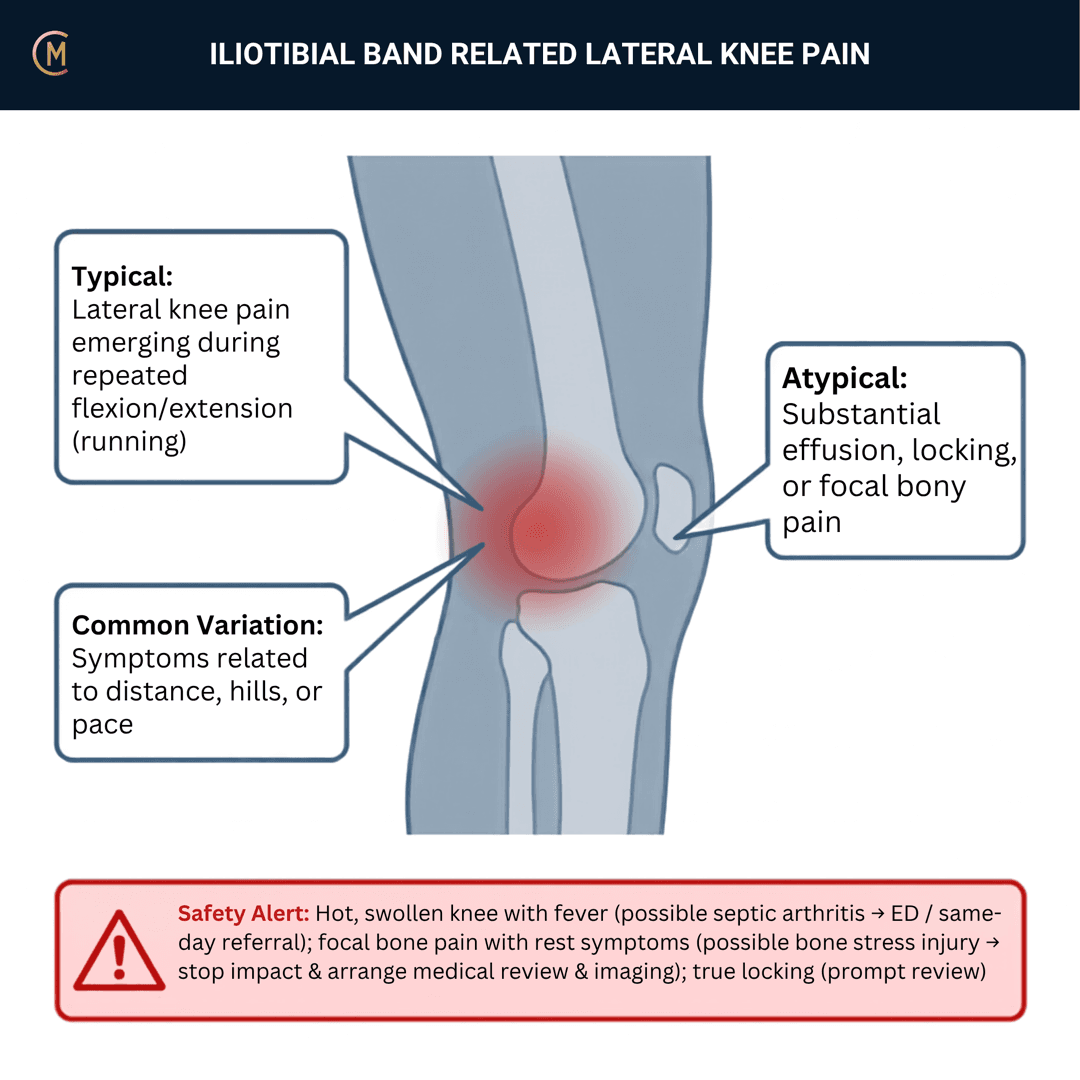
How it behaves: Sharp pain about 2–3 cm above the lateral joint line, during or after running or cycling. Worse downhill and with volume spikes. Eased by rest or reduced load. No locking, no instability.
The one thing to take from this page:
This is compression, not friction. The band isn't a rope rubbing on a rock — it's anchored, and it compresses the innervated tissue underneath it at around 30° of knee flexion. Once you hold that model, stretching the band stops making sense.
Compression, not friction
| The old model | What the anatomy shows |
|---|---|
| A band sliding back and forth over a bony bump | A band that is anchored to the femur, compressing the tissue beneath it |
| So: stretch it, roll it, lengthen it | So: reduce the compressive load, and build capacity for it |
| Mechanism assumed | Examined directly (Fairclough et al. 2006; Fairclough et al. 2007) |
2 · SE — THE SUBJECTIVE PATTERN (the 70%)
Five stages, in your course's order.
MAIN PROBLEM
"It's fine for the first three kilometres, then it's sharp and I have to stop."
"Downhills kill it."
"It came on when I put my mileage up for the marathon."
BODY CHART
- One finger, lateral, just above the joint line. Get them to point.
- Not the joint line itself — that's a meniscal question.
- Not the greater trochanter — that's gluteal tendinopathy.
- Any pain into the shin, or pins and needles? Different question.
BEHAVIOUR — the pattern is a distance, not a movement
- Aggs: running, especially downhill; a consistent distance or time before it starts; stairs down; cycling.
- Eases: stopping. Often settles quickly once they stop, and comes back at the same point next run.
- 24-hr pattern: none of its own — it is a distance-to-onset pattern, not a time-of-day one. Settles once they stop and returns at the same point next run.
- Night: night or rest pain is a referral trigger in §6, not this pattern.
- Severity: VAS 0–10 at best / at worst / right now.
- The key measure: how far, or how long, before it starts. That is your asterisk and your outcome. Not pain at rest.
- Irritability: resting symptoms + vigour of the provoking activity + time to settle. Usually low at rest, sharp on the run.
- Note: it hurts around 30° of knee flexion — which is why downhill and the early stance phase are the aggravators.
HISTORY
- What changed? Volume, hills, surface, camber, shoes, cadence, a new bike fit.
- Training pattern. Sudden mileage build, new terrain, track direction.
- Previous episodes, and what worked.
- Anything else in the chain — hip, back, foot.
- Are they actually a runner? It has been described in non-athletes.
SPECIAL / SCREENING QUESTIONS
- Any locking, catching, giving way, or swelling? None of those are ITBS.
- Any night pain, rest pain, fever, weight loss?
- Any calf pain or swelling?
- Any trauma?
Assessing this region? Download the Knee assessment template →
3 · HYPOTHESIS RANKING
| Competing pattern | The one discriminating feature |
|---|---|
| Lateral meniscus tear | At the joint line, with locking or catching, positive McMurray or Thessaly, worse with deep flexion and twisting. |
| LCL injury | A varus mechanism, laxity on varus stress, tender along the ligament. |
| Patellofemoral pain | Anterior or diffuse, worse with stairs, squatting and prolonged sitting. |
| Lateral patellar retinaculum / patellar maltracking | Anterolateral, related to patellar tracking rather than a running distance. |
| Proximal tibiofibular joint | More posterolateral and inferior, tender over the joint. |
| Common peroneal nerve | Paraesthesia and lateral shin symptoms, not a clean load-distance pattern. |
| Gluteal tendinopathy | Lateral HIP, at the greater trochanter, worse lying on it. |
| Bone stress injury of the lateral femoral condyle | Night or rest pain, focal bony tenderness, doesn't settle on stopping. |
The one that's easiest to miss
Bone stress. ITBS settles when they stop. If the pain persists at rest or at night, or is focally tender on the bone, it is not compression of soft tissue under a band — and that needs imaging, not a cadence change.
4 · RED FLAGS — DON'T MISS THIS
This section is free, on every pattern, forever. Safety is never gated.
| Finding | What it suggests | What you do |
|---|---|---|
| Night pain or rest pain that doesn't settle on stopping | Bone stress, infection, tumour | Medical review and imaging |
| Focal bony tenderness over the lateral femoral condyle | Bone stress injury | Imaging — ask for MRI; a normal X-ray doesn't clear it (Fredericson et al. 2006) [21] |
| True effusion | Intra-articular | Reassess — this is not ITBS |
| Locking, catching, or a block to extension | Meniscal | Orthopaedic review |
| Giving way or instability | Ligamentous | Reassess and examine the ligaments |
| Hot, red, swollen knee, fever | Septic arthritis | ED / same-day medical referral |
| Calf pain, swelling or warmth | DVT | Urgent medical review |
| Unexplained weight loss, cancer history | Malignancy | Urgent medical review |
| Progressive lateral shin numbness or foot drop | Common peroneal nerve | Urgent medical review |
| Low energy availability, menstrual disturbance, rapid load spike | Bone stress risk profile | Raise your threshold, and ask |
The rule: ITBS is a load-distance pattern that stops when the load stops. Pain that ignores the load is not ITBS.
Cross-links: Patellofemoral pain · Meniscus tear · Gluteal tendinopathy · Septic arthritis / DVT / tumour
5 · OE — THE OBJECTIVE (the 30%)
Members
Sections 5 to 7 are for members
The objective exam, management and pearls, plus the six-minute lesson and the debrief. Free with an account.
Sign in or join free6 · MX — MANAGEMENT ESSENTIALS
Members
Sections 5 to 7 are for members
The objective exam, management and pearls, plus the six-minute lesson and the debrief. Free with an account.
Sign in or join free7 · CLINICAL PEARLS + RETRIEVAL CHECK
Members
Sections 5 to 7 are for members
The objective exam, management and pearls, plus the six-minute lesson and the debrief. Free with an account.
Sign in or join freeMembers
The 5-minute lesson is for members
Twelve slides on this pattern: what you'll hear, what to examine, what to do. Free with an account.
Sign in or join freeGuideline anchor
No Australian guideline and no clinical practice guideline for this condition from any body.
More
Anchored to the systematic review of iliotibial band syndrome in runners (van der Worp et al. 2012, PMID 22994651), the examination of the evidence behind treatment options (Falvey et al. 2010, PMID 19706004) and the current conservative treatment reviews (Sanchez-Alvarado et al. 2024, PMID 39247485). The mechanism is anchored to Fairclough's anatomical work (Fairclough et al. 2006, PMID 16533314; Fairclough et al. 2007, PMID 16996312) — which is where the 'compression, not friction' pearl comes from.
There is no guideline. The systematic review is from 2012 and conservative treatment has since been described as facing a research gap (Friede et al. 2022). This page is anchored to anatomy and to reviews, not to a recommendation framework.
Members
The evidence summary is for members
Verified diagnostic accuracy, where the evidence stands and what it doesn't settle. Free with an account.
Sign in or join freeSources · 20
ShowHide
Every source on this page resolves and title-verifies against PubMed. Newest first.
- 2020Martinez-Velez et al. (2020). Iliotibial band syndrome in non-athletes. Minerva anestesiologica, 86(10), 1111-1112. https://doi.org/10.23736/S0375-9393.20.14194-4
- 2016Willett et al. (2016). An Anatomic Investigation of the Ober Test. The American journal of sports medicine, 44(3), 696-701. https://doi.org/10.1177/0363546515621762
- 2015Aderem & Louw (2015). Biomechanical risk factors associated with iliotibial band syndrome in runners: a systematic review. BMC musculoskeletal disorders, 16, 356. https://doi.org/10.1186/s12891-015-0808-7
- 2014Louw & Deary (2014). The biomechanical variables involved in the aetiology of iliotibial band syndrome in distance runners - A systematic review of the literature. Physical therapy in sport : official journal of the Association of Chartered Physiotherapists in Sports Medicine, 15(1), 64-75. https://doi.org/10.1016/j.ptsp.2013.07.002
- 2020Foch et al. (2020). Relationship between iliotibial band syndrome and hip neuromechanics in women runners. Gait & posture, 77, 64-68. https://doi.org/10.1016/j.gaitpost.2019.12.021
- 2023Foch et al. (2023). Lower extremity kinematics during running and hip abductor strength in iliotibial band syndrome: A systematic review and meta-analysis. Gait & posture, 101, 73-81. https://doi.org/10.1016/j.gaitpost.2023.02.001
- 2024Marais et al. (2024). Risk factors associated with a history of iliotibial band syndrome (hITBS) in distance runners: a cross-sectional study in 76 654 race entrants - a SAFER XXXIII study. The Physician and sportsmedicine, 52(6), 568-578. https://doi.org/10.1080/00913847.2024.2341607
- 1994Ekman et al. (1994). Magnetic resonance imaging of iliotibial band syndrome. The American journal of sports medicine, 22(6), 851-4. https://doi.org/10.1177/036354659402200619
- 2012van der Worp et al. (2012). Iliotibial band syndrome in runners: a systematic review. Sports medicine (Auckland, N.Z.), 42(11), 969-92. https://doi.org/10.2165/11635400-000000000-00000
- 2010Falvey et al. (2010). Iliotibial band syndrome: an examination of the evidence behind a number of treatment options. Scandinavian journal of medicine & science in sports, 20(4), 580-7. https://doi.org/10.1111/j.1600-0838.2009.00968.x
- 2024Sanchez-Alvarado et al. (2024). Effects of conservative treatment strategies for iliotibial band syndrome on pain and function in runners: a systematic review. Frontiers in sports and active living, 6, 1386456. https://doi.org/10.3389/fspor.2024.1386456
- 2022Friede et al. (2022). Conservative treatment of iliotibial band syndrome in runners: Are we targeting the right goals?. Physical therapy in sport : official journal of the Association of Chartered Physiotherapists in Sports Medicine, 54, 44-52. https://doi.org/10.1016/j.ptsp.2021.12.006
- 2020McKay et al. (2020). Iliotibial band syndrome rehabilitation in female runners: a pilot randomized study. Journal of orthopaedic surgery and research, 15(1), 188. https://doi.org/10.1186/s13018-020-01713-7
- 2022Jahanshahi et al. (2022). Comparing Functional Motor Control Exercises With Therapeutic Exercise in Wrestlers With Iliotibial Band Syndrome. Journal of sport rehabilitation, 31(8), 1006-1015. https://doi.org/10.1123/jsr.2020-0541
- 2015Shamus & Shamus (2015). THE MANAGEMENT OF ILIOTIBIAL BAND SYNDROME WITH A MULTIFACETED APPROACH: A DOUBLE CASE REPORT. International journal of sports physical therapy, 10(3), 378-90. PubMed 26075154
- 2005Fredericson & Wolf (2005). Iliotibial band syndrome in runners: innovations in treatment. Sports medicine (Auckland, N.Z.), 35(5), 451-9. https://doi.org/10.2165/00007256-200535050-00006
- 2006Fairclough et al. (2006). The functional anatomy of the iliotibial band during flexion and extension of the knee: implications for understanding iliotibial band syndrome. Journal of anatomy, 208(3), 309-16. https://doi.org/10.1111/j.1469-7580.2006.00531.x
- 2007Fairclough et al. (2007). Is iliotibial band syndrome really a friction syndrome?. Journal of science and medicine in sport, 10(2), 74-6; discussion 77-8. https://doi.org/10.1016/j.jsams.2006.05.017
- 2011Strauss et al. (2011). Iliotibial band syndrome: evaluation and management. The Journal of the American Academy of Orthopaedic Surgeons, 19(12), 728-36. https://doi.org/10.5435/00124635-201112000-00003
- 2016Baker & Fredericson (2016). Iliotibial Band Syndrome in Runners: Biomechanical Implications and Exercise Interventions. Physical medicine and rehabilitation clinics of North America, 27(1), 53-77. https://doi.org/10.1016/j.pmr.2015.08.001
Mapped to this pattern
Generic measures that also apply
- Borg RPE
Borg Rating of Perceived Exertion Scale (6-20)
perceived exertion · 1 items · 1 min
- GROC
Global Rating of Change Scale
perceived change since baseline · 1 items · 1 min
- NPRS
Numeric Pain Rating Scale
pain intensity · 1 items · 1 min
- PGIC
Patient Global Impression of Change
perceived change since baseline · 1 items · 1 min
- PSFS
Patient-Specific Functional Scale
patient-generated function · 3 items · 2 min
- SANE
Single Assessment Numeric Evaluation
patient-rated function as a percentage of normal · 1 items · 1 min
- VAS
Visual Analogue Scale
pain intensity · 1 items · 1 min
- Borg CR10
Borg Category Ratio 10 Scale
perceived exertion or symptom intensity, ratio scale · 1 items · 1 min
- GAS
Goal Attainment Scaling
individualised goal achievement · 10 min
Did this page do its job?
CliniStudy is in beta. One tap is enough — it decides what gets fixed first.