
1 · SNAPSHOT
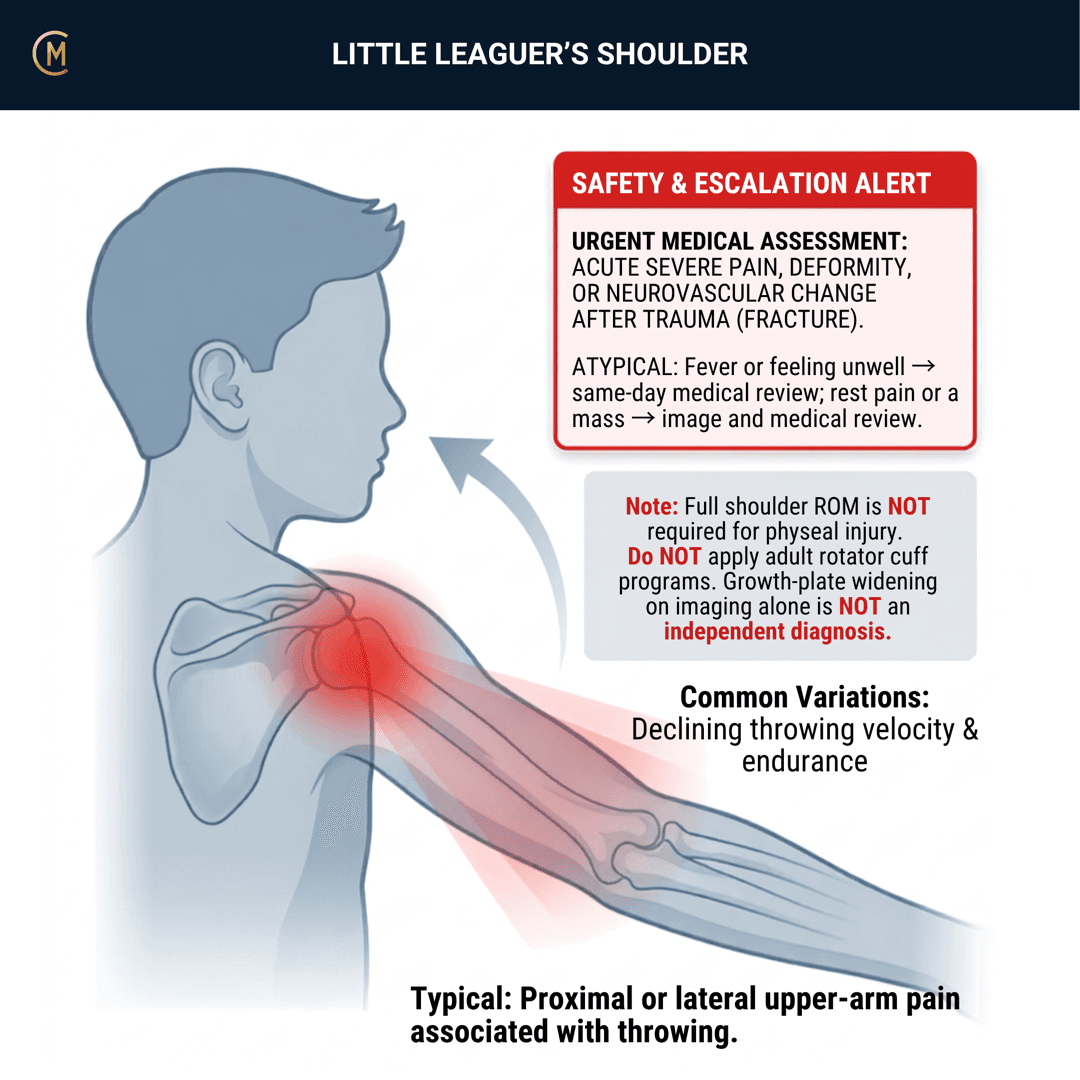
Who: Skeletally immature overhead athletes. Baseball pitchers and catchers above all; the same logic applies to cricket bowlers, javelin and swimmers.
What: Stress failure at the proximal humeral physis.
How it behaves: Gradual lateral shoulder or proximal arm ache. Worse with throwing volume, worst through cocking and acceleration. No single trauma.
The one thing to take from this page:
The open growth plate is the diagnosis. Same sport, same position, same load — in the growing shoulder the physis is the weak link, and that changes the management before you have touched them.
The safety split
| Uncomplicated — yours | Escalate |
|---|---|
| Gradual, load-related onset | Acute trauma or a pop |
| Pain only with throwing volume | Night pain or pain at rest |
| Focal proximal humeral tenderness | Systemic symptoms, fever, weight loss |
| Full or near-full range | Persistent loss of range |
| No neurological symptoms | Weakness, wasting or numbness |
| Improving on deload | Not improving despite genuine deload |
⚠️ No Australian guideline exists, and the pitch-count numbers you'll hear are American governing-body rules, not clinical thresholds. The principle transfers: count the load, mandate rest days, don't throw year-round. The number comes from the local competition, not from a page.
2 · SE — THE SUBJECTIVE PATTERN (the 70%)
Five stages, in your course's order. The workload history is the diagnosis and the treatment. You are taking it from a child, a parent, and indirectly a coach — and the three of them will give you three different stories about how much throwing has happened.
MAIN PROBLEM
"My shoulder aches when I throw."
"He's lost velocity."
"He can't get it in from the outfield anymore."
Velocity loss and loss of control are the presenting symptom as often as pain is. They frequently arrive first.
BODY CHART
- Mark the lateral shoulder and proximal arm — that is the pattern.
- Not the neck, not the AC joint, not the bicipital groove, not a diffuse scapular ache. Each of those points elsewhere.
- Mark any numbness, tingling or weakness — that is a different conversation.
BEHAVIOUR
| Fits epiphysiolysis | Points elsewhere | |
|---|---|---|
| Aggs | Cocking to acceleration, throwing volume, fatigue | Overhead reaching in daily life → think again |
| Onset | Gradual | Acute trauma or a pop → image |
| Night | Settles with rest | Night pain, rest pain → escalate |
| Range | Full or near-full | Persistent loss → escalate |
| Power | Normal | Weakness or wasting → nerve |
HISTORY — the workload audit
Ask all of it. This is the assessment.
- Pitch counts, innings, rest days.
- Multiple teams, overlapping seasons, showcases, year-round throwing.
- Position — pitcher and catcher carry the load.
- Velocity change, control change, fatigue during outings.
- Was he throwing through pain? Ask the child on their own if you can.
- Recent spike — a carnival, a representative squad, a new coach.
SPECIAL / SCREENING QUESTIONS
- Night pain, rest pain, fever, weight loss, feeling unwell? This is an adolescent with bone pain. Ask it.
- Any single traumatic event?
- Numbness, tingling, weakness, wasting?
- Growth spurt? Physeal injury tracks growth and load together [1].
Assessing this region? Download the Shoulder assessment template →
3 · HYPOTHESIS RANKING
| Competing pattern | The one discriminating feature |
|---|---|
| Rotator cuff–related shoulder pain | Skeletally mature. This one is physeal — adolescent thrower, tender proximal humeral physis, widening against the other side. |
| Suprascapular nerve entrapment | Weakness and wasting rather than load-related physeal pain. |
| Anterior instability | Apprehension in abduction and external rotation rather than pain that tracks throwing volume. |
The two that outrank the table
Proximal humeral fracture or a bone lesion. Adolescent, proximal humerus, and it is the classic site. Trauma, night pain, rest pain, systemic symptoms or a non-mechanical story means you image before you rehabilitate.
Little leaguer's elbow, sitting alongside it. The same workload produces both. Screen the medial elbow in every young thrower's shoulder — you will find it more often than you expect.
And the one that changes what a normal picture means
Physeal widening may be only part of the story. A narrative review argues that posterior glenoid dysplasia and shoulder adaptation also belong in the picture [2]. So a physis that looks normal does not close the question — the workload pattern still does the reasoning.
4 · RED FLAGS — DON'T MISS THIS
This section is free, on every pattern, forever. Safety is never gated.
| Finding | What it suggests | What you do |
|---|---|---|
| Night pain or pain at rest | Bone lesion, infection | Image. Medical review |
| Fever, weight loss, feeling unwell | Infection, systemic disease | Medical review, same day |
| Acute trauma with severe pain | Physeal or proximal humeral fracture | Image |
| Visible deformity or swelling | Structural | Image |
| Persistent loss of range | Fracture, lesion, or joint pathology | Image |
| Weakness or muscle wasting | Nerve involvement | Escalate |
| Numbness or tingling | Nerve involvement | Escalate |
| No improvement despite genuine deload | Reconsider the whole diagnosis | Image, and keep them off throwing |
The rule: gradual, load-related lateral shoulder pain with full range in a skeletally immature thrower is yours. Trauma, night pain, systemic symptoms, stiffness, weakness or no response to deload is not.
Cross-links: Little leaguer's elbow · Rotator cuff–related shoulder pain · Suprascapular nerve entrapment
5 · OE — THE OBJECTIVE (the 30%)
Members
Sections 5 to 7 are for members
The objective exam, management and pearls, plus the six-minute lesson and the debrief. Free with an account.
Sign in or join free6 · MX — MANAGEMENT ESSENTIALS
Members
Sections 5 to 7 are for members
The objective exam, management and pearls, plus the six-minute lesson and the debrief. Free with an account.
Sign in or join free7 · CLINICAL PEARLS + RETRIEVAL CHECK
Members
Sections 5 to 7 are for members
The objective exam, management and pearls, plus the six-minute lesson and the debrief. Free with an account.
Sign in or join freeMembers
The 5-minute lesson is for members
Twelve slides on this pattern: what you'll hear, what to examine, what to do. Free with an account.
Sign in or join freeGuideline anchor
No Australian guideline covers youth throwing shoulder injury.
More
Anchored to the systematic review of diagnosis and management (Bednar et al. 2021, PMID 34377716) for the clinical pattern and the deload-plus-staged-return structure, the narrative review of the modern picture (Myers et al. 2024, PMID 39035657) for what physeal widening does and doesn't explain, and the conservative-treatment outcome cohort (Harada et al. 2018, PMID 29054382) for the prognosis conversation.
None of these is an Australian document and none is a formal guideline. The systematic review itself reports that treatment protocols vary — so the structure transfers (deload, rebuild, stage the return, gate it on criteria) but the timeframes are not a standard. The pitch-count rules in circulation are American youth baseball governing-body rules, not clinical thresholds, and Australian club and cricket structures differ.
Members
The evidence summary is for members
Verified diagnostic accuracy, where the evidence stands and what it doesn't settle. Free with an account.
Sign in or join freeSources · 17
ShowHide
Every source on this page resolves and title-verifies against PubMed. Newest first.
- 2006Caine et al. (2006). Physeal injuries in children's and youth sports: reasons for concern?. British journal of sports medicine, 40(9), 749-60. https://doi.org/10.1136/bjsm.2005.017822
- 2024Myers et al. (2024). A narrative review of little league shoulder: proximal humeral physis widening is only one piece of the puzzle, it is time to consider posterior glenoid dysplasia. JSES international, 8(4), 724-733. https://doi.org/10.1016/j.jseint.2024.03.006
- 2021Mine et al. (2021). Risk Factors of Shoulder and Elbow Injuries in Baseball: A Scoping Review of 3 Types of Evidence. Orthopaedic journal of sports medicine, 9(12), 23259671211064645. https://doi.org/10.1177/23259671211064645
- 2018Pennock et al. (2018). Shoulder MRI Abnormalities in Asymptomatic Little League Baseball Players. Orthopaedic journal of sports medicine, 6(2), 2325967118756825. https://doi.org/10.1177/2325967118756825
- 2021Bednar et al. (2021). Diagnosis and Management of Little League Shoulder: A Systematic Review. Orthopaedic journal of sports medicine, 9(7), 23259671211017563. https://doi.org/10.1177/23259671211017563
- 2025Uchino et al. (2025). Novel Stress Tests for Diagnosing Little League Shoulder and Determining the Timing of Return to Sports. Orthopaedic journal of sports medicine, 13(5), 23259671251331055. https://doi.org/10.1177/23259671251331055
- 2016Heyworth et al. (2016). Trends in the Presentation, Management, and Outcomes of Little League Shoulder. The American journal of sports medicine, 44(6), 1431-8. https://doi.org/10.1177/0363546516632744
- 2018Harada et al. (2018). Outcome of conservative treatment for Little League shoulder in young baseball players: factors related to incomplete return to baseball and recurrence of pain. Journal of shoulder and elbow surgery, 27(1), 1-9. https://doi.org/10.1016/j.jse.2017.08.018
- 2002Lyman et al. (2002). Effect of pitch type, pitch count, and pitching mechanics on risk of elbow and shoulder pain in youth baseball pitchers. The American journal of sports medicine, 30(4), 463-8. https://doi.org/10.1177/03635465020300040201
- 2006Olsen SJ 2nd et al. (2006). Risk factors for shoulder and elbow injuries in adolescent baseball pitchers. The American journal of sports medicine, 34(6), 905-12. https://doi.org/10.1177/0363546505284188
- 2021Matsuura et al. (2021). Limiting the Pitch Count in Youth Baseball Pitchers Decreases Elbow Pain. Orthopaedic journal of sports medicine, 9(3), 2325967121989108. https://doi.org/10.1177/2325967121989108
- 2012Fleisig & Andrews (2012). Prevention of elbow injuries in youth baseball pitchers. Sports health, 4(5), 419-24. https://doi.org/10.1177/1941738112454828
- 2018Melugin et al. (2018). Injury Prevention in Baseball: from Youth to the Pros. Current reviews in musculoskeletal medicine, 11(1), 26-34. https://doi.org/10.1007/s12178-018-9456-5
- 2026Kriz et al. (2026). Do Pitching Restriction Policies Reduce Shoulder and Elbow Injuries in High School Baseball Players?. Orthopaedic journal of sports medicine, 14(2), 23259671251412404. https://doi.org/10.1177/23259671251412404
- 2015Zaremski et al. (2015). Detection and prevention of glenohumeral epiphysiolysis. Current sports medicine reports, 14(3), 159-60. https://doi.org/10.1249/JSR.0000000000000146
- 2024Sgroi et al. (2024). Throwing Injuries and Prevention Strategies in Youth Baseball. HSS journal : the musculoskeletal journal of Hospital for Special Surgery, 20(3), 341-345. https://doi.org/10.1177/15563316241249139
- 1974Cahill et al. (1974). Little league shoulder: lesions of the proximal humeral epiphyseal plate. The Journal of sports medicine, 2(3), 150-2. https://doi.org/10.1177/036354657400200303
Mapped to this pattern
Generic measures that also apply
- Borg RPE
Borg Rating of Perceived Exertion Scale (6-20)
perceived exertion · 1 items · 1 min
- GROC
Global Rating of Change Scale
perceived change since baseline · 1 items · 1 min
- NPRS
Numeric Pain Rating Scale
pain intensity · 1 items · 1 min
- PGIC
Patient Global Impression of Change
perceived change since baseline · 1 items · 1 min
- PSFS
Patient-Specific Functional Scale
patient-generated function · 3 items · 2 min
- SANE
Single Assessment Numeric Evaluation
patient-rated function as a percentage of normal · 1 items · 1 min
- VAS
Visual Analogue Scale
pain intensity · 1 items · 1 min
- Borg CR10
Borg Category Ratio 10 Scale
perceived exertion or symptom intensity, ratio scale · 1 items · 1 min
- GAS
Goal Attainment Scaling
individualised goal achievement · 10 min
Did this page do its job?
CliniStudy is in beta. One tap is enough — it decides what gets fixed first.