
1 · SNAPSHOT
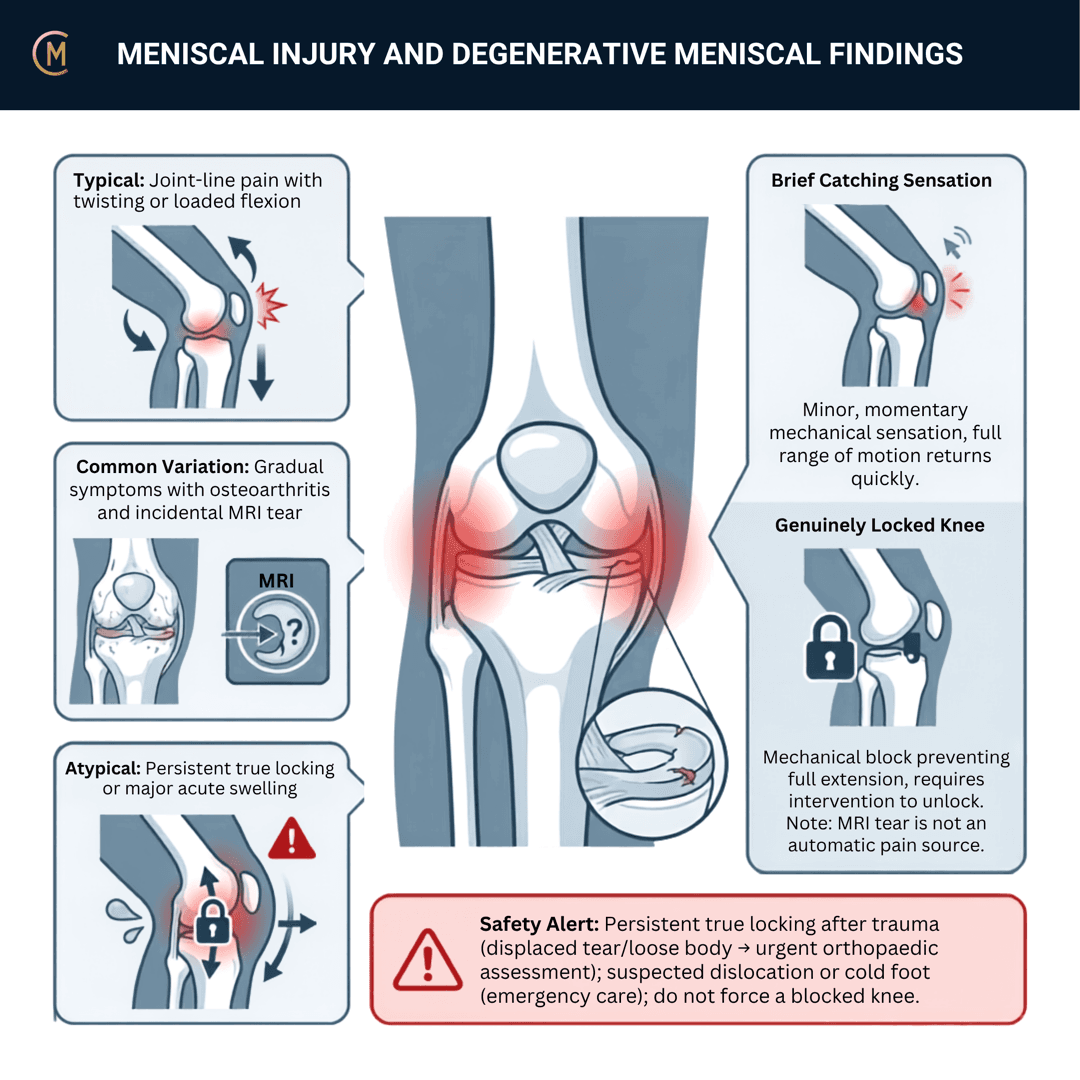
Who: Two populations. A young athlete who twisted on a loaded knee. And an adult over 40 whose knee has been grumbling for months.
What: Medial or lateral joint-line pain, often with swelling that came on over hours rather than minutes.
How it behaves: Twisting, squatting, pivoting, stairs. Catching or clicking that comes and goes.
The one thing to take from this page:
In middle age, a meniscal tear is a normal finding. Sixty-one per cent of people who have one report no pain, aching or stiffness at all.
| Finding | Figure |
|---|---|
| Tear on MRI, women aged 50–59 | 19% (95% CI 15–24) |
| Tear on MRI, men aged 70–90 | 56% (95% CI 46–66) |
| With radiographic OA: tear in symptomatic vs asymptomatic knees | 63% vs 60% |
| Without radiographic OA | 32% vs 23% |
| People with a tear reporting no symptoms in the previous month | 61% |
(Englund et al. 2008 — [25]. 991 ambulatory adults aged 50–90, not selected for knee problems. This is the same source and the same figure the knee OA page carries.)
Read that third row again. A three-point gap between symptomatic and asymptomatic knees. Finding a tear on a scan in someone over 50 tells you almost nothing about why their knee hurts.
Meniscal tears affect an estimated 12% of the adult population, and knee pain accounts for around 5% of all adult primary-care visits [1].
⚠️ Australia has a standard that reaches half of this pattern. The ACSQHC Osteoarthritis of the Knee Clinical Care Standard (2024) covers degenerative tears in adults 45 and over and states that meniscal changes on imaging do not warrant arthroscopy. It does not cover traumatic tears, under-45s, or the locked knee. For those, this page is anchored to European consensus.
Pattern > Label. "Meniscal tear" is a tissue finding. The pattern is which meniscal tear, in which knee, at which age.
2 · SE — THE SUBJECTIVE PATTERN (the 70%)
Five stages, in your course's order. The order changes with the story — a twisting injury reorders to MAIN PROBLEM → BODY CHART → HISTORY → BEHAVIOUR.
MAIN PROBLEM
"My knee catches." "It swelled up the next morning." "I can't squat."
BODY CHART
- Joint line, medial far more often than lateral, and they can usually put a finger near it.
- Diffuse ache over the whole knee points you back toward osteoarthritis.
- Anything below the knee or into the calf — different conversation.
HISTORY — this is the fork
Two stories, and you are sorting them here, not in the objective.
| TRAUMATIC | DEGENERATIVE | |
|---|---|---|
| Onset | A moment. Pivot, squat, deep flexion | Progressive, no single event |
| Age | Typically under 40 | Typically 40+, and the ESSKA definition is no significant trauma, over 35 |
| Swelling | Hours, not minutes (minutes = think ACL — see that page) | Intermittent, activity-related |
| Company it keeps | Often isolated, sometimes ACL | Osteoarthritis, usually |
BEHAVIOUR
- Aggs: twisting, pivoting, squatting, deep flexion, stairs, getting out of a car.
- Eases: straight-line walking, offloading.
- Severity: VAS 0–10 at best / at worst / right now.
- Irritability: resting symptoms, vigour of the provoking activity, time to settle.
SPECIAL / SCREENING QUESTIONS
Fever, systemic illness, recent injection or surgery, malignancy history, night pain, anticoagulants, calf symptoms. See §4.
The two questions that actually shift the odds
Ask about a pivot, and ask about the pain's location — these are not throwaway history items, they are two of the three variables in the best-performing cluster available [2]:
| Cluster | Content | Result |
|---|---|---|
| Traumatic | Trauma during a pivot + medial pain location + medial joint-line tenderness | LR+ 8.9 (95% CI 6.1–13.1) · LR− 0.10 (0.03–0.28) |
| Degenerative | Progressive onset + medial pain + pain while pivoting + no varus/valgus malalignment + full passive flexion | LR+ 6.4 (95% CI 4.0–10.4) · LR− 0.10 (0.03–0.31) |
279 consecutive new knee complaints across two orthopaedic clinics, two family-medicine clinics and a university community — the closest thing to a placement caseload in this literature. Prevalence 28.7%. Carry the caveat: these are derivation figures and the authors state external validation is mandatory and has not been done.
Two of those three traumatic variables come out of the history. The subjective is doing most of the work here, as usual.
Assessing this region? Download the Knee assessment template →
3 · HYPOTHESIS RANKING
| Competing pattern | The one discriminating feature |
|---|---|
| Knee osteoarthritis | Diffuse, morning stiffness under 30 min, crepitus, age — see the knee OA page |
| ACL rupture | Swelling in minutes, a pop, immediate giving way — see the ACL page |
| Patellofemoral pain | Anterior, not joint line. Stairs and prolonged sitting |
| MCL sprain | Valgus mechanism, tender above the joint line on the ligament, valgus stress reproduces it |
| Referred hip | Groin, and the hip screen changes it |
| Septic arthritis | Hot, unwell, cannot weight-bear — §4, and it is time-critical |
Two patterns, one word — this is the page
The traumatic and degenerative tears are not variants of each other. They are different conditions that happen to share a tissue.
- The degenerative tear is a feature of an ageing knee, not an event in it. ESSKA defines it as a lesion occurring without significant acute trauma in a patient older than 35 [3].
- Its base rate climbs with age until it is the majority finding — 56% of men aged 70–90 (Englund 2008).
- Its management is exercise. Six randomised trials say so, and one of them used sham surgery as the comparator.
- The traumatic tear in a young athlete is a genuine injury with a genuine repair question — and even there, early surgery did not beat physiotherapy at two years.
Jones' hypothesis categories that change your plan: pathophysiology — traumatic or degenerative — plus precautions (the locked knee, the septic knee) and prognosis, which differs enormously between the two.
The scan will find a tear in half of the people this age. The reasoning is what tells you whether it matters.
4 · RED FLAGS — DON'T MISS THIS
This section is free, on every pattern, forever.
| Signs / symptoms | Implication |
|---|---|
| Hot, swollen, systemically unwell, cannot weight-bear | Septic arthritis — same-day referral |
| Acute trauma + any Ottawa Knee Rule positive | Fracture — imaging before anything else |
| A knee that will not straighten and the patient cannot release | True mechanical block — displaced bucket-handle tear. Urgent orthopaedic opinion |
| Night pain unchanged by position, weight loss, malignancy history | Tumour |
| Calf pain, swelling, warmth, recent immobilisation or travel | DVT |
| Rapid effusion in minutes after trauma | Haemarthrosis — ACL, fracture, dislocation |
Screening for fracture
Ottawa Knee Rule: sensitivity 0.99 (95% CI 0.97–1.00), −LR 0.07 (0.02–0.24) — in 8 studies and 7,385 adults with acute knee injury assessed by emergency physicians [4].
And specificity 0.49. Same grammar as the Ottawa Ankle Rules: it rules out, it never rules in. Half of everyone you clear with it will still be negative on imaging, and that is the rule working as designed.
Screening for infection — and the trap in it
Fever is only 57% sensitive (95% CI 52–62) for septic arthritis, in 14 studies and 6,242 patients [5]. More than four in ten people with a septic joint are not febrile when you see them.
Joint pain 85% (78–90), joint swelling 78% (71–85), sweats 27%, rigors 19%. No history or examination finding rules it out. If the picture fits, refer — do not wait for a temperature.
(Same source, same figures as the knee OA page. The two agree.)
The vocabulary flag — and it is the most useful thing here
"Locking" is doing two jobs and only one of them is a flag.
- Catching, clicking, a knee that grabs and lets go — extremely common, and not a surgical indication. See §5 and §6.
- A knee that is stuck short of full extension and the patient cannot straighten it themselves — that is a block, and it is the one that goes up the line.
Ask the question that separates them: "Can you get it straight yourself, or does it stay stuck?"
A hot, unwell knee that cannot bear weight is septic until proven otherwise — and 43% of them have no fever.
Ottawa rules fracture out. It never rules one in.
"It catches" and "it will not straighten" are two different sentences. Find out which one you have.
5 · OE — THE OBJECTIVE (the 30%)
Members
Sections 5 to 7 are for members
The objective exam, management and pearls, plus the six-minute lesson and the debrief. Free with an account.
Sign in or join free6 · MX — MANAGEMENT ESSENTIALS
Members
Sections 5 to 7 are for members
The objective exam, management and pearls, plus the six-minute lesson and the debrief. Free with an account.
Sign in or join free7 · CLINICAL PEARLS + RETRIEVAL CHECK
Members
Sections 5 to 7 are for members
The objective exam, management and pearls, plus the six-minute lesson and the debrief. Free with an account.
Sign in or join freeMembers
The 5-minute lesson is for members
Twelve slides on this pattern: what you'll hear, what to examine, what to do. Free with an account.
Sign in or join freeGuideline anchor
ACSQHC Osteoarthritis of the Knee Clinical Care Standard (2024) — the only Australian standard reaching this presentation, by way of degenerative tears in adults 45 and over.
Its scope is knee OSTEOARTHRITIS in adults 45+. It covers the degenerative tear by extension and states that meniscal changes found on imaging do not warrant arthroscopy. It does NOT cover traumatic tears, under-45s, or the locked knee. The PMID is the editorial announcing the standard, not the standard itself.
Members
The evidence summary is for members
Verified diagnostic accuracy, where the evidence stands and what it doesn't settle. Free with an account.
Sign in or join freeSources · 25
ShowHide
Every source on this page resolves and title-verifies against PubMed. Newest first.
- 2023Duong et al. (2023). Evaluation and Treatment of Knee Pain: A Review. JAMA, 330(16), 1568-1580. https://doi.org/10.1001/jama.2023.19675
- 2018Décary et al. (2018). Diagnostic Validity of Combining History Elements and Physical Examination Tests for Traumatic and Degenerative Symptomatic Meniscal Tears. PM & R : the journal of injury, function, and rehabilitation, 10(5), 472-482. https://doi.org/10.1016/j.pmrj.2017.10.009
- 2017Beaufils et al. (2017). Surgical management of degenerative meniscus lesions: the 2016 ESSKA meniscus consensus. Knee surgery, sports traumatology, arthroscopy : official journal of the ESSKA, 25(2), 335-346. https://doi.org/10.1007/s00167-016-4407-4
- 2020Sims et al. (2020). Diagnostic accuracy of the Ottawa Knee Rule in adult acute knee injuries: a systematic review and meta-analysis. European radiology, 30(8), 4438-4446. https://doi.org/10.1007/s00330-020-06804-x
- 2007Margaretten et al. (2007). Does this adult patient have septic arthritis?. JAMA, 297(13), 1478-88. https://doi.org/10.1001/jama.297.13.1478
- 2005Karachalios et al. (2005). Diagnostic accuracy of a new clinical test (the Thessaly test) for early detection of meniscal tears. The Journal of bone and joint surgery. American volume, 87(5), 955-62. https://doi.org/10.2106/JBJS.D.02338
- 2015Blyth et al. (2015). Diagnostic accuracy of the Thessaly test, standardised clinical history and other clinical examination tests (Apley's, McMurray's and joint line tenderness) for meniscal tears in comparison with magnetic resonance imaging diagnosis. Health technology assessment (Winchester, England), 19(62), 1-62. https://doi.org/10.3310/hta19620
- 2015Smith et al. (2015). Special tests for assessing meniscal tears within the knee: a systematic review and meta-analysis. Evidence-based medicine, 20(3), 88-97. https://doi.org/10.1136/ebmed-2014-110160
- 2022McHugh et al. (2022). Mechanical symptoms and meniscal tear: a reappraisal. Osteoarthritis and cartilage, 30(2), 178-183. https://doi.org/10.1016/j.joca.2021.09.009
- 2016Sihvonen et al. (2016). Mechanical Symptoms and Arthroscopic Partial Meniscectomy in Patients With Degenerative Meniscus Tear: A Secondary Analysis of a Randomized Trial. Annals of internal medicine, 164(7), 449-55. https://doi.org/10.7326/M15-0899
- 2020Sihvonen et al. (2020). Arthroscopic partial meniscectomy for a degenerative meniscus tear: a 5 year follow-up of the placebo-surgery controlled FIDELITY (Finnish Degenerative Meniscus Lesion Study) trial. British journal of sports medicine, 54(22), 1332-1339. https://doi.org/10.1136/bjsports-2020-102813
- 2013Sihvonen et al. (2013). Arthroscopic partial meniscectomy versus sham surgery for a degenerative meniscal tear. The New England journal of medicine, 369(26), 2515-24. https://doi.org/10.1056/NEJMoa1305189
- 2016Kise et al. (2016). Exercise therapy versus arthroscopic partial meniscectomy for degenerative meniscal tear in middle aged patients: randomised controlled trial with two year follow-up. BMJ (Clinical research ed.), 354, i3740. https://doi.org/10.1136/bmj.i3740
- 2025Berg et al. (2025). Arthroscopic partial meniscectomy versus exercise therapy for degenerative meniscal tears: 10-year follow-up of the OMEX randomised controlled trial. British journal of sports medicine, 59(2), 91-98. https://doi.org/10.1136/bjsports-2024-108644
- 2022Noorduyn et al. (2022). Effect of Physical Therapy vs Arthroscopic Partial Meniscectomy in People With Degenerative Meniscal Tears: Five-Year Follow-up of the ESCAPE Randomized Clinical Trial. JAMA network open, 5(7), e2220394. https://doi.org/10.1001/jamanetworkopen.2022.20394
- 2013Katz et al. (2013). Surgery versus physical therapy for a meniscal tear and osteoarthritis. The New England journal of medicine, 368(18), 1675-84. https://doi.org/10.1056/NEJMoa1301408
- 2023Fernández-Matías et al. (2023). Effectiveness of exercise versus arthroscopic partial meniscectomy plus exercise in the management of degenerative meniscal tears at 5-year follow-up: a systematic review and meta-analysis. Archives of orthopaedic and trauma surgery, 143(5), 2609-2620. https://doi.org/10.1007/s00402-022-04579-y
- 2020Noorduyn et al. (2020). Functional Outcomes of Arthroscopic Partial Meniscectomy Versus Physical Therapy for Degenerative Meniscal Tears Using a Patient-Specific Score: A Randomized Controlled Trial. Orthopaedic journal of sports medicine, 8(10), 2325967120954392. https://doi.org/10.1177/2325967120954392
- 2022van der Graaff et al. (2022). Arthroscopic partial meniscectomy versus physical therapy for traumatic meniscal tears in a young study population: a randomised controlled trial. British journal of sports medicine, 56(15), 870-876. https://doi.org/10.1136/bjsports-2021-105059
- 2020Kopf et al. (2020). Management of traumatic meniscus tears: the 2019 ESSKA meniscus consensus. Knee surgery, sports traumatology, arthroscopy : official journal of the ESSKA, 28(4), 1177-1194. https://doi.org/10.1007/s00167-020-05847-3
- 2020Blanchard et al. (2020). Return to Play After Isolated Meniscal Repairs in Athletes: A Systematic Review. Orthopaedic journal of sports medicine, 8(11), 2325967120962093. https://doi.org/10.1177/2325967120962093
- 2023D'Ambrosi et al. (2023). In elite athletes with meniscal injuries, always repair the lateral, think about the medial! A systematic review. Knee surgery, sports traumatology, arthroscopy : official journal of the ESSKA, 31(6), 2500-2510. https://doi.org/10.1007/s00167-022-07208-8
- 2017Krych et al. (2017). Non-operative management of medial meniscus posterior horn root tears is associated with worsening arthritis and poor clinical outcome at 5-year follow-up. Knee surgery, sports traumatology, arthroscopy : official journal of the ESSKA, 25(2), 383-389. https://doi.org/10.1007/s00167-016-4359-8
- 2024Ackerman et al. (2024). Special Editorial: Ensuring a fit-for-purpose resource for consumers, clinicians and health services - The updated Osteoarthritis of the Knee Clinical Care Standard. Australian journal of general practice, 53(9), 599-603. https://doi.org/10.31128/AJGP-06-24-7332
- 2008Englund et al. (2008). Incidental meniscal findings on knee MRI in middle-aged and elderly persons. The New England journal of medicine, 359(11), 1108-15. https://doi.org/10.1056/NEJMoa0800777
Mapped to this pattern
- IKDC
International Knee Documentation Committee Subjective Knee Form
knee symptoms, function and sport activity · 18 items · 6 min
- KOOS
Knee Injury and Osteoarthritis Outcome Score
knee injury and osteoarthritis outcome · 42 items · 10 min
- Tegner
Tegner Activity Score
activity level · 1 items · 2 min
- Lysholm
Lysholm Knee Scoring Scale
knee symptoms after ligament injury · 8 items · 4 min
- Marx
Marx Activity Rating Scale
activity frequency · 4 items · 2 min
- Ottawa Knee
Ottawa Knee Rule
imaging decision rule · 5 items · 1 min
Generic measures that also apply
- Borg RPE
Borg Rating of Perceived Exertion Scale (6-20)
perceived exertion · 1 items · 1 min
- GROC
Global Rating of Change Scale
perceived change since baseline · 1 items · 1 min
- NPRS
Numeric Pain Rating Scale
pain intensity · 1 items · 1 min
- PGIC
Patient Global Impression of Change
perceived change since baseline · 1 items · 1 min
- PSFS
Patient-Specific Functional Scale
patient-generated function · 3 items · 2 min
- SANE
Single Assessment Numeric Evaluation
patient-rated function as a percentage of normal · 1 items · 1 min
- VAS
Visual Analogue Scale
pain intensity · 1 items · 1 min
- Borg CR10
Borg Category Ratio 10 Scale
perceived exertion or symptom intensity, ratio scale · 1 items · 1 min
- GAS
Goal Attainment Scaling
individualised goal achievement · 10 min
Did this page do its job?
CliniStudy is in beta. One tap is enough — it decides what gets fixed first.