
1 · SNAPSHOT
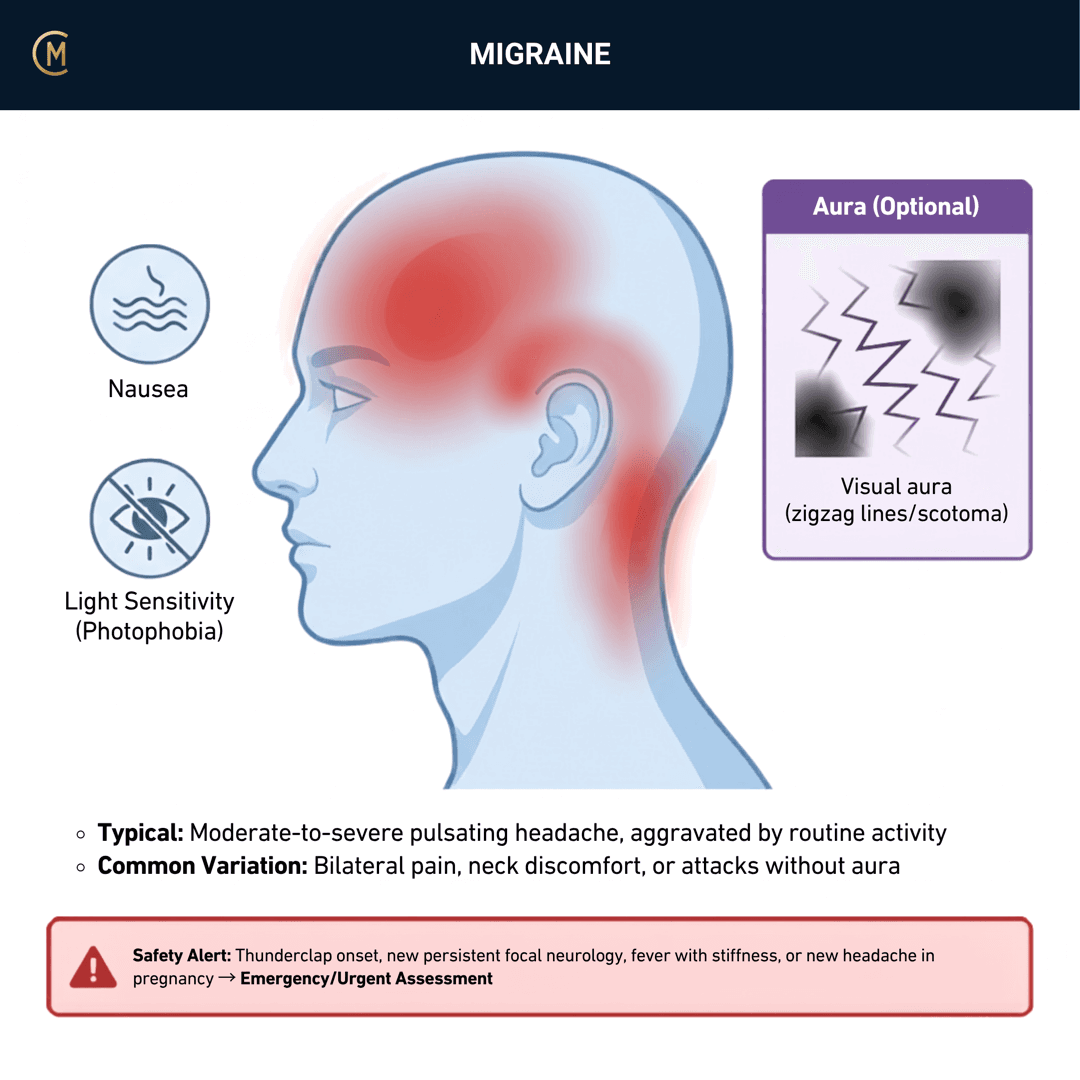
You won't cure it, and there are three things you can do that matter.
Illness script in one line: unilateral throbbing headache lasting 4 to 72 hours, moderate to severe, made worse by routine physical activity, with nausea and both light and sound sensitivity, sometimes preceded by aura.
Caseload frequency: you will see migraineurs constantly, usually presenting for something else. Read further: prevalence, disease burden and the need for preventive therapy [1], prevalence and burden [2].
The three things this page is actually for
1. Recognise it, so you don't treat it as a neck. Every row of the migraine picture is the opposite of tension-type headache [3].
2. Know that migraine with aura and cervical artery dissection have been studied together [4]. It changes what you do before you touch a neck.
3. Know that exercise is a preventive intervention, not just kindness. Read further: network meta-analysis of exercise interventions [5].
Everything else — triptans, CGRP therapies, prophylaxis — you refer.
2 · SE — THE SUBJECTIVE PATTERN (the 70%)
MAIN PROBLEM
"I get migraines." Take that word seriously and then check it — plenty of people call any bad headache a migraine, and plenty of true migraineurs have been told for years they have sinus headaches or neck headaches.
BODY CHART
- Unilateral, and it can swap sides between attacks. Always the exact same side, every time, is a flag.
- Frontotemporal, retro-orbital, sometimes occipital.
- ± neck and shoulder symptoms — common, and part of the attack.
BEHAVIOUR — the criteria
| Feature | Migraine |
|---|---|
| Duration | 4 to 72 hours untreated |
| Quality | Pulsating / throbbing |
| Intensity | Moderate to severe |
| Routine physical activity | AGGRAVATED — or they avoid it because of the headache |
| Nausea or vomiting | Present |
| Photophobia and phonophobia | BOTH |
- Aggs: movement, light, sound, smells, exertion.
- Eases: dark, quiet, sleep, lying still. They want to be still — the opposite of cluster headache, where they can't stay still.
HISTORY — six things
- Aura: present, and what kind? Typical visual aura, gradual onset over minutes, 5 to 60 minutes, fully reversible. Motor weakness, aura over 60 minutes, always the same side, or a first-ever aura over 50 — medical review, not physiotherapy.
- Attack frequency, and the trend.
- Analgesic and triptan days per month. Medication overuse headache [6] is as relevant here as in tension-type headache. Ask it as a number.
- Hormonal pattern. The usual line is "triggered by hormones" — give it its name: menstrual migraine, which has its own acute and preventive treatment literature [7].
- Sleep. Read further: migraine and sleep disorders [8]. Clinical pearl: stress and sleep regulation are the key modifiable factors.
- Dizziness or vertigo with attacks. See below. This is the addition that will change a real patient's care.
The one that gets missed: vestibular migraine
Read further: diagnostic criteria for vestibular migraine [9], prevalence and functional implications of vestibular symptoms in migraine [10], an update on the condition [11].
Why it matters to you: dizziness gets sent to physiotherapy. A migraineur with episodic vertigo is routinely worked up as cervicogenic dizziness and treated for months. Ask every dizzy patient about headache history.
SPECIAL / SCREENING QUESTIONS
The full SNNOOP10 secondary headache screen [12] — thunderclap, new or changed headache over 50, progressive, positional, fever, neurological deficit, cancer or immunosuppression, papilloedema, trauma, pregnancy, painful eye with autonomic features.
Plus the CAD/VBI screen — the 5 D's and 3 N's — and read the next section before you do anything cervical.
Assessing this region? Download the Cervical Spine assessment template →
3 · HYPOTHESIS RANKING
Top three, and the one feature that separates each
| Pattern | The discriminating feature |
|---|---|
| 1. Migraine | Unilateral, throbbing, 4–72 h, aggravated by activity, nausea, both photophobia and phonophobia. |
| 2. Tension-type headache | Bilateral, pressing, not aggravated by activity, no nausea, at most one of photo or phonophobia. Every row inverted. |
| 3. Cervicogenic headache | Side-locked — always the same side. Reproduced from the upper cervical segments. Provoked by neck movement or sustained posture. Its own page. |
Also on the list
| Pattern | The discriminating feature |
|---|---|
| Vestibular migraine | Episodic vertigo with migrainous features. Ask every dizzy patient about headache. |
| Cluster headache | Severe unilateral orbital, 15–180 min, autonomic features, restless and agitated — they cannot stay still. |
| Medication overuse headache | 15+ headache days a month with regular acute medication. Common in migraineurs and it changes everything. |
| Secondary headache | Any SNNOOP10 flag. Any atypical aura. |
The overlap that costs students most
Migraine and cervicogenic headache coexist, and a migraineur will usually have a stiff, tender neck. That is not the same as the neck causing the headache. Clinical pearl: screen for cervicogenic overlap and treat the mechanical component if present. Treat the component. Don't claim the headache.
4 · RED FLAGS — DON'T MISS THIS
Free forever. Safety is never behind a paywall.
| Finding | What it means |
|---|---|
| Thunderclap — maximal within seconds | Subarachnoid haemorrhage. EMERGENCY. |
| First-ever aura over 50, or a first-ever "worst headache" | Urgent review. |
| Aura lasting over 60 minutes, motor weakness, or aura always on the same side | Not typical aura. Medical review, not physiotherapy. |
| A clear change in an established migraine pattern | Urgent. "I've had migraines for years" is not immunity. |
| Neurological deficit persisting between attacks | EMERGENCY. |
| Fever with neck stiffness or rash | Meningitis until excluded. EMERGENCY. |
| Worse lying flat · papilloedema · cancer or immunosuppression | Urgent. The SNNOOP10 list. |
| Neck pain or headache of sudden new character, especially with any of the 5 D's or 3 N's | Cervical arterial dysfunction. Escalate. Do not manipulate. |
The line most teaching misses
Migraine, migraine aura and cervical artery dissection have been systematically reviewed and meta-analysed together [4]. The association is enough on its own: a history of migraine with aura is part of your arterial reasoning before any cervical technique, and high-velocity thrust is not a default in this patient.
And the practical one: a migraineur is also the patient most likely to have medication overuse headache. Screen it every time [6].
Any red flag: stop, escalate, and check it with your educator.
5 · OE — THE OBJECTIVE (the 30%)
Members
Sections 5 to 7 are for members
The objective exam, management and pearls, plus the six-minute lesson and the debrief. Free with an account.
Sign in or join free6 · MX — MANAGEMENT ESSENTIALS
Members
Sections 5 to 7 are for members
The objective exam, management and pearls, plus the six-minute lesson and the debrief. Free with an account.
Sign in or join free7 · CLINICAL PEARLS + RETRIEVAL CHECK
Members
Sections 5 to 7 are for members
The objective exam, management and pearls, plus the six-minute lesson and the debrief. Free with an account.
Sign in or join freeMembers
The 4-minute lesson is for members
Twelve slides on this pattern: what you'll hear, what to examine, what to do. Free with an account.
Sign in or join freeGuideline anchor
No Australian guideline for this presentation. Anchored to The Australian anchor is Australian Prescriber's migraine management article (Jenkins et al. 2020, PMID 33093740) — not a formal clinical practice guideline, and the page says so.
More
The pharmacological anchors are the evidence-based guidelines for the pharmacological treatment of migraine in Cephalalgia (Ornello et al. 2025, PMID 40277321), the International Headache Society global practice recommendations for acute pharmacological treatment (Puledda et al. 2024, PMID 39133176) and the 2025 guideline update to acute treatment (Robblee et al. 2026, PMID 41321235). The physiotherapy anchor is a network meta-analysis of exercise interventions for migraine in Headache (Reina-Varona et al. 2024, PMID 38597252). The safety anchor for anyone considering cervical treatment is a systematic review and meta-analysis of migraine, migraine aura and cervical artery dissection (Rist et al. 2011, PMID 21511950).
The guidelines here are pharmacological and written for prescribers. There is no physiotherapy management guideline for migraine. The Australian Prescriber article is a practice review, not a clinical practice guideline.
Members
The evidence summary is for members
Verified diagnostic accuracy, where the evidence stands and what it doesn't settle. Free with an account.
Sign in or join freeSources · 20
ShowHide
Every source on this page resolves and title-verifies against PubMed. Newest first.
- 2007Lipton et al. (2007). Migraine prevalence, disease burden, and the need for preventive therapy. Neurology, 68(5), 343-9. https://doi.org/10.1212/01.wnl.0000252808.97649.21
- 2024Cohen et al. (2024). Prevalence and burden of migraine in the United States: A systematic review. Headache, 64(5), 516-532. https://doi.org/10.1111/head.14709
- 2023Onan et al. (2023). Debate: differences and similarities between tension-type headache and migraine. The journal of headache and pain, 24(1), 92. https://doi.org/10.1186/s10194-023-01614-0
- 2011Rist et al. (2011). Migraine, migraine aura, and cervical artery dissection: a systematic review and meta-analysis. Cephalalgia : an international journal of headache, 31(8), 886-96. https://doi.org/10.1177/0333102411401634
- 2024Reina-Varona et al. (2024). Efficacy of various exercise interventions for migraine treatment: A systematic review and network meta-analysis. Headache, 64(7), 873-900. https://doi.org/10.1111/head.14696
- 2023Ashina et al. (2023). Medication overuse headache. Nature reviews. Disease primers, 9(1), 5. https://doi.org/10.1038/s41572-022-00415-0
- 2024Khoo et al. (2024). Acute and preventive treatment of menstrual migraine: a meta-analysis. The journal of headache and pain, 25(1), 143. https://doi.org/10.1186/s10194-024-01848-6
- 2020Tiseo et al. (2020). Migraine and sleep disorders: a systematic review. The journal of headache and pain, 21(1), 126. https://doi.org/10.1186/s10194-020-01192-5
- 2012Lempert et al. (2012). Vestibular migraine: diagnostic criteria. Journal of vestibular research : equilibrium & orientation, 22(4), 167-72. https://doi.org/10.3233/VES-2012-0453
- 2025Tu et al. (2025). Prevalence, Clinical Correlates, and Functional Implications of Vestibular Symptoms in Patients With Migraine. Neurology, 105(9), e214248. https://doi.org/10.1212/WNL.0000000000214248
- 2024Villar-Martinez & Goadsby (2024). Vestibular migraine: an update. Current opinion in neurology, 37(3), 252-263. https://doi.org/10.1097/WCO.0000000000001257
- 2019Do et al. (2019). Red and orange flags for secondary headaches in clinical practice: SNNOOP10 list. Neurology, 92(3), 134-144. https://doi.org/10.1212/WNL.0000000000006697
- 2025Dominguez et al. (2025). Magnesium and Migraine. Nutrients, 17(4). https://doi.org/10.3390/nu17040725
- 2015Cameron et al. (2015). Triptans in the Acute Treatment of Migraine: A Systematic Review and Network Meta-Analysis. Headache, 55 Suppl 4, 221-35. https://doi.org/10.1111/head.12601
- 2024Charles et al. (2024). Calcitonin gene-related peptide-targeting therapies are a first-line option for the prevention of migraine: An American Headache Society position statement update. Headache, 64(4), 333-341. https://doi.org/10.1111/head.14692
- 2025Ornello et al. (2025). Evidence-based guidelines for the pharmacological treatment of migraine, summary version. Cephalalgia : an international journal of headache, 45(4), 3331024251321500. https://doi.org/10.1177/03331024251321500
- 2024Puledda et al. (2024). International Headache Society global practice recommendations for the acute pharmacological treatment of migraine. Cephalalgia : an international journal of headache, 44(8), 3331024241252666. https://doi.org/10.1177/03331024241252666
- 2026Robblee et al. (2026). 2025 guideline update to acute treatment of migraine for adults in the emergency department: The American Headache Society evidence assessment of parenteral pharmacotherapies. Headache, 66(1), 53-76. https://doi.org/10.1111/head.70016
- 2020Jenkins (2020). Migraine management. Australian prescriber, 43(5), 148-151. https://doi.org/10.18773/austprescr.2020.047
- 2023Zhang & Robbins (2023). Migraine. Annals of internal medicine, 176(1), ITC1-ITC16. https://doi.org/10.7326/AITC202301170
Mapped to this pattern
Generic measures that also apply
- Borg RPE
Borg Rating of Perceived Exertion Scale (6-20)
perceived exertion · 1 items · 1 min
- GROC
Global Rating of Change Scale
perceived change since baseline · 1 items · 1 min
- NPRS
Numeric Pain Rating Scale
pain intensity · 1 items · 1 min
- PGIC
Patient Global Impression of Change
perceived change since baseline · 1 items · 1 min
- PSFS
Patient-Specific Functional Scale
patient-generated function · 3 items · 2 min
- SANE
Single Assessment Numeric Evaluation
patient-rated function as a percentage of normal · 1 items · 1 min
- VAS
Visual Analogue Scale
pain intensity · 1 items · 1 min
- Borg CR10
Borg Category Ratio 10 Scale
perceived exertion or symptom intensity, ratio scale · 1 items · 1 min
- GAS
Goal Attainment Scaling
individualised goal achievement · 10 min
Did this page do its job?
CliniStudy is in beta. One tap is enough — it decides what gets fixed first.