
1 · SNAPSHOT
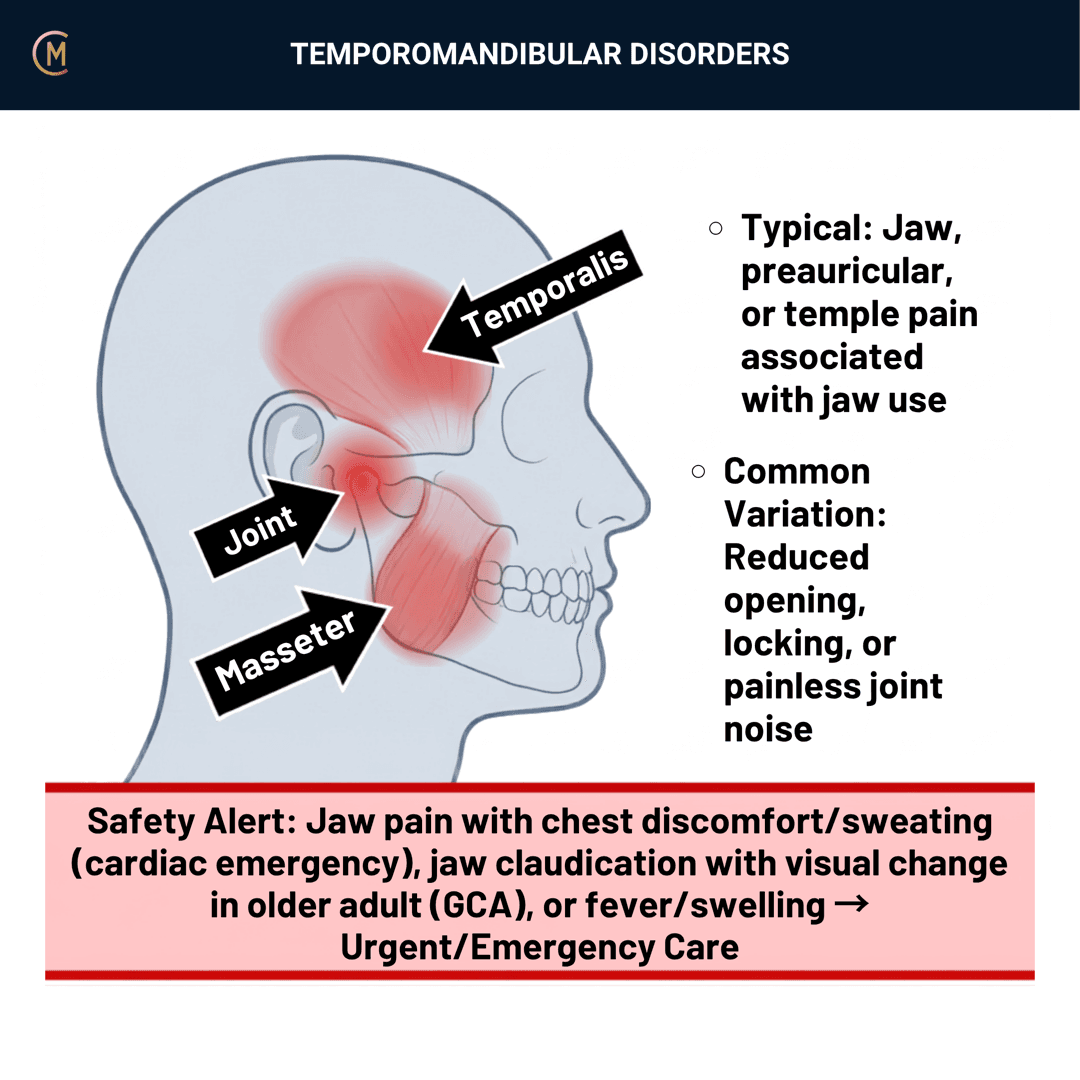
Common, mostly self-limiting, and full of things students do that don't help.
Illness script in one line: ache around the jaw, temple or in front of the ear, usually one side, with clicking or catching on opening and chewing, worse with stress, clenching and long conversations, eased by rest and soft food.
Caseload frequency: high, and mostly arriving attached to something else — neck pain, headache, or a dentist's referral. Read further: global prevalence [1][2].
Start with the name
"TMJ dysfunction" is the old label. The current classification is the Diagnostic Criteria for Temporomandibular Disorders — DC/TMD [3], with the taxonomy expanded since [4] and the question of a consensus standard of care revisited [5].
Why it matters to you: DC/TMD splits this into two families that are managed differently.
| Pain-related TMD | Intra-articular TMD | |
|---|---|---|
| Examples | Myalgia · arthralgia · headache attributed to TMD | Disc displacement with or without reduction · degenerative joint disease |
| Dominant complaint | Pain | Clicking, catching, locking, limitation |
| Your job | Load management, exercise, stress and sleep | The same, plus knowing when it's a locked jaw |
Most of what you see is pain-related, most of it settles, and most of the harm comes from over-treating the noise.
2 · SE — THE SUBJECTIVE PATTERN (the 70%)
MAIN PROBLEM
"My jaw clicks and aches." Or: it catches · it locks · it's tired by the end of the day · it hurts to eat a burger.
Ask which bothers them more — the pain or the noise. The answer sorts the whole session.
BODY CHART
- Pre-auricular, over the joint, into the masseter and temporalis. Usually unilateral.
- ± ear symptoms — fullness, ache, tinnitus. Common. Often seen an ENT first.
- ± temporal headache. Headache attributed to TMD is a DC/TMD diagnosis in its own right.
- ± neck. Cervical and postural dysfunction are common.
BEHAVIOUR
- Aggs: chewing (especially tough or chewy food), long conversations, yawning, singing, dental appointments, stress. The end of a busy day.
- Eases: rest, soft diet, heat, not talking.
- 24-hr pattern: the end of a busy day of talking and chewing. Morning symptoms point at nocturnal clenching — the bruxism referral in §6.
- Night: waking with it points at clenching. Night pain with weight loss or a cancer history is the §4 flag.
- Severity: VAS 0–10 at best / at worst / right now.
- Coding: typically In, occasionally Is with an acute limitation. Morning symptoms point at nocturnal clenching.
- Irritability: usually low.
HISTORY — five questions, three of them new
- Clicking: painful or painless? And can they open fully? A painless click in someone who opens normally is common and is not a disorder.
- Has the jaw ever LOCKED — and did it unlock? Closed lock that won't release is a different, urgent problem.
- Sleep. It's a lever too. Read further: insomnia as a risk factor for TMD [6].
- Stress and psychological load. It's worse with stress. Co-managing psychosocial stress has its evidence. Read further: psychological factors and TMD [7].
- Bruxism — and hold it lightly. Read further: bruxism, TMD and headache [8][9]. The correlation is real. The causation is not settled. Don't build the whole plan on it.
And ask about headache, because the traffic goes both ways
Read further: TMD in migraine and tension-type headache [10]. Examine the jaw in your headache patients and ask about headache in your jaw patients. Every time.
SPECIAL / SCREENING QUESTIONS
Fever, swelling, trismus. Progressive limitation. Systemic joint symptoms. Numbness in the jaw or lip. Weight loss. Cancer history. New jaw pain on chewing in someone over 50. Chest, arm or jaw pain on exertion.
Assessing this region? Download the Cervical Spine assessment template →
3 · HYPOTHESIS RANKING
Top three, and the one feature that separates each
| Pattern | The discriminating feature |
|---|---|
| 1. Pain-related TMD (myalgia / arthralgia) | Pain on chewing and on palpation of masseter and temporalis, reproduced by loading the jaw. Opening may be near-normal. |
| 2. Intra-articular TMD (disc displacement) | Clicking with deviation on opening, or catching and locking. Clinical pearl: click + deviation = disc displacement with reduction. |
| 3. Headache attributed to TMD, or a primary headache with TMD | Systematically reviewed and meta-analysed together. Which came first is usually undecidable — treat both. |
Also on the list
| Pattern | The discriminating feature |
|---|---|
| Cervicogenic headache / upper cervical referral | Reproduced from the upper cervical segments, not from jaw loading. |
| Dental pathology | Tooth-specific, thermal sensitivity, worse at night. Refer. |
| Ear pathology | Hearing change, discharge, vertigo. Refer. |
| Trigeminal neuralgia | Electric-shock paroxysms of seconds, triggered by light touch. |
| Giant cell arteritis | Over 50, new jaw pain on chewing, temporal tenderness, visual symptoms. See below. |
| Referred cardiac pain | Jaw or throat discomfort on exertion, easing with rest. Its own page. |
4 · RED FLAGS — DON'T MISS THIS
Free forever. Safety is never behind a paywall.
Jaw pain has two mimics that a physiotherapy student will meet and can miss.
| Finding | What it means |
|---|---|
| Over 50, NEW jaw pain that comes on with chewing and eases when they stop, with temporal tenderness, scalp tenderness, headache or visual symptoms | GIANT CELL ARTERITIS. Jaw claudication is a classification criterion [11]. Sight-threatening. SAME-DAY medical review. |
| Jaw, throat or neck discomfort brought on by EXERTION and relieved by rest | Cardiac referral. Its own page. Escalate. |
| Fever, swelling, hot joint, unable to open | Infection. Urgent. |
| A locked jaw that will not unlock | Acute closed lock. Urgent dental or maxillofacial review — not a mobilisation problem. |
| Progressive limitation with other joints involved, morning stiffness over 30 minutes | Inflammatory arthropathy. Medical review. |
| Numbness in the lip, chin or jaw, or a neuropathic facial pain that keeps progressing | Malignancy until excluded — cancer can present as a progressive neuropathic pain (Zakrzewska 2013) [21]. Urgent. |
| Unexplained weight loss, cancer history, night pain | Urgent. |
The distinction that matters most
TMD jaw pain builds with chewing and lingers. Jaw claudication in giant cell arteritis comes on with chewing, forces them to stop, and eases within minutes of stopping — like claudication anywhere else. In anyone over 50, that difference is sight-threatening.
Any red flag: stop, escalate, and check it with your educator.
5 · OE — THE OBJECTIVE (the 30%)
Members
Sections 5 to 7 are for members
The objective exam, management and pearls, plus the six-minute lesson and the debrief. Free with an account.
Sign in or join free6 · MX — MANAGEMENT ESSENTIALS
Members
Sections 5 to 7 are for members
The objective exam, management and pearls, plus the six-minute lesson and the debrief. Free with an account.
Sign in or join free7 · CLINICAL PEARLS + RETRIEVAL CHECK
Members
Sections 5 to 7 are for members
The objective exam, management and pearls, plus the six-minute lesson and the debrief. Free with an account.
Sign in or join freeMembers
The 4-minute lesson is for members
Twelve slides on this pattern: what you'll hear, what to examine, what to do. Free with an account.
Sign in or join freeGuideline anchor
No Australian guideline.
More
The diagnostic anchor is the Diagnostic Criteria for Temporomandibular Disorders (DC/TMD) for clinical and research applications (Schiffman et al. 2014, PMID 24482784), with the taxonomy expanded (Peck et al. 2014, PMID 24443898) and the question of a consensus standard of care revisited (Manfredini et al. 2026, PMID 41065623). The physiotherapy anchor is a systematic review and meta-analysis of manual therapy and therapeutic exercise for temporomandibular disorders in Physical Therapy (Armijo-Olivo et al. 2016, PMID 26294683). The occlusion anchor is a Cochrane review of occlusal interventions (Singh et al. 2024, PMID 39282765) and a systematic review of association studies between TMD and dental occlusion (Manfredini et al. 2017, PMID 28600812).
The DC/TMD is a diagnostic classification, not a management guideline. No physiotherapy management guideline for TMD exists.
Members
The evidence summary is for members
Verified diagnostic accuracy, where the evidence stands and what it doesn't settle. Free with an account.
Sign in or join freeSources · 20
ShowHide
Every source on this page resolves and title-verifies against PubMed. Newest first.
- 2025Alqutaibi et al. (2025). Global prevalence of temporomandibular disorders: a systematic review and meta-analysis. Journal of oral & facial pain and headache, 39(2), 48-65. https://doi.org/10.22514/jofph.2025.025
- 2024Zieliński et al. (2024). A Meta-Analysis of the Global Prevalence of Temporomandibular Disorders. Journal of clinical medicine, 13(5). https://doi.org/10.3390/jcm13051365
- 2014Schiffman et al. (2014). Diagnostic Criteria for Temporomandibular Disorders (DC/TMD) for Clinical and Research Applications: recommendations of the International RDC/TMD Consortium Network* and Orofacial Pain Special Interest Group†. Journal of oral & facial pain and headache, 28(1), 6-27. https://doi.org/10.11607/jop.1151
- 2014Peck et al. (2014). Expanding the taxonomy of the diagnostic criteria for temporomandibular disorders. Journal of oral rehabilitation, 41(1), 2-23. https://doi.org/10.1111/joor.12132
- 2026Manfredini & Kandasamy (2026). Temporomandibular disorders: Do we finally have a consensus standard of care for dissemination?. American journal of orthodontics and dentofacial orthopedics : official publication of the American Association of Orthodontists, its constituent societies, and the American Board of Orthodontics, 169(1), 8-11. https://doi.org/10.1016/j.ajodo.2025.08.017
- 2025Kim et al. (2025). Insomnia as a risk factor for temporomandibular disorders: a nationwide population-based cohort study. BMC oral health, 25(1), 1786. https://doi.org/10.1186/s12903-025-06967-3
- 2025Saini et al. (2025). The relationship between psychological factors and temporomandibular disorders: a systematic review and meta-analysis. Head & face medicine, 21(1), 46. https://doi.org/10.1186/s13005-025-00522-9
- 2024Voß et al. (2024). Bruxism, temporomandibular disorders, and headache: a narrative review of correlations and causalities. Pain, 165(11), 2409-2418. https://doi.org/10.1097/j.pain.0000000000003277
- 2024Romero-Reyes & Bassiur (2024). Temporomandibular Disorders, Bruxism and Headaches. Neurologic clinics, 42(2), 573-584. https://doi.org/10.1016/j.ncl.2023.12.010
- 2024Bizzarri et al. (2024). Temporomandibular disorders in migraine and tension-type headache patients: a systematic review with meta-analysis. Journal of oral & facial pain and headache, 38(2), 11-24. https://doi.org/10.22514/jofph.2024.011
- 2022Ponte et al. (2022). 2022 American College of Rheumatology/EULAR Classification Criteria for Giant Cell Arteritis. Arthritis & rheumatology (Hoboken, N.J.), 74(12), 1881-1889. https://doi.org/10.1002/art.42325
- 2017Manfredini et al. (2017). Temporomandibular disorders and dental occlusion. A systematic review of association studies: end of an era?. Journal of oral rehabilitation, 44(11), 908-923. https://doi.org/10.1111/joor.12531
- 2025Pascu et al. (2025). Occlusion and Temporomandibular Disorders: A Scoping Review. Medicina (Kaunas, Lithuania), 61(5). https://doi.org/10.3390/medicina61050791
- 2024Yan et al. (2024). Risk factors associated with temporomandibular joint disorder: A mendelian randomization analysis. Journal of oral rehabilitation, 51(11), 2239-2247. https://doi.org/10.1111/joor.13795
- 2016Armijo-Olivo et al. (2016). Effectiveness of Manual Therapy and Therapeutic Exercise for Temporomandibular Disorders: Systematic Review and Meta-Analysis. Physical therapy, 96(1), 9-25. https://doi.org/10.2522/ptj.20140548
- 2025De-La-Iglesia et al. (2025). Algorithm for Temporomandibular Disorders With Osteopathic Manipulative Therapy: An Expert Consensus. Journal of chiropractic medicine, 24(1-4), 219-225. https://doi.org/10.1016/j.jcm.2025.09.034
- 2024Singh et al. (2024). Occlusal interventions for managing temporomandibular disorders. The Cochrane database of systematic reviews, 9(9), CD012850. https://doi.org/10.1002/14651858.CD012850.pub2
- 2024Saini et al. (2024). The effectiveness of botulinum toxin for temporomandibular disorders: A systematic review and meta-analysis. PloS one, 19(3), e0300157. https://doi.org/10.1371/journal.pone.0300157
- 2024Zhang et al. (2024). Arthrocentesis for temporomandibular joint disorders: a network meta-analysis of randomised controlled trials. BMC oral health, 24(1), 1108. https://doi.org/10.1186/s12903-024-04858-7
- 2015Gauer & Semidey (2015). Diagnosis and treatment of temporomandibular disorders. American family physician, 91(6), 378-86. PubMed 25822556
Mapped to this pattern
Generic measures that also apply
- Borg RPE
Borg Rating of Perceived Exertion Scale (6-20)
perceived exertion · 1 items · 1 min
- GROC
Global Rating of Change Scale
perceived change since baseline · 1 items · 1 min
- NPRS
Numeric Pain Rating Scale
pain intensity · 1 items · 1 min
- PGIC
Patient Global Impression of Change
perceived change since baseline · 1 items · 1 min
- PSFS
Patient-Specific Functional Scale
patient-generated function · 3 items · 2 min
- SANE
Single Assessment Numeric Evaluation
patient-rated function as a percentage of normal · 1 items · 1 min
- VAS
Visual Analogue Scale
pain intensity · 1 items · 1 min
- Borg CR10
Borg Category Ratio 10 Scale
perceived exertion or symptom intensity, ratio scale · 1 items · 1 min
- GAS
Goal Attainment Scaling
individualised goal achievement · 10 min
Did this page do its job?
CliniStudy is in beta. One tap is enough — it decides what gets fixed first.