
1 · SNAPSHOT
The shoulder page you must know before you need it.
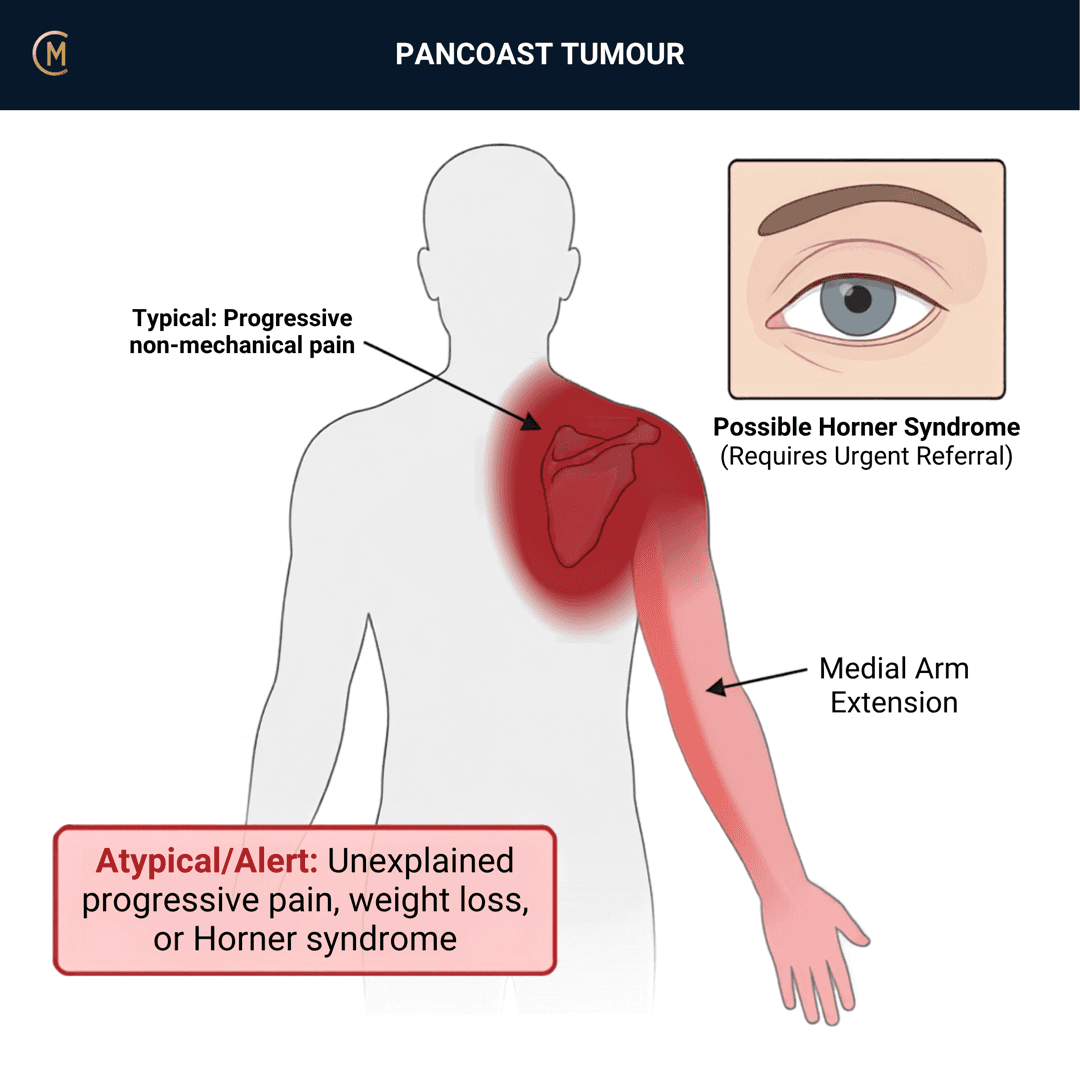
Illness script in one line: shoulder, scapular or medial arm pain with no mechanical cause, worse at night, unrelieved by rest or position, in a smoker or older adult, with hand weakness or numbness in a C8–T1 pattern and sometimes a drooping eyelid and small pupil on the same side.
Caseload frequency: rare. You may go a whole career without one, and you will absolutely see the presentation it hides inside — an unexplained shoulder.
The line that gets students
Classic teaching lists "normal shoulder imaging" under objective findings. Read that sentence again, because it is the trap.
A normal shoulder X-ray or ultrasound is what you'll be handed. It reassures the patient, it reassures the referrer, and it means nothing here — because the tumour is in the lung apex, not the shoulder.
"Normal shoulder imaging" doesn't mean it's clear. It means you imaged the wrong thing.
Pancoast tumour masquerading as musculoskeletal pain has been reported [1]. Read further: pulmonary pathology presenting as shoulder pain, written for physios [2], orthopaedic aspects and early diagnosis [3], shoulder pain as a diagnostic dilemma [4]. This is an old problem that keeps happening.
2 · SE — THE SUBJECTIVE PATTERN (the 70%)
On a red-flag pattern the subjective is not 70% — it is close to all of it. The examination confirms; the story is what saves the patient.
MAIN PROBLEM
"My shoulder's been aching for months and nothing helps." Often already seen someone. Often already had a scan. Often already been given exercises.
BODY CHART
- Shoulder, scapular, or the medial (ulnar) side of the arm. C8–T2.
- Ask them to trace it. Medial arm, medial forearm, into the little and ring fingers is not a rotator cuff pattern. The cuff refers to the deltoid insertion and rarely below the elbow.
- ± anterior chest wall or axilla.
BEHAVIOUR — this section decides the page
| Feature | What it should look like | What this pattern looks like |
|---|---|---|
| Relationship to movement | Clear aggravating and easing positions | None that hold up. It doesn't behave mechanically. |
| Effect of rest | Eases | Unrelieved. |
| Night | Sore lying on it; position change helps | Wakes them, and no position helps. |
| Trajectory | Fluctuating, or slowly improving | Steadily worse. |
| Response to treatment | Something shifts | Nothing shifts. |
One pearl applies directly: "not movement-provoked = not MSK until proven otherwise." Cross-link the cardiac and pulmonary referred pain page — the reasoning is identical.
HISTORY
- Smoking — current, past, pack-years. Ask it as a number. Read further: lung cancer screening guideline [5], low-dose CT screening in a high-risk population [6]. You are not ordering it — but "ask your GP whether you're eligible for lung cancer screening" is inside your scope and it is a good sentence.
- Weight loss, appetite, fatigue, cough, haemoptysis, breathlessness, hoarseness.
- Age. Older, but not a rule.
- Hand: dropping things, doing up buttons, grip changing.
- Eye or face: has anyone said your eyelid looks lower? Do you sweat less on one side of your face?
- What has already been done, and did any of it change anything? Failed treatment is data.
The delay is documented on both sides
Read further: patient and doctor delay [7], a delayed diagnosis missed by patient and clinician [8].
Nobody misses this because it's rare. They miss it because it looks treatable and someone kept treating it.
Assessing this region? Download the Shoulder assessment template →
3 · HYPOTHESIS RANKING
The point of this page is that it should be ON the list, not top of it
| Pattern | The discriminating feature |
|---|---|
| Rotator cuff–related shoulder pain | Load-related, painful arc, refers to the deltoid insertion, responds to something. Not C8, not nocturnal-unrelieved, not progressive. |
| Cervical radiculopathy (C8/T1) | Same distribution — this is the honest confusion. But: mechanical relationship, positive ULNT, relief with unloading or arm-overhead. Read further: cervicobrachialgia and Pancoast tumour [9]. |
| Thoracic outlet syndrome | Postural, load-related, provoked by sustained overhead positions, no constitutional symptoms. |
| Adhesive capsulitis | True capsular pattern with PROM loss and a firm end-feel. Pancoast gives reduced ROM without a mechanical restriction. |
| Pancoast tumour | Non-mechanical, night-unrelieved, progressive, C8–T2, hand wasting, ± Horner's, smoker. |
| Cardiac or pulmonary referral | Exertional, or pleuritic with breathlessness. Its own page. |
| Metastatic disease, infection | Constitutional symptoms, cancer history. |
The rule that runs this section
Every unexplained shoulder gets the non-mechanical question asked, and every shoulder with C8/T1 symptoms gets the hand and the pupils looked at. That costs you sixty seconds and it is the entire job.
4 · RED FLAGS — DON'T MISS THIS
Free forever. Safety is never behind a paywall.
On this page the red flags are the diagnosis.
| Finding | What it means |
|---|---|
| Shoulder pain with NO reproducible mechanical pattern | The single most important finding. Not MSK until proven otherwise. |
| Night pain unrelieved by any position | Different from "sore lying on it". Ask specifically. |
| Progressive, despite treatment | Failed treatment is data. Escalate, don't intensify. |
| C8–T1 sensory or motor symptoms — medial arm, ring and little finger, grip loss | Lower trunk brachial plexus. Examine the hand. |
| Wasting of the hand intrinsics | Look at the first dorsal interosseous and the hypothenar eminence, both hands, side by side. |
| Horner's syndrome — ptosis and miosis on the same side | See section 5. And note it is also the sign of carotid dissection. |
| Smoking history, weight loss, cough, haemoptysis, hoarseness | Constitutional. Ask every time on an unexplained shoulder. |
| "Normal shoulder imaging" | Not a clearance. The chest has not been imaged. |
The two sentences to hold
A shoulder that doesn't behave mechanically, doesn't settle at night, and doesn't respond to anything is a referral, not a rehab plan.
The referral is same-week. It is not conditional on failing another four sessions.
Any red flag: stop, escalate, and check it with your educator.
5 · OE — THE OBJECTIVE
Members
Sections 5 to 7 are for members
The objective exam, management and pearls, plus the six-minute lesson and the debrief. Free with an account.
Sign in or join free6 · MX — MANAGEMENT ESSENTIALS
Members
Sections 5 to 7 are for members
The objective exam, management and pearls, plus the six-minute lesson and the debrief. Free with an account.
Sign in or join free7 · CLINICAL PEARLS + RETRIEVAL CHECK
Members
Sections 5 to 7 are for members
The objective exam, management and pearls, plus the six-minute lesson and the debrief. Free with an account.
Sign in or join freeMembers
The 5-minute lesson is for members
Twelve slides on this pattern: what you'll hear, what to examine, what to do. Free with an account.
Sign in or join freeGuideline anchor
No Australian guideline for the physiotherapy recognition of this presentation.
More
The Australian anchor for when to investigate is Cancer Australia's Investigating symptoms of lung cancer: a guide for all health professionals (2020), which lists unexplained, persistent chest and/or shoulder pain lasting more than three weeks (earlier with risk factors) as a trigger for an urgent chest X-ray. The imaging anchor is the ACR Appropriateness Criteria for Horner syndrome (Dubey et al. 2025, PMID 41193044). The risk-profile anchor is the CHEST guideline and expert panel report on screening for lung cancer (Mazzone et al. 2021, PMID 34270968), with low-dose CT screening in a high-risk population reported in Lancet Oncology (Bhamani et al. 2025, PMID 40154514). The recognition anchor — and the most useful paper on this page for a physiotherapy student — is a report of pulmonary pathology recognised in a patient presenting with shoulder pain, published in Physiotherapy Theory and Practice (Brindisino et al. 2022, PMID 32459135), alongside a report of Pancoast tumour masquerading as musculoskeletal pain (Gadikota et al. 2025, PMID 40860246).
The guidelines here govern imaging and screening decisions made by doctors. Nothing on this page is a treatment guideline, because the physiotherapy management of this condition is recognition and referral.
Members
The evidence summary is for members
Verified diagnostic accuracy, where the evidence stands and what it doesn't settle. Free with an account.
Sign in or join freeSources · 20
ShowHide
Every source on this page resolves and title-verifies against PubMed. Newest first.
- 2025Gadikota et al. (2025). Pancoast tumor masquerading as musculoskeletal pain. Orthopedic reviews, 17, 143289. https://doi.org/10.52965/001c.143289
- 2022Brindisino et al. (2022). Recognition of pulmonary pathology in a patient presenting with shoulder pain. Physiotherapy theory and practice, 38(4), 597-607. https://doi.org/10.1080/09593985.2020.1768611
- 1973Spengler et al. (1973). Orthopaedic aspects and early diagnosis of superior sulcus tumor of lung (Pancoast). The Journal of bone and joint surgery. American volume, 55(8), 1645-50. PubMed 4804986
- 1984Kovach & Huslig (1984). Shoulder pain and Pancoast tumor: a diagnostic dilemma. Journal of manipulative and physiological therapeutics, 7(1), 25-31. PubMed 6716016
- 2021Mazzone et al. (2021). Screening for Lung Cancer: CHEST Guideline and Expert Panel Report. Chest, 160(5), e427-e494. https://doi.org/10.1016/j.chest.2021.06.063
- 2025Bhamani et al. (2025). Low-dose CT for lung cancer screening in a high-risk population (SUMMIT): a prospective, longitudinal cohort study. The Lancet. Oncology, 26(5), 609-619. https://doi.org/10.1016/S1470-2045(25)00082-8
- 2006Ichinohe et al. (2006). Delay by patients and doctors in treatment of Pancoast tumor. Wiener klinische Wochenschrift, 118(13-14), 405-10. https://doi.org/10.1007/s00508-006-0615-0
- 2025Laouar et al. (2025). When Patient and Clinician Miss the Signal: A Delayed Diagnosis of Pancoast Tumor. Cureus, 17(9), e91732. https://doi.org/10.7759/cureus.91732
- 2004Villas et al. (2004). Cervicobrachialgia and pancoast tumor: value of standard anteroposterior cervical radiographs in early diagnosis. Orthopedics, 27(10), 1092-5. https://doi.org/10.3928/0147-7447-20041001-20
- 2024Disse et al. (2024). Differentiation of Horner Syndrome and Physiological Anisocoria by Automated Pupillometry. Journal of neuro-ophthalmology : the official journal of the North American Neuro-Ophthalmology Society, 45(3), 327-332. https://doi.org/10.1097/WNO.0000000000002262
- 2012Gao & Crompton (2012). Horner Syndrome: A Practical Approach to Investigation and Management. Asia-Pacific journal of ophthalmology (Philadelphia, Pa.), 1(3), 175-9. https://doi.org/10.1097/APO.0b013e318256009d
- 2010Almog et al. (2010). Diagnostic value of imaging in horner syndrome in adults. Journal of neuro-ophthalmology : the official journal of the North American Neuro-Ophthalmology Society, 30(1), 7-11. https://doi.org/10.1097/WNO.0b013e3181ce1a12
- 2025Dubey et al. (2025). ACR Appropriateness Criteria® Horner Syndrome. Journal of the American College of Radiology : JACR, 22(11S), S550-S577. https://doi.org/10.1016/j.jacr.2025.08.041
- 1983O'Connell et al. (1983). Superior sulcus tumor: radiographic diagnosis and workup. AJR. American journal of roentgenology, 140(1), 25-30. https://doi.org/10.2214/ajr.140.1.25
- 2013Manenti et al. (2013). Pancoast tumor: the role of magnetic resonance imaging. Case reports in radiology, 2013, 479120. https://doi.org/10.1155/2013/479120
- 2025Langer et al. (2025). Therapeutic modalities for superior sulcus tumor (Pancoast) tumor - A systematic review. Lung cancer (Amsterdam, Netherlands), 206, 108640. https://doi.org/10.1016/j.lungcan.2025.108640
- 2026Li (2026). A minimally invasive hybrid approach to a complex challenge: VATS resection for superior sulcus tumor with literature review. Journal of cardiothoracic surgery, 21(1). https://doi.org/10.1186/s13019-026-04084-y
- 2026Gritsiuta et al. (2026). Superior sulcus tumor with vertebral invasion following initial diagnosis of cavitary lung disease: a case report. AME case reports, 10, 143. https://doi.org/10.21037/acr-2026-0121
- 2023Rao et al. (2023). Pancoast Tumor With Cardiac Metastases and Intracardiac Thrombosis. Journal of investigative medicine high impact case reports, 11, 23247096231154642. https://doi.org/10.1177/23247096231154642
- 2023Rahimzadeh et al. (2023). Erector Spinae Plane Block for the Treatment of Intractable Pain in a Patient with Pancoast Tumor: A Case Report. Anesthesiology and pain medicine, 13(3), e135829. https://doi.org/10.5812/aapm-135829
Generic measures that also apply
- Borg RPE
Borg Rating of Perceived Exertion Scale (6-20)
perceived exertion · 1 items · 1 min
- GROC
Global Rating of Change Scale
perceived change since baseline · 1 items · 1 min
- NPRS
Numeric Pain Rating Scale
pain intensity · 1 items · 1 min
- PGIC
Patient Global Impression of Change
perceived change since baseline · 1 items · 1 min
- PSFS
Patient-Specific Functional Scale
patient-generated function · 3 items · 2 min
- SANE
Single Assessment Numeric Evaluation
patient-rated function as a percentage of normal · 1 items · 1 min
- VAS
Visual Analogue Scale
pain intensity · 1 items · 1 min
- Borg CR10
Borg Category Ratio 10 Scale
perceived exertion or symptom intensity, ratio scale · 1 items · 1 min
- GAS
Goal Attainment Scaling
individualised goal achievement · 10 min
Did this page do its job?
CliniStudy is in beta. One tap is enough — it decides what gets fixed first.