
1 · SNAPSHOT
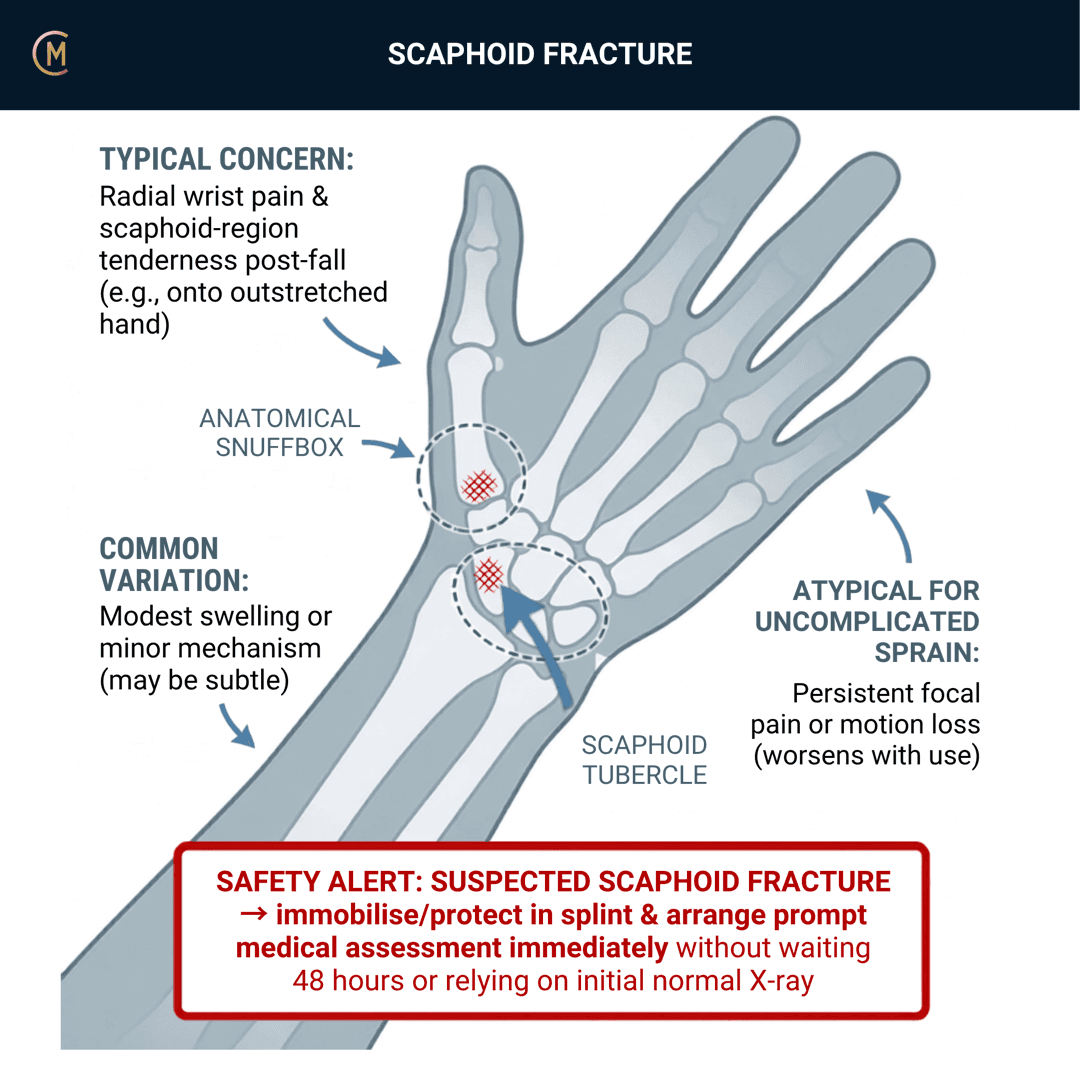
The most commonly missed fracture in the body, and it gets missed in exactly the room you'll be standing in.
Illness script in one line: someone fell onto an outstretched hand, thought they'd sprained their wrist, and is still sore at the base of the thumb more than 48 hours later.
Caseload frequency: you will see the presentation regularly. Read further: carpal and scaphoid fracture incidence in south-eastern Australia [1], the wider epidemiology [2].
The X-ray that comes back normal
One sentence makes this page: "X-ray may be negative initially — high index of suspicion required."
That is the entire problem. The patient goes to a GP or an ED, gets a wrist X-ray, is told it's clear, and is sent to you with "wrist sprain, please rehab."
Read further: imaging for suspected scaphoid fracture [3], early MRI in clinical scaphoid fracture [4], diagnostic characteristics and reliability of radiological methods [5], variation in how scaphoid fracture is defined on MRI [6].
Occult scaphoid fracture was called a diagnostic enigma in 1989 [7]. It still is.
A normal first X-ray does not clear a snuffbox-tender wrist. It never has.
2 · SE — THE SUBJECTIVE PATTERN
Acute and traumatic, so the UniSA order changes: MAIN PROBLEM → BODY CHART → HISTORY → BEHAVIOUR.
MAIN PROBLEM
"I sprained my wrist and it's still sore."
That sentence, plus a fall onto an outstretched hand, plus more than 48 hours, is the whole trigger. May feel "sprained wrist" but pain persists >48 hrs.
BODY CHART
- Radial wrist, at the base of the thumb. Ask them to point with one finger — the anatomical snuffbox is the answer you're listening for.
- ± into the thenar eminence and the thumb.
- Swelling is often unimpressive. The absence of a dramatic wrist is not reassurance.
HISTORY
- The mechanism. FOOSH — a fall onto the outstretched, extended, radially deviated wrist. Sport, a trip, a bike, a ladder.
- How long ago, and is it settling? The 48-hour mark is the line that matters.
- Have they been imaged, when, and what were they told? See section 1. "The X-ray was clear" is the sentence you must not accept.
- What can they not do? Gripping, pinching, pushing up out of a chair, opening a jar.
- Any previous wrist injury on that side?
BEHAVIOUR
- Aggs: gripping and pinching, pushing through the hand, wrist extension, radial deviation.
- Eases: rest, not using it. And this is the trap — it eases enough that people stop worrying.
- Irritability: often low, which is exactly why it gets dismissed.
SPECIAL / SCREENING QUESTIONS
High-energy mechanism, other injuries, any numbness or circulatory change in the hand, and whether the wrist looks or feels deformed.
Assessing this region? Download the Wrist & Hand assessment template →
3 · HYPOTHESIS RANKING
Top three, and the one feature that separates each
| Pattern | The discriminating feature |
|---|---|
| 1. Scaphoid fracture | FOOSH + snuffbox tenderness + still sore beyond 48 hours. Ranked first on consequence, not on probability. |
| 2. Wrist sprain / soft tissue injury | The default label, and the diagnosis of exclusion — not the starting point. It only becomes the answer after the scaphoid has been properly excluded. |
| 3. Distal radius fracture | More swelling, more deformity, tenderness over the distal radius rather than the snuffbox. Often obvious. Sometimes not. |
Also on the list
| Pattern | The discriminating feature |
|---|---|
| Scapholunate ligament injury / perilunate injury | Dorsal wrist pain, a clunk, a much more unstable pattern from the same mechanism. Easily missed alongside a scaphoid fracture. |
| Other carpal fractures | Triquetral, hamate hook — different tenderness locations, same mechanism. |
| De Quervain's tenosynovitis | Gradual onset, no trauma, tender over the radial styloid rather than in the snuffbox. Its own page — and the honest confusion on the radial side. |
| 1st CMC osteoarthritis | Older, gradual, pain with pinch and jar-opening, positive grind test. |
The rule that runs this page
On a radial-sided wrist after a fall, the scaphoid is ranked first until someone with imaging says otherwise. That's not clinical reasoning — it's risk management, and here they're the same thing.
4 · RED FLAGS — DON'T MISS THIS
Free forever. Safety is never behind a paywall.
On this page the fracture is the red flag. What follows is what it costs to miss it, and what else the same fall does.
| Finding | What it means |
|---|---|
| FOOSH + anatomical snuffbox tenderness, at any time point | Scaphoid fracture until imaging says otherwise. Immobilise and refer today. |
| Pain at the base of the thumb persisting beyond 48 hours after a fall | Same action. |
| A normal X-ray in a snuffbox-tender wrist | NOT A CLEARANCE. Repeat imaging or MRI is a medical decision — your job is to say so, in writing. |
| Pain settling but tenderness persisting | The most dangerous version. Avoid early loading even if pain subsides. |
| Dorsal wrist pain, a clunk, or gross instability | Scapholunate or perilunate injury. Urgent. |
| Obvious deformity, high-energy mechanism, or multiple injuries | Escalate to ED. |
| A cold, pale or discoloured hand | Vascular compromise. EMERGENCY. |
| New or progressive numbness or weakness in the hand | Possible nerve compromise. Urgent: same day. |
What missing it actually costs
Read further: outcomes of delayed cast treatment for the missed scaphoid fracture [8]. Risk factors for nonunion in acute fractures treated with cast immobilisation have been examined [9], and a small proximal-to-distal fragment ratio identified as a risk factor [10]. Read further: treatment of established nonunion [11].
Read further: the litigation cost of negligent scaphoid fracture management [12]. That paper exists for a reason, and knowing it exists is a legitimate part of the education.
The scaphoid has a retrograde blood supply. Miss a proximal pole fracture and you are not risking a slow recovery — you are risking avascular necrosis and a wrist that never works properly again.
Any red flag: stop, escalate, and check it with your educator.
5 · OE — THE OBJECTIVE
Members
Sections 5 to 7 are for members
The objective exam, management and pearls, plus the six-minute lesson and the debrief. Free with an account.
Sign in or join free6 · MX — MANAGEMENT ESSENTIALS
Members
Sections 5 to 7 are for members
The objective exam, management and pearls, plus the six-minute lesson and the debrief. Free with an account.
Sign in or join free7 · CLINICAL PEARLS + RETRIEVAL CHECK
Members
Sections 5 to 7 are for members
The objective exam, management and pearls, plus the six-minute lesson and the debrief. Free with an account.
Sign in or join freeMembers
The 4-minute lesson is for members
Twelve slides on this pattern: what you'll hear, what to examine, what to do. Free with an account.
Sign in or join freeGuideline anchor
No Australian clinical practice guideline — but unusually, there are two Australian anchors.
More
Carpal and scaphoid fracture incidence has been reported in an epidemiological study in south-eastern Australia (Holloway et al. 2015, PMID 25910867) and the initial management of potential occult scaphoid fracture examined in Australasia (Kelly et al. 2010, PMID 20414381). The diagnostic anchors are a systematic review and meta-analysis of clinical diagnostic evaluation for scaphoid fractures in the Journal of Hand Surgery (Mallee et al. 2014, PMID 25091335), a systematic review of which clinical features best predict occult scaphoid fractures in the Emergency Medicine Journal (Coventry et al. 2023, PMID 37169546) and a meta-analysis of adult scaphoid fracture in Academic Emergency Medicine (Carpenter et al. 2014, PMID 24673666).
These are diagnostic systematic reviews and emergency-medicine practice studies, not a physiotherapy management guideline. There is no guideline for the physiotherapy management of this fracture — because the physiotherapy job in the acute phase is recognition and referral.
Members
The evidence summary is for members
Verified diagnostic accuracy, where the evidence stands and what it doesn't settle. Free with an account.
Sign in or join freeSources · 20
ShowHide
Every source on this page resolves and title-verifies against PubMed. Newest first.
- 2015Holloway et al. (2015). Carpal and scaphoid fracture incidence in south-eastern Australia: an epidemiologic study. Archives of osteoporosis, 10, 10. https://doi.org/10.1007/s11657-015-0215-6
- 2012Duckworth et al. (2012). Scaphoid fracture epidemiology. The journal of trauma and acute care surgery, 72(2), E41-5. https://doi.org/10.1097/ta.0b013e31822458e8
- 2008Ring & Lozano-Calderón (2008). Imaging for suspected scaphoid fracture. The Journal of hand surgery, 33(6), 954-7. https://doi.org/10.1016/j.jhsa.2008.04.016
- 2003Brydie & Raby (2003). Early MRI in the management of clinical scaphoid fracture. The British journal of radiology, 76(905), 296-300. https://doi.org/10.1259/bjr/19790905
- 2025Smith et al. (2025). The diagnostic characteristics and reliability of radiological methods used in the assessment of scaphoid fracture union : a systematic review. Bone & joint open, 6(3), 246-253. https://doi.org/10.1302/2633-1462.63.BJO-2024-0211.R1
- 2026van Boxel et al. (2026). Variation in definitions of scaphoid fracture on MRI scans for suspected fracture: a systematic review. The Journal of hand surgery, European volume, 51(2), 139-145. https://doi.org/10.1177/17531934251367541
- 1989Mittal & Dargan (1989). Occult scaphoid fracture: a diagnostic enigma. Journal of orthopaedic trauma, 3(4), 306-8. https://doi.org/10.1097/00005131-198912000-00008
- 2015Grewal et al. (2015). The Missed Scaphoid Fracture-Outcomes of Delayed Cast Treatment. Journal of wrist surgery, 4(4), 278-83. https://doi.org/10.1055/s-0035-1564983
- 2026Dean et al. (2026). Risk factors for scaphoid nonunion in acute fractures treated with cast immobilization. Bone & joint open, 7(8), 1001-1006. https://doi.org/10.1302/2633-1462.78.BJO-2026-0012.R1
- 2025Sugiura et al. (2025). A Small Ratio of Proximal to Distal Bone Fragments Is a Risk Factor for Scaphoid Nonunion: A Volumetric Analysis of Preoperative CT. Journal of wrist surgery, 14(3), 226-232. https://doi.org/10.1055/s-0044-1779286
- 2015Pinder et al. (2015). Treatment of Scaphoid Nonunion: A Systematic Review of the Existing Evidence. The Journal of hand surgery, 40(9), 1797-1805.e3. https://doi.org/10.1016/j.jhsa.2015.05.003
- 2015Harrison et al. (2015). The litigation cost of negligent scaphoid fracture management. European journal of emergency medicine : official journal of the European Society for Emergency Medicine, 22(2), 142-3. https://doi.org/10.1097/MEJ.0000000000000152
- 2014Mallee et al. (2014). Clinical diagnostic evaluation for scaphoid fractures: a systematic review and meta-analysis. The Journal of hand surgery, 39(9), 1683-1691.e2. https://doi.org/10.1016/j.jhsa.2014.06.004
- 2023Coventry et al. (2023). Which clinical features best predict occult scaphoid fractures? A systematic review of diagnostic test accuracy studies. Emergency medicine journal : EMJ, 40(8), 576-582. https://doi.org/10.1136/emermed-2023-213119
- 2014Carpenter et al. (2014). Adult scaphoid fracture. Academic emergency medicine : official journal of the Society for Academic Emergency Medicine, 21(2), 101-21. https://doi.org/10.1111/acem.12317
- 1996Grover (1996). Clinical assessment of scaphoid injuries and the detection of fractures. Journal of hand surgery (Edinburgh, Scotland), 21(3), 341-3. https://doi.org/10.1016/s0266-7681(05)80197-4
- 2020Mallee et al. (2020). Detecting scaphoid fractures in wrist injury: a clinical decision rule. Archives of orthopaedic and trauma surgery, 140(4), 575-581. https://doi.org/10.1007/s00402-020-03383-w
- 2010Kelly (2010). Initial management of potential occult scaphoid fracture in Australasia. International journal of emergency medicine, 3(1), 45-7. https://doi.org/10.1007/s12245-009-0138-3
- 2009Modi et al. (2009). Operative versus nonoperative treatment of acute undisplaced and minimally displaced scaphoid waist fractures--a systematic review. Injury, 40(3), 268-73. https://doi.org/10.1016/j.injury.2008.07.030
- 2015Tada et al. (2015). Scaphoid Fracture--Overview and Conservative Treatment. Hand surgery : an international journal devoted to hand and upper limb surgery and related research : journal of the Asia-Pacific Federation of Societies for Surgery of the Hand, 20(2), 204-9. https://doi.org/10.1142/S0218810415400018
Mapped to this pattern
Generic measures that also apply
- Borg RPE
Borg Rating of Perceived Exertion Scale (6-20)
perceived exertion · 1 items · 1 min
- DASH
Disabilities of the Arm, Shoulder and Hand
upper limb disability · 30 items · 8 min
- GROC
Global Rating of Change Scale
perceived change since baseline · 1 items · 1 min
- NPRS
Numeric Pain Rating Scale
pain intensity · 1 items · 1 min
- PGIC
Patient Global Impression of Change
perceived change since baseline · 1 items · 1 min
- PSFS
Patient-Specific Functional Scale
patient-generated function · 3 items · 2 min
- QuickDASH
QuickDASH
upper limb disability, short form · 11 items · 4 min
- SANE
Single Assessment Numeric Evaluation
patient-rated function as a percentage of normal · 1 items · 1 min
- UEFI
Upper Extremity Functional Index
upper limb function · 20 items · 5 min
- VAS
Visual Analogue Scale
pain intensity · 1 items · 1 min
- Borg CR10
Borg Category Ratio 10 Scale
perceived exertion or symptom intensity, ratio scale · 1 items · 1 min
- GAS
Goal Attainment Scaling
individualised goal achievement · 10 min
Did this page do its job?
CliniStudy is in beta. One tap is enough — it decides what gets fixed first.