
1 · SNAPSHOT
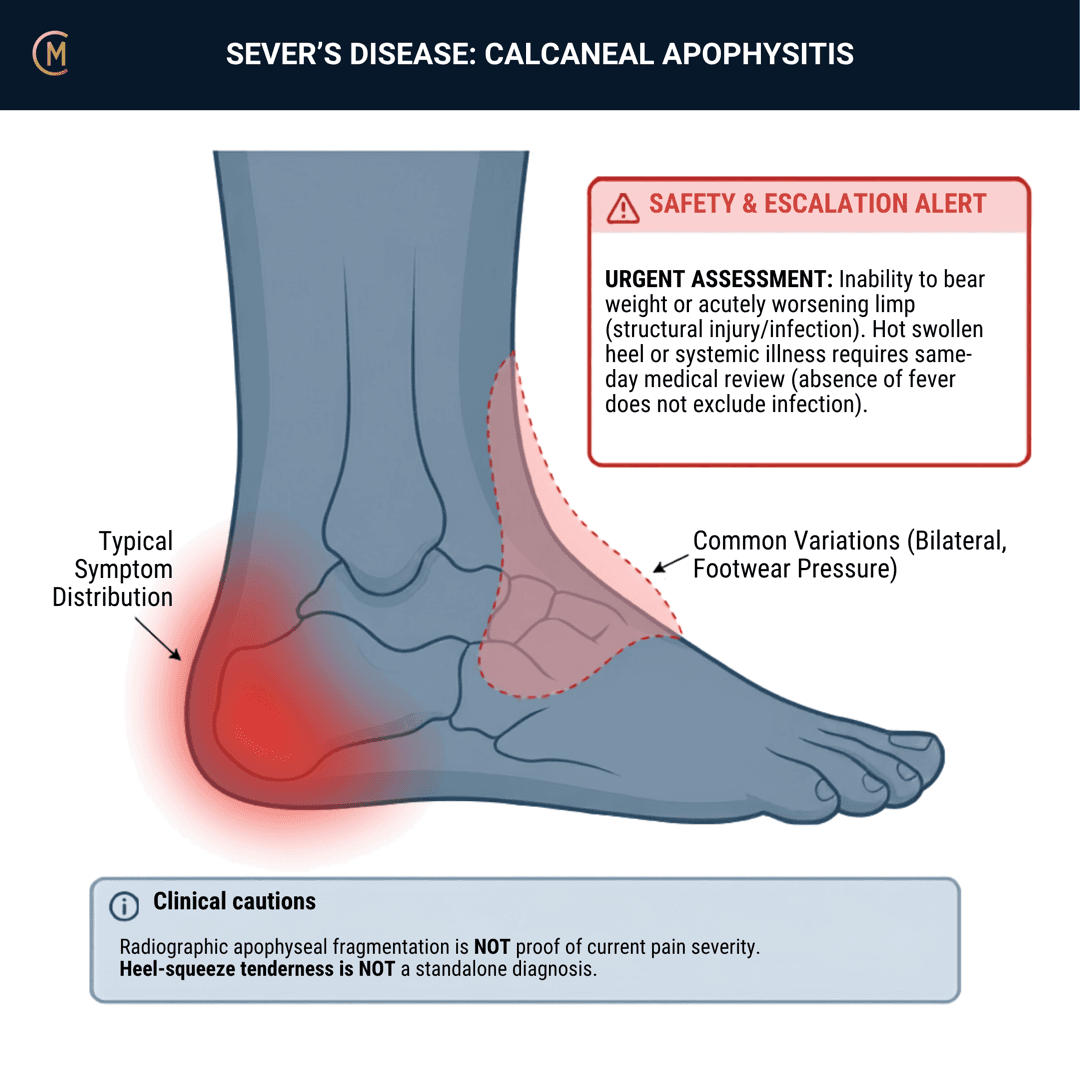
Who: Active children, typically 8–14 years, during growth and sport exposure. Common in youth football and running.
What: Traction and compression overload at the calcaneal apophysis.
How it behaves: Gradual posterior heel pain, worse with running and jumping, tight shoes, and growth spurts. Pain walking after sport. Often bilateral.
The one thing to take from this page:
"Pain = overload, not damage." How you explain this to the child and the parent shapes the next six months more than any device you issue.
The two jobs
| 1. Screen it | 2. Keep them playing |
|---|---|
| Typical presentations don't need imaging [4] | Modified participation, not rest |
| Atypical ones do — see section 4 | Deload, cushion, restore calf mobility, strengthen once settled |
| The differential includes fracture, infection, tumour, tarsal coalition | Reassure the family: self-limiting with growth |
One honest note about the treatment evidence
Wait-and-see, orthotic and physiotherapy approaches may all improve [1], and improvement also occurs over time (James et al. 2016). That doesn't make treatment pointless — it reframes the question from "which device works" to "what keeps this child playing while it resolves."
⚠️ No guideline exists, and none is likely for a self-limiting condition. Anchored to the conservative treatment systematic review [2].
2 · SE — THE SUBJECTIVE PATTERN (the 70%)
Five stages, in your course's order — and remember you are taking a history from two people. The child tells you what hurts; the parent tells you what changed and what they're worried about. Ask both.
MAIN PROBLEM
"My heels hurt after footy."
"He's limping after training and it's fine by the next morning."
"She's stopped wanting to go."
That last one matters. Pain severity here is associated with physical and contextual factors, so measure function and sport participation rather than squeeze pain alone [3].
BODY CHART
- Mark it posterior heel, at the apophysis — not the Achilles insertion and not the plantar heel.
- Mark both heels. Bilateral is typical and it is reassuring.
BEHAVIOUR
| Fits Sever's | Points elsewhere | |
|---|---|---|
| Aggs | Running, jumping, tight shoes | Shoe-counter pressure → retrocalcaneal bursitis |
| Severity | VAS 0–10 at best / at worst / right now | — |
| Timing | After sport, settles overnight | Night pain → image |
| Sides | Often bilateral | Severe unilateral → image |
| Course | Fluctuates with sport load | Progressive, or systemic features → image |
HISTORY
- Sport load — hours, sessions, codes, surfaces, a recent increase, a new season.
- Growth — a recent growth spurt. Apophysis maturation and heel pain are linked in youth sport, and growth timing helps explain the vulnerability and the recurrence (Honma et al. 2024).
- Footwear — studs, tight shoes, barefoot sports.
- Previous episodes, and how they resolved.
SPECIAL / SCREENING QUESTIONS
The atypical screen — ask it every time:
- Trauma? Night pain? Systemic symptoms — fever, unwell, weight loss? Severe unilateral pain? Unable to weight-bear? Not improving?
- Any other joints involved, or morning stiffness?
Assessing this region? Download the Ankle & Foot assessment template →
3 · HYPOTHESIS RANKING
| Competing pattern | The one discriminating feature |
|---|---|
| Achilles tendinopathy | Skeletally mature, thickened tendon, pain on loading and stretch. Sever's is apophyseal with a positive squeeze test. |
| Calcaneal stress fracture | Focal calcaneal pain persisting at rest or at night. Image if atypical [4], unilateral or traumatic. |
| Retrocalcaneal bursitis | Tender anterior to the Achilles, aggravated by shoe-counter pressure rather than by impact. |
The list that makes the screen worth doing
Paediatric heel pain differentials include fracture, infection, tumour, tarsal coalition, Achilles pathology, plantar fasciitis and inflammatory disease [4].
That list is the reason the atypical screen is not a formality. Sever's is common and it is benign — and the cost of assuming it in the wrong child is high enough that the questions get asked every time.
4 · RED FLAGS — DON'T MISS THIS
This section is free, on every pattern, forever. Safety is never gated.
Typical, or not?
| Typical — manage it | Atypical — image it |
|---|---|
| Bilateral or clearly activity-related | Severe unilateral pain |
| Active 8–14, growing | Trauma |
| Squeeze tenderness at the apophysis | Night pain |
| Settles with rest, returns with sport | Systemic symptoms — fever, unwell, weight loss |
| No systemic features | Unable to weight-bear |
| No local heat, redness or swelling | Heel pain with local inflammatory signs — osteomyelitis until proven otherwise; same-day medical review, not a heel lift (Winiker & Schärli 1991) [22] |
| Improving with load management | Not improving |
What atypical is atypical for
Fracture · infection · tumour · tarsal coalition · Achilles pathology · plantar fasciitis · inflammatory disease (Kothari et al. 2023).
And what imaging is actually for
Imaging excludes other pathology. It does not confirm Sever's. Radiographic fragmentation and sclerosis can be nonspecific and a normal variant [6], and the diagnosis is primarily clinical — typical history and examination are more useful than routine radiography [6].
The counterpoint. One retrospective series X-rayed children already diagnosed clinically and found abnormal films in 5.1% — bone cysts and stress fractures — with no common history or examination finding that predicted them; its authors argue for routine lateral films (Rachel et al. 2011) [21]. It's one series. It's why the atypical column above matters, and why a heel that isn't settling gets imaged.
Cross-links: Achilles tendinopathy · Plantar fasciopathy · Stress fracture — metatarsal, navicular, calcaneal
5 · OE — THE OBJECTIVE (the 30%)
Members
Sections 5 to 7 are for members
The objective exam, management and pearls, plus the six-minute lesson and the debrief. Free with an account.
Sign in or join free6 · MX — MANAGEMENT ESSENTIALS
Members
Sections 5 to 7 are for members
The objective exam, management and pearls, plus the six-minute lesson and the debrief. Free with an account.
Sign in or join free7 · CLINICAL PEARLS + RETRIEVAL CHECK
Members
Sections 5 to 7 are for members
The objective exam, management and pearls, plus the six-minute lesson and the debrief. Free with an account.
Sign in or join freeMembers
The 4-minute lesson is for members
Twelve slides on this pattern: what you'll hear, what to examine, what to do. Free with an account.
Sign in or join freeGuideline anchor
No guideline exists for calcaneal apophysitis, in Australia or anywhere.
More
Anchored to the systematic review of conservative treatment (Hernandez-Lucas et al. 2024, PMID 38592198) and the pragmatic randomised trial comparing wait-and-see, orthotic and physiotherapy approaches (Wiegerinck et al. 2016, PMID 25985369), which between them describe both what helps and how much of the improvement is time.
No guideline exists, and none is likely for a self-limiting condition. The evidence is a set of small trials of footwear, orthoses and exercise against each other and against time, and its central honest finding — that improvement also occurs over time — is on the page rather than buried.
Members
The evidence summary is for members
Verified diagnostic accuracy, where the evidence stands and what it doesn't settle. Free with an account.
Sign in or join freeSources · 20
ShowHide
Every source on this page resolves and title-verifies against PubMed. Newest first.
- 2016Wiegerinck et al. (2016). Treatment of Calcaneal Apophysitis: Wait and See Versus Orthotic Device Versus Physical Therapy: A Pragmatic Therapeutic Randomized Clinical Trial. Journal of pediatric orthopedics, 36(2), 152-7. https://doi.org/10.1097/BPO.0000000000000417
- 2024Hernandez-Lucas et al. (2024). Conservative Treatment of Sever's Disease: A Systematic Review. Journal of clinical medicine, 13(5). https://doi.org/10.3390/jcm13051391
- 2015James et al. (2015). Factors Associated with Pain Severity in Children with Calcaneal Apophysitis (Sever Disease). The Journal of pediatrics, 167(2), 455-9. https://doi.org/10.1016/j.jpeds.2015.04.053
- 2023Kothari et al. (2023). A Review of Pediatric Heel Pain. Cureus, 15(1), e34228. https://doi.org/10.7759/cureus.34228
- 2020Gao et al. (2020). Radiographic study of Sever's disease. Experimental and therapeutic medicine, 20(2), 933-937. https://doi.org/10.3892/etm.2020.8796
- 2013Perhamre et al. (2013). Sever's injury: a clinical diagnosis. Journal of the American Podiatric Medical Association, 103(5), 361-8. https://doi.org/10.7547/1030361
- 2023Nieto-Gil et al. (2023). Risk factors and associated factors for calcaneal apophysitis (Sever's disease): a systematic review. BMJ open, 13(6), e064903. https://doi.org/10.1136/bmjopen-2022-064903
- 2021Alfaro-Santafé et al. (2021). Effectiveness of Custom-Made Foot Orthoses vs. Heel-Lifts in Children with Calcaneal Apophysitis (Sever's Disease): A CONSORT-Compliant Randomized Trial. Children (Basel, Switzerland), 8(11). https://doi.org/10.3390/children8110963
- 2022Belikan et al. (2022). Incidence of calcaneal apophysitis (Sever's disease) and return-to-play in adolescent athletes of a German youth soccer academy: a retrospective study of 10 years. Journal of orthopaedic surgery and research, 17(1), 83. https://doi.org/10.1186/s13018-022-02979-9
- 2010James et al. (2010). Heel raises versus prefabricated orthoses in the treatment of posterior heel pain associated with calcaneal apophysitis (Sever's Disease): a randomised control trial. Journal of foot and ankle research, 3, 3. https://doi.org/10.1186/1757-1146-3-3
- 2011Scharfbillig et al. (2011). Sever's disease: a prospective study of risk factors. Journal of the American Podiatric Medical Association, 101(2), 133-45. https://doi.org/10.7547/1010133
- 2013James et al. (2013). "Effectiveness of interventions in reducing pain and maintaining physical activity in children and adolescents with calcaneal apophysitis (Sever's disease): a systematic review". Journal of foot and ankle research, 6(1), 16. https://doi.org/10.1186/1757-1146-6-16
- 2014Wiegerinck et al. (2014). Incidence of calcaneal apophysitis in the general population. European journal of pediatrics, 173(5), 677-9. https://doi.org/10.1007/s00431-013-2219-9
- 2016James et al. (2016). Effectiveness of footwear and foot orthoses for calcaneal apophysitis: a 12-month factorial randomised trial. British journal of sports medicine, 50(20), 1268-1275. https://doi.org/10.1136/bjsports-2015-094986
- 2017Kuyucu et al. (2017). Assessment of the kinesiotherapy's efficacy in male athletes with calcaneal apophysitis. Journal of orthopaedic surgery and research, 12(1), 146. https://doi.org/10.1186/s13018-017-0637-5
- 2018Ceylan & Caypinar (2018). Incidence of calcaneal apophysitis in Northwest Istanbul. BMC musculoskeletal disorders, 19(1), 267. https://doi.org/10.1186/s12891-018-2184-6
- 2019Martinelli et al. (2019). Prevalence and Associated Factors of Sever's Disease in an Athletic Population. Journal of the American Podiatric Medical Association, 109(5), 351-356. https://doi.org/10.7547/17-105
- 2021Fares et al. (2021). Sever's Disease of the Pediatric Population: Clinical, Pathologic, and Therapeutic Considerations. Clinical medicine & research, 19(3), 132-137. https://doi.org/10.3121/cmr.2021.1639
- 2023Sweeney et al. (2023). Comparison of Braces for Treatment of Sever's Disease (Calcaneal Apophysitis) in Barefoot Athletes: A Randomized Clinical Trial. Journal of athletic training, 58(5), 437-444. https://doi.org/10.4085/1062-6050-0266.22
- 2024Honma et al. (2024). Exploring the Link Between Calcaneal Apophysis Maturation and Heel Pain in Youth Baseball Players. Orthopaedic journal of sports medicine, 12(10), 23259671241253861. https://doi.org/10.1177/23259671241253861
Mapped to this pattern
Generic measures that also apply
- Borg RPE
Borg Rating of Perceived Exertion Scale (6-20)
perceived exertion · 1 items · 1 min
- GROC
Global Rating of Change Scale
perceived change since baseline · 1 items · 1 min
- NPRS
Numeric Pain Rating Scale
pain intensity · 1 items · 1 min
- PGIC
Patient Global Impression of Change
perceived change since baseline · 1 items · 1 min
- PSFS
Patient-Specific Functional Scale
patient-generated function · 3 items · 2 min
- SANE
Single Assessment Numeric Evaluation
patient-rated function as a percentage of normal · 1 items · 1 min
- VAS
Visual Analogue Scale
pain intensity · 1 items · 1 min
- Borg CR10
Borg Category Ratio 10 Scale
perceived exertion or symptom intensity, ratio scale · 1 items · 1 min
- GAS
Goal Attainment Scaling
individualised goal achievement · 10 min
Did this page do its job?
CliniStudy is in beta. One tap is enough — it decides what gets fixed first.