
1 · SNAPSHOT
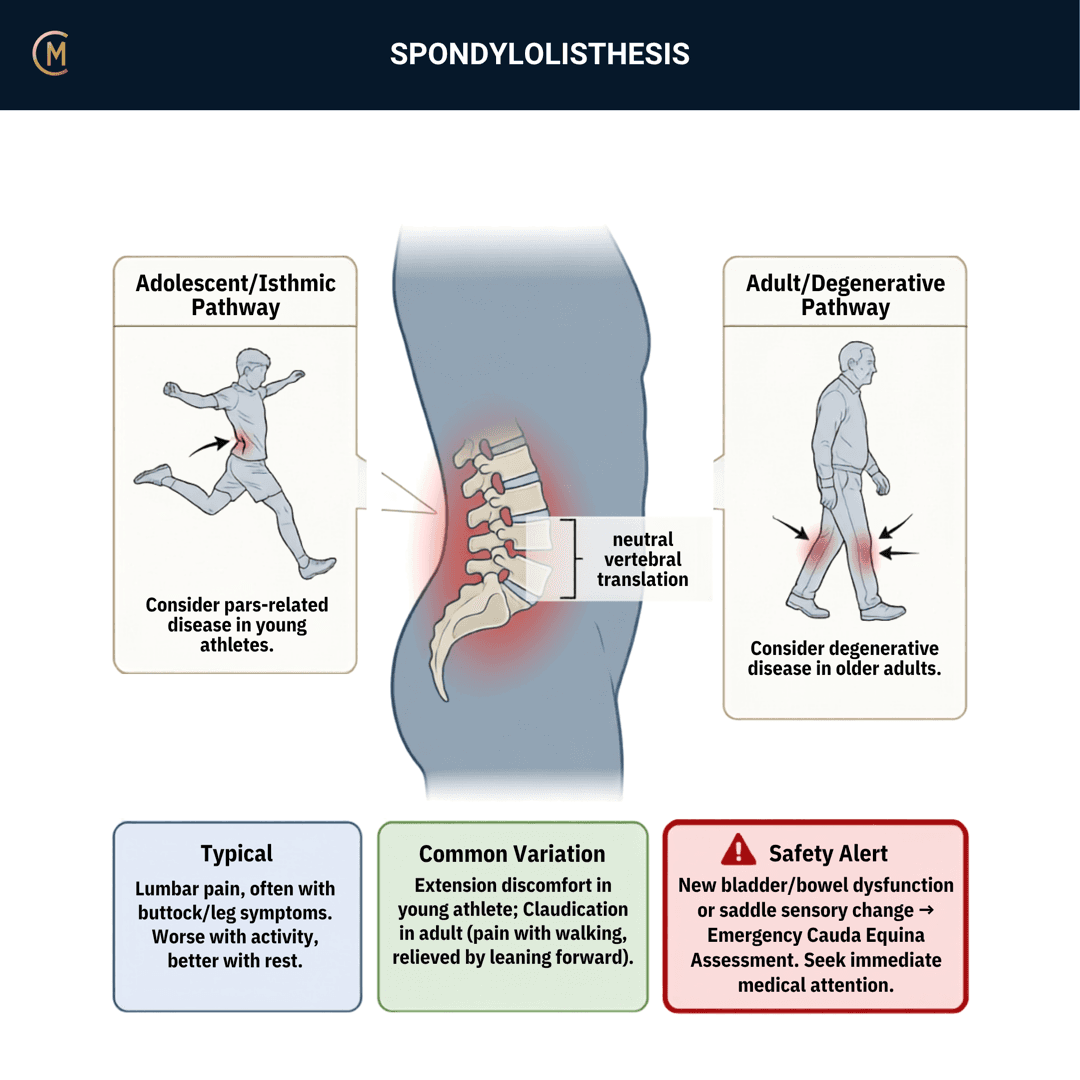
Who: Two different people. Adolescent athletes in extension sports, and older adults with degenerative change.
What: Forward slip of one vertebra on another.
How it behaves: Local or bilateral lumbar pain ± referred buttock or thigh pain. Aggs: extension, prolonged standing, activity. Eases: rest or flexion. May describe clicking or a "slipping" sensation.
The one thing to take from this page:
Isthmic and degenerative spondylolisthesis share a word and almost nothing else. Different age, different mechanism, different level, different natural history — and the clinical guideline only covers one of them. Work out which one you have before you do anything else.
Two conditions, one word
| ISTHMIC | DEGENERATIVE | |
|---|---|---|
| Who | Adolescent athlete | Typically over 50 |
| Mechanism | A pars defect — spondylolysis comes first | Facet and disc degeneration |
| Sports | Extension and rotation — gymnastics, cricket fast bowling, diving | Not sport-driven |
| Level | Usually L5–S1 | Usually L4–L5 |
| Guideline | Not covered | Covered, with a natural history systematic review |
| Watch for | Missing the lysis before the slip | Radicular symptoms and stenosis |
2 · SE — THE SUBJECTIVE PATTERN (the 70%)
Five stages, in your course's order.
MAIN PROBLEM
"It hurts when I arch back."
"I can't stand at the sink for more than ten minutes."
"It feels like something's shifting."
BODY CHART
- Local lumbar, often bilateral, often low.
- Buttock or posterior thigh referral? Common, and non-dermatomal.
- Any dermatomal leg pain, numbness or weakness? That's a radicular question and it changes the page.
- Both legs, with walking? That's a stenosis question — common in the degenerative group.
BEHAVIOUR — extension is the signature
- Aggs: extension, prolonged standing, walking, activity, arching. In the adolescent: the sport itself.
- Eases: rest, sitting, flexion. Flexion-easing is the pattern.
- 24-hr pattern: extension, prolonged standing and walking build it; rest, sitting and flexion ease it. Standing tolerance in minutes is the measure.
- Night: night pain and rest pain are §4 flags.
- Severity: VAS 0–10 at best / at worst / right now.
- Coding: M / In / P / Is.
- Irritability: resting symptoms + vigour of the provoking activity + time to settle.
- Standing tolerance in minutes is the practical measure.
HISTORY — and the first question is age
Under twenty and playing an extension sport? Think isthmic, and think spondylolysis first — the defect precedes the slip. Read further: diagnosis and management of spondylolysis and spondylolisthesis [1][2], the sports presentation [3].
Over fifty with insidious onset? Think degenerative. Read further: incidence and risk factors [4], risk factors for a mobile slip [5].
- Sport, position, volume, and when the pain started relative to a training change.
- Previous imaging, and what they were told.
- Progression — is standing tolerance dropping?
- Any neurogenic claudication?
SPECIAL / SCREENING QUESTIONS
- Bladder, bowel or saddle change?
- Progressive leg weakness or numbness?
- Night pain, weight loss, fever, cancer history?
- In the adolescent: how long has this been going on, and has anyone imaged it? Delayed diagnosis of high-grade disease is described [6].
Assessing this region? Download the Lumbar Spine & SIJ assessment template →
3 · HYPOTHESIS RANKING
| Competing pattern | The one discriminating feature |
|---|---|
| Spondylolysis without slip | Same patient, same pattern, no listhesis. In the adolescent athlete this is the more likely finding, and it comes first. |
| Lumbar facet (PIV) joint | Extension-provoked and segmental, but no step, no slipping sensation, no adolescent-athlete or degenerative context. |
| Lumbar instability | Transition movements, aberrant movement, "goes out" — overlaps heavily. |
| Lumbar spinal canal stenosis | Bilateral leg heaviness with walking, eased by flexion. Frequently coexists with degenerative slip. |
| Lumbar radicular pain | Dermatomal leg pain, positive SLR or slump, neurological findings. |
| Non-specific low back pain | No extension dominance, no step, no context. |
| Sacral or pelvic stress injury (adolescent) | Focal bony tenderness, load spike, night pain. |
The one that decides the adolescent's page
Spondylolysis. The pars defect comes before the slip. A teenage athlete with several weeks of extension-related back pain who has never been imaged is the presentation where high-grade disease gets diagnosed late (Kolenko et al. 2022). Take it seriously and get an opinion.
4 · RED FLAGS — DON'T MISS THIS
This section is free, on every pattern, forever. Safety is never gated.
| Finding | What it suggests | What you do |
|---|---|---|
| Bladder or bowel change, saddle anaesthesia, bilateral leg symptoms | Cauda equina | EMERGENCY |
| Progressive leg weakness or numbness | Neural compression | URGENT medical review |
| Rapidly worsening standing or walking tolerance | Progressive slip or stenosis | Medical review |
| Adolescent athlete with weeks of extension-related back pain, never imaged | Spondylolysis or high-grade slip | Imaging and medical review. Delayed diagnosis is described |
| Neurogenic claudication with a degenerative slip | Stenosis | Medical review |
| Night pain, rest pain, weight loss, fever, cancer history | Malignancy, infection | Urgent medical review |
| Severe pain after minimal trauma, or corticosteroid use | Fracture | Imaging |
| A visible or palpable step with a sudden change in symptoms | Progression | Medical review |
The rule: the grade on the film doesn't decide urgency — the neurology and the trajectory do. A teenager who's been sore for two months in an extension sport gets imaged.
Cross-links: Non-specific low back pain · Lumbar instability · Lumbar radicular pain · Cauda equina syndrome
5 · OE — THE OBJECTIVE (the 30%)
Members
Sections 5 to 7 are for members
The objective exam, management and pearls, plus the six-minute lesson and the debrief. Free with an account.
Sign in or join free6 · MX — MANAGEMENT ESSENTIALS
Members
Sections 5 to 7 are for members
The objective exam, management and pearls, plus the six-minute lesson and the debrief. Free with an account.
Sign in or join free7 · CLINICAL PEARLS + RETRIEVAL CHECK
Members
Sections 5 to 7 are for members
The objective exam, management and pearls, plus the six-minute lesson and the debrief. Free with an account.
Sign in or join freeMembers
The 4-minute lesson is for members
Twelve slides on this pattern: what you'll hear, what to examine, what to do. Free with an account.
Sign in or join freeGuideline anchor
No Australian guideline.
More
Anchored to the evidence-based clinical guideline for degenerative lumbar spondylolisthesis, summarised in Spine Journal (Matz et al. 2016, PMID 26681351), with a summary of guidelines for treatment (Chan et al. 2019, PMID 31078236) and definition, natural history and conservative management set out alongside it (Bydon et al. 2019, PMID 31078230). The natural history has been systematically reviewed (Atalay et al. 2023, PMID 37271258). The physiotherapy anchor is a randomised trial in Physical Therapy comparing stabilisation with flexion exercises (Nava-Bringas et al. 2021, PMID 33792726).
The guideline covers DEGENERATIVE spondylolisthesis. It does not cover the isthmic spondylolisthesis of the adolescent athlete, which has a different natural history and a different literature. Read the guideline for the older adult; read the paediatric and sports literature for the teenager.
Members
The evidence summary is for members
Verified diagnostic accuracy, where the evidence stands and what it doesn't settle. Free with an account.
Sign in or join freeSources · 20
ShowHide
Every source on this page resolves and title-verifies against PubMed. Newest first.
- 2022Wu et al. (2022). Diagnosis and Management of Spondylolysis and Spondylolisthesis in Children. JBJS reviews, 10(3). https://doi.org/10.2106/JBJS.RVW.21.00176
- 2022Mohile et al. (2022). Spondylolysis and Isthmic Spondylolisthesis: A Guide to Diagnosis and Management. Journal of the American Board of Family Medicine : JABFM, 35(6), 1204-1216. https://doi.org/10.3122/jabfm.2022.220130R1
- 2021Chung & Shimer (2021). Lumbosacral Spondylolysis and Spondylolisthesis. Clinics in sports medicine, 40(3), 471-490. https://doi.org/10.1016/j.csm.2021.03.004
- 2022Yamada et al. (2022). Incidence of and risk factors for spondylolisthesis, scoliosis, and vertebral fracture in rheumatoid arthritis. Journal of bone and mineral metabolism, 40(1), 120-131. https://doi.org/10.1007/s00774-021-01261-y
- 2015Grannum et al. (2015). Risk Factors For the Development of a Mobile Degenerative Spondylolisthesis at L4-L5. Spine deformity, 3(1), 98-104. https://doi.org/10.1016/j.jspd.2014.06.012
- 2022Kolenko & Bauer (2022). A delayed diagnosis of high-grade spondylolisthesis. JAAPA : official journal of the American Academy of Physician Assistants, 35(3), 38-41. https://doi.org/10.1097/01.JAA.0000805816.85664.a6
- 2017Beneck et al. (2017). Spondylolisthesis Identified Using Ultrasound Imaging. The Journal of orthopaedic and sports physical therapy, 47(12), 970. https://doi.org/10.2519/jospt.2017.7363
- 2021Nava-Bringas et al. (2021). Stabilization Exercises Versus Flexion Exercises in Degenerative Spondylolisthesis: A Randomized Controlled Trial. Physical therapy, 101(8). https://doi.org/10.1093/ptj/pzab108
- 2024Lin et al. (2024). Effectiveness of Lumbar Segmental Stabilization Exercises in Managing Disability and Pain Intensity Among Patients With Lumbar Spondylolysis and Spondylolisthesis: A Systematic Review and Meta-analysis of Randomized Controlled Trials. Spine, 49(21), 1512-1520. https://doi.org/10.1097/BRS.0000000000004989
- 2023Atalay et al. (2023). Natural History of Degenerative Spondylolisthesis: A Systematic Review and Meta-analysis. World neurosurgery, 176, e634-e643. https://doi.org/10.1016/j.wneu.2023.05.112
- 2019Bydon et al. (2019). Degenerative Lumbar Spondylolisthesis: Definition, Natural History, Conservative Management, and Surgical Treatment. Neurosurgery clinics of North America, 30(3), 299-304. https://doi.org/10.1016/j.nec.2019.02.003
- 2019Boyd et al. (2019). Outcome of Conservative Management in the Treatment of Symptomatic Spondylolysis and Grade I Spondylolisthesis. Bulletin of the Hospital for Joint Disease (2013), 77(3), 172-182. PubMed 31487482
- 2021Austevoll et al. (2021). Decompression with or without Fusion in Degenerative Lumbar Spondylolisthesis. The New England journal of medicine, 385(6), 526-538. https://doi.org/10.1056/NEJMoa2100990
- 2023Gadjradj et al. (2023). Decompression alone versus decompression with fusion in patients with lumbar spinal stenosis with degenerative spondylolisthesis: a systematic review and meta-analysis. European spine journal : official publication of the European Spine Society, the European Spinal Deformity Society, and the European Section of the Cervical Spine Research Society, 32(3), 1054-1067. https://doi.org/10.1007/s00586-022-07507-1
- 2025Nedelea et al. (2025). Surgical and non-surgical management of spondylolisthesis: a comprehensive review. Journal of medicine and life, 18(3), 196-207. https://doi.org/10.25122/jml-2025-0039
- 2016Matz et al. (2016). Guideline summary review: An evidence-based clinical guideline for the diagnosis and treatment of degenerative lumbar spondylolisthesis. The spine journal : official journal of the North American Spine Society, 16(3), 439-48. https://doi.org/10.1016/j.spinee.2015.11.055
- 2019Chan et al. (2019). Summary of Guidelines for the Treatment of Lumbar Spondylolisthesis. Neurosurgery clinics of North America, 30(3), 353-364. https://doi.org/10.1016/j.nec.2019.02.009
- 2020Aoki et al. (2020). Prevalence of lumbar spondylolysis and spondylolisthesis in patients with degenerative spinal disease. Scientific reports, 10(1), 6739. https://doi.org/10.1038/s41598-020-63784-0
- 2022Akkawi & Zmerly (2022). Degenerative Spondylolisthesis: A Narrative Review. Acta bio-medica : Atenei Parmensis, 92(6), e2021313. https://doi.org/10.23750/abm.v92i6.10526
- 2024Rahyussalim et al. (2024). Association between spinopelvic alignment and the development of degenerative spondylolisthesis: a systematic review and meta-analysis. European journal of orthopaedic surgery & traumatology : orthopedie traumatologie, 34(2), 713-722. https://doi.org/10.1007/s00590-023-03754-0
Mapped to this pattern
Generic measures that also apply
- Borg RPE
Borg Rating of Perceived Exertion Scale (6-20)
perceived exertion · 1 items · 1 min
- GROC
Global Rating of Change Scale
perceived change since baseline · 1 items · 1 min
- NPRS
Numeric Pain Rating Scale
pain intensity · 1 items · 1 min
- PGIC
Patient Global Impression of Change
perceived change since baseline · 1 items · 1 min
- PSFS
Patient-Specific Functional Scale
patient-generated function · 3 items · 2 min
- SANE
Single Assessment Numeric Evaluation
patient-rated function as a percentage of normal · 1 items · 1 min
- VAS
Visual Analogue Scale
pain intensity · 1 items · 1 min
- Borg CR10
Borg Category Ratio 10 Scale
perceived exertion or symptom intensity, ratio scale · 1 items · 1 min
- GAS
Goal Attainment Scaling
individualised goal achievement · 10 min
Did this page do its job?
CliniStudy is in beta. One tap is enough — it decides what gets fixed first.