
1 · SNAPSHOT
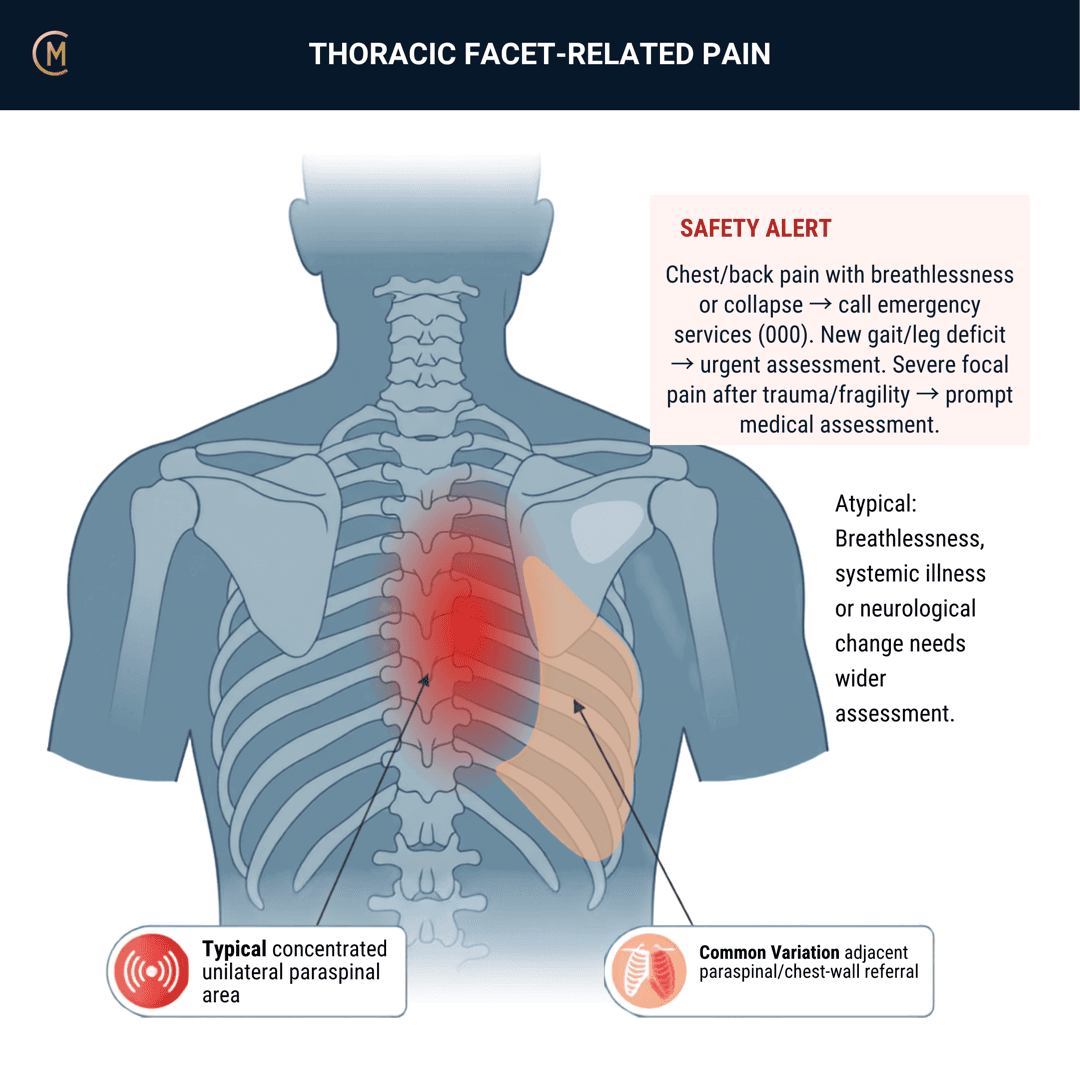
Who: Anyone. Desk-based workers, adolescents and people who did something awkward. It is common enough to have been studied in the general population, in workers and in high school students.
What: Segmental thoracic pain of PIV joint origin. Honestly labelled: non-specific thoracic spine pain with a segmental, movement-provoked presentation.
How it behaves: Localised, sharp or stabbing. Aggs: extension, ipsilateral rotation, deep breathing, coughing. Eases: unloading, gentle movement. May wrap around the rib cage — pseudo-visceral referral.
The one thing to take from this page:
This is the most common thing you'll see in the thoracic spine and it responds well — but no test names the joint, and the wrap around the rib cage is the exact presentation where a cardiac or pulmonary cause gets missed. Clear the chest, then treat the pattern.
Two honest notes before you start
| The claim | The correction |
|---|---|
| "Manipulation is highly effective for rapid relief" | The thoracic-pain trials are old and small, and no effect estimate is verified. Most modern thoracic manipulation trials are about NECK pain. Manual therapy stays. The adjective goes. |
| "It's the T6 facet" | No verified test names a thoracic segment or joint as the source. Reliability is not accuracy. Patterns > labels. |
2 · SE — THE SUBJECTIVE PATTERN (the 70%)
Five stages, in your course's order.
MAIN PROBLEM
"I turned to grab something in the back seat and it caught."
"There's a sharp spot between my shoulder blades."
"It goes round to the front when it's bad."
BODY CHART
- Localised, paravertebral, often unilateral. One or two fingers, not a hand.
- Draw the wrap if there is one. Note where it ends — around the chest wall, or into the abdomen?
- Mark the neck and the shoulder girdle. They come together often.
- Any arm or leg symptoms? Ask. The answer should be no.
BEHAVIOUR
- Aggs: extension, ipsilateral rotation, reaching behind, deep breathing, coughing, sustained sitting.
- Eases: unloading, gentle movement, changing position, lying down.
- 24-hr pattern: aches after sustained sitting, eases with gentle movement and unloading.
- Night: lying down is in the Eases. Night pain and rest pain are §4 flags.
- Severity: VAS 0–10 at best / at worst / right now.
- Coding: M / In / P / Is.
- Irritability: resting symptoms + vigour of the provoking activity + time to settle. Usually low.
- The key: is there a movement that reliably reproduces it? If there is, that's your comparable sign and your whole reassessment.
HISTORY
- Onset — awkward movement, a lift, a sustained posture, or nothing at all.
- Work and study posture, hours, and equipment. It is common in workers and in adolescents.
- Previous episodes. Recurrence is the norm.
- General health, including anything cardiac, respiratory or gastrointestinal.
SPECIAL / SCREENING QUESTIONS — always, on chest wall pain
- Any breathlessness, sweating, nausea, dizziness?
- Is it linked to exertion?
- Any fever, night sweats, weight loss, night or rest pain?
- Any relationship to food, meals, or bowel habit?
- Any arm, leg or bladder and bowel symptoms?
Assessing this region? Download the Thoracic Spine assessment template →
3 · HYPOTHESIS RANKING
| Competing pattern | The one discriminating feature |
|---|---|
| Costovertebral / costotransverse dysfunction | Sharp and catching with the breath, reproduced by rib springing rather than central or unilateral PA. These two overlap heavily — and it barely changes what you do. |
| Costochondritis | Anterior, at the junctions, tender there, not reproduced from behind. |
| Rib contusion or stress injury | Trauma or overuse history, focal bony tenderness. |
| Thoracic discogenic pain | Flexion-loading dominant, band-like, ± neurology. |
| Cervical referral | Reproduced from the neck. Read further: cervicothoracic differentiation testing, reliability and diagnostic accuracy [1]. |
| Shoulder girdle referral | Reproduced by shoulder tests, not by spinal movement. |
| Axial spondyloarthritis | The inflammatory time pattern — morning stiffness easing with movement over three months, under forty. |
The one that outranks the table — and this is why the wrap matters
The pseudo-visceral wrap is the classic presentation, and it is also exactly the presentation where a visceral cause gets missed. The pearl says it: always rule out cardiac and pulmonary red flags with chest wall pain. The entity itself is real and treatable — thoracic spine pain with pseudovisceral symptoms has been described and treated [2] — which is exactly why you have to earn the label rather than assume it.
Reproduce it, or don't diagnose it.
4 · RED FLAGS — DON'T MISS THIS
This section is free, on every pattern, forever. Safety is never gated.
A low-risk label does not mean you skip this. The low-risk label is what's left after you've done it.
| Finding | What it suggests | What you do |
|---|---|---|
| Central or crushing chest pain, breathlessness, sweating, nausea, radiation to jaw or arm | Cardiac | 000 / EMERGENCY |
| Exertional onset, settling with rest | Cardiac until proven otherwise | Same-day medical review |
| Pleuritic pain with breathlessness, calf symptoms, recent immobility or surgery | Pulmonary embolus | EMERGENCY |
| Pain not reproduced by any movement or palpation | Not mechanical | Medical review |
| Chest wall pain you can reproduce, especially left-sided | Still not a cardiac clearance — chest wall syndrome coexisted with coronary disease in 19 and neoplasm in 6 of 300 primary care cases (Verdon et al. 2007) [21] | Finish the cardiac screen anyway |
| Abnormal vital signs | Whatever the cause | Medical review |
| Night pain, rest pain, fever, weight loss, cancer history | Infection, malignancy | Urgent medical review |
| Any neurological deficit, band of altered sensation, or gait change | Cord | URGENT |
| Relationship to meals, or associated gastrointestinal symptoms | Visceral | Medical review |
| Inflammatory time pattern in someone under forty | Axial spondyloarthritis | Rheumatology referral |
The rule: always rule out cardiac and pulmonary red flags with chest wall pain. The wrap around the rib cage is the thing that makes this pattern feel obvious and the thing that makes it dangerous. Take the vitals.
Cross-links: Costovertebral / costotransverse dysfunction · Costochondritis / Tietze's · Cardiac / pulmonary referred pain · Thoracic discogenic pain
5 · OE — THE OBJECTIVE (the 30%)
Members
Sections 5 to 7 are for members
The objective exam, management and pearls, plus the six-minute lesson and the debrief. Free with an account.
Sign in or join free6 · MX — MANAGEMENT ESSENTIALS
Members
Sections 5 to 7 are for members
The objective exam, management and pearls, plus the six-minute lesson and the debrief. Free with an account.
Sign in or join free7 · CLINICAL PEARLS + RETRIEVAL CHECK
Members
Sections 5 to 7 are for members
The objective exam, management and pearls, plus the six-minute lesson and the debrief. Free with an account.
Sign in or join freeMembers
The 4-minute lesson is for members
Twelve slides on this pattern: what you'll hear, what to examine, what to do. Free with an account.
Sign in or join freeGuideline anchor
No Australian guideline for this presentation, and no clinical practice guideline for thoracic spine pain at all.
More
Anchored to the survey of clinical practice in the management of thoracic spine pain and dysfunction (Heneghan et al. 2019, PMID 30500720) and the cross-sectional study of the management of non-specific thoracic spine pain (Risetti et al. 2023, PMID 37202740), with the review of outcome measures used in conservative management (Kovanur Sampath et al. 2026, PMID 41577354). Epidemiology is anchored to the Australian-led general-population work (Briggs et al. 2009, PMID 19563667).
No clinical practice guideline exists for thoracic spine pain. What anchors this page is a practice survey, a cross-sectional management study and an outcome-measures review — descriptions of what clinicians do, not recommendations about what works. The trials in mechanical thoracic pain are old and small; the modern manipulation trials are mostly about NECK pain.
Members
The evidence summary is for members
Verified diagnostic accuracy, where the evidence stands and what it doesn't settle. Free with an account.
Sign in or join freeSources · 20
ShowHide
Every source on this page resolves and title-verifies against PubMed. Newest first.
- 2019Swanson et al. (2019). Reliability and diagnostic accuracy of cervicothoracic differentiation testing and regional unloading for identifying improvement after thoracic manipulation in individuals with neck pain. Musculoskeletal science & practice, 39, 80-90. https://doi.org/10.1016/j.msksp.2018.11.013
- 2022Perry (2022). Treatment of thoracic spine pain and pseudovisceral symptoms with dry needling and manual therapy in a 78-year-old female: A case report. Physiotherapy theory and practice, 38(13), 3255-3263. https://doi.org/10.1080/09593985.2021.1987603
- 2020Takatalo et al. (2020). Intra- and inter-rater reliability of thoracic spine mobility and posture assessments in subjects with thoracic spine pain. BMC musculoskeletal disorders, 21(1), 529. https://doi.org/10.1186/s12891-020-03551-4
- 2022Määttä et al. (2022). Lower thoracic spine extension mobility is associated with higher intensity of thoracic spine pain. The Journal of manual & manipulative therapy, 30(5), 300-308. https://doi.org/10.1080/10669817.2022.2047270
- 2026Kovanur Sampath et al. (2026). Outcome measures used in the conservative management of people with non-specific thoracic spine pain (NTSP): a scoping review protocol. BMJ open, 16(1), e114437. https://doi.org/10.1136/bmjopen-2025-114437
- 2001Schiller (2001). Effectiveness of spinal manipulative therapy in the treatment of mechanical thoracic spine pain: a pilot randomized clinical trial. Journal of manipulative and physiological therapeutics, 24(6), 394-401. https://doi.org/10.1067/mmt.2001.116420
- 2002Long (2002). Effectiveness of spinal manipulative therapy in the treatment of mechanical thoracic spine pain: a pilot randomized clinical trial. Journal of manipulative and physiological therapeutics, 25(8), 538. https://doi.org/10.1067/mmt.2002.127068
- 2008Crothers et al. (2008). Spinal manipulative therapy versus Graston Technique in the treatment of non-specific thoracic spine pain: design of a randomised controlled trial. Chiropractic & osteopathy, 16, 12. https://doi.org/10.1186/1746-1340-16-12
- 2014Young et al. (2014). Thoracic manipulation versus mobilization in patients with mechanical neck pain: a systematic review. The Journal of manual & manipulative therapy, 22(3), 141-53. https://doi.org/10.1179/2042618613Y.0000000043
- 2016Dunning et al. (2016). Upper cervical and upper thoracic manipulation versus mobilization and exercise in patients with cervicogenic headache: a multi-center randomized clinical trial. BMC musculoskeletal disorders, 17, 64. https://doi.org/10.1186/s12891-016-0912-3
- 2024Yang et al. (2024). Effectiveness and safety of thoracic manipulation in the treatment of neck pain: An updated systematic review and meta-analysis. Technology and health care : official journal of the European Society for Engineering and Medicine, 32(S1), 385-402. https://doi.org/10.3233/THC-248034
- 2019Heneghan et al. (2019). Management of thoracic spine pain and dysfunction: A survey of clinical practice in the UK. Musculoskeletal science & practice, 39, 58-66. https://doi.org/10.1016/j.msksp.2018.11.006
- 2023Risetti et al. (2023). Management of non-specific thoracic spine pain: a cross-sectional study among physiotherapists. BMC musculoskeletal disorders, 24(1), 398. https://doi.org/10.1186/s12891-023-06505-8
- 2014Rock & Rainey (2014). Treatment of nonspecific thoracic spine pain with trigger point dry needling and intramuscular electrical stimulation: a case series. International journal of sports physical therapy, 9(5), 699-711. PubMed 25328832
- 2015Fernández-de-Las-Peñas et al. (2015). Dry needling for the management of thoracic spine pain. The Journal of manual & manipulative therapy, 23(3), 147-53. https://doi.org/10.1179/2042618615Y.0000000001
- 2009Briggs et al. (2009). Prevalence and associated factors for thoracic spine pain in the adult working population: a literature review. Journal of occupational health, 51(3), 177-92. https://doi.org/10.1539/joh.k8007
- 2009Briggs et al. (2009). Thoracic spine pain in the general population: prevalence, incidence and associated factors in children, adolescents and adults. A systematic review. BMC musculoskeletal disorders, 10, 77. https://doi.org/10.1186/1471-2474-10-77
- 2014Roquelaure et al. (2014). Incidence and risk factors for thoracic spine pain in the working population: the French Pays de la Loire study. Arthritis care & research, 66(11), 1695-702. https://doi.org/10.1002/acr.22323
- 2020Bikbov et al. (2020). Prevalence of and factors associated with low Back pain, thoracic spine pain and neck pain in Bashkortostan, Russia: the Ural Eye and Medical Study. BMC musculoskeletal disorders, 21(1), 64. https://doi.org/10.1186/s12891-020-3080-4
- 2023De Vitta et al. (2023). Thoracic Spine Pain in High School Adolescents: A One-Year Longitudinal Study. Healthcare (Basel, Switzerland), 11(2). https://doi.org/10.3390/healthcare11020196
Generic measures that also apply
- Borg RPE
Borg Rating of Perceived Exertion Scale (6-20)
perceived exertion · 1 items · 1 min
- GROC
Global Rating of Change Scale
perceived change since baseline · 1 items · 1 min
- NPRS
Numeric Pain Rating Scale
pain intensity · 1 items · 1 min
- PGIC
Patient Global Impression of Change
perceived change since baseline · 1 items · 1 min
- PSFS
Patient-Specific Functional Scale
patient-generated function · 3 items · 2 min
- SANE
Single Assessment Numeric Evaluation
patient-rated function as a percentage of normal · 1 items · 1 min
- VAS
Visual Analogue Scale
pain intensity · 1 items · 1 min
- Borg CR10
Borg Category Ratio 10 Scale
perceived exertion or symptom intensity, ratio scale · 1 items · 1 min
- GAS
Goal Attainment Scaling
individualised goal achievement · 10 min
Did this page do its job?
CliniStudy is in beta. One tap is enough — it decides what gets fixed first.