
1 · SNAPSHOT
Who: Repetitive overhead activity, carrying, trauma, or a long history of postural loading. Overhead athletes specifically.
What: Compression of the neurovascular bundle at the thoracic outlet. Three syndromes share the name.
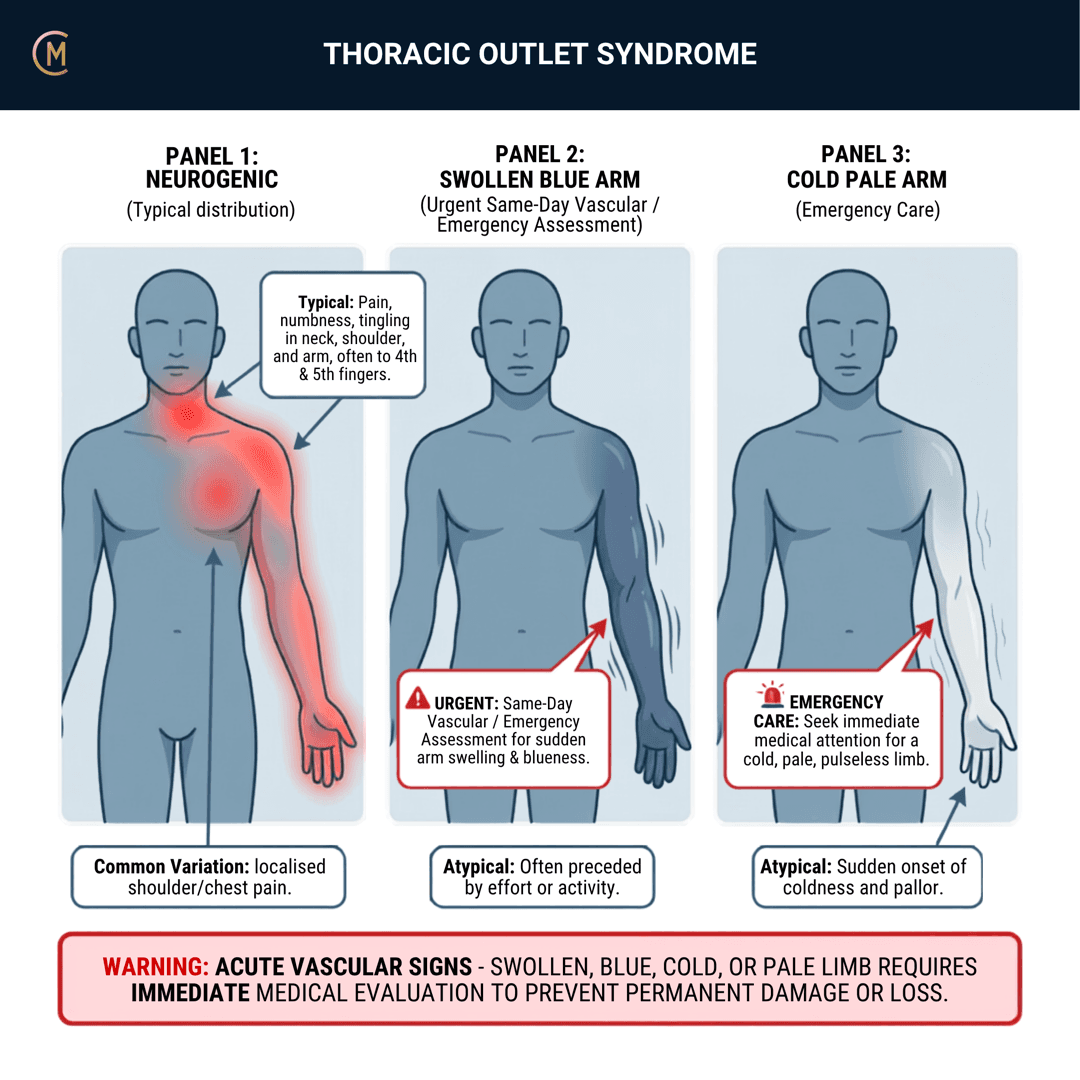
How it behaves: Pain and paraesthesia — neck, shoulder, arm, hand. Aggs: overhead activity, carrying loads, sustained postures. May describe swelling, heaviness, a cold hand.
Three syndromes, one name
| What you see | What it is | |
|---|---|---|
| Neurogenic (nTOS) | Pain, paraesthesia, hand weakness and clumsiness | The large majority. Your patient. |
| Venous (vTOS) | Swollen, heavy, discoloured arm, often after effort | Effort thrombosis. SAME-DAY. |
| Arterial (aTOS) | Cold, pale hand, diminished pulse, distal ischaemic changes | Possible arterial ischaemia requires emergency assessment. |
The one thing to take from this page:
This is a diagnosis of exclusion. Clear the cervical spine and the distal entrapments first, and take the vascular history every single time — because patients may describe a swollen, heavy, cold hand, and two of the three syndromes that share this name need medical review before any rehabilitation.
2 · SE — THE SUBJECTIVE PATTERN (the 70%)
Five stages, in your course's order.
MAIN PROBLEM
"My arm goes dead when I work above my head."
"Carrying the shopping sets it off."
"My hand feels heavy and clumsy by the end of the day."
BODY CHART
Chart interpretation: Neurogenic symptoms, possible venous thrombosis and possible arterial ischaemia need separate interpretation. Atypical means atypical for routine musculoskeletal rehabilitation, not necessarily atypical for that vascular subtype.
- Neck, shoulder girdle, down the arm, into the hand. Map it and mark P1.
- Ask which fingers. A C8/T1 distribution — ulnar border, ring and little finger — is the classic nTOS pattern and it is not the classic carpal tunnel pattern.
- Mark colour, temperature and swelling changes on the chart. Most students never do. On this pattern it changes the disposition.
BEHAVIOUR
- Aggs: overhead activity, carrying loads, sustained postures, prolonged driving, sleeping with the arm overhead.
- Eases: lowering the arm, unloading the shoulder girdle, rest.
- 24-hr pattern: builds with overhead activity and carrying loads, settles when the arm comes down.
- Night: sleeping with the arm overhead is in the Aggs. Night pain with weight loss, fever or a lower-trunk pattern is the §4 flag.
- Severity: VAS 0–10 at best / at worst / right now.
- The position, not the movement, is usually the aggravator. Ask how long they can hold the arm up before it starts.
- Irritability: resting symptoms + vigour of the provoking position + time to settle. Time-to-settle after overhead work is your best asterisk here.
HISTORY
- Repetitive overhead activity — occupational or sporting. Read further: TOS in sport [1].
- Trauma — including cervical or clavicular injury.
- Postural loading, a long desk or driving history.
- Any previous neck imaging? Ask whether a cervical rib was ever mentioned.
- Progression — is the hand getting weaker or clumsier?
SPECIAL / SCREENING QUESTIONS — do not skip these
- Has the arm ever swollen, gone blue or purple, or felt heavy after effort? → venous.
- Does the hand go cold, white or blotchy? → arterial.
- Any sudden change?
- Any night pain, weight loss, fever, or smoking history with a new neck or shoulder symptom? — the apical lung.
- Any dropping of objects, wasting, or loss of dexterity?
Assessing this region? Download the Thoracic Spine assessment template →
3 · HYPOTHESIS RANKING
On this pattern the ranking is not a formality — it is the diagnosis. TOS is defined by what you have excluded.
| Competing pattern | The one discriminating feature |
|---|---|
| Cervical radiculopathy | Dermatomal and myotomal, reproduced by neck movement, not by arm position. Cervical Compression and the distraction relief pattern. Clear this first. |
| Distal nerve entrapment — cubital or carpal tunnel | Symptoms localised to that nerve's territory below the elbow or wrist, and provoked at that site. |
| Rotator cuff–related shoulder pain | Pain with resisted shoulder tests, not paraesthesia, and no hand symptoms. |
| Suprascapular nerve entrapment | Posterior shoulder, infraspinatus wasting, no hand symptoms. |
| Mechanical neck pain with referral | Referral without neurological findings or positional vascular features. |
| Complex regional pain / widespread sensitisation | Non-anatomical distribution, allodynia, autonomic features without a positional pattern. |
The ones that outrank the table
- Venous TOS (effort thrombosis). Swollen, heavy, discoloured arm. Not a rehab problem.
- Arterial TOS. Cold, pale, diminished pulse, distal ischaemic changes. Medical review first. Acute limb ischaemia is an emergency; outside that, management typically begins conservatively, with physical therapy, after the medical work-up (Huang et al. 2021) [21].
- Apical lung pathology. Smoking history, night pain, weight loss, a lower-trunk pattern.
One anatomical factor to ask about
Cervical rib. Read further: cervical rib prevalence and its association with TOS [2]. The practical point is that this is not purely a postural condition, and asking whether previous imaging ever mentioned an extra rib is a free question.
4 · RED FLAGS — DON'T MISS THIS
This section is free, on every pattern, forever. Safety is never gated.
Two of the three syndromes that share this name are vascular.
| Finding | What it suggests | What you do |
|---|---|---|
| Swollen, heavy, blue or purple arm, especially after effort | Venous TOS / effort thrombosis (Paget-Schroetter) | SAME-DAY medical review. Do not treat, do not massage, do not mobilise |
| Cold, pale painful hand with diminished/absent pulse | Possible arterial ischaemia | Emergency assessment |
| Arm claudication — aches and tires with use, settles with rest — or a pale, cool arm, especially in an overhead athlete | Possible arterial TOS (Huang et al. 2021) [21] | Medical review before you rehab it — diagnosis needs imaging |
| Sudden colour change, severe pain, distal ischaemic changes or digital ulceration | Arterial event or embolus | EMERGENCY |
| Progressive hand weakness, wasting or loss of dexterity | Established neurogenic compression | Urgent medical / surgical review |
| Night pain, weight loss, fever, smoking history, lower-trunk pattern | Apical lung pathology | Urgent medical review |
| Bilateral upper limb neurology, gait change, or upper motor neurone signs | Cord | Urgent medical review |
| Symptoms after neck or clavicular trauma with a vascular feature | Vascular injury | Urgent medical review |
The rule: a swollen arm or a cold hand is a vascular finding, not a postural one. The classification of these syndromes is set out in the consensus documents and the reporting standards — and the point of knowing it is that the two vascular syndromes get a medical review before you rehabilitate them.
Cross-links: Cervical radiculopathy · Mechanical neck pain · Rotator cuff–related shoulder pain · Suprascapular nerve entrapment
5 · OE — THE OBJECTIVE (the 30%)
Members
Sections 5 to 7 are for members
The objective exam, management and pearls, plus the six-minute lesson and the debrief. Free with an account.
Sign in or join free6 · MX — MANAGEMENT ESSENTIALS
Members
Sections 5 to 7 are for members
The objective exam, management and pearls, plus the six-minute lesson and the debrief. Free with an account.
Sign in or join free7 · CLINICAL PEARLS + RETRIEVAL CHECK
Members
Sections 5 to 7 are for members
The objective exam, management and pearls, plus the six-minute lesson and the debrief. Free with an account.
Sign in or join freeMembers
The 4-minute lesson is for members
Twelve slides on this pattern: what you'll hear, what to examine, what to do. Free with an account.
Sign in or join freeGuideline anchor
No Australian guideline for this presentation.
More
Anchored to the European Association of Neurosurgical Societies consensus pair — Part I on anatomy, diagnosis and classification (Dengler et al. 2022, PMID 35319532) and Part II on the management of neurogenic TOS (Rochkind et al. 2023, PMID 36542350) — with the INTOS Workgroup consensus recommendations (Chim et al. 2024, PMID 39206209), the expert consensus on diagnostic criteria (Wagner et al. 2026, PMID 42169800), and the Society for Vascular Surgery reporting standards (Illig et al. 2016, PMID 27565607). Imaging is anchored to the ACR Appropriateness Criteria (Zurkiya et al. 2020, PMID 32370976).
These are consensus documents, not evidence-graded clinical guidelines. They exist precisely because the evidence base does not support a graded guideline — Cochrane has reviewed treatment for TOS and the field is still writing consensus criteria in 2026. Treat them as the best available agreement, not as settled evidence.
Members
The evidence summary is for members
Verified diagnostic accuracy, where the evidence stands and what it doesn't settle. Free with an account.
Sign in or join freeSources · 20
ShowHide
Every source on this page resolves and title-verifies against PubMed. Newest first.
- 2022Garraud et al. (2022). Thoracic Outlet Syndrome in Sport: A Systematic Review. Frontiers in physiology, 13, 838014. https://doi.org/10.3389/fphys.2022.838014
- 2018Henry et al. (2018). Cervical Rib Prevalence and its Association with Thoracic Outlet Syndrome: A Meta-Analysis of 141 Studies with Surgical Considerations. World neurosurgery, 110, e965-e978. https://doi.org/10.1016/j.wneu.2017.11.148
- 2026Wagner et al. (2026). Defining Diagnostic Criteria for Neurogenic Thoracic Outlet Syndrome: An Expert Consensus. Orthopaedic journal of sports medicine, 14(5), 23259671261440925. https://doi.org/10.1177/23259671261440925
- 2020Zurkiya et al. (2020). ACR Appropriateness Criteria® Thoracic Outlet Syndrome. Journal of the American College of Radiology : JACR, 17(5S), S323-S334. https://doi.org/10.1016/j.jacr.2020.01.029
- 2019Hardy et al. (2019). Thoracic Outlet Syndrome: Diagnostic Accuracy of MRI. Orthopaedics & traumatology, surgery & research : OTSR, 105(8), 1563-1569. https://doi.org/10.1016/j.otsr.2019.09.020
- 2022Daley et al. (2022). Use of Electroneuromyography in the Diagnosis of Neurogenic Thoracic Outlet Syndrome: A Systematic Review and Meta-Analysis. Journal of clinical medicine, 11(17). https://doi.org/10.3390/jcm11175206
- 2023Rochkind et al. (2023). Thoracic Outlet Syndrome Part II: Consensus on the Management of Neurogenic Thoracic Outlet Syndrome by the European Association of Neurosurgical Societies' Section of Peripheral Nerve Surgery. Neurosurgery, 92(2), 251-257. https://doi.org/10.1227/neu.0000000000002232
- 2024Chim & Hagan (2024). Consensus Recommendations for Neurogenic Thoracic Outlet Syndrome from the INTOS Workgroup. Plastic and reconstructive surgery. Global open, 12(8), e6107. https://doi.org/10.1097/GOX.0000000000006107
- 2024Hock et al. (2024). Current Clinical Concepts: Rehabilitation of Thoracic Outlet Syndrome. Journal of athletic training, 59(7), 683-695. https://doi.org/10.4085/1062-6050-0138.22
- 2021Collins & Orpin (2021). Physical Therapy Management of Neurogenic Thoracic Outlet Syndrome. Thoracic surgery clinics, 31(1), 61-69. https://doi.org/10.1016/j.thorsurg.2020.09.003
- 2019Balderman et al. (2019). Physical therapy management, surgical treatment, and patient-reported outcomes measures in a prospective observational cohort of patients with neurogenic thoracic outlet syndrome. Journal of vascular surgery, 70(3), 832-841. https://doi.org/10.1016/j.jvs.2018.12.027
- 2014Povlsen et al. (2014). Treatment for thoracic outlet syndrome. The Cochrane database of systematic reviews, 2014(11), CD007218. https://doi.org/10.1002/14651858.CD007218.pub3
- 2022Colbert et al. (2022). Rehabilitation in Overhead Athletes With Thoracic Outlet Syndrome. Arthroscopy, sports medicine, and rehabilitation, 4(1), e181-e188. https://doi.org/10.1016/j.asmr.2021.11.007
- 2023Cralle et al. (2023). Thoracic outlet syndrome in females: A systematic review. Seminars in vascular surgery, 36(4), 487-491. https://doi.org/10.1053/j.semvascsurg.2023.09.003
- 2024Price et al. (2024). Pediatric thoracic outlet syndrome: a systematic review and meta-analysis. Journal of neurosurgery. Pediatrics, 33(5), 484-495. https://doi.org/10.3171/2024.2.PEDS23511
- 2010Hooper et al. (2010). Thoracic outlet syndrome: a controversial clinical condition. Part 1: anatomy, and clinical examination/diagnosis. The Journal of manual & manipulative therapy, 18(2), 74-83. https://doi.org/10.1179/106698110X12640740712734
- 2016Illig et al. (2016). Reporting standards of the Society for Vascular Surgery for thoracic outlet syndrome. Journal of vascular surgery, 64(3), e23-35. https://doi.org/10.1016/j.jvs.2016.04.039
- 2021Illig et al. (2021). The Incidence of Thoracic Outlet Syndrome. Annals of vascular surgery, 70, 263-272. https://doi.org/10.1016/j.avsg.2020.07.029
- 2021Hwang et al. (2021). Diagnosis of Neurogenic Thoracic Outlet Syndrome Based on the Clinical Status. Annals of vascular surgery, 76, 454-462. https://doi.org/10.1016/j.avsg.2021.03.051
- 2022Dengler et al. (2022). Thoracic Outlet Syndrome Part I: Systematic Review of the Literature and Consensus on Anatomy, Diagnosis, and Classification of Thoracic Outlet Syndrome by the European Association of Neurosurgical Societies' Section of Peripheral Nerve Surgery. Neurosurgery, 90(6), 653-667. https://doi.org/10.1227/neu.0000000000001908
Mapped to this pattern
Generic measures that also apply
- Borg RPE
Borg Rating of Perceived Exertion Scale (6-20)
perceived exertion · 1 items · 1 min
- GROC
Global Rating of Change Scale
perceived change since baseline · 1 items · 1 min
- NPRS
Numeric Pain Rating Scale
pain intensity · 1 items · 1 min
- PGIC
Patient Global Impression of Change
perceived change since baseline · 1 items · 1 min
- PSFS
Patient-Specific Functional Scale
patient-generated function · 3 items · 2 min
- SANE
Single Assessment Numeric Evaluation
patient-rated function as a percentage of normal · 1 items · 1 min
- VAS
Visual Analogue Scale
pain intensity · 1 items · 1 min
- Borg CR10
Borg Category Ratio 10 Scale
perceived exertion or symptom intensity, ratio scale · 1 items · 1 min
- GAS
Goal Attainment Scaling
individualised goal achievement · 10 min
Did this page do its job?
CliniStudy is in beta. One tap is enough — it decides what gets fixed first.