
1 · SNAPSHOT
The top differential on the Dupuytren's page, and the thing that looks like it for about ten seconds.
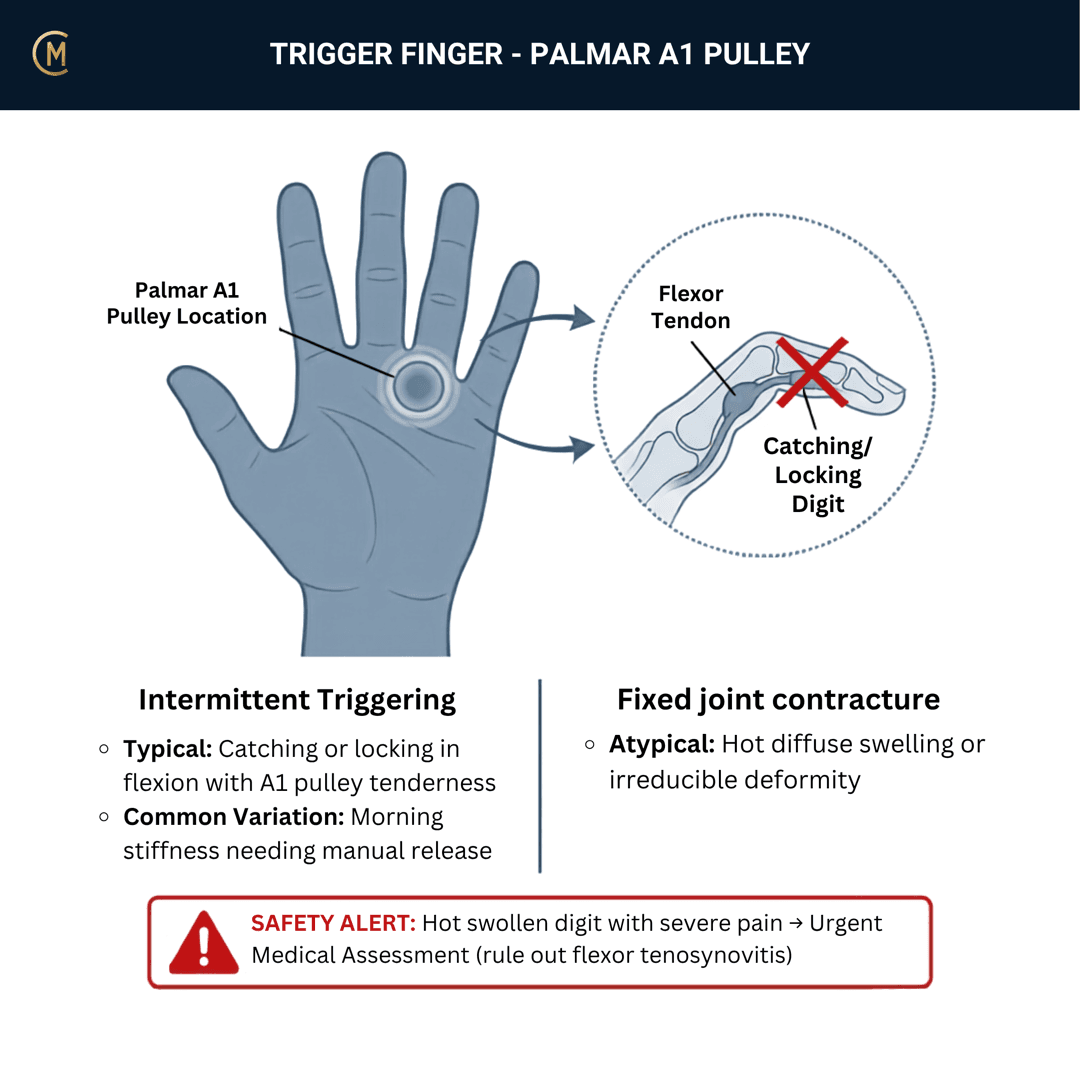
Illness script in one line: a finger that catches, clicks or locks in flexion and has to be prised straight, worst first thing in the morning, with a tender lump in the palm at the base of the finger.
Caseload frequency: common in general outpatients, and common alongside other hand problems rather than on its own.
Three questions before you treat it
This is the organising idea. The diagnosis is usually easy — the story plus a tender nodule at the A1 pulley is the whole of it. What changes management is what else is going on.
| Question | Why it changes what you do |
|---|---|
| Are they diabetic? | Read further: management of diabetic trigger finger [1], diabetes and infection risk after release [2]. |
| Is the median nerve involved? | Read further: the trigger finger and carpal tunnel association [3][4][5][6]. |
| How old are they? | Read further: paediatric trigger finger and its treatment algorithm [7]. A child's thumb is not a small adult's finger |
Ask all three in the first two minutes. None of them is about the finger.
And unusually — there is a consensus guideline, published in Physical Therapy
Read further: the European HANDGUIDE multidisciplinary consensus guideline [8], the same group's review of conservative, surgical and postsurgical interventions [9], a current-concepts review [10], conservative management [11].
2 · SE — THE SUBJECTIVE PATTERN (the 70%)
Main problem
"My finger clicks and gets stuck."
Get the grade of the complaint, because it sets the urgency:
| What they describe | What it means |
|---|---|
| Discomfort and a lump, no catching | Early. Load and splint territory |
| Catching that clears itself | The classic picture |
| Locking that needs the other hand to release it | Established, and the point where the conversation changes |
| Stuck flexed and won't come out at all | Section 4 |
Body chart
Ask them to point, and expect a surprise. The catch is felt at the PIP joint; the problem is in the palm at the A1 pulley, at the base of the finger over the MCP. Patients almost always point at the wrong joint, and being able to say "the noise is here but the problem is here" is the most reassuring thing you will say all session.
Behaviour
Aggs: first thing in the morning — the single most characteristic feature; sustained gripping, tools, steering, a bag handle, repetitive gripping at work; cold.
Eases: movement through the day, warmth, avoiding a hard sustained grip.
Severity: VAS 0–10 at best / at worst / right now.
Morning dominance matters. A finger that is worst on waking and loosens with use is this; a finger that is worst at the end of the day under load is usually something else.
History
- Gradual, no injury is the usual story.
- Diabetes — ask it directly, and ask about control, not just the label.
- Recent carpal tunnel release? Read further: trigger finger after open carpal tunnel release (Raducha et al. 2021), coincidence or complication (Lin et al. 2018).
- Inflammatory arthritis? Read further: management of trigger digit in rheumatoid arthritis [12]. Section 4.
- Any other digit done before? Read further: risk factors for a second trigger digit [13]. It tells you to warn people, and to look at the other fingers.
- Occupational and hand-load history.
Special / screening questions
- Numbness or tingling, especially at night? The median nerve question. Section 4.
- Multiple digits, both hands, or a systemic picture? Section 4.
- Can they get it straight at all? Section 4.
- In a child — which digit, and when was it first noticed? Section 4.
Assessing this region? Download the Wrist & Hand assessment template →
3 · HYPOTHESIS RANKING
| Pattern | The one discriminating feature |
|---|---|
| Trigger finger | A catch or lock in flexion, a tender nodule at the A1 pulley in the palm, worst in the morning — and full passive extension once it is unlocked. |
| Dupuytren's contracture | A palpable cord and a fixed flexion deformity that will NOT passively extend. No catch, no click, no morning dominance. Its own page — and the ten-second lookalike this page exists to separate out. |
| Carpal tunnel syndrome | Numbness rather than catching. Genuinely coexists (Gancarczyk et al. 2013; Fitch et al. 2021). One does not exclude the other — check both. |
| MCP or PIP joint pathology (OA, inflammatory) | Joint-line tenderness and swelling rather than a discrete palmar nodule, with stiffness that doesn't unlock. |
| Flexor tendon injury or partial laceration | An event, and a deficit rather than a catch. |
| Paediatric trigger thumb | A child, usually the thumb, often fixed rather than triggering. Its own algorithm. Section 4. |
| Inflammatory arthritis presenting in the flexor sheaths | Multiple digits, both hands, boggy swelling, morning stiffness well past 30 minutes (UniSA coding: In), other joints. Section 4. |
The discriminator that does most of the work: can you passively straighten it? Trigger finger unlocks. A Dupuytren's cord doesn't.
4 · RED FLAGS — DON'T MISS THIS
Free forever. Never gated.
1. A digit that will not passively extend
A finger stuck in flexion that you cannot passively straighten is not a trigger finger you are watching — it is a locked digit, and it needs an opinion rather than a review appointment.
And if it never triggered in the first place, reconsider the diagnosis: a fixed flexion deformity with a palpable cord and no catch is Dupuytren's — its own page — and a deficit after an injury is a tendon question.
2. A child
Read further: paediatric trigger finger and its treatment algorithm [7].
A child's trigger digit — usually the thumb, often held fixed rather than actively triggering — has a different natural history and a different management pathway from the adult condition. Refer to the appropriate paediatric service and do not improvise adult treatment onto it.
3. Diabetes
Read further: management of diabetic trigger finger [1], diabetes and infection risk after release [2].
This is not a reason to withhold treatment. It is a reason to ask the question, to include it in what you communicate to the referrer, and to be careful about promising a simple, low-risk operation on someone else's behalf.
4. Inflammatory arthritis in the flexor sheaths
Read further: management of trigger digit in rheumatoid arthritis [12].
Several digits, both hands, boggy rather than discrete swelling, morning stiffness well past thirty minutes (UniSA coding: In), and other joints involved is an inflammatory screen — and the referral is time-sensitive. A single nodular trigger finger is a mechanical problem; four of them across two hands is a systemic question.
5. Infection or an acutely hot, red digit
A hot, red, exquisitely tender finger with pain on passive extension is not stenosing tenosynovitis. That is a same-day medical problem.
5 · OE — THE OBJECTIVE (the 30%)
Members
Sections 5 to 7 are for members
The objective exam, management and pearls, plus the six-minute lesson and the debrief. Free with an account.
Sign in or join free6 · MX — MANAGEMENT ESSENTIALS
Members
Sections 5 to 7 are for members
The objective exam, management and pearls, plus the six-minute lesson and the debrief. Free with an account.
Sign in or join free7 · CLINICAL PEARLS + RETRIEVAL CHECK
Members
Sections 5 to 7 are for members
The objective exam, management and pearls, plus the six-minute lesson and the debrief. Free with an account.
Sign in or join freeMembers
The 4-minute lesson is for members
Twelve slides on this pattern: what you'll hear, what to examine, what to do. Free with an account.
Sign in or join freeGuideline anchor
No Australian guideline — but there is a multidisciplinary consensus guideline, and it was published in Physical Therapy.
More
The European HANDGUIDE multidisciplinary consensus guideline for managing trigger finger (Huisstede et al. 2014, PMID 24810861). Behind it, the same group's systematic review of the effectiveness of conservative, surgical and postsurgical interventions (Huisstede et al. 2018, PMID 28860097), a current-concepts review of management in adults (Gil et al. 2020, PMID 32732655) and a systematic review of conservative management in the Journal of Hand Therapy (Lunsford et al. 2019, PMID 29290504).
The HANDGUIDE document is a multidisciplinary consensus guideline, not an Australian one, and it is now over a decade old. The supporting syntheses are systematic reviews rather than guidelines.
Members
The evidence summary is for members
Verified diagnostic accuracy, where the evidence stands and what it doesn't settle. Free with an account.
Sign in or join freeSources · 20
ShowHide
Every source on this page resolves and title-verifies against PubMed. Newest first.
- 2019Kuczmarski et al. (2019). Management of Diabetic Trigger Finger. The Journal of hand surgery, 44(2), 150-153. https://doi.org/10.1016/j.jhsa.2018.03.045
- 2022Atthakomol et al. (2022). Association between diabetes mellitus and risk of infection after trigger finger release: a systematic review and meta-analysis. International orthopaedics, 46(8), 1-8. https://doi.org/10.1007/s00264-022-05440-y
- 2013Gancarczyk & Strauch (2013). Carpal tunnel syndrome and trigger digit: common diagnoses that occur "hand in hand". The Journal of hand surgery, 38(8), 1635-7. https://doi.org/10.1016/j.jhsa.2013.04.032
- 2021Fitch et al. (2021). The Coexistence of Carpal Tunnel Syndrome in Workers With Trigger Digit. Hand (New York, N.Y.), 16(6), 753-758. https://doi.org/10.1177/1558944719893048
- 2021Raducha et al. (2021). Rates of and Risk Factors for Trigger Finger after Open Carpal Tunnel Release. Journal of wrist surgery, 10(5), 413-417. https://doi.org/10.1055/s-0041-1730343
- 2018Lin et al. (2018). Coincidence or complication? A systematic review of trigger digit after carpal tunnel release. Journal of plastic surgery and hand surgery, 52(2), 67-73. https://doi.org/10.1080/2000656X.2017.1345751
- 2018Womack et al. (2018). Treatment of paediatric trigger finger: a systematic review and treatment algorithm. Journal of children's orthopaedics, 12(3), 209-217. https://doi.org/10.1302/1863-2548.12.180058
- 2014Huisstede et al. (2014). Multidisciplinary consensus guideline for managing trigger finger: results from the European HANDGUIDE Study. Physical therapy, 94(10), 1421-33. https://doi.org/10.2522/ptj.20130135
- 2018Huisstede et al. (2018). Effectiveness of Conservative, Surgical, and Postsurgical Interventions for Trigger Finger, Dupuytren Disease, and De Quervain Disease: A Systematic Review. Archives of physical medicine and rehabilitation, 99(8), 1635-1649.e21. https://doi.org/10.1016/j.apmr.2017.07.014
- 2020Gil et al. (2020). Current Concepts in the Management of Trigger Finger in Adults. The Journal of the American Academy of Orthopaedic Surgeons, 28(15), e642-e650. https://doi.org/10.5435/JAAOS-D-19-00614
- 2019Lunsford et al. (2019). Conservative management of trigger finger: A systematic review. Journal of hand therapy : official journal of the American Society of Hand Therapists, 32(2), 212-221. https://doi.org/10.1016/j.jht.2017.10.016
- 2022Bickham et al. (2022). Current Management of Trigger Digit in Rheumatoid Arthritis Patients: A Survey of ASSH Members. Hand (New York, N.Y.), 17(6), 1098-1103. https://doi.org/10.1177/1558944720975137
- 2014Ferree et al. (2014). Risk factors for return with a second trigger digit. The Journal of hand surgery, European volume, 39(7), 704-7. https://doi.org/10.1177/1753193412469129
- 2016Mifune et al. (2016). High-resolution ultrasound in the diagnosis of trigger finger and evaluation of response to steroid injection. Skeletal radiology, 45(12), 1661-1667. https://doi.org/10.1007/s00256-016-2485-5
- 2019Sato et al. (2019). Correlation between Hypervascularization of the First Annular Pulley on Color Doppler Imaging of Trigger Finger and Patients' Backgrounds. Journal of ultrasound in medicine : official journal of the American Institute of Ultrasound in Medicine, 38(11), 2909-2913. https://doi.org/10.1002/jum.14996
- 2019Teo et al. (2019). Effectiveness of proximal interphalangeal joint-blocking orthosis vs metacarpophalangeal joint-blocking orthosis in trigger digit management: A randomized clinical trial. Journal of hand therapy : official journal of the American Society of Hand Therapists, 32(4), 444-451. https://doi.org/10.1016/j.jht.2018.02.007
- 2016Malliaropoulos et al. (2016). Radial extracorporeal shockwave therapy for the treatment of finger tenosynovitis (trigger digit). Open access journal of sports medicine, 7, 143-151. https://doi.org/10.2147/OAJSM.S108126
- 2021Cushman et al. (2021). A Systematic Review of the Efficacy of Corticosteroid Injections of Tendon Sheaths, Excluding Stenosing Tenosynovitis of the Wrist and Hand. American journal of physical medicine & rehabilitation, 100(7), 683-688. https://doi.org/10.1097/PHM.0000000000001609
- 2021Abdoli et al. (2021). Comparing the Corticosteroid Injection and A1 Pulley Percutaneous Release in Treatment of Trigger Finger: A Clinical Trial. The journal of hand surgery Asian-Pacific volume, 26(2), 207-213. https://doi.org/10.1142/S2424835521500193
- 2022Burton et al. (2022). Multi-site evaluation of advanced practice hand therapy clinics for the management of patients with trigger digit. Journal of hand therapy : official journal of the American Society of Hand Therapists, 35(4), 655-664. https://doi.org/10.1016/j.jht.2021.06.007
Generic measures that also apply
- Borg RPE
Borg Rating of Perceived Exertion Scale (6-20)
perceived exertion · 1 items · 1 min
- DASH
Disabilities of the Arm, Shoulder and Hand
upper limb disability · 30 items · 8 min
- GROC
Global Rating of Change Scale
perceived change since baseline · 1 items · 1 min
- NPRS
Numeric Pain Rating Scale
pain intensity · 1 items · 1 min
- PGIC
Patient Global Impression of Change
perceived change since baseline · 1 items · 1 min
- PSFS
Patient-Specific Functional Scale
patient-generated function · 3 items · 2 min
- QuickDASH
QuickDASH
upper limb disability, short form · 11 items · 4 min
- SANE
Single Assessment Numeric Evaluation
patient-rated function as a percentage of normal · 1 items · 1 min
- UEFI
Upper Extremity Functional Index
upper limb function · 20 items · 5 min
- VAS
Visual Analogue Scale
pain intensity · 1 items · 1 min
- Borg CR10
Borg Category Ratio 10 Scale
perceived exertion or symptom intensity, ratio scale · 1 items · 1 min
- GAS
Goal Attainment Scaling
individualised goal achievement · 10 min
Did this page do its job?
CliniStudy is in beta. One tap is enough — it decides what gets fixed first.