
1 · SNAPSHOT
Common, easy to find, and the best-evidenced conservative problem in this region.
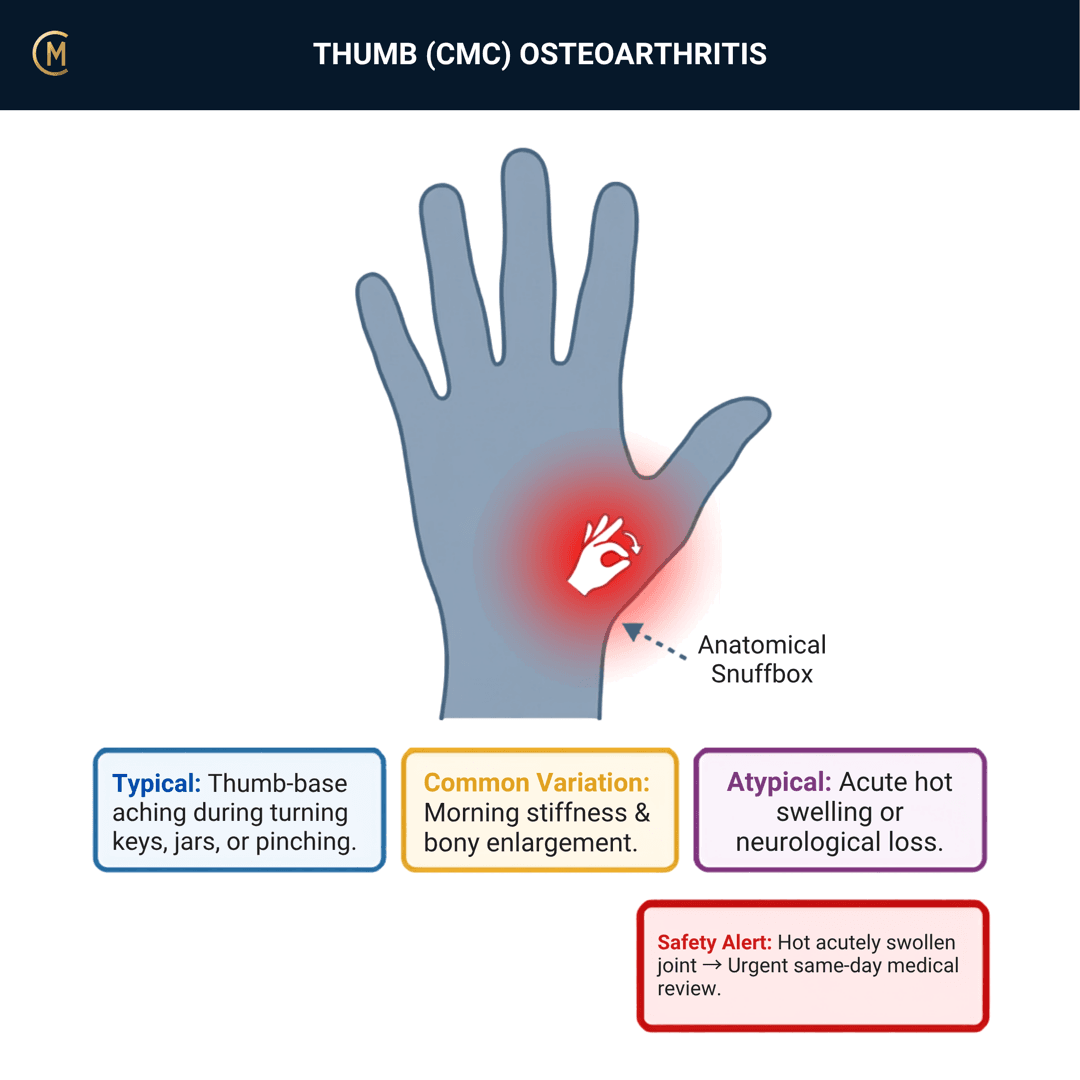
Illness script in one line: aching at the base of the thumb on pinch and grip — jars, keys, taps, pegs — building over months to years in an older adult, with stiffness and a sense the thumb is getting weaker.
Caseload frequency: common, and commoner still on a hand or older-adult caseload. It also arrives as a secondary finding on someone referred for something else.
For once, the evidence is on your side
This matters because of where it sits. Elsewhere in this region you've been told the honest thing repeatedly — no loading trial exists for De Quervain's, radial tunnel has no agreed diagnostic criteria, mallet finger's six-week rule is a compliance device. Here the picture is different, and a student should notice the difference.
Read further: a randomised trial of exercise therapy [1], a meta-analysis of the most clinically effective nonoperative interventions [2] with commentary [3], a meta-analysis of physical therapy interventions [4], a review of exercise-based interventions [5], a systematic review of proprioceptive training [6].
That's a randomised trial and four syntheses, most of them physiotherapy-facing, for one small joint.
| Elsewhere in this region | Here |
|---|---|
| "No trial of loading is verified in our library" | A randomised trial of exercise therapy, in a top OA journal |
| "The evidence is thinner than the confidence around it" | Four separate syntheses of conservative care |
| Teach it as reasoning | Teach it as a treatment, and mean it |
The three standard management lines are all supportable here. That is not true of every page you've read.
2 · SE — THE SUBJECTIVE PATTERN (the 70%)
Main problem
"I can't open jars any more." aching at base of thumb during pinch or jar opening.
The complaint is almost always functional and almost always about pinch, not grip. Jars, keys in a lock, taps, pegs, zips, wringing a cloth, a car door, a kettle.
Body chart
The base of the thumb, at the joint — and they usually point to it with one finger.
The discrimination you want is two centimetres wide:
- On the joint line at the thumb base, with bony enlargement → this page.
- 1–2 cm proximal, over the radial styloid and the first dorsal compartment → De Quervain's. Its own page.
- In the snuffbox after a fall → scaphoid. Its own page, free forever.
Behaviour
Typical: stiffness and weakness on use.
Aggs: pinch under load — jars, keys, taps, pegs, buttons, opening packets, writing, needlework, phone use with the thumb.
Eases: rest, avoiding the specific pinch, warmth, a splint.
Severity: VAS 0–10 at best / at worst / right now.
Ask about morning stiffness and time it. UniSA behaviour coding: <30 min is M, >30 min is In — and stiffness lasting well over half an hour, in more than one joint, points somewhere else. Section 4.
History
gradual onset in older adults. Months to years, fluctuating, with slow functional loss.
Ask what they've stopped doing. People adapt around this joint silently — they buy a jar opener, stop knitting, get someone else to do the pegs — and then report they're "managing fine". The adaptations are the history.
Special / screening questions
- Both hands? Frequently, and often asymmetrically.
- Other joints — DIPs, knees, hips? Hand OA rarely arrives alone.
- Any swelling, redness or heat? Section 4.
- Any numbness or tingling? Shouldn't be. Carpal tunnel genuinely coexists here — its own page.
- What do they do with their hands? Occupation, hobbies, care of grandchildren, needlework, trades.
Assessing this region? Download the Wrist & Hand assessment template →
3 · HYPOTHESIS RANKING
| Pattern | The one discriminating feature |
|---|---|
| 1st CMC osteoarthritis | Pain on pinch at the joint line, positive grind, bony enlargement, loss of web space, gradual and older. |
| De Quervain's tenosynovitis | Tender 1–2 cm proximal over the first dorsal compartment, positive Finkelstein, no bony enlargement, and it can happen at any age. Its own page. |
| Scaphoid fracture | A fall, and tenderness in the snuffbox rather than at the joint line. Its own page, free forever. |
| Inflammatory arthritis (RA, psoriatic) | Polyarticular, symmetrical, MCP involvement, morning stiffness well over 30 minutes. Hand OA does not usually behave like that. Section 4. |
| Crystal arthropathy | Hot, red, swollen, sudden. Gout and CPPD both hit small joints. Its own page, free forever. |
| Carpal tunnel syndrome | Numbness rather than pain, night waking, relieved by shaking. Genuinely coexists — finding one doesn't exclude the other. Its own page. |
The discriminator that does most of the work: exactly where they point, and whether the joint is bony or hot.
4 · RED FLAGS — DON'T MISS THIS
Free forever. Never gated.
Osteoarthritis of the thumb base is not dangerous. Three things that look like it are.
1. A hot, red, swollen thumb base is not an OA flare
Crystal arthropathy and joint infection both present at small joints. Sudden onset, redness, warmth and pain out of proportion is the pattern — and it is not separable from infection at the bedside. A temperature, or a history of IV drug use, pushes infection up the list (Jennings et al. 2017) [21].
Action: same-day medical referral, exactly as on the gout page — which is free forever, so read the whole thing. Don't call it a flare and give them a splint.
2. Polyarticular, symmetrical, and stiff for more than half an hour
Inflammatory arthritis presents in hands, and the thumb base is not exempt.
Look for: more than one joint, symmetrically; MCP involvement; morning stiffness well beyond thirty minutes (UniSA coding: In); soft or boggy swelling rather than bony enlargement; fatigue or systemic symptoms; a personal or family history of psoriasis or inflammatory disease.
Action: refer for medical assessment and say what you're suspecting. Early inflammatory arthritis is a time-sensitive referral, and a physiotherapist is often the first clinician to see the pattern across several joints.
3. Wrong age, wrong story
gradual onset in older adults. That line is doing red-flag work.
Under about 45, with no trauma and no inflammatory picture — look harder. The likeliest answer is De Quervain's, not early OA, and thumb-base pain in a young adult that doesn't fit either deserves a second opinion.
Also not this page: night pain that dominates, rapid progression over weeks, a palpable mass, or any constitutional symptom.
5 · OE — THE OBJECTIVE (the 30%)
Members
Sections 5 to 7 are for members
The objective exam, management and pearls, plus the six-minute lesson and the debrief. Free with an account.
Sign in or join free6 · MX — MANAGEMENT ESSENTIALS
Members
Sections 5 to 7 are for members
The objective exam, management and pearls, plus the six-minute lesson and the debrief. Free with an account.
Sign in or join free7 · CLINICAL PEARLS + RETRIEVAL CHECK
Members
Sections 5 to 7 are for members
The objective exam, management and pearls, plus the six-minute lesson and the debrief. Free with an account.
Sign in or join freeMembers
The 4-minute lesson is for members
Twelve slides on this pattern: what you'll hear, what to examine, what to do. Free with an account.
Sign in or join freeGuideline anchor
No Australian guideline, and no clinical practice guideline of any kind — but this is the best-evidenced conservative problem in the whole wrist and hand chapter.
More
The nonoperative anchor is a meta-analysis of the most clinically effective nonoperative interventions in Clinical Orthopaedics and Related Research (Thakker et al. 2025, PMID 39560669), published with a CORR Insights commentary (Wolf et al. 2025, PMID 39589316). The exercise anchor is a randomised trial of exercise therapy in Osteoarthritis and Cartilage (Wouters et al. 2026, PMID 41138847), with physical therapy interventions meta-analysed in Disability and Rehabilitation (Tossini et al. 2024, PMID 38450686) and exercise-based interventions reviewed (Karanasios et al. 2024, PMID 38667585).
None of these is a clinical practice guideline. They are, unusually for this chapter, mostly physiotherapy-facing — a randomised trial of exercise therapy and three separate syntheses of conservative care.
Members
The evidence summary is for members
Verified diagnostic accuracy, where the evidence stands and what it doesn't settle. Free with an account.
Sign in or join freeSources · 20
ShowHide
Every source on this page resolves and title-verifies against PubMed. Newest first.
- 2026Wouters et al. (2026). Effectiveness of exercise therapy in patients with thumb carpometacarpal osteoarthritis: A multicenter, randomized controlled trial. Osteoarthritis and cartilage, 34(5), 679-690. https://doi.org/10.1016/j.joca.2025.10.005
- 2025Thakker et al. (2025). What Are the Most Clinically Effective Nonoperative Interventions for Thumb Carpometacarpal Osteoarthritis? An Up-to-date Systematic Review and Network Meta-analysis. Clinical orthopaedics and related research, 483(4), 719-736. https://doi.org/10.1097/CORR.0000000000003300
- 2025Wolf (2025). CORR Insights®: What Are the Most Clinically Effective Nonoperative Interventions for Thumb Carpometacarpal Osteoarthritis? An Up-to-date Systematic Review and Network Meta-analysis. Clinical orthopaedics and related research, 483(4), 737-739. https://doi.org/10.1097/CORR.0000000000003322
- 2024Tossini et al. (2024). Effect of physical therapy interventions in individuals with primary thumb carpometacarpal osteoarthritis: a systematic review and meta-analysis. Disability and rehabilitation, 46(26), 6251-6265. https://doi.org/10.1080/09638288.2024.2325652
- 2024Karanasios et al. (2024). Exercise-Based Interventions Are Effective in the Management of Patients with Thumb Carpometacarpal Osteoarthritis: A Systematic Review and Meta-Analysis of Randomised Controlled Trials. Healthcare (Basel, Switzerland), 12(8). https://doi.org/10.3390/healthcare12080823
- 2026Eapen et al. (2026). Effectiveness of proprioceptive training in patients with thumb carpometacarpal osteoarthritis: A systematic review. Journal of hand therapy : official journal of the American Society of Hand Therapists, 39(2), 459-468. https://doi.org/10.1016/j.jht.2026.02.015
- 2024McGee et al. (2024). Psychometric properties of body structures and functions measures in non-surgical thumb carpometacarpal osteoarthritis: A systematic review. Journal of hand therapy : official journal of the American Society of Hand Therapists, 37(1), 22-37. https://doi.org/10.1016/j.jht.2023.07.002
- 2025Nelson et al. (2025). Development and Assessment of the Curtis Thumb Carpometacarpal Osteoarthritis Radiographic Classification. Journal of hand surgery global online, 7(4), 100733. https://doi.org/10.1016/j.jhsg.2025.03.007
- 2026Bouredoucen (2026). Imaging of Trapeziometacarpal Osteoarthritis: Preoperative Assessment and Postoperative Evaluation. RoFo : Fortschritte auf dem Gebiete der Rontgenstrahlen und der Nuklearmedizin. https://doi.org/10.1055/a-2808-4634
- 2026Nute et al. (2026). Initial Nonoperative Treatment Choices for Thumb Carpometacarpal Osteoarthritis. Plastic and reconstructive surgery, 157(3), 495-500. https://doi.org/10.1097/PRS.0000000000012436
- 2025Boccolari et al. (2025). Conservative rehabilitation approach for trapeziometacarpal osteoarthritis. Hand surgery & rehabilitation, 44(4), 102216. https://doi.org/10.1016/j.hansur.2025.102216
- 2026Milone et al. (2026). Deficit of the thenar muscles does not contribute to outcomes after intra-articular botulinum neurotoxin-A for base-of-thumb osteoarthritis. Annals of physical and rehabilitation medicine, 69(2), 102054. https://doi.org/10.1016/j.rehab.2025.102054
- 2026Papadakis et al. (2026). Rapid Low-Cost Production of a Patient-Specific Thumb Orthosis Using Smartphone Light Detection and Ranging (LiDAR) Scanning and Three-Dimensional (3D) Printing. Cureus, 18(4), e106955. https://doi.org/10.7759/cureus.106955
- 2024Krez et al. (2024). Efficacy of Intra-Articular Corticosteroid Injection for Nonsurgical Management of Trapeziometacarpal Osteoarthritis: A Systematic Review and Meta-Analysis of Randomized Controlled Trials. The Journal of hand surgery, 49(6), 511-525. https://doi.org/10.1016/j.jhsa.2024.02.001
- 2023Winter et al. (2023). Autologous Fat and Platelet-Rich Plasma Injections in Trapeziometacarpal Osteoarthritis: A Systematic Review and Meta-Analysis. Plastic and reconstructive surgery, 151(1), 119-131. https://doi.org/10.1097/PRS.0000000000009789
- 2025Fang et al. (2025). A systematic review of systematic reviews comparing simple trapeziectomy versus trapeziectomy with ligament reconstruction and tendon interposition for trapeziometacarpal osteoarthritis. Journal of hand and microsurgery, 17(1), 100160. https://doi.org/10.1016/j.jham.2024.100160
- 2025Datta et al. (2025). Joint Replacement Versus Trapeziectomy for Trapeziometacarpal Osteoarthritis: A Systematic Review. Cureus, 17(10), e94908. https://doi.org/10.7759/cureus.94908
- 2026Aldemir et al. (2026). Thumb carpometacarpal osteoarthritis: Arthrodesis versus trapeziectomy with ligament reconstruction and tendon interposition. Joint diseases and related surgery, 37(3), 777-784. https://doi.org/10.52312/jdrs.2026.2927
- 2024Rotem & Kadar (2024). New Technologies in the Treatment of Base of Thumb Osteoarthritis. The Journal of the American Academy of Orthopaedic Surgeons, 33(17), 951-960. https://doi.org/10.5435/JAAOS-D-23-01059
- 2026Ulusoy & Ayhan Kuru (2026). Predictive factors affecting functional outcomes following conservative treatment in trapeziometacarpal osteoarthritis: A systematic review. Journal of hand therapy : official journal of the American Society of Hand Therapists, 39(3), 674-682. https://doi.org/10.1016/j.jht.2025.12.002
Mapped to this pattern
Generic measures that also apply
- Borg RPE
Borg Rating of Perceived Exertion Scale (6-20)
perceived exertion · 1 items · 1 min
- DASH
Disabilities of the Arm, Shoulder and Hand
upper limb disability · 30 items · 8 min
- GROC
Global Rating of Change Scale
perceived change since baseline · 1 items · 1 min
- NPRS
Numeric Pain Rating Scale
pain intensity · 1 items · 1 min
- PGIC
Patient Global Impression of Change
perceived change since baseline · 1 items · 1 min
- PSFS
Patient-Specific Functional Scale
patient-generated function · 3 items · 2 min
- QuickDASH
QuickDASH
upper limb disability, short form · 11 items · 4 min
- SANE
Single Assessment Numeric Evaluation
patient-rated function as a percentage of normal · 1 items · 1 min
- UEFI
Upper Extremity Functional Index
upper limb function · 20 items · 5 min
- VAS
Visual Analogue Scale
pain intensity · 1 items · 1 min
- Borg CR10
Borg Category Ratio 10 Scale
perceived exertion or symptom intensity, ratio scale · 1 items · 1 min
- GAS
Goal Attainment Scaling
individualised goal achievement · 10 min
Did this page do its job?
CliniStudy is in beta. One tap is enough — it decides what gets fixed first.