
1 · SNAPSHOT
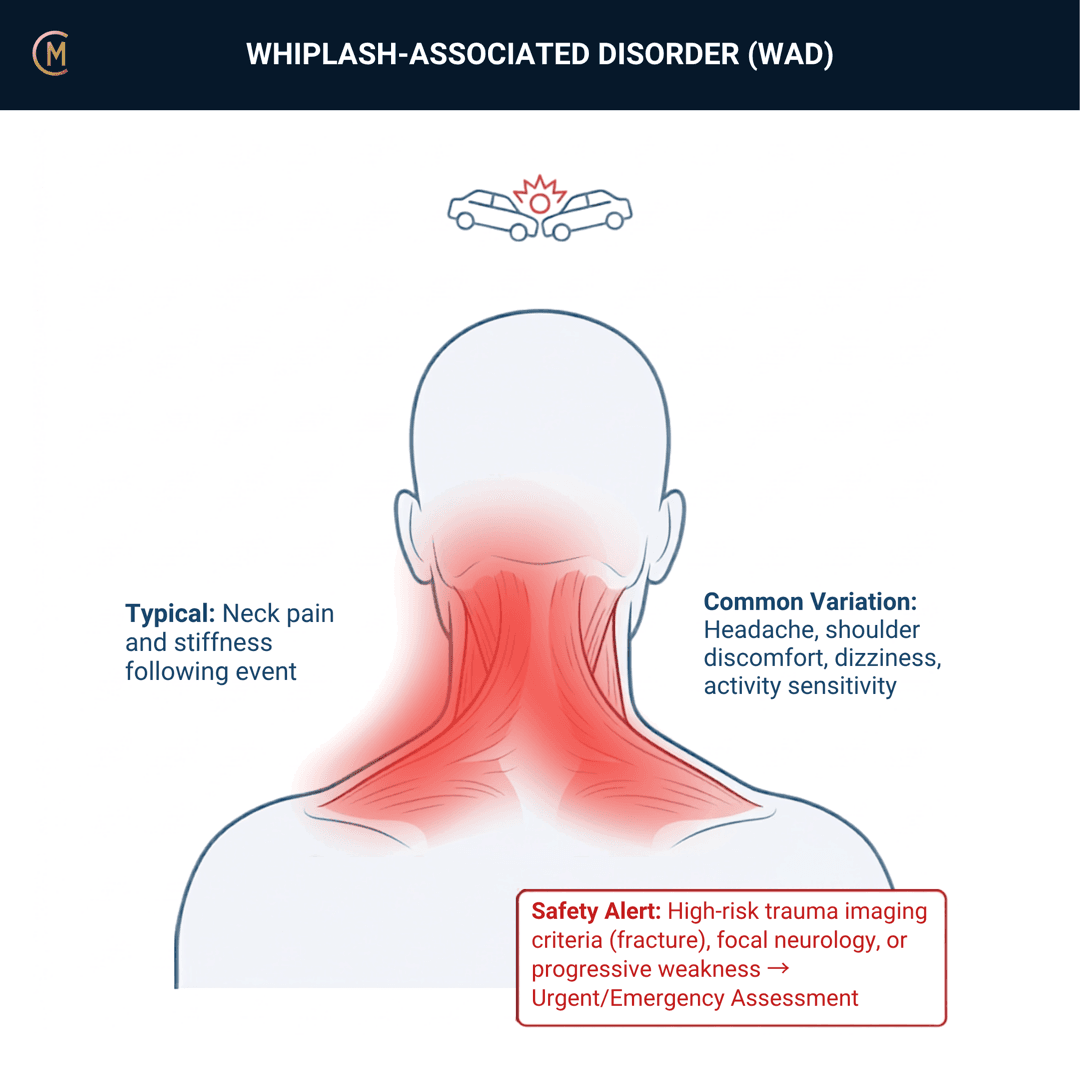
Who: Anyone off a motor vehicle collision, or an equivalent acceleration–deceleration mechanism. Often within 48 hours, often already imaged, sometimes already in a collar.
What: Neck pain and stiffness ± headache, ± shoulder or upper-thoracic referral, ± dizziness or visual disturbance.
How it behaves: Aggs: movement, sustained postures, load, and often the drive home. Eases: rest early, then movement. Symptoms commonly ↑ over the first 24–72 h — say that before it happens, or the phone call on day three sounds like a deterioration.
The illness script in one line:
An acceleration–deceleration load that leaves a mechanically irritable, guarded neck in everyone — and in about half of them, a sensitised nervous system and a live stress response that are still there a year later.
The one thing to take from this page:
The subjective carries almost the whole reasoning load. The objective is a safety check plus a baseline. The question is not "what tissue got hurt in the crash". It is "is there a fracture, is there a root or a vessel involved, and is this one of the half who will still be in pain in a year?"
| Figure | Number |
|---|---|
| Still reporting neck pain at 1 year | ≈50% — 47 scientifically admissible studies |
| When recovery happens | first 3 months, then it levels off — 67 articles, 38 prospective cohorts |
| PTSD symptom trajectories, n=229 | resilient 75.1% · recovering 10.0% · chronic 14.9% |
| Canadian C-Spine Rule | Se 100% (95% CI 98–100), Sp 42.5% (40–44) · 8,924 patients, 151 (1.7%) important injuries |
| CCR vs NEXUS, same 8,283 patients | CCR missed 1, NEXUS missed 16 · Se 99.4% vs 90.7%, Sp 45.1% vs 36.8% (both P<0.001) |
| Predominantly neuropathic symptoms after whiplash | 34% (range 25–75) · 54 studies, 390,644 patients |
| Inter-rater reliability of the WAD grade | κ 0.04 (−0.04 to 0.12) to 0.80 (0.67–0.94) |
| Alar ligament high signal — WAD / chronic non-traumatic / pain-free | 49% / 33% / 40% (χ², P = 0.22) |
| Chronic WAD vs chronic non-traumatic neck pain, NDI | +11.15/100 (8.63–13.68) |
| Sessions to get a low-risk patient self-managing by 12 weeks | on average 3 (guideline flowchart) |
| Cases expected to need a specialist medical opinion | fewer than 5% |
| Annual incidence | no reliable single figure. It differs substantially between countries and the Task Force calls the evidence sparse |
[1][2][3][4][5][6][7][8][9][10]
✅ The guideline banner — read it exactly
Australia has a whiplash guideline, and it is an unusually strong one.
What it is. The Australian Clinical Guidelines for Health Professionals Managing People with Whiplash-Associated Disorders, Fourth Edition, developed by SIRA NSW with the John Walsh Centre for Rehabilitation Research — an 18-member multidisciplinary panel, GRADE Evidence-to-Decision, built to the NHMRC Standard, registered on the Australian Clinical Practice Guidelines Register on 27 April 2021, public consultation 5 June – 5 July 2023.
What it covers. Diagnosis, prognosis, treatment AND assessment, in both acute and chronic WAD, with a strength rating and a panel vote count on every single item, plus two care flowcharts that carry the review timeline. Evidence base: 44 RCTs acute, 19 chronic; 57 prospective cohorts for acute prognosis, 6 for chronic.
What it does NOT cover, and you say all three out loud. ① Its approval status is unresolved. The administrative report says it will be submitted to the NHMRC for consideration of approval after public consultation; nothing found confirms that approval happened. ② SIRA still names the third edition. SIRA's own whiplash page — last updated 19 December 2024, read live 1 Sep 2026 — describes the December 2014 third edition as its guidelines, and that document stops at 12 weeks. ③ It makes no recommendation for WAD-associated headache and sends you to the headache guidelines instead.
So: anchor to the fourth edition, name the third, and tell your educator which is which. When they ask "says who?", the Canadian C-Spine Rule and the prognostic tools are Australian strong-for. The chronic pathway is a guideline whose approval status nobody has confirmed.
The grade, and where it came from — know the provenance
A student will be asked to grade a patient with this, so know what you are holding.
- Source. WAD grades 0–IV come from the Quebec Task Force scientific monograph, which also coined the term "whiplash-associated disorders" [11]. Thirty-one years on it is still the classification the guideline, the insurer and the literature all run on.
- How the Australian guideline operationalises it. WAD 0–II on cervical ROM and palpation · WAD III on neurological assessment · WAD IV on the Canadian C-Spine Rule.
- Superseded? No. Challenged, yes — and never replaced. Sterling proposed swapping it for a measurable motor / sensory / psychological profile because the QTF version "is primarily based on the severity of signs and symptoms" and "its usefulness has been questioned" [12]. That proposal has never been validated as a replacement system.
- Two cracks you must know. Inter-rater κ ran 0.04 to 0.80 across three raters scoring the same 80 patients — the grade is only as good as the training behind it (Shergill et al. 2021). And grade II, defined by the absence of nerve involvement, shows the same sensory dysfunction and nerve mechanosensitivity as everyone else: predominantly neuropathic symptoms in 34%, abnormal electrodiagnostic testing in 32% (Fundaun et al. 2022).
- In practice: grade it, record it, and hold it loosely. In a NSW audit of 288 claimant files the QTF classification was actually recorded in 19.9% of them [13].
Patterns > Labels. "WAD II" names a severity band with a leaky definition and unreliable scoring. A guarded, movement-provoked neck after a collision, cleared on the Canadian C-Spine Rule, with a risk score attached names the problem you can actually manage this week. Check the grade with your clinical educator.
2 · SE — THE SUBJECTIVE PATTERN (the 70%)
The order changes here, and this is the page that shows you why. Your course teaches the five stages as main problem → body chart → behaviour → history → special/screening questions. For an acute traumatic presentation it reorders to:
MAIN PROBLEM → BODY CHART → HISTORY → BEHAVIOUR → SPECIAL / SCREENING QUESTIONS
History moves up because after a collision the history is the safety step. Mechanism, age, what has already happened to them — imaging, an ED visit, a collar, a claim — decides whether you are allowed to test cervical rotation at all. You cannot code a 24-hour pattern on a neck you have not yet cleared. Run the acute order, write it in your S/E in that order, and say why if your educator asks.
And 70/30 applies especially hard here. By the end of the subjective you have the grade, the fracture decision, the differential and — the part that matters — the prognosis. The P/E gives you asterisk signs and a baseline.
MAIN PROBLEM
"I was stopped at the lights and someone went into the back of me. I felt alright that night. The next morning I couldn't turn my head to reverse out of the driveway."
Delayed onset is normal, not reassuring and not alarming. Ask what they think is wrong and what they expect will happen — their expectation of recovery is a strong-for prognostic factor, and it is free.
BODY CHART
Draw it, mark P1 and P2 separately, mark φp where it is genuinely pain-free, then read it against the list.
| What you draw | What it points at |
|---|---|
| Central / bilateral neck ± upper trap ± interscapular, diffuse | WAD 0–II — this pattern |
| Suboccipital → frontal / temporal headache | WAD-associated headache — the guideline makes no recommendation and sends you to the headache guidelines |
| Arm pain > neck pain, dermatomal, ± paraesthesia or numbness | WAD III — cervical radicular. §3 |
| New, unfamiliar head or neck pain, unlike their usual, ± 5 D's / 3 N's | Cervical arterial dysfunction. §4, then the CAD page |
| Midline bony pain ± any Canadian C-Spine Rule high-risk factor | WAD IV until imaged. §4 |
| Hands, gait, buttons | Cervical myelopathy. That page |
Count the areas, don't just draw them. The number of painful body areas and the number of painful symptoms are both strong-for prognostic factors in the Australian guideline (9/12, 75% of the panel). A body chart with widespread marks on it is a prognosis, not just a picture.
HISTORY
Mechanism, timeline, and what has already been done. Then the part this page exists for.
The crash does not predict the outcome. Say it out loud — it is the single most common thing they will raise.
- The Australian guideline rates every crash factor conditional against as a prognostic factor: injury severity score, head restraint, head position at impact, awareness of collision, vehicle type, speed, seatbelt, self-reported collision severity, position in vehicle, airbag, direction of impact — 9/13 (69%) conditional against, with 4/13 (21%) going strong against.
- Strong evidence across 50 papers and 29 prospective cohorts that rear-end collision is NOT associated with an adverse prognosis [14].
- A NSW meta-review of 12 systematic reviews: factors related to the collision were not associated with continuing pain and disability [15].
What does predict — and you can measure all of it at visit one.
| Ask / measure | Guideline rating | The number behind it |
|---|---|---|
| Initial pain intensity (VAS) | STRONG FOR (9/12, 75%) | Strong evidence as an adverse prognostic factor since 2003 (Scholten-Peeters et al. 2003) |
| Initial neck disability (NDI) | STRONG FOR (9/12) | Higher initial NDI still predicted poor outcome at 2–3 years, OR 1.00–1.1, r² = 0.56 [16] |
| Number of painful body areas · number of symptoms | STRONG FOR (9/12) | Greater initial pain, more symptoms, greater initial disability → slower recovery (Carroll et al. 2008) |
| Post-traumatic stress symptoms | STRONG FOR (12/13, 92%) | Trajectories: resilient 75.1%, recovering 10.0%, chronic 14.9%; the chronic class carried more pain-related disability at 6 months (Ravn et al. 2019) |
| Expectations of recovery | STRONG FOR (12/13) | One of only three psychological factors that held up across 31 studies [17] |
| Depression · catastrophising · coping | conditional for (8/13, 62%) | — |
| Cold hyperalgesia | conditional for (11/12, 92%) | Still predicting at 2–3 years, OR 1.1–1.13 (Sterling et al. 2006) |
| Age, gender, education, employment, income | conditional against (11/13, 85%) | — |
And the negative list is the useful half. Across 31 studies, anxiety, travel anxiety, depression, personality, pre-collision distress, general psychological distress and avoidance behaviour were NOT associated with chronic WAD (Campbell et al. 2018). Only poor expectations of recovery, post-traumatic stress symptoms and passive coping were consistent.
The prognostic screen — the highest-value five minutes on this pattern
- Use a tool, not an impression. WhipPredict and the SF-OMPSQ (Örebro) are both STRONG FOR, 9/9 — 100% of the panel. That is the same strength rating the guideline gives the Canadian C-Spine Rule.
- The whiplash CPR is three history items: age, initial NDI, and hyperarousal symptoms. Full recovery predicted by age <35 and initial NDI ≤32%; ongoing moderate/severe pain and disability predicted by age ≥35, initial NDI ≥40% and hyperarousal. PPV 90.9% for ongoing moderate/severe disability, 80.0% for full recovery, in 101 people [18].
- ⚠️ And it is a retrospective secondary analysis. Only 3 prognostic CPRs in this field have been externally validated and none has had an impact analysis [19]. The rule predicts. Nobody has shown that acting on it helps.
- The uncomfortable finding, and the reason to use the tool anyway. Physiotherapist risk judgement was compared with the CPR in 38 patients and 24 therapists. Agreement in 11/38 (29%) of cases, κ = −0.03 (95% CI −0.17 to 0.12) — worse than chance. Therapists were mostly reading range of movement (61%), and they planned the same number of sessions regardless of risk (χ²(2) = 2.69, p = 0.26) [20].
BEHAVIOUR
- Coding: M / In / P / Is. Morning stiffness <30 min = M, >30 min = In. Most acute WAD codes P early (constant, movement-provoked) and shifts to Is as it settles.
- 24-hour pattern: expect it to be worse over the first 24–72 h, then to track down. A neck that is escalating past 72 h with new symptoms goes back to §4, not into a progression.
- Severity: VAS 0–10 at best / at worst / right now.
- Irritability — all three parts, and it sets your dose. Resting symptoms + vigour of the provoking activity + time to settle. High irritability → AROM to P1 only, no overpressure, and no PAIVMs above Grade II. Low irritability → full P/E and a loading plan on day one.
- Ask what they have stopped doing. Driving is the one they will not volunteer.
SPECIAL / SCREENING QUESTIONS
Every one of these, every time — and they are all free (§4).
- Canadian C-Spine Rule questions before you test rotation (§4).
- 5 D's and 3 N's — dizziness, diplopia, dysarthria, dysphagia, drop attacks; nausea, nystagmus, numbness. Plus: is this head or neck pain new and unfamiliar?
- UMN symptoms — clumsy hands, dropping things, gait change, bladder change.
- Dermatomal or myotomal symptoms below the shoulder.
- Post-traumatic stress, at week 3–4 in the medium/high-risk group: PCL-5, ± depression, catastrophising, coping. That is exactly where the guideline's flowchart puts it.
- Systemically unwell, unexplained weight loss, night pain that wakes and won't settle with position.
Assessing this region? Download the Cervical Spine assessment template →
3 · HYPOTHESIS RANKING
Order of operations on this pattern: rule out the dangerous thing (§4), then grade, then discriminate. Fracture/dislocation (WAD IV), cervical arterial dysfunction and myelopathy all live in §4 and are free. What follows is what is left.
Top three, one discriminating feature each.
| Rank | Pattern | The one discriminating feature |
|---|---|---|
| 1 | Cervical radicular pain — WAD III | Arm pain > neck pain, dermatomal, with paraesthesia or numbness on history and a neurological deficit ± antalgic posture on examination. That combination is the guideline's own screening recommendation for radiculopathy (conditional for, 8/11 73%; 3/11 27% strong for). MRI only if not recovering — then manage it as radiculopathy, not as WAD. |
| 2 | Non-traumatic mechanical neck pain | No collision is the obvious split — but the presentation differs too, and by a clinically relevant margin. Chronic WAD vs chronic non-traumatic neck pain, 61 studies / 45 meta-analysed: NDI +11.15/100 (95% CI 8.63–13.68), pain +8.15/100 (5.80–10.50), cervical flexion −5.30° (−7.44 to −3.16), remote cold sensitivity SMD 0.89 (0.57–1.21), depression SMD 0.60 (0.27–0.93). No difference for dizziness symptoms, stress, anxiety, balance or local cold sensitivity. Mostly moderate certainty (Chen et al. 2025). That page. |
| 3 | WAD-associated headache | The headache is the main problem, not the neck. The Australian guideline makes no specific recommendation here and directs you to the headache guidelines. Discriminate cervicogenic from tension from migraine on the headache table you were taught — the cervical flexion-rotation test numbers live on the mechanical neck pain page. |
And the one that isn't a competing diagnosis at all.
Post-traumatic stress as the driver. Not a differential — a competing explanation for why they are not recovering. Screen it at week 3–4 with the PCL-5 if medium/high risk. 14.9% of a 229-person cohort ran a chronic PTSD-symptom trajectory, and that group carried more pain-related disability at 6 months (Ravn et al. 2019). PTSS is strong-for prognostically (12/13, 92%).
The boundary between grade II and grade III leaks, so hold it loosely. Across 54 studies and 390,644 patients: predominantly neuropathic symptoms in 34% (range 25–75), nerve pathology on neurological examination in 13%, on electrodiagnostic testing in 32% — and the same sensory dysfunction and nerve mechanosensitivity (median nerve PPT SMD −1.10, 95% CI −1.50 to −0.70; neurodynamic tests SMD 1.68, 0.92–2.44) appeared in grade II, whose definition is the absence of nerve involvement (Fundaun et al. 2022). A grade II is not proof of a clean nerve. Check the neurological examination with your clinical educator, and repeat it.
4 · RED FLAGS — DON'T MISS THIS
Free forever. Safety is never gated in CliniStudy, and it never will be. Fracture, instability and cervical arterial dysfunction after a collision all live on this page, permanently outside the paywall, and so does the referral pathway.
Fracture and dislocation — WAD IV. Decide it with a rule, not a feeling
The Canadian C-Spine Rule is the only STRONG FOR diagnostic recommendation in the entire Australian guideline — 9/9, 100% of the panel. It earns that.
Three questions, in order:
- Any high-risk factor that mandates radiography? — age ≥65, a dangerous mechanism, or paraesthesia in the extremities → image. Do not test rotation.
- Any low-risk factor that allows safe assessment of range of motion? — simple rear-end MVC, sitting position in the department, ambulatory at any time since injury, delayed onset of neck pain, absence of midline cervical tenderness. No low-risk factor → image.
- Can they actively rotate 45° left and right? No → image.
Se 100% (95% CI 98–100), Sp 42.5% (40–44) on 8,924 alert, stable blunt-trauma adults with 151 (1.7%) clinically important injuries; projected radiography rate 58.2% (Stiell et al. 2001). The low specificity is the price, and it is the correct price — you will send more than you find.
Learn the CCR. Do not learn both. Head to head in 8,283 patients with 169 (2.0%) important injuries: CCR Se 99.4% vs NEXUS 90.7% (P<0.001), Sp 45.1% vs 36.8% (P<0.001), radiography 55.9% vs 66.6%. The CCR would have missed 1 patient. NEXUS would have missed 16 (Stiell et al. 2003).
⚠️ The rule's real-world weak point is you. In 845/8,283 (10.2%) of patients the clinician did not assess range of motion as the algorithm requires (Stiell et al. 2003). An unassessed step is not a negative test.
Cervical arterial dysfunction — after a collision, this is live
New and unfamiliar head or neck pain — not like their usual neck — ± the 5 D's and 3 N's. A mechanical pattern does not clear it. Full pathway on the CAD page, which is also free. Don't manage around it.
Progressive neurological deficit
Record power, reflexes and sensation, bilaterally, at visit one and again at review. A myotome dropping across visits is a referral, not a rehab progression. WAD III not recovering by day 7 → the guideline's own pathway is MRI (conditional for, 11/12 92%), then manage as cervical radiculopathy. Any UMN sign — clumsy hands, gait change, ↑ reflexes, bladder change → myelopathy page.
The ordinary ones, still
Systemically unwell, fever, unexplained weight loss · night pain that wakes and won't settle with position · history of cancer or significant immunosuppression.
What imaging is NOT for — and this is where students get burned
Do not order or chase a scan to explain the pain or predict the outcome. Radiological factors are rated STRONG AGAINST as prognostic in acute WAD (10/11, 91%), and advanced MRI/ultrasound of muscle size, morphology, fat infiltration or stiffness is strong consensus against as assessment (10/12 acute, 10/10 chronic).
The case that settles it. High-resolution proton-weighted MRI of the alar ligaments in 173 people, read by two blinded neuroradiologists. High signal (grade 2–3) in at least one alar ligament: 49% of persistent WAD I–II, 33% of chronic non-traumatic neck pain, and 40% of people with no neck pain and no neck trauma (χ², P = 0.22). The authors: the assumption that these changes are due to the trauma is not supported, and their diagnostic value and clinical relevance are questionable (Myran et al. 2008).
⚠️ And know what you are arguing against. The claim that MRI shows gradeable craniovertebral ligament lesions after whiplash comes from a review of the authors' own work [21]. Myran et al. tested it blinded and did not reproduce it. Never cite Krakenes & Kaale as evidence for imaging the alar ligaments. If a patient arrives with a report like that, your job is to explain the 40%.
Bladder, gait and clumsy hands = cord, not neck. New, unfamiliar head or neck pain after a collision = vessel until cleared. Midline bony pain, age ≥65, dangerous mechanism, or paraesthesia in the extremities = image before you test rotation.
5 · OE — THE OBJECTIVE (the 30%)
Members
Sections 5 to 7 are for members
The objective exam, management and pearls, plus the six-minute lesson and the debrief. Free with an account.
Sign in or join free6 · MX — MANAGEMENT ESSENTIALS
Members
Sections 5 to 7 are for members
The objective exam, management and pearls, plus the six-minute lesson and the debrief. Free with an account.
Sign in or join free7 · CLINICAL PEARLS + RETRIEVAL CHECK
Members
Sections 5 to 7 are for members
The objective exam, management and pearls, plus the six-minute lesson and the debrief. Free with an account.
Sign in or join freeMembers
The 4-minute lesson is for members
Twelve slides on this pattern: what you'll hear, what to examine, what to do. Free with an account.
Sign in or join freeGuideline anchor
Australian Clinical Guidelines for Health Professionals Managing People with Whiplash-Associated Disorders, Fourth Edition (SIRA NSW with the John Walsh Centre for Rehabilitation Research; GRADE Evidence-to-Decision; 18-member multidisciplinary panel; acute AND chronic WAD).
More
Read directly on 1 Sep 2026 from its Summary of Recommendations (SIRA cat. SIRA09172, ISBN 978-0-7347-4734-1) and Technical Report Chapter 4 (Papic et al. 2023). SIRA's live guideline page still names the third edition (December 2014) as its operative guideline, so this page cites BOTH and says which is which.
The fourth edition genuinely covers this pattern and covers it further than any other Australian document for these patterns - diagnosis, prognosis, treatment AND assessment, in BOTH acute and chronic WAD, with a strength rating and a panel vote count on every item, plus two care flowcharts carrying the review timeline. What is NOT established is its approval status: the administrative report states the guidelines will be submitted to the NHMRC for consideration of approval following public consultation, and SIRA's own whiplash page (last updated 19 December 2024, read live 1 Sep 2026) still describes the December 2014 third edition as its guidelines - a document that stops at 12 weeks. The fourth edition also makes NO specific recommendation for WAD-associated headache and directs the reader to the headache guidelines. This page anchors to the fourth edition, names the third, and says the approval status is unresolved.
Members
The evidence summary is for members
Verified diagnostic accuracy, where the evidence stands and what it doesn't settle. Free with an account.
Sign in or join freeSources · 33
ShowHide
Every source on this page resolves and title-verifies against PubMed. Newest first.
- 2008Carroll et al. (2008). Course and prognostic factors for neck pain in whiplash-associated disorders (WAD): results of the Bone and Joint Decade 2000-2010 Task Force on Neck Pain and Its Associated Disorders. Spine, 33(4 Suppl), S83-92. https://doi.org/10.1097/BRS.0b013e3181643eb8
- 2008Kamper et al. (2008). Course and prognostic factors of whiplash: a systematic review and meta-analysis. Pain, 138(3), 617-629. https://doi.org/10.1016/j.pain.2008.02.019
- 2019Ravn et al. (2019). Trajectories of posttraumatic stress symptoms after whiplash: A prospective cohort study. European journal of pain (London, England), 23(3), 515-525. https://doi.org/10.1002/ejp.1325
- 2001Stiell et al. (2001). The Canadian C-spine rule for radiography in alert and stable trauma patients. JAMA, 286(15), 1841-8. https://doi.org/10.1001/jama.286.15.1841
- 2003Stiell et al. (2003). The Canadian C-spine rule versus the NEXUS low-risk criteria in patients with trauma. The New England journal of medicine, 349(26), 2510-8. https://doi.org/10.1056/NEJMoa031375
- 2022Fundaun et al. (2022). Nerve pathology and neuropathic pain after whiplash injury: a systematic review and meta-analysis. Pain, 163(7), e789-e811. https://doi.org/10.1097/j.pain.0000000000002509
- 2021Shergill et al. (2021). Inter-rater reliability of the Quebec Task Force classification system for recent-onset Whiplash Associated Disorders. The Journal of the Canadian Chiropractic Association, 65(2), 186-192. PubMed 34658390
- 2008Myran et al. (2008). Magnetic resonance imaging assessment of the alar ligaments in whiplash injuries: a case-control study. Spine, 33(18), 2012-6. https://doi.org/10.1097/BRS.0b013e31817bb0bd
- 2025Chen et al. (2025). Differences in the clinical presentation of chronic whiplash-associated disorders and nontraumatic neck pain: a systematic review and meta-analysis. Pain, 166(8), 1738-1756. https://doi.org/10.1097/j.pain.0000000000003554
- 2008Holm et al. (2008). The burden and determinants of neck pain in whiplash-associated disorders after traffic collisions: results of the Bone and Joint Decade 2000-2010 Task Force on Neck Pain and Its Associated Disorders. Spine, 33(4 Suppl), S52-9. https://doi.org/10.1097/BRS.0b013e3181643ece
- 1995Spitzer et al. (1995). Scientific monograph of the Quebec Task Force on Whiplash-Associated Disorders: redefining "whiplash" and its management. Spine, 20(8 Suppl), 1S-73S. PubMed 7604354
- 2004Sterling (2004). A proposed new classification system for whiplash associated disorders--implications for assessment and management. Manual therapy, 9(2), 60-70. https://doi.org/10.1016/j.math.2004.01.006
- 2018Bandong et al. (2018). Adoption and use of guidelines for whiplash: an audit of insurer and health professional practice in New South Wales, Australia. BMC health services research, 18(1), 622. https://doi.org/10.1186/s12913-018-3439-5
- 2003Scholten-Peeters et al. (2003). Prognostic factors of whiplash-associated disorders: a systematic review of prospective cohort studies. Pain, 104(1-2), 303-22. https://doi.org/10.1016/s0304-3959(03)00050-2
- 2017Sarrami et al. (2017). Factors predicting outcome in whiplash injury: a systematic meta-review of prognostic factors. Journal of orthopaedics and traumatology : official journal of the Italian Society of Orthopaedics and Traumatology, 18(1), 9-16. https://doi.org/10.1007/s10195-016-0431-x
- 2006Sterling et al. (2006). Physical and psychological factors maintain long-term predictive capacity post-whiplash injury. Pain, 122(1-2), 102-8. https://doi.org/10.1016/j.pain.2006.01.014
- 2018Campbell et al. (2018). Psychological Factors and the Development of Chronic Whiplash-associated Disorder(s): A Systematic Review. The Clinical journal of pain, 34(8), 755-768. https://doi.org/10.1097/AJP.0000000000000597
- 2015Ritchie et al. (2015). External validation of a clinical prediction rule to predict full recovery and ongoing moderate/severe disability following acute whiplash injury. The Journal of orthopaedic and sports physical therapy, 45(4), 242-50. https://doi.org/10.2519/jospt.2015.5642
- 2016Ritchie & Sterling (2016). Recovery Pathways and Prognosis After Whiplash Injury. The Journal of orthopaedic and sports physical therapy, 46(10), 851-861. https://doi.org/10.2519/jospt.2016.6918
- 2019Kelly et al. (2019). Agreement is very low between a clinical prediction rule and physiotherapist assessment for classifying the risk of poor recovery of individuals with acute whiplash injury. Musculoskeletal science & practice, 39, 73-79. https://doi.org/10.1016/j.msksp.2018.11.003
- 2006Krakenes & Kaale (2006). Magnetic resonance imaging assessment of craniovertebral ligaments and membranes after whiplash trauma. Spine, 31(24), 2820-6. https://doi.org/10.1097/01.brs.0000245871.15696.1f
- 2006Treleaven et al. (2006). The relationship of cervical joint position error to balance and eye movement disturbances in persistent whiplash. Manual therapy, 11(2), 99-106. https://doi.org/10.1016/j.math.2005.04.003
- 2013Stone et al. (2013). Measures of central hyperexcitability in chronic whiplash associated disorder--a systematic review and meta-analysis. Manual therapy, 18(2), 111-7. https://doi.org/10.1016/j.math.2012.07.009
- 2004Sterling et al. (2004). Characterization of acute whiplash-associated disorders. Spine, 29(2), 182-8. https://doi.org/10.1097/01.BRS.0000105535.12598.AE
- 2024Bellosta-López et al. (2024). Longitudinal Changes and Associations Between Quantitative Sensory Testing and Psychological Factors in Whiplash-Associated Disorders: A Systematic Review and Meta-Analyses-Based Data Synthesis. The journal of pain, 25(1), 12-30. https://doi.org/10.1016/j.jpain.2023.07.021
- 2022Chrcanovic et al. (2022). Exercise therapy for whiplash-associated disorders: a systematic review and meta-analysis. Scandinavian journal of pain, 22(2), 232-261. https://doi.org/10.1515/sjpain-2021-0064
- 2014Michaleff et al. (2014). Comprehensive physiotherapy exercise programme or advice for chronic whiplash (PROMISE): a pragmatic randomised controlled trial. Lancet (London, England), 384(9938), 133-41. https://doi.org/10.1016/S0140-6736(14)60457-8
- 2013Lamb et al. (2013). Emergency department treatments and physiotherapy for acute whiplash: a pragmatic, two-step, randomised controlled trial. Lancet (London, England), 381(9866), 546-56. https://doi.org/10.1016/S0140-6736(12)61304-X
- 2019Sterling et al. (2019). Physiotherapist-delivered stress inoculation training integrated with exercise versus physiotherapy exercise alone for acute whiplash-associated disorder (StressModex): a randomised controlled trial of a combined psychological/physical intervention. British journal of sports medicine, 53(19), 1240-1247. https://doi.org/10.1136/bjsports-2018-100139
- 2023Rebbeck et al. (2023). Implementation of a risk-stratified, guideline-based clinical pathway of care to improve health outcomes following whiplash injury (Whiplash ImPaCT): a multicentre, randomized, controlled trial. Pain, 164(10), 2216-2227. https://doi.org/10.1097/j.pain.0000000000002940
- 2021Christensen et al. (2021). Soft-collar use in rehabilitation of whiplash-associated disorders - A systematic review and meta-analysis. Musculoskeletal science & practice, 55, 102426. https://doi.org/10.1016/j.msksp.2021.102426
- 2012Spearing et al. (2012). Does injury compensation lead to worse health after whiplash? A systematic review. Pain, 153(6), 1274-1282. https://doi.org/10.1016/j.pain.2012.03.007
- 2007Jull et al. (2007). Does the presence of sensory hypersensitivity influence outcomes of physical rehabilitation for chronic whiplash?--A preliminary RCT. Pain, 129(1-2), 28-34. https://doi.org/10.1016/j.pain.2006.09.030
Mapped to this pattern
- NDI
Neck Disability Index
neck-related disability · 10 items · 5 min
- OMPSQ-SF
Orebro Musculoskeletal Pain Screening Questionnaire - Short Form
psychosocial risk of prolonged disability · 10 items · 5 min
- TSK-11
Tampa Scale of Kinesiophobia
fear of movement and re-injury · 11 items · 3 min
- WDQ
Whiplash Disability Questionnaire
whiplash-related disability · 13 items · 5 min
- CCR
Canadian C-Spine Rule
cervical imaging decision rule · 3 items · 2 min
- CSI
Central Sensitization Inventory
central sensitisation-related symptoms · 25 items · 6 min
- DHI
Dizziness Handicap Inventory
dizziness-related handicap · 25 items · 6 min
- IEQ
Injustice Experience Questionnaire
perceived injustice related to injury · 12 items · 3 min
- NEXUS
NEXUS Criteria for C-Spine Imaging
cervical imaging decision rule · 5 items · 1 min
- PCS
Pain Catastrophizing Scale
catastrophic thinking about pain · 13 items · 4 min
Generic measures that also apply
- Borg RPE
Borg Rating of Perceived Exertion Scale (6-20)
perceived exertion · 1 items · 1 min
- GROC
Global Rating of Change Scale
perceived change since baseline · 1 items · 1 min
- NPRS
Numeric Pain Rating Scale
pain intensity · 1 items · 1 min
- PGIC
Patient Global Impression of Change
perceived change since baseline · 1 items · 1 min
- PSFS
Patient-Specific Functional Scale
patient-generated function · 3 items · 2 min
- SANE
Single Assessment Numeric Evaluation
patient-rated function as a percentage of normal · 1 items · 1 min
- VAS
Visual Analogue Scale
pain intensity · 1 items · 1 min
- Borg CR10
Borg Category Ratio 10 Scale
perceived exertion or symptom intensity, ratio scale · 1 items · 1 min
- GAS
Goal Attainment Scaling
individualised goal achievement · 10 min
Did this page do its job?
CliniStudy is in beta. One tap is enough — it decides what gets fixed first.