
1 · SNAPSHOT
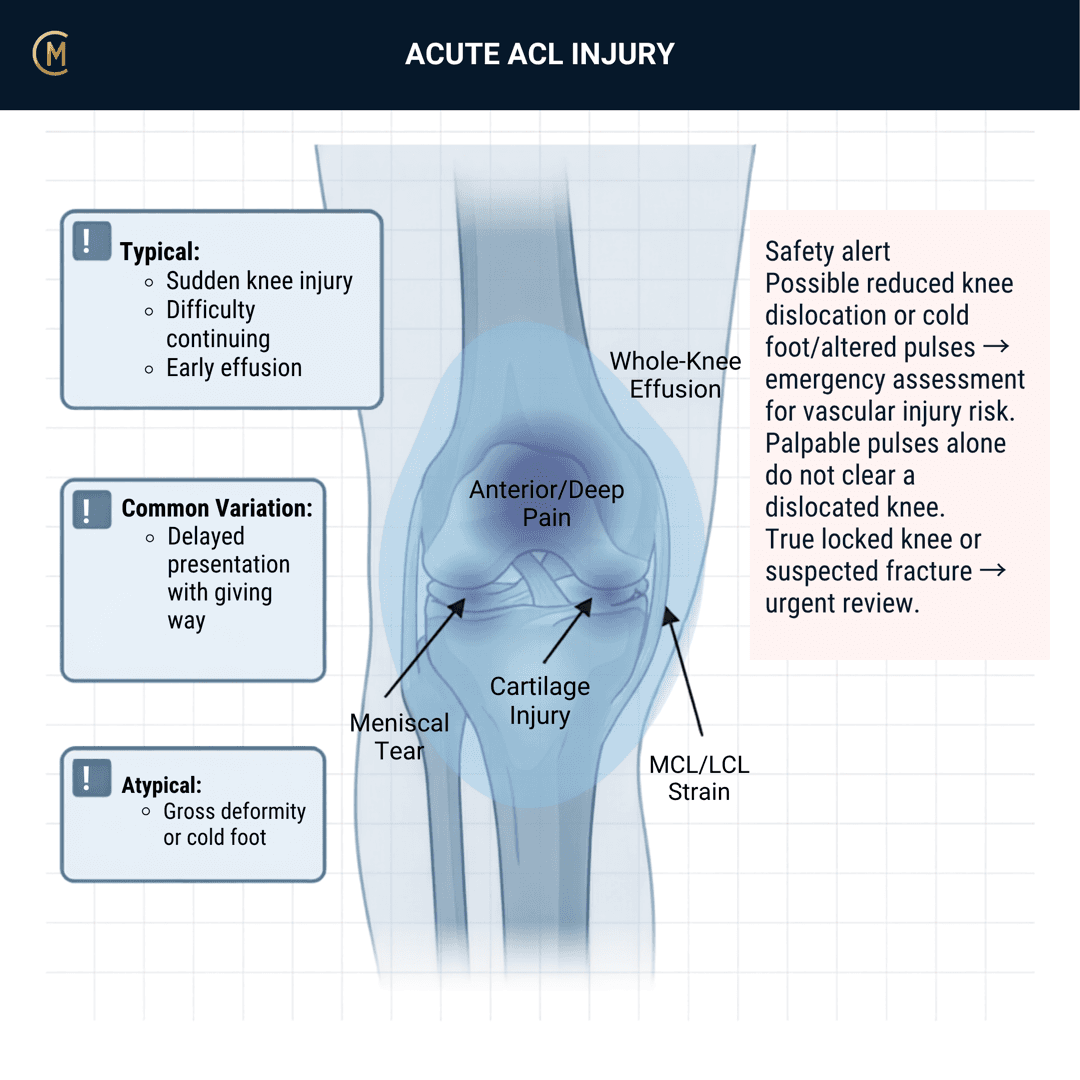
Who: Pivoting-sport athletes. In Australia, most often on a football, netball or basketball court, and increasingly children.
What: A twisting, decelerating or landing moment. A pop. Swelling within hours — often within one.
How it behaves: Giving way on turning. Confidence gone long before strength is.
The one thing to take from this page:
Australia reconstructs more ACLs than almost anywhere on earth, and has no national guideline telling anyone when to.
| Figure | Value |
|---|---|
| Australian ACL reconstruction incidence, 2003–08 | 52.0 per 100,000 person-years (95% CI 51.6–52.5) |
| The same figure in Scandinavia | 32–38 |
| Australian incidence 2014–15, males aged 20–24 | 283 per 100,000 |
| Australian incidence 2014–15, females aged 15–19 | 164 per 100,000 |
| Rise in under-25s, 2000–01 to 2014–15 | 52.6 → 91.4 per 100,000 (+74%) |
| Fastest-growing age group | 5–14 year-olds (boys 7.7%/yr, girls 8.8%/yr) |
| Direct hospital cost, 2014–15 | A$142 million |
([1] [2], 197,557 primary reconstructions over 15 years, national hospital morbidity data.)
Sports by reconstruction incidence in Australia: skiing, then Australian rules football, rugby, netball, soccer.
⚠️ No Australian clinical guideline exists for this presentation; the Australian Orthopaedic Association and Australian Knee Society consensus position statement covers the surgery-or-not decision. Anchored to the JOSPT Knee Ligament Sprain CPG [3] for diagnosis and the Aspetar rehabilitation guideline [4] afterwards. The 2017 guideline predates SNNAP, the Aspetar guideline and both KANON healing analyses.
Pattern > Label. "ACL rupture" names a ligament. It does not name a treatment.
2 · SE — THE SUBJECTIVE PATTERN (the 70%)
Acute and traumatic, so the order reorders: MAIN PROBLEM → BODY CHART → HISTORY → BEHAVIOUR.
MAIN PROBLEM
"I went to change direction and my knee gave way." Often: "I heard it."
BODY CHART
- Deep and diffuse rather than pointable. Localised joint-line pain suggests company — meniscus, MCL. See the meniscus page.
- Medial pain with a valgus mechanism — think MCL.
HISTORY — the three questions
- The mechanism. Non-contact pivot, deceleration, or a landing. Or a contact valgus blow.
- The pop. Common, not diagnostic.
- How fast did it swell? Minutes means haemarthrosis. Hours to a day is a different story and points more toward meniscus.
And screen for the limb-threatening version. Multi-ligament instability after high-energy trauma, or a knee that dislocated and reduced itself, is a vascular emergency — see §4.
BEHAVIOUR
- Aggs: turning, pivoting, uneven ground, stairs down.
- Eases: straight-line, braced, slow.
- Severity: VAS 0–10 at best / at worst / right now.
- Giving way — how often, doing what, and can they predict it?
- Irritability: resting symptoms, vigour, time to settle.
SPECIAL / SCREENING QUESTIONS
Neurovascular symptoms, previous knee surgery, sport level and demands, work demands, general health. See §4.
The part students skip — and it predicts more than strength does
Ask what they are afraid of. The ACL-RSI exists because fear of re-injury is a measurable barrier to return, and it moves on a knowable trajectory: pre-operative 44.4 (95% CI 38.2–50.7), rising to 61.5 (58.6–64.4) at 3–6 months, then plateauing to 70.7 (63.0–78.5) at 2–5 years.
(Carry the caveat: across 83 studies, 78% were at high risk of bias and every analysis was rated weak or limited certainty.)
Qualitative work in 18 Australians identified five distinct sources of that fear: external messages from clinicians and others; the sheer difficulty of the rehabilitation journey; threat to identity and independence; socioeconomic factors; and ongoing psychological barriers [5].
"External messages" means you. What a student says in week one about "your ACL" becomes part of the fear the patient carries at month nine.
Assessing this region? Download the Knee assessment template →
3 · HYPOTHESIS RANKING
| Competing pattern | The one discriminating feature |
|---|---|
| Meniscal tear | Swelling over hours, joint-line pain, catching — see the meniscus page |
| MCL sprain | Valgus mechanism, tender on the ligament above the joint line, valgus stress reproduces it |
| Patellar dislocation | Lateral apprehension, medial retinacular tenderness, often a self-reduced "it went out" |
| PCL injury | Dashboard or fall-on-flexed-knee mechanism, posterior sag |
| Fracture | Ottawa Knee Rule positive — §4 |
| Knee dislocation / multiligament | Two or more ligaments grossly unstable. This is the emergency — §4 |
The haemarthrosis is the reasoning object
A knee that swells within an hour of a twisting injury has bled into itself, and that fact carries a 12-year prognosis.
In 814 of 1,129 (70%) consecutive patients presenting after acute knee trauma with haemarthrosis, classified on sub-acute MRI [6]:
| Radiographic OA at 12 years | Symptomatic | |
|---|---|---|
| Haemarthrosis with no structural injury | 6% | 4% |
| Haemarthrosis with structural injury | 36% | 21% |
| Relative risk | 8 (95% CI 3–21) | 6 (2–20) |
| Injured vs contralateral knee, overall | 34% (30–37) vs 18% (15–20) | — |
| Highest risk combination | ACL + meniscus, RR 3.1 (2.1–4.6) | — |
81% (78–84) were satisfied with their knee function at 12 years. Both halves of that are true and both belong in the conversation.
Jones' hypothesis categories that change your plan: precautions and contraindications first — vascular, fracture — then sources of symptoms and patient perspectives, which on this pattern genuinely drive management.
Blood in the joint is not a symptom. It is a finding with a decade attached.
4 · RED FLAGS — DON'T MISS THIS
This section is free, on every pattern, forever.
The one that is a genuine emergency
Knee dislocation is a limb-threatening injury and it may have reduced itself before you saw it. Suspect it whenever two or more ligaments are grossly unstable after high-energy trauma.
Across 862 knee dislocations [7]:
| Weighted frequency | |
|---|---|
| Vascular injury | 18% (171/862) |
| Nerve injury | 25% (75/272) |
| Highest vascular prevalence — ACL + PCL + MCL pattern | 32% |
| Posterior dislocation | 25% |
Check and document pedal pulses, capillary refill, and distal sensation and power — bilaterally. A normal-looking foot does not exclude an intimal tear. This goes to an emergency department, not to a physiotherapy follow-up.
(These are surgical and trauma series. The published abstract's amputation figure is internally inconsistent.)
The rest of the screen
| Signs / symptoms | Implication |
|---|---|
| Ottawa Knee Rule positive after acute trauma | Fracture |
| Hot, unwell, cannot weight-bear | Septic arthritis — see the meniscus page for the numbers |
| Knee locked short of extension, patient cannot release it | Displaced meniscal tear — a true block |
| Progressive neurological symptoms below the knee | Nerve injury |
| Calf pain, swelling, warmth after immobilisation | DVT |
Ottawa Knee Rule: sensitivity 98.5% (95% CI 93.2–100), −LR 0.05 (0.02–0.23), specificity 48.6% — 6 studies, 4,249 adults with acute knee injury [8]. It rules fracture out. It never rules one in.
Two or more ligaments grossly unstable after high-energy trauma is a vascular emergency until a pulse says otherwise — and 18% of them have a vascular injury.
Document pulses and distal neurology bilaterally, every time, and write down what you found.
Ottawa rules fracture out. Specificity 48.6% means it never rules one in.
5 · OE — THE OBJECTIVE (the 30%)
Members
Sections 5 to 7 are for members
The objective exam, management and pearls, plus the six-minute lesson and the debrief. Free with an account.
Sign in or join free6 · MX — MANAGEMENT ESSENTIALS
Members
Sections 5 to 7 are for members
The objective exam, management and pearls, plus the six-minute lesson and the debrief. Free with an account.
Sign in or join free7 · CLINICAL PEARLS + RETRIEVAL CHECK
Members
Sections 5 to 7 are for members
The objective exam, management and pearls, plus the six-minute lesson and the debrief. Free with an account.
Sign in or join freeMembers
The 5-minute lesson is for members
Twelve slides on this pattern: what you'll hear, what to examine, what to do. Free with an account.
Sign in or join freeGuideline anchor
No Australian clinical guideline.
More
The Australian anchor for the surgery-or-not decision is the Australian Orthopaedic Association and Australian Knee Society consensus position statement on non-operative and operative ACL management (2021): structured rehabilitation improves outcomes either way, and delayed optional reconstruction is contraindicated with a repairable meniscal tear or osteochondral lesion. Diagnosis and the physiotherapy detail are anchored to the JOSPT Knee Ligament Sprain CPG, Revision 2017 (Logerstedt et al., PMID 29089004).
No Australian guideline exists for acute ACL injury. Australia has one of the highest reconstruction rates in the world and no national guideline to go with it. The Australian contribution here is primary research, not guidance — Zbrojkiewicz (MJA 2018), Janssen (2012), Webster & Feller (2016), Ardern (2014), all La Trobe or national registry data.
Members
The evidence summary is for members
Verified diagnostic accuracy, where the evidence stands and what it doesn't settle. Free with an account.
Sign in or join freeSources · 26
ShowHide
Every source on this page resolves and title-verifies against PubMed. Newest first.
- 2012Janssen et al. (2012). High incidence and costs for anterior cruciate ligament reconstructions performed in Australia from 2003-2004 to 2007-2008: time for an anterior cruciate ligament register by Scandinavian model?. Scandinavian journal of medicine & science in sports, 22(4), 495-501. https://doi.org/10.1111/j.1600-0838.2010.01253.x
- 2018Zbrojkiewicz et al. (2018). Increasing rates of anterior cruciate ligament reconstruction in young Australians, 2000-2015. The Medical journal of Australia, 208(8), 354-358. https://doi.org/10.5694/mja17.00974
- 2017Logerstedt et al. (2017). Knee Stability and Movement Coordination Impairments: Knee Ligament Sprain Revision 2017. The Journal of orthopaedic and sports physical therapy, 47(11), A1-A47. https://doi.org/10.2519/jospt.2017.0303
- 2023Kotsifaki et al. (2023). Aspetar clinical practice guideline on rehabilitation after anterior cruciate ligament reconstruction. British journal of sports medicine, 57(9), 500-514. https://doi.org/10.1136/bjsports-2022-106158
- 2023Little et al. (2023). Understanding Fear after an Anterior Cruciate Ligament Injury: A Qualitative Thematic Analysis Using the Common-Sense Model. International journal of environmental research and public health, 20(4). https://doi.org/10.3390/ijerph20042920
- 2025Isacsson et al. (2025). Long-term impact of acute knee injury with hemarthrosis: Osteoarthritis incidence and patient-reported outcomes in a large consecutive cohort over 12 years. Osteoarthritis and cartilage open, 7(4), 100700. https://doi.org/10.1016/j.ocarto.2025.100700
- 2014Medina et al. (2014). Vascular and nerve injury after knee dislocation: a systematic review. Clinical orthopaedics and related research, 472(9), 2621-9. https://doi.org/10.1007/s11999-014-3511-3
- 2004Bachmann et al. (2004). The accuracy of the Ottawa knee rule to rule out knee fractures: a systematic review. Annals of internal medicine, 140(2), 121-4. https://doi.org/10.7326/0003-4819-140-5-200403020-00013
- 2013van Eck et al. (2013). Methods to diagnose acute anterior cruciate ligament rupture: a meta-analysis of physical examinations with and without anaesthesia. Knee surgery, sports traumatology, arthroscopy : official journal of the ESSKA, 21(8), 1895-903. https://doi.org/10.1007/s00167-012-2250-9
- 2022Tanaka et al. (2022). Diagnostic Accuracy of Physical Examination Tests for Suspected Acute Anterior Cruciate Ligament Injury: A Systematic Review and Meta-Analysis. International journal of sports physical therapy, 17(5), 742-752. https://doi.org/10.26603/001c.36434
- 2006Benjaminse et al. (2006). Clinical diagnosis of an anterior cruciate ligament rupture: a meta-analysis. The Journal of orthopaedic and sports physical therapy, 36(5), 267-88. https://doi.org/10.2519/jospt.2006.2011
- 2019Filbay & Grindem (2019). Evidence-based recommendations for the management of anterior cruciate ligament (ACL) rupture. Best practice & research. Clinical rheumatology, 33(1), 33-47. https://doi.org/10.1016/j.berh.2019.01.018
- 2017Wellsandt et al. (2017). Limb Symmetry Indexes Can Overestimate Knee Function After Anterior Cruciate Ligament Injury. The Journal of orthopaedic and sports physical therapy, 47(5), 334-338. https://doi.org/10.2519/jospt.2017.7285
- 2023Filbay et al. (2023). Evidence of ACL healing on MRI following ACL rupture treated with rehabilitation alone may be associated with better patient-reported outcomes: a secondary analysis from the KANON trial. British journal of sports medicine, 57(2), 91-98. https://doi.org/10.1136/bjsports-2022-105473
- 2025Filbay et al. (2025). Association Between ACL Continuity on Magnetic Resonance Imaging at 5 Years After an Acute ACL Rupture and 11-Year Outcomes: A Secondary Analysis From the KANON Trial. The American journal of sports medicine, 53(8), 1893-1900. https://doi.org/10.1177/03635465251339061
- 2016Grindem et al. (2016). Simple decision rules can reduce reinjury risk by 84% after ACL reconstruction: the Delaware-Oslo ACL cohort study. British journal of sports medicine, 50(13), 804-8. https://doi.org/10.1136/bjsports-2016-096031
- 2016Kyritsis et al. (2016). Likelihood of ACL graft rupture: not meeting six clinical discharge criteria before return to sport is associated with a four times greater risk of rupture. British journal of sports medicine, 50(15), 946-51. https://doi.org/10.1136/bjsports-2015-095908
- 2018Welling et al. (2018). Low rates of patients meeting return to sport criteria 9 months after anterior cruciate ligament reconstruction: a prospective longitudinal study. Knee surgery, sports traumatology, arthroscopy : official journal of the ESSKA, 26(12), 3636-3644. https://doi.org/10.1007/s00167-018-4916-4
- 2014Ardern et al. (2014). Fifty-five per cent return to competitive sport following anterior cruciate ligament reconstruction surgery: an updated systematic review and meta-analysis including aspects of physical functioning and contextual factors. British journal of sports medicine, 48(21), 1543-52. https://doi.org/10.1136/bjsports-2013-093398
- 2018Lai et al. (2018). Eighty-three per cent of elite athletes return to preinjury sport after anterior cruciate ligament reconstruction: a systematic review with meta-analysis of return to sport rates, graft rupture rates and performance outcomes. British journal of sports medicine, 52(2), 128-138. https://doi.org/10.1136/bjsports-2016-096836
- 2016Wiggins et al. (2016). Risk of Secondary Injury in Younger Athletes After Anterior Cruciate Ligament Reconstruction: A Systematic Review and Meta-analysis. The American journal of sports medicine, 44(7), 1861-76. https://doi.org/10.1177/0363546515621554
- 2016Webster & Feller (2016). Exploring the High Reinjury Rate in Younger Patients Undergoing Anterior Cruciate Ligament Reconstruction. The American journal of sports medicine, 44(11), 2827-2832. https://doi.org/10.1177/0363546516651845
- 2020Ekås et al. (2020). Evidence too weak to guide surgical treatment decisions for anterior cruciate ligament injury: a systematic review of the risk of new meniscal tears after anterior cruciate ligament injury. British journal of sports medicine, 54(9), 520-527. https://doi.org/10.1136/bjsports-2019-100956
- 2010Frobell et al. (2010). A randomized trial of treatment for acute anterior cruciate ligament tears. The New England journal of medicine, 363(4), 331-42. https://doi.org/10.1056/NEJMoa0907797
- 2013Frobell et al. (2013). Treatment for acute anterior cruciate ligament tear: five year outcome of randomised trial. BMJ (Clinical research ed.), 346, f232. https://doi.org/10.1136/bmj.f232
- 2022Beard et al. (2022). Rehabilitation versus surgical reconstruction for non-acute anterior cruciate ligament injury (ACL SNNAP): a pragmatic randomised controlled trial. Lancet (London, England), 400(10352), 605-615. https://doi.org/10.1016/S0140-6736(22)01424-6
Mapped to this pattern
- ACL-RSI
Anterior Cruciate Ligament - Return to Sport after Injury
psychological readiness to return to sport · 12 items · 4 min
- IKDC
International Knee Documentation Committee Subjective Knee Form
knee symptoms, function and sport activity · 18 items · 6 min
- KOOS
Knee Injury and Osteoarthritis Outcome Score
knee injury and osteoarthritis outcome · 42 items · 10 min
- Tegner
Tegner Activity Score
activity level · 1 items · 2 min
- TSK-11
Tampa Scale of Kinesiophobia
fear of movement and re-injury · 11 items · 3 min
- Lysholm
Lysholm Knee Scoring Scale
knee symptoms after ligament injury · 8 items · 4 min
- Marx
Marx Activity Rating Scale
activity frequency · 4 items · 2 min
- Ottawa Knee
Ottawa Knee Rule
imaging decision rule · 5 items · 1 min
- Pittsburgh
Pittsburgh Knee Rules
imaging decision rule · 3 items · 1 min
Generic measures that also apply
- Borg RPE
Borg Rating of Perceived Exertion Scale (6-20)
perceived exertion · 1 items · 1 min
- GROC
Global Rating of Change Scale
perceived change since baseline · 1 items · 1 min
- NPRS
Numeric Pain Rating Scale
pain intensity · 1 items · 1 min
- PGIC
Patient Global Impression of Change
perceived change since baseline · 1 items · 1 min
- PSFS
Patient-Specific Functional Scale
patient-generated function · 3 items · 2 min
- SANE
Single Assessment Numeric Evaluation
patient-rated function as a percentage of normal · 1 items · 1 min
- VAS
Visual Analogue Scale
pain intensity · 1 items · 1 min
- Borg CR10
Borg Category Ratio 10 Scale
perceived exertion or symptom intensity, ratio scale · 1 items · 1 min
- GAS
Goal Attainment Scaling
individualised goal achievement · 10 min
Did this page do its job?
CliniStudy is in beta. One tap is enough — it decides what gets fixed first.