
1 · SNAPSHOT
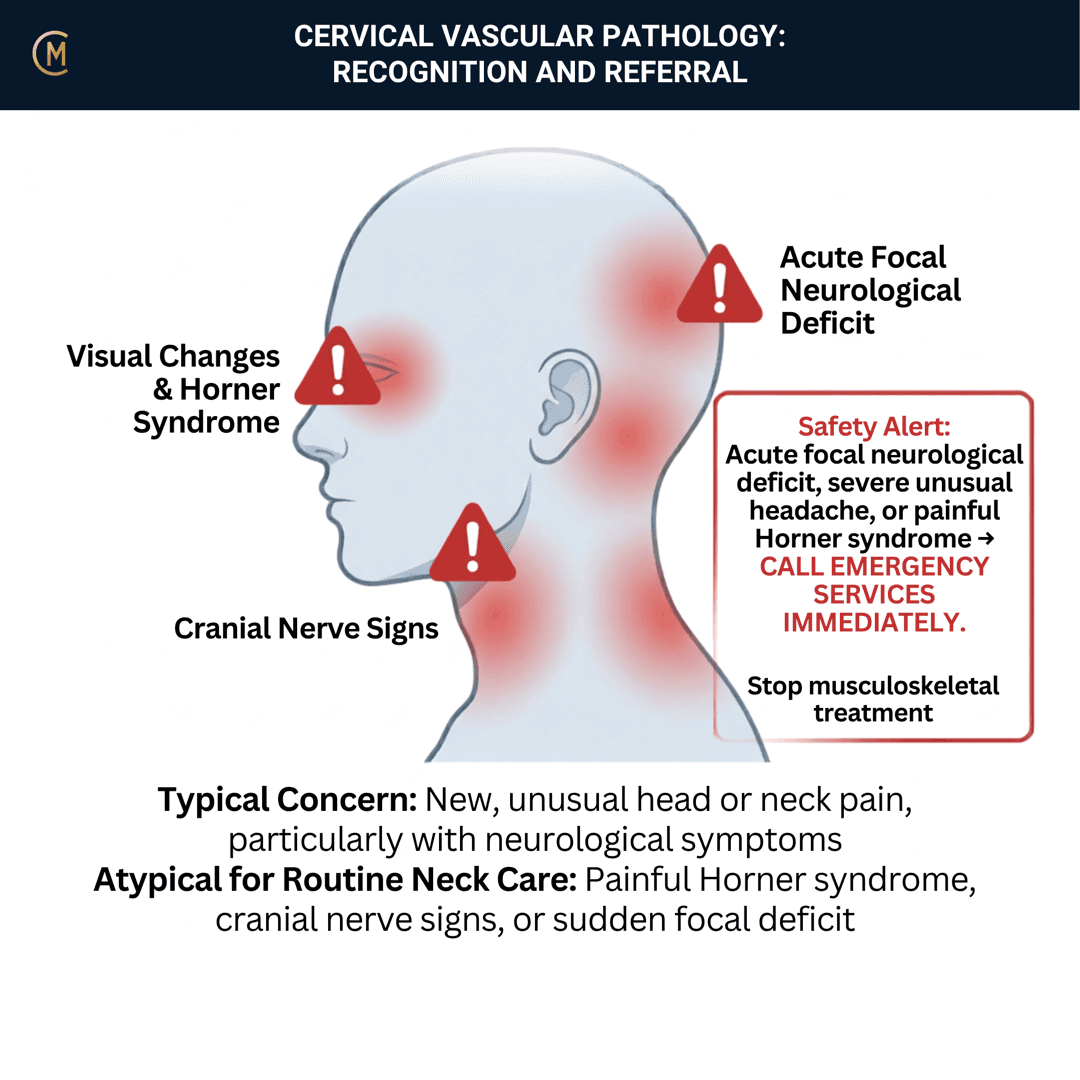
This entire page is free, permanently. Red-flag content is never gated in CliniStudy, and gating this one would put the referral pathway behind a paywall.
Who: Younger than you expect. Mean age around 50 in population data, and it accounts for 15–25% of ischaemic strokes under 50.
What: Neck pain and headache — often nothing else, at first.
How it behaves: New, unfamiliar, and not like their usual neck.
The one thing to take from this page:
Pain comes first. The neurology comes later. The gap is hours to days — and the patient may be sitting in front of you inside it.
| Figure | Population |
|---|---|
| Head or neck pain at presentation | 80% (population-based, n = 48) |
| Headache or neck pain across reviews | 65–95% |
| Cerebral ischaemia | 56% |
| Partial Horner's syndrome | 25% |
| Dissections presenting with pain ONLY | 20/245 (8%) — median delay to diagnosis 7 days, range 4 hours to 29 days |
| Had transient ischaemic features in the month before admission | 67% (24 Australian cases aged ≤55) |
| Sent home from an emergency department in the preceding 14 days | 3.1% (95% CI 2.7–3.5) — about 1 in 30, n = 7,090 |
[1][2][3][4][5]
How common: 4.69 per 100,000 person-years in the most recent population data — internal carotid 2.43, vertebral 2.01 [6]. The earlier study of the same county gives 2.6 (95% CI 1.86–3.33).
⚠️ There IS an Australian anchor — and this page has not read it. The APA Clinical Guide to Safe Manual Therapy Practice in the Cervical Spine (2017) is not PubMed-indexed and is member-access. Everything attributable to it sits in
citations_unverified. The international anchor is the 2023 IFOMPT Cervical Framework [7].
Pattern > Label. And here the label keeps moving: IFOMPT went from "cervical arterial dysfunction" in 2014 to "vascular pathologies of the neck" in 2023, and a 2023 commentary argues that term is wrong too.
2 · SE — THE SUBJECTIVE PATTERN (the 70%)
The subjective IS the screen. It is not a preamble to a test — it is the test.
Five stages, in your course's order.
MAIN PROBLEM
"I've got a headache and my neck's really sore." Nothing about that sentence is alarming. That is the problem.
BODY CHART
Pain location differs by which artery, and it is worth knowing:
| Site | |
|---|---|
| Internal carotid dissection | Temporal 46%, frontal 19% |
| Vertebral dissection | Nuchal or occipital 80% |
[8]
And in 1,972 vertebral dissection patients [9]: dizziness or vertigo 58%, headache 51%, neck pain 46%, stroke 63%, TIA 14%.
HISTORY — the four questions that matter
- Is this new, and is it different from your usual headache or neck pain? In the pain-only series, the pain was different from earlier episodes in all but one of 20.
- Any recent minor neck trauma, strain, or manipulation? In 24 Australian cases, 71% (17/24) reported recent minor mechanical trauma or strain.
- Any brief episodes in the last month — dizziness, visual disturbance, weakness, numbness — that came and went? 67% reported exactly this.
- Do you get migraines? Migraine is the risk factor with the best causal evidence: OR 1.69 (95% CI 1.24–2.30), p = 0.0009 per doubling of migraine prevalence [10].
BEHAVIOUR
- Mechanical aggravation and easing does not clear it. See §3.
- New, severe, unfamiliar, or unusually sudden onset raises the stakes.
SPECIAL / SCREENING QUESTIONS
The 5 D's and 3 N's — dizziness, diplopia, dysarthria, dysphagia, drop attacks; nausea, nystagmus, numbness. Plus recent infection, hypertension, and connective tissue disorders.
And read §5 before you decide what that list is worth.
The risk profile is not what you were taught
A clean cardiovascular history does not reassure. It points the wrong way.
| Factor | Finding |
|---|---|
| Hypercholesterolaemia and being overweight | INVERSELY associated with dissection |
| Cardiovascular risk factor count | <1 per dissection case vs >3 per stroke control |
| Migraine | The strongest, and causally supported |
| Hypertension, recent infection, cervical trauma | Established |
| Known connective tissue disease | Present in only 7.9% of 1,972 vertebral dissections |
([11] [12]; Gottesman et al. 2012.)
The healthy 38-year-old with a new headache and a sore neck is the presentation. Not the 70-year-old with three risk factors.
Assessing this region? Download the Cervical Spine assessment template →
3 · HYPOTHESIS RANKING
| Competing pattern | The one discriminating feature |
|---|---|
| Mechanical neck pain / cervicogenic headache | Reproducible and resolvable on sustained upper cervical mobilisation — reproduction and resolution of familiar head pain gave OR 36, sensitivity 78%, specificity 90% |
| Primary headache — migraine, tension | A pattern they recognise. Dissection headache is new and unfamiliar |
| Cervical myelopathy | Gait, hands, hyperreflexia — see that page |
| Vestibular pathology | Dizziness without pain, and a normal neurological screen. But see below |
| Atherosclerotic VBI | Older, vascular risk factors present, positional. A different pathology from dissection — do not merge them |
| Subarachnoid haemorrhage | Thunderclap onset. Emergency |
The dangerous overlap — and why a mechanical pattern does not clear it
This is the sentence the page exists for:
"Early features of CAD can mimic a painful musculoskeletal presentation and a patient may present for treatment of neck pain and headache with a dissection in progress."
— Thomas, Rivett, Bateman, Stanwell & Levi 2016 [13], Australian masterclass.
So "no reproducible mechanical neck pain" is the most dangerous line taught on this pattern, because it implies that finding a mechanical pattern rules dissection out. It does not.
And the dizzy patient is where it hides. Dizziness or vertigo accounts for 2.1–4.4% of all emergency consultations, and up to one third of vertebrobasilar strokes presenting with vertigo are missed [14]. Add: up to 20% of diffusion-weighted MRI scans are falsely negative if obtained within 24–48 hours of symptom onset.
Jones' hypothesis categories that change your plan: precautions and contraindications, and nothing else matters until that one is settled.
The question is never "is this mechanical?" It is "is this ALSO something else?"
4 · RED FLAGS — DON'T MISS THIS
The whole page is the red flag. This section is the action.
| Signs / symptoms | Implication |
|---|---|
| New, unfamiliar, severe head or neck pain — especially with recent minor trauma or strain | Dissection until proven otherwise |
| Any of the 5 D's or 3 N's — dizziness, diplopia, dysarthria, dysphagia, drop attacks, nausea, nystagmus, numbness | Posterior circulation ischaemia. See §5 for what this list is and is not |
| Partial Horner's — ptosis and miosis without anhidrosis | Internal carotid dissection. 25% |
| Transient episodes in the preceding weeks that came and went | 67% of cases had these |
| Pulsatile tinnitus, lower cranial nerve palsy | Carotid dissection |
| Thunderclap onset | Subarachnoid haemorrhage — emergency |
| Progressive or unexplained neurological signs | Stroke in evolution |
What to do — and it is short
- Stop. No manual therapy, no sustained end-range positions, no thrust, and no exercise into provocative range.
- Refer. Same-day medical assessment for a suspected dissection; emergency services if there are neurological signs, a thunderclap onset, or the patient is deteriorating.
- Document what you found and what you did, in the words you used. This is the note that matters.
- Say it plainly to the patient. "Your pain is real and it may not be coming from the joints and muscles. I want a doctor to look at this today."
The Australian prediction tool — promising, and not yet validated
Four variables: age 40–55 (versus under 40), trauma, recent-onset headache, and more than two neurological features. In 37 radiologically confirmed dissections against 20 non-dissection strokes and 100 healthy controls [15]:
| AUC | 0.953 (95% CI 0.916–0.987) |
| Threshold ≥3 of 7 | sensitivity 87%, specificity 79% |
Carry the caveat. Retrospective, tertiary hospital, and never validated prospectively in primary care — which is exactly where a student would use it.
New, unfamiliar head or neck pain in someone under 55 is a dissection question until you have answered it.
Transient episodes in the last month are the warning shot. Two in three cases had them.
A mechanical pattern does not clear this. Nothing you can do with your hands clears this.
5 · OE — THE OBJECTIVE (the 30%)
Members
Sections 5 to 7 are for members
The objective exam, management and pearls, plus the six-minute lesson and the debrief. Free with an account.
Sign in or join free6 · MX — MANAGEMENT ESSENTIALS
Members
Sections 5 to 7 are for members
The objective exam, management and pearls, plus the six-minute lesson and the debrief. Free with an account.
Sign in or join free7 · CLINICAL PEARLS + RETRIEVAL CHECK
Members
Sections 5 to 7 are for members
The objective exam, management and pearls, plus the six-minute lesson and the debrief. Free with an account.
Sign in or join freeMembers
The 4-minute lesson is for members
Twelve slides on this pattern: what you'll hear, what to examine, what to do. Free with an account.
Sign in or join freeGuideline anchor
Australian guideline: International IFOMPT Cervical Framework — examination of the cervical region for potential vascular pathologies of the neck prior to musculoskeletal intervention (Rushton et al.)
The 2023 revision changed the terminology from 'cervical arterial dysfunction' to 'vascular pathologies of the neck' and WIDENED the scope from orthopaedic manual therapy to musculoskeletal intervention — it now covers exercise and mobilisation, not just thrust. Erratum JOSPT 2023;53(6):372-374.
Members
The evidence summary is for members
Verified diagnostic accuracy, where the evidence stands and what it doesn't settle. Free with an account.
Sign in or join freeSources · 26
ShowHide
Every source on this page resolves and title-verifies against PubMed. Newest first.
- 2006Lee et al. (2006). Incidence and outcome of cervical artery dissection: a population-based study. Neurology, 67(10), 1809-12. https://doi.org/10.1212/01.wnl.0000244486.30455.71
- 2022Keser et al. (2022). Cervical Artery Dissections: Etiopathogenesis and Management. Vascular health and risk management, 18, 685-700. https://doi.org/10.2147/VHRM.S362844
- 2006Arnold et al. (2006). Pain as the only symptom of cervical artery dissection. Journal of neurology, neurosurgery, and psychiatry, 77(9), 1021-4. https://doi.org/10.1136/jnnp.2006.094359
- 2015Thomas et al. (2015). Risk Factors and Clinical Presentation of Cervical Arterial Dissection: Preliminary Results of a Prospective Case-Control Study. The Journal of orthopaedic and sports physical therapy, 45(7), 503-11. https://doi.org/10.2519/jospt.2015.5877
- 2020Liberman et al. (2020). Misdiagnosis of Cervicocephalic Artery Dissection in the Emergency Department. Stroke, 51(6), 1876-1878. https://doi.org/10.1161/STROKEAHA.120.029390
- 2024Griffin et al. (2024). Epidemiology of Spontaneous Cervical Artery Dissection: Population-Based Study. Stroke, 55(3), 670-677. https://doi.org/10.1161/STROKEAHA.123.043647
- 2023Rushton et al. (2023). International Framework for Examination of the Cervical Region for Potential of Vascular Pathologies of the Neck Prior to Musculoskeletal Intervention: International IFOMPT Cervical Framework. The Journal of orthopaedic and sports physical therapy, 53(1), 7-22. https://doi.org/10.2519/jospt.2022.11147
- 2022Arning et al. (2022). The Clinical Features of Dissection of the Cervical Brain-Supplying Arteries. Deutsches Arzteblatt international, 119(35-36), 581-587. https://doi.org/10.3238/arztebl.m2022.0238
- 2012Gottesman et al. (2012). Clinical characteristics of symptomatic vertebral artery dissection: a systematic review. The neurologist, 18(5), 245-54. https://doi.org/10.1097/NRL.0b013e31826754e1
- 2022Daghlas et al. (2022). Migraine, Stroke, and Cervical Arterial Dissection: Shared Genetics for a Triad of Brain Disorders With Vascular Involvement. Neurology. Genetics, 8(1), e653. https://doi.org/10.1212/NXG.0000000000000653
- 2014Debette (2014). Pathophysiology and risk factors of cervical artery dissection: what have we learnt from large hospital-based cohorts?. Current opinion in neurology, 27(1), 20-8. https://doi.org/10.1097/WCO.0000000000000056
- 2011Thomas et al. (2011). Risk factors and clinical features of craniocervical arterial dissection. Manual therapy, 16(4), 351-6. https://doi.org/10.1016/j.math.2010.12.008
- 2016Thomas (2016). Cervical arterial dissection: An overview and implications for manipulative therapy practice. Manual therapy, 21, 2-9. https://doi.org/10.1016/j.math.2015.07.008
- 2025Tarnutzer et al. (2025). Diagnostic Errors in the Acutely Dizzy Patient-Lessons Learned. Brain sciences, 15(1). https://doi.org/10.3390/brainsci15010055
- 2024Thomas et al. (2024). Development of a diagnostic support tool for predicting cervical arterial dissection in primary care. The Journal of manual & manipulative therapy, 32(2), 173-181. https://doi.org/10.1080/10669817.2023.2250164
- 2013Hutting et al. (2013). Diagnostic accuracy of premanipulative vertebrobasilar insufficiency tests: a systematic review. Manual therapy, 18(3), 177-82. https://doi.org/10.1016/j.math.2012.09.009
- 2019Kranenburg et al. (2019). Effects of Head and Neck Positions on Blood Flow in the Vertebral, Internal Carotid, and Intracranial Arteries: A Systematic Review. The Journal of orthopaedic and sports physical therapy, 49(10), 688-697. https://doi.org/10.2519/jospt.2019.8578
- 2019Moser et al. (2019). Effect of cervical manipulation on vertebral artery and cerebral haemodynamics in patients with chronic neck pain: a crossover randomised controlled trial. BMJ open, 9(5), e025219. https://doi.org/10.1136/bmjopen-2018-025219
- 2020Hutting et al. (2020). Yes, we should abandon pre-treatment positional testing of the cervical spine. Musculoskeletal science & practice, 49, 102181. https://doi.org/10.1016/j.msksp.2020.102181
- 2021de Best et al. (2021). Interexaminer Agreement and Reliability of an Internationally Endorsed Screening Framework for Cervical Vascular Risks Following Manual Therapy and Exercise: The Go4Safe Project. Physical therapy, 101(10). https://doi.org/10.1093/ptj/pzab166
- 2017Swait & Finch (2017). What are the risks of manual treatment of the spine? A scoping review for clinicians. Chiropractic & manual therapies, 25, 37. https://doi.org/10.1186/s12998-017-0168-5
- 2008Cassidy et al. (2008). Risk of vertebrobasilar stroke and chiropractic care: results of a population-based case-control and case-crossover study. Spine, 33(4 Suppl), S176-83. https://doi.org/10.1097/BRS.0b013e3181644600
- 2023Whedon et al. (2023). The association between cervical artery dissection and spinal manipulation among US adults. European spine journal : official publication of the European Spine Society, the European Spinal Deformity Society, and the European Section of the Cervical Spine Research Society, 32(10), 3497-3504. https://doi.org/10.1007/s00586-023-07844-9
- 2014Biller et al. (2014). Cervical arterial dissections and association with cervical manipulative therapy: a statement for healthcare professionals from the american heart association/american stroke association. Stroke, 45(10), 3155-74. https://doi.org/10.1161/STR.0000000000000016
- 2014Rushton et al. (2014). International framework for examination of the cervical region for potential of Cervical Arterial Dysfunction prior to Orthopaedic Manual Therapy intervention. Manual therapy, 19(3), 222-8. https://doi.org/10.1016/j.math.2013.11.005
- 2011Debette et al. (2011). Differential features of carotid and vertebral artery dissections: the CADISP study. Neurology, 77(12), 1174-81. https://doi.org/10.1212/WNL.0b013e31822f03fc
Mapped to this pattern
Generic measures that also apply
- Borg RPE
Borg Rating of Perceived Exertion Scale (6-20)
perceived exertion · 1 items · 1 min
- GROC
Global Rating of Change Scale
perceived change since baseline · 1 items · 1 min
- NPRS
Numeric Pain Rating Scale
pain intensity · 1 items · 1 min
- PGIC
Patient Global Impression of Change
perceived change since baseline · 1 items · 1 min
- PSFS
Patient-Specific Functional Scale
patient-generated function · 3 items · 2 min
- SANE
Single Assessment Numeric Evaluation
patient-rated function as a percentage of normal · 1 items · 1 min
- VAS
Visual Analogue Scale
pain intensity · 1 items · 1 min
- Borg CR10
Borg Category Ratio 10 Scale
perceived exertion or symptom intensity, ratio scale · 1 items · 1 min
- GAS
Goal Attainment Scaling
individualised goal achievement · 10 min
Did this page do its job?
CliniStudy is in beta. One tap is enough — it decides what gets fixed first.