
1 · SNAPSHOT
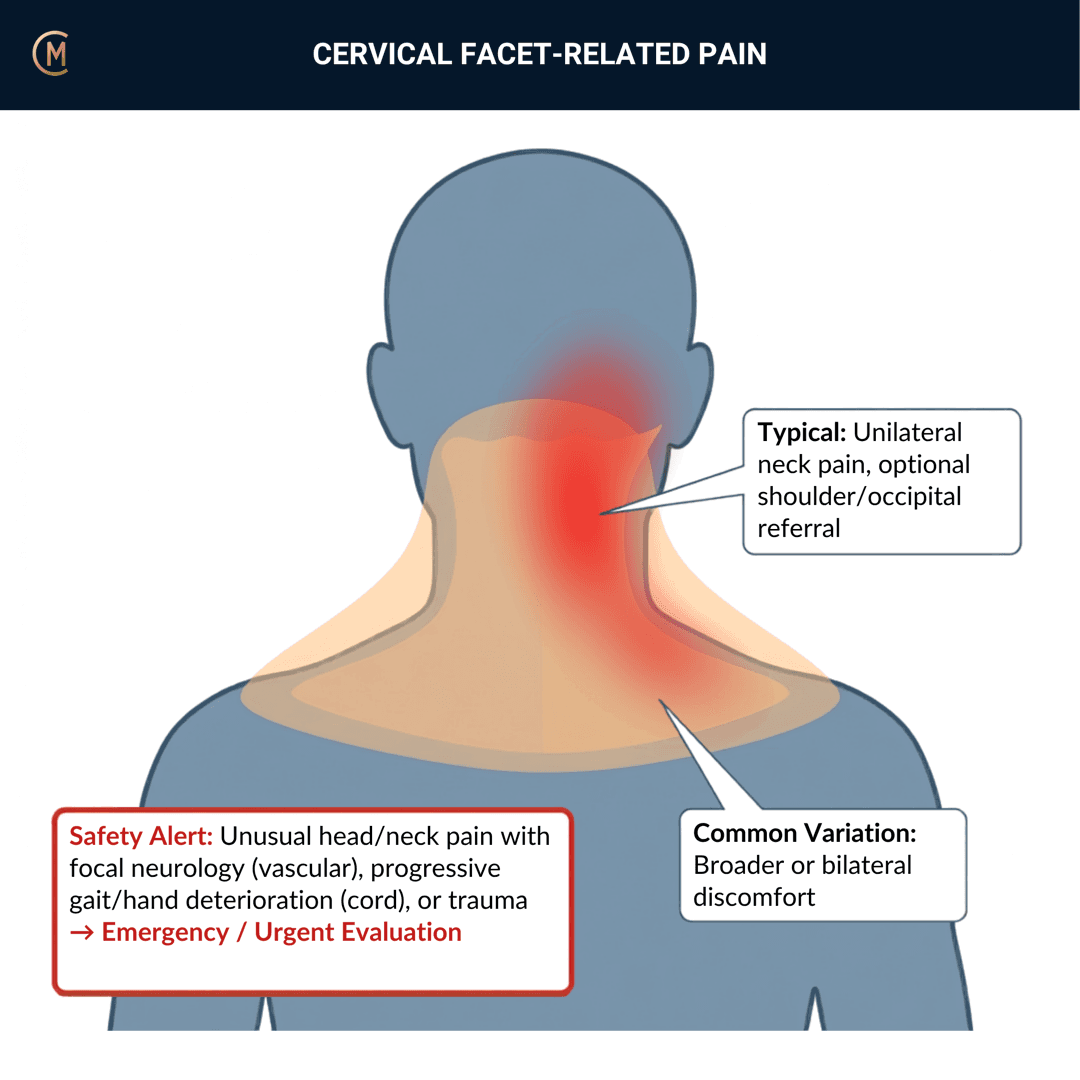
The naming, first, because it costs marks and wastes search time. UniSA teaches this joint as the PIV joint — the posterior intervertebral joint. The literature calls the same structure the cervical facet joint or the cervical zygapophysial joint (also spelled zygapophyseal). PubMed holds zero records using the string "PIV joint". You type one name and the literature prints the other. Write PIV joint in your notes; search cervical zygapophysial, cervical zygapophyseal, cervical facet and medial branch block when you go looking. Same joint every time.
Who: Anyone with a neck. Often after a sudden rotation, a lateral flexion, an awkward night's sleep — or a rear-end collision, which is where most of the evidence was built.
What: Unilateral, non-midline neck pain ± referral into the scapular region, stopping at the shoulder.
How it behaves: Aggs: extension, rotation, sustained postures, the movement that started it. Eases: unloading, gentle movement, changing position. Sharp or catching early → dull ache later.
The illness script in one line:
One segment's posterior joint made sore and stiff — so the pain sits off the midline on one side, refers to the scapula, never goes below the shoulder, and comes back under your thumb at a single level.
The one thing to take from this page:
The reference standard for this diagnosis is a controlled medial branch block — two anaesthetics of different duration, or an anaesthetic against placebo saline, under fluoroscopy. Nobody on a five-week placement will perform one, order one or see the result of one. Every number below is measured against a test you cannot reach. That is the honest frame for the whole page.
| Figure | Number |
|---|---|
| Facet-mediated pain in chronic neck pain, 12 controlled studies | 36%–67%, Level II, substantial heterogeneity |
| False-positive rate of a single block | 26%–63% (45% in the largest cervical series) |
| Post-whiplash, placebo-controlled blocks | 60% (95% CI 46–73) |
| Post-whiplash, comparative blocks | 54% (40–68) |
| Mixed chronic neck pain practice | 39% (32–45) |
| Australian clinical audit, repeat block required | 36% (27–45) |
| Commonest symptomatic levels in that audit | C3-4 31% · C5-6 29% |
| Level picked from a standard pain diagram, first attempt | 83% (29/35) |
| Third occipital nerve (C2-3) headache, post-whiplash | 27% (18–36); 53% (37–68) where headache dominated |
| Unilateral PAIVMs (intersegmental mobility) vs blocks | sens 0.91 (0.85–0.94) · spec 0.74 (0.65–0.81) |
| Cluster: manual exam + segmental tenderness + extension-rotation | spec 84% (77–90) · +LR 4.94 (2.8–8.2) |
| People living with neck pain worldwide, 2020 | 203 million (95% UI 163–253) |
(GBD 2021 [1] [2] [3] [4] [5] [6] [7] [8] [9].)
No Australian guideline exists for this presentation. ACSQHC publishes twenty-one clinical care standards and the only musculoskeletal ones are Low Back Pain (2022) and Osteoarthritis of the Knee (2024). No cervical standard. No RACGP neck guideline. Anchored to Neck Pain: Revision 2017 [10], named as the profession anchor and nothing more.
Now the other half, and it is this page's contribution. The absence of an Australian guideline is not an absence of Australian evidence. The reference standard for this entire pattern was built in Australia — Bogduk, Lord, Barnsley and Wallis at the Cervical Spine Research Unit in Newcastle; Jull at UQ, published in the MJA; Speldewinde's clinical audit, also MJA; the current serious-adverse-event review from UQ. We wrote the evidence and never wrote the guideline.
The only guideline-shaped document that names this pattern is interventional pain medicine — controlled blocks, image guidance, radiofrequency ablation after confirmation [11]. Not one line of it is physiotherapy.
Patterns > Labels. "C5-6 facet joint" names a structure you cannot confirm. Unilateral, non-midline, one level, comparable sign, nothing below the shoulder names the problem you can treat on Monday. Check it with your educator.
2 · SE — THE SUBJECTIVE PATTERN (the 70%)
Five stages, in order. And the honest opening, because it is a finding rather than a failure: the subjective does less work on this page than on any other neck pattern. In 100 consecutive chronic post-whiplash patients taken to controlled third occipital nerve blocks, there were "no distinguishing features on history or examination that enabled a definitive diagnosis to be made before the nerve blocks" — the single significant clinical association was tenderness over C2-3, p=0.01 [7].
So the subjective here does what a subjective is actually for. It generates a level hypothesis, sets your dosage, and rules out the neighbours. It does not name the joint.
MAIN PROBLEM
"It's this one spot, right side, just here. Woke up with it Tuesday and I can't turn my head to reverse the car. It goes into my shoulder blade a bit. Nothing down the arm."
Listen for one spot, one side, and nothing down the arm. Ask them to point with one finger. If they use a whole hand across the back of the neck, you are on the mechanical neck pain page instead.
BODY CHART
- P1: unilateral, non-midline, over the posterolateral neck at one or two levels. P2 commonly into the scapular region or the upper trapezius. Mark the shoulder as the boundary — this pattern does not go below it.
- Draw P+ / P++ where they show you the worst of it, and mark the side clearly. Check and mark both sides. Bilateral is a different conversation.
- The pain charts you were shown come from five people. Distending each joint capsule in 5 asymptomatic volunteers produced a clinically distinguishable pattern at every segment, and every segmental chart in every textbook descends from that study [12].
- The correction, from real patients: in patients with block-proven joints, pain location and distribution "varies considerably; more so than in studies of normal volunteers". Adjacent segments overlap; remote segments do not [13]. No accuracy figure exists in that paper — do not quote one from it.
- So use the chart to generate a level, never to name one. It is better at that than you expect: two observers predicted the correct segmental level from the body diagram in all 9 patients later shown to have a symptomatic joint — in a study of ten people [14]. And in the Australian audit, the level was found from a standard pain diagram at the first attempt in 83% (29/35) [5].
- If headache is on the chart, mark whether it is suboccipital → frontal/temporal and unilateral. That is the C2-3 / third occipital nerve branch: prevalence 27% (95% CI 18–36) of all chronic post-whiplash neck pain, 53% (37–68) where headache dominated (Lord et al. 1994).
BEHAVIOUR
- Aggs: extension, rotation to the painful side, sustained postures, the position they slept in, reversing the car, the desk after lunch.
Eases: unloading, supporting the head, gentle movement, changing position. Sharp or catching early → dull ache as it settles. - 24-hr pattern: the position they slept in and the desk after lunch are in the Aggs; gentle movement and changing position ease it. Morning stiffness under 30 minutes = M.
- Night: the position they slept in is in the Aggs. Night pain alongside progressive constant pain or new neurological signs is the medical-review row in §6.
- Severity: VAS 0–10 at best / at worst / right now.
- Coding: usually In — intermittent, position-driven — moving to P when irritable, and back to Is as it settles. Morning stiffness <30 min = M; >30 min = In, and >30 min in a young patient with bilateral symptoms should make you re-ask the inflammatory questions.
- Irritability decides your dosage, and it has three parts. Resting symptoms? How vigorous is the activity that provokes it? How long does it take to settle? High irritability = Grades I–II to P1 only, no overpressure (o.p.), and no combined-movement or quadrant provocation on day one. You are choosing a technique from this answer, not from a diagnosis.
HISTORY
- Onset: sudden rotation or lateral flexion, an awkward sleeping position, a reaching-and-turning movement — or a rear-end collision. Date it, and date what it has done since.
- Read the prevalence literature knowing where it came from. The high numbers are post-whiplash, referred, tertiary populations: 54% (40–68) with comparative blocks [3] and 60% (46–73) with placebo-controlled blocks [4]. The lower ones are mixed and clinical: 39% (32–45) in a general chronic spinal pain practice [6] and 36% (27–45) in the Australian audit, where a confirmatory repeat block was required and many patients declined (Speldewinde et al. 2001). The published range across 12 controlled studies is 36% to 67% [2].
Two of the four foundational prevalence studies are exclusively whiplash cohorts, and they produce the two highest figures. Most of what the profession "knows" about this joint was learned in a post-traumatic cohort at Newcastle. Do not quote 60% at a desk worker with a stiff neck. If there is a collision in the history, see the whiplash page as well as this one. - Previous episodes, previous imaging, what they have been told, and what helped last time.
- Anything about a worst-ever, new or unfamiliar head or neck pain goes straight to section 4 before you go any further.
SPECIAL / SCREENING QUESTIONS
Every patient. Every time. Before you touch them — and on this page that sentence is not a formality, because manual therapy is the treatment.
- CAD/VBI: the 5 D's and 3 N's — dizziness, diplopia, dysarthria, dysphagia, drop attacks; nausea, numbness, nystagmus. Plus new, unfamiliar or severe head/neck pain, and any recent trauma. Cervical arterial dysfunction.
- Myelopathy: both hands? Dropping things, buttons, handwriting? Unsteady on your feet? Bladder change? Cervical myelopathy.
- Fracture: after trauma, run the Canadian C-spine Rule before anything else.
- The ordinary serious ones: severe pain becoming progressive and constant, night pain, new neurological signs, unexplained weight loss, fever, cancer history.
- Arm symptoms below the shoulder — dermatomal band, paraesthesia, numbness, myotomal weakness — moves you to cervical radiculopathy. This pattern does not go below the shoulder.
Assessing this region? Download the Cervical Spine assessment template →
3 · HYPOTHESIS RANKING
Rank the mechanical patterns — then rule out the dangerous ones first, in section 4. One discriminating feature each. That is all you need to move between them.
| # | Competing pattern | The one discriminating feature |
|---|---|---|
| 1 | Non-specific / mechanical neck pain | Diffuse, midline or bilateral — a smear, not a spot. It will not localise to one level with a comparable sign on unilateral PAIVMs. This is the pattern next door and it is defined by the absence of the others. Mechanical neck pain — and note that it borrows this page's accuracy numbers and says so. |
| 2 | Cervical discogenic pain | Central or bilateral deep ache ± medial scapular referral, worse the day after sustained flexion or loading, described as pressure or stiffness rather than sharp. Reproduced by central PAIVMs, not unilateral. |
| 3 | Cervical radicular pain / radiculopathy | Arm pain below the shoulder in a dermatomal band, ± paraesthesia, numbness or myotomal weakness. Combined ULNTs pooled sensitivity 0.97 (95% CI 0.88–0.99), specificity 0.51 (0.40–0.62) — do all four, bilaterally, and use them as your rule-out in the same session ([15]; very low certainty throughout). PIV joint pain does not go below the shoulder. Cervical radiculopathy. |
And if headache dominates, branch before you rank. Unilateral suboccipital → frontal/temporal headache triggered by neck movement is the C2-3 / third occipital nerve presentation. The cervical flexion-rotation test separates cervicogenic headache with sensitivity 83.0% (95% CI 70.0–92.0), specificity 83.0% (71.0–91.0), +LR 5.0 (2.6–9.5), −LR 0.2 (0.1–0.4) at moderate certainty — 4 studies, n=182, and the single most credible cervical test anywhere on this page [16].
The check that stops you over-calling it: a lower cervical PIV joint does not close the FRT. Mean rotation to the limited side was 37.5° in lower cervical facet pain versus 26° in cervicogenic headache (P<0.01), with a positive cut-off of 32° — sensitivity 75%, specificity 92%, in 24 patients, one examiner [17].
Rank the mechanical ones. Rule out the dangerous ones first. Section 4 is not optional reading on this page — it is the section that decides whether you are allowed to treat.
4 · RED FLAGS — DON'T MISS THIS
This section is free, on every pattern, forever. Safety is never gated, and it never will be.
And this is the page where it bites hardest, because the treatment for this pattern is your hands on somebody's neck. Screen before you touch, not after.
CAD/VBI — the one that changes what you are allowed to do
5 D's and 3 N's: dizziness, diplopia, dysarthria, dysphagia, drop attacks; nausea, numbness, nystagmus. Plus new, unfamiliar or severe head or neck pain, and recent trauma.
The IFOMPT framework, approved by 22 member countries, says two things you need in your mouth before a viva: CAD presentations and adverse events are rare but potentially serious, and "manual therapists cannot rely on the results of one clinical test" to conclude anything about the presence or risk of cervical arterial dysfunction. The framework is history plus an explicit risk:benefit analysis, deliberately informative rather than prescriptive — it is consensus, and it contains no diagnostic accuracy data at all [18]. Learn it properly on the cervical arterial dysfunction page.
The treatment itself is the risk — this is the number nobody teaches you
Across 233 studies and 334 serious adverse event cases after conservative physical procedures directed at the cervical spine: 58% vascular (mostly arterial dissection or vertebral-artery related), 25% neurological, 12% combined, 5% other. Manipulation was involved in 75% — but events also followed gentle mobilisation, exercise, vestibular testing, acupuncture and massage. Initial symptoms were sharp increases in headache or neck pain, nausea, vomiting, dizziness and altered sensation, during treatment or within 48 hours, often preceding the neurological signs. Outcomes: 62% recovered favourably, 16% with disability, 6% died [19].
Gentle is not the same as safe. Screen, consent, and tell every patient what to watch for over the next 48 hours and what to do about it.
The cord
Hand clumsiness, buttons, handwriting, unsteady gait, urinary urgency, bilateral symptoms, UMN signs. Any of these and the PIV hypothesis is irrelevant. Cervical myelopathy — screen here, learn it there.
Post-trauma
Run the Canadian C-spine Rule: dangerous mechanism, age ≥65, extremity paraesthesia, or inability to rotate 45° each way. In 8,283 alert, stable trauma patients across nine emergency departments, 169 (2.0%) had a clinically important injury. CCR sensitivity 99.4% versus NEXUS 90.7% (P<0.001), specificity 45.1% versus 36.8%. CCR would have missed 1 patient; NEXUS missed 16 [20]. Emergency population, post-trauma — not a clinic base rate.
The ordinary serious ones, still
Severe neck pain becoming progressive and constant, neurological signs and symptoms, and nocturnal neck pain are the most frequently reported flags for tumour. Then the honest caveat: the entire primary-care evidence base is 25 studies, all case reports, reporting is inconsistent in both directions, and no diagnostic accuracy has ever been assessed [21]. Escalate on the pattern, not on a score.
What to do
| Trigger | Urgency |
|---|---|
| Any CAD/VBI feature | Same-day medical assessment; emergency with focal neurological signs, a thunderclap onset or deterioration — and no technique of any grade in the meantime |
| Any myelopathy feature — bilateral symptoms, clumsy hands, gait, bladder | Urgent medical referral; emergency if cord symptoms are acute or rapidly progressive |
| Trauma failing the Canadian C-spine Rule | Imaging before anything else |
| Progressive constant pain, night pain, new neurological signs, systemic features | Medical review |
| New headache, nausea, dizziness or altered sensation within 48 h of treatment | Stop. Escalate. Do not re-treat. |
Bladder + gait + clumsy hands = cord, not joint.
If a new symptom appears within 48 hours of your technique → stop and escalate.
5 · OE — THE OBJECTIVE (the 30%)
Members
Sections 5 to 7 are for members
The objective exam, management and pearls, plus the six-minute lesson and the debrief. Free with an account.
Sign in or join free6 · MX — MANAGEMENT ESSENTIALS
Members
Sections 5 to 7 are for members
The objective exam, management and pearls, plus the six-minute lesson and the debrief. Free with an account.
Sign in or join free7 · CLINICAL PEARLS + RETRIEVAL CHECK
Members
Sections 5 to 7 are for members
The objective exam, management and pearls, plus the six-minute lesson and the debrief. Free with an account.
Sign in or join freeMembers
The 4-minute lesson is for members
Twelve slides on this pattern: what you'll hear, what to examine, what to do. Free with an account.
Sign in or join freeGuideline anchor
No current Australian guideline exists for non-traumatic neck pain: the 2003 NHMRC acute musculoskeletal pain guideline has lapsed, and SIRA's whiplash guideline covers traumatic neck pain only.
More
Anchored to Neck Pain: Revision 2017 (Blanpied et al. 2017, PMID 28666405) — the same international anchor as the sibling mechanical neck pain page. The only guideline-shaped document that names this pattern is interventional pain medicine and contains no physiotherapy at all (Sebastian et al. 2025, PMID 41523379).
ACSQHC publishes twenty-one clinical care standards; the only musculoskeletal ones are Low Back Pain (2022) and Osteoarthritis of the Knee (2024). There is no cervical standard and no RACGP neck guideline. This matches row 3 of data/guideline-anchor-table.md and the has_au_guideline setting on mechanical-neck-pain. The second half must be said too: the reference-standard literature for this pattern is overwhelmingly Australian — Bogduk, Lord, Barnsley and Wallis at the Cervical Spine Research Unit, University of Newcastle; Jull at the University of Queensland in the MJA; Speldewinde's clinical audit also in the MJA; and the current serious-adverse-event review from UQ. Australia wrote the evidence and never wrote the guideline.
Members
The evidence summary is for members
Verified diagnostic accuracy, where the evidence stands and what it doesn't settle. Free with an account.
Sign in or join freeSources · 33
ShowHide
Every source on this page resolves and title-verifies against PubMed. Newest first.
- 2024Anon. (2024). Global, regional, and national burden of neck pain, 1990-2020, and projections to 2050: a systematic analysis of the Global Burden of Disease Study 2021. The Lancet. Rheumatology, 6(3), e142-e155. https://doi.org/10.1016/S2665-9913(23)00321-1
- 2026Manchikanti et al. (2026). An Updated (2026) Best-Evidence Synthesis Appraisal of the Diagnostic Accuracy and Utility of Facet (Zygapophysial) Joint Injections in Chronic Spinal Pain. Pain physician, 29(4S), S229-S271. PubMed 42370931
- 1995Barnsley et al. (1995). The prevalence of chronic cervical zygapophysial joint pain after whiplash. Spine, 20(1), 20-5; discussion 26. https://doi.org/10.1097/00007632-199501000-00004
- 1996Lord et al. (1996). Chronic cervical zygapophysial joint pain after whiplash. A placebo-controlled prevalence study. Spine, 21(15), 1737-44; discussion 1744-5. https://doi.org/10.1097/00007632-199608010-00005
- 2001Speldewinde et al. (2001). Diagnostic cervical zygapophyseal joint blocks for chronic cervical pain. The Medical journal of Australia, 174(4), 174-6. https://doi.org/10.5694/j.1326-5377.2001.tb143210.x
- 2007Manchukonda et al. (2007). Facet joint pain in chronic spinal pain: an evaluation of prevalence and false-positive rate of diagnostic blocks. Journal of spinal disorders & techniques, 20(7), 539-45. https://doi.org/10.1097/BSD.0b013e3180577812
- 1994Lord et al. (1994). Third occipital nerve headache: a prevalence study. Journal of neurology, neurosurgery, and psychiatry, 57(10), 1187-90. https://doi.org/10.1136/jnnp.57.10.1187
- 2018Usunier et al. (2018). Clinical Diagnostic Tests versus Medial Branch Blocks for Adults with Persisting Cervical Zygapophyseal Joint Pain: A Systematic Review and Meta-Analysis. Physiotherapy Canada. Physiotherapie Canada, 70(2), 179-187. https://doi.org/10.3138/ptc.2016-89.mt
- 2014Schneider et al. (2014). Derivation of a clinical decision guide in the diagnosis of cervical facet joint pain. Archives of physical medicine and rehabilitation, 95(9), 1695-701. https://doi.org/10.1016/j.apmr.2014.02.026
- 2017Blanpied et al. (2017). Neck Pain: Revision 2017. The Journal of orthopaedic and sports physical therapy, 47(7), A1-A83. https://doi.org/10.2519/jospt.2017.0302
- 2025Sebastian et al. (2025). Consensus-Based Interventions for Cervical and Lumbar Facet Joint Pain and Sacroiliac Joint Disorders: A Concise Summary of International Practice Guidelines. Cureus, 17(12), e98977. https://doi.org/10.7759/cureus.98977
- 1990Dwyer et al. (1990). Cervical zygapophyseal joint pain patterns. I: A study in normal volunteers. Spine, 15(6), 453-7. https://doi.org/10.1097/00007632-199006000-00004
- 2007Cooper et al. (2007). Cervical zygapophysial joint pain maps. Pain medicine (Malden, Mass.), 8(4), 344-53. https://doi.org/10.1111/j.1526-4637.2006.00201.x
- 1990Aprill et al. (1990). Cervical zygapophyseal joint pain patterns. II: A clinical evaluation. Spine, 15(6), 458-61. https://doi.org/10.1097/00007632-199006000-00005
- 2026Thoomes et al. (2026). Diagnostic accuracy of physical examination tests for painful cervical radiculopathy: update of a systematic review and meta-analysis. BMC musculoskeletal disorders, 27(1). https://doi.org/10.1186/s12891-026-09551-0
- 2022Demont et al. (2022). Cervicogenic headache, an easy diagnosis? A systematic review and meta-analysis of diagnostic studies. Musculoskeletal science & practice, 62, 102640. https://doi.org/10.1016/j.msksp.2022.102640
- 2010Hall et al. (2010). The influence of lower cervical joint pain on range of motion and interpretation of the flexion-rotation test. The Journal of manual & manipulative therapy, 18(3), 126-31. https://doi.org/10.1179/106698110X12640740712293
- 2014Rushton et al. (2014). International framework for examination of the cervical region for potential of Cervical Arterial Dysfunction prior to Orthopaedic Manual Therapy intervention. Manual therapy, 19(3), 222-8. https://doi.org/10.1016/j.math.2013.11.005
- 2025Leung et al. (2025). Serious adverse events associated with conservative physical procedures directed towards the cervical spine: A systematic review. Journal of bodywork and movement therapies, 41, 56-77. https://doi.org/10.1016/j.jbmt.2024.10.018
- 2003Stiell et al. (2003). The Canadian C-spine rule versus the NEXUS low-risk criteria in patients with trauma. The New England journal of medicine, 349(26), 2510-8. https://doi.org/10.1056/NEJMoa031375
- 2026Occhetto et al. (2026). Red flags to screen for tumours in patients with neck pain: A scoping review. Physiotherapy, 131, 101869. https://doi.org/10.1016/j.physio.2025.101869
- 1988Jull et al. (1988). The accuracy of manual diagnosis for cervical zygapophysial joint pain syndromes. The Medical journal of Australia, 148(5), 233-6. https://doi.org/10.5694/j.1326-5377.1988.tb99431.x
- 2007King et al. (2007). The validity of manual examination in assessing patients with neck pain. The spine journal : official journal of the North American Spine Society, 7(1), 22-6. https://doi.org/10.1016/j.spinee.2006.07.009
- 2025Williams et al. (2025). An overview of systematic reviews investigating clinical features for diagnosing neck pain and its associated disorders. The Journal of manual & manipulative therapy, 33(4), 286-298. https://doi.org/10.1080/10669817.2024.2436403
- 2013Schneider et al. (2013). Intrarater and interrater reliability of select clinical tests in patients referred for diagnostic facet joint blocks in the cervical spine. Archives of physical medicine and rehabilitation, 94(8), 1628-34. https://doi.org/10.1016/j.apmr.2013.02.015
- 2014Anderst et al. (2014). In vivo cervical facet joint capsule deformation during flexion-extension. Spine, 39(8), E514-20. https://doi.org/10.1097/BRS.0000000000000235
- 2025Gong et al. (2025). Effectiveness of musculoskeletal manipulations in patients with neck pain: a systematic review and network meta-analysis. BMJ open, 15(10), e098682. https://doi.org/10.1136/bmjopen-2024-098682
- 2015Gross et al. (2015). Exercises for mechanical neck disorders. The Cochrane database of systematic reviews, 1(1), CD004250. https://doi.org/10.1002/14651858.CD004250.pub5
- 2025Benetton et al. (2025). Effectiveness of Manual Joint Mobilization Techniques in the Treatment of Nonspecific Neck Pain: Systematic Review With Meta-Analysis and Meta-Regression of Randomized Controlled Trials. The Journal of orthopaedic and sports physical therapy, 55(3), 1-20. https://doi.org/10.2519/jospt.2025.12836
- 2025Barbosa-Silva et al. (2025). The Effectiveness of Mulligan's Techniques in Non-Specific Neck Pain: A Systematic Review and Meta-Analysis. Physiotherapy research international : the journal for researchers and clinicians in physical therapy, 30(3), e70045. https://doi.org/10.1002/pri.70045
- 1996Lord et al. (1996). Percutaneous radio-frequency neurotomy for chronic cervical zygapophyseal-joint pain. The New England journal of medicine, 335(23), 1721-6. https://doi.org/10.1056/NEJM199612053352302
- 2020Engel et al. (2020). The Effectiveness of Cervical Medial Branch Thermal Radiofrequency Neurotomy Stratified by Selection Criteria: A Systematic Review of the Literature. Pain medicine (Malden, Mass.), 21(11), 2726-2737. https://doi.org/10.1093/pm/pnaa219
- 2012Schneider et al. (2012). Screening of patients suitable for diagnostic cervical facet joint blocks--a role for physiotherapists. Manual therapy, 17(2), 180-3. https://doi.org/10.1016/j.math.2011.11.004
Mapped to this pattern
Generic measures that also apply
- Borg RPE
Borg Rating of Perceived Exertion Scale (6-20)
perceived exertion · 1 items · 1 min
- GROC
Global Rating of Change Scale
perceived change since baseline · 1 items · 1 min
- NPRS
Numeric Pain Rating Scale
pain intensity · 1 items · 1 min
- PGIC
Patient Global Impression of Change
perceived change since baseline · 1 items · 1 min
- PSFS
Patient-Specific Functional Scale
patient-generated function · 3 items · 2 min
- SANE
Single Assessment Numeric Evaluation
patient-rated function as a percentage of normal · 1 items · 1 min
- VAS
Visual Analogue Scale
pain intensity · 1 items · 1 min
- Borg CR10
Borg Category Ratio 10 Scale
perceived exertion or symptom intensity, ratio scale · 1 items · 1 min
- GAS
Goal Attainment Scaling
individualised goal achievement · 10 min
Did this page do its job?
CliniStudy is in beta. One tap is enough — it decides what gets fixed first.