
1 · SNAPSHOT
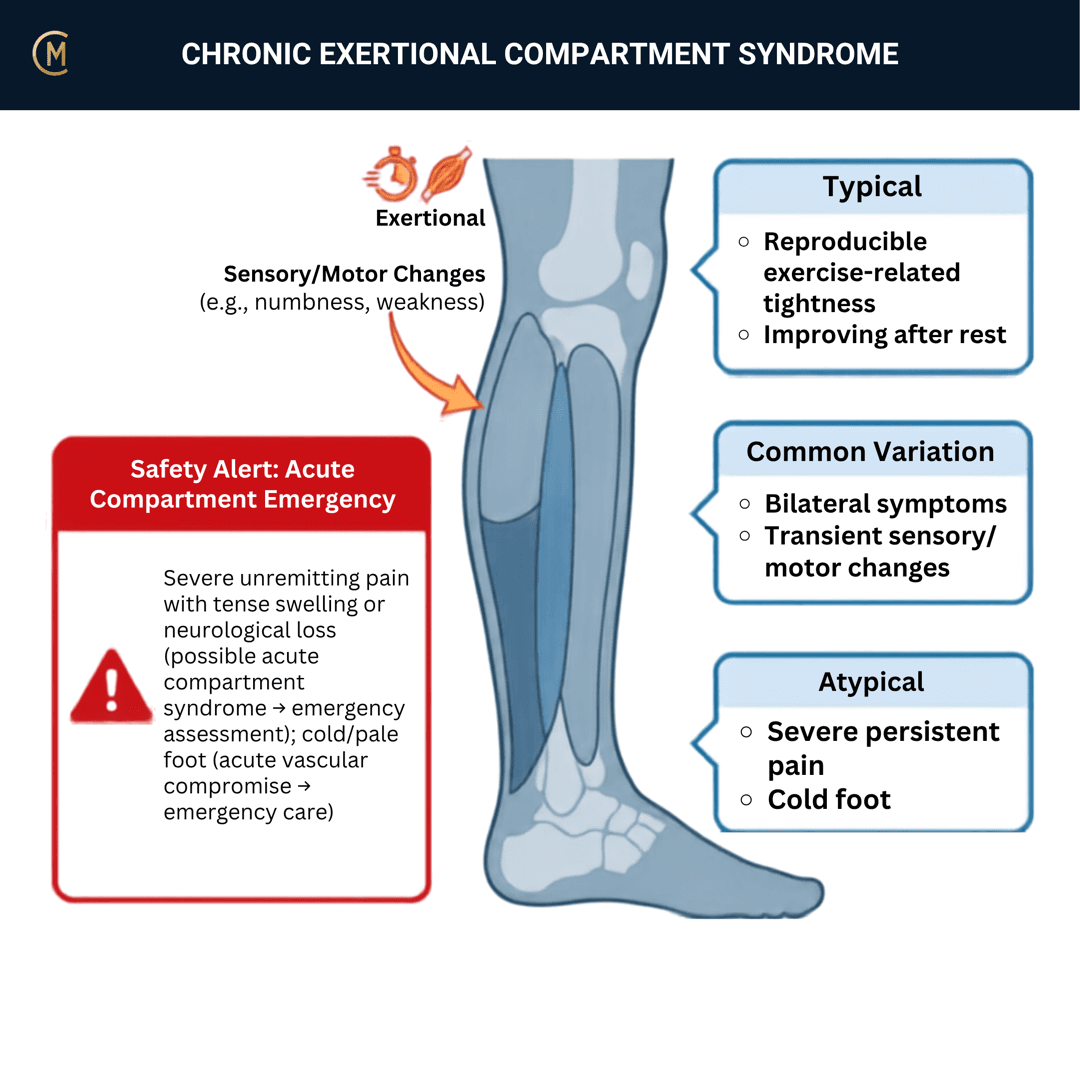
Who: Runners and military populations. Often bilateral.
What: Exertional pressure symptoms in a leg compartment — anterior and deep posterior most commonly.
How it behaves: Reproducible tightness, ache or numbness that builds with exercise at a fairly consistent time, distance or intensity, and relieves within minutes of stopping. Normal at rest.
The one thing to take from this page:
The onset-and-relief timing is the diagnosis. A pressure number without that story is not a diagnosis, and a pressure number that contradicts the story should lose.
The timing test
| Fits CECS | Ask a different question |
|---|---|
| Builds at a predictable point each session | Random, unpredictable onset |
| Settles within minutes of stopping | Doesn't settle — persists at rest |
| Normal exam at rest | Tender at rest → MTSS |
| Diffuse compartment tightness | Focal point tenderness → stress fracture |
| Reproducible with the same run | Pain out of proportion, progressive neurology → acute compartment syndrome |
⚠️ No Australian guideline exists. The strongest document is an international Delphi consensus statement — expert agreement, not trial evidence. Nothing on this page rests on a randomised comparison.
2 · SE — THE SUBJECTIVE PATTERN (the 70%)
Five stages, in your course's order. The exam can be completely normal, so the history is not the 70% here — it is closer to the 90%.
MAIN PROBLEM
"About 3km in, my shins get so tight I have to stop."
"It goes away almost as soon as I walk."
"My foot slaps and I get pins and needles when I run."
Get the number out of them. Time, distance, pace or intensity — the reproducibility is the finding.
BODY CHART
- Compartment, not a line. Diffuse through the anterior or deep posterior compartment.
- A line along the posteromedial tibial border is MTSS.
- A point you can cover with a fingertip is a stress fracture.
- Mark numbness, foot slap and weakness separately.
BEHAVIOUR
| Fits CECS | Points elsewhere | |
|---|---|---|
| Onset | Predictable — same distance or intensity | Unpredictable → reconsider |
| Relief | Minutes of rest | Doesn't settle → escalate |
| Rest | Completely normal | Sore at rest → MTSS |
| Night | Nothing | Night pain → stress fracture, screen |
| Symptoms | Tightness, ache, numbness, foot slap | Cramping with walking in an older adult → claudication |
| Sides | Often bilateral | Strictly unilateral, calf swelling → DVT question |
| Severity | VAS 0–10 at best / at worst / right now | — |
HISTORY
- Training load, surface, footwear, and what changed.
- Military or occupational marching load? It is a recognised population.
- Has anyone measured pressures already, and what were they told?
- Any previous leg injury or surgery?
SPECIAL / SCREENING QUESTIONS
- Does it ever hurt when you're not exercising?
- Calf swelling, warmth, recent immobility, long flight, or a clotting history? DVT.
- Any back pain, or symptoms going into the foot in a band? Lumbar referral.
- Do the symptoms come on with walking rather than running, in an older patient? Vascular.
- Does the timing shift with knee position or ankle position? Popliteal artery entrapment behaves differently.
Assessing this region? Download the Ankle & Foot assessment template →
3 · HYPOTHESIS RANKING
| Competing pattern | The one discriminating feature |
|---|---|
| Medial tibial stress syndrome | Diffuse tenderness present at rest. CECS is normal at rest and only reproduced by exertion. |
| Tibial stress fracture | Focal point tenderness, pain on percussion or hop, persists at rest and at night. |
| Popliteal artery entrapment | Vascular rather than compartmental — check pulses, and consider imaging if the timing doesn't fit. |
| Lumbar referral or nerve entrapment | Back-related behaviour, or a nerve distribution rather than a compartment. |
| Vascular claudication | Walking rather than running, older patient, vascular risk factors, pulses. |
The three that outrank the table
Acute compartment syndrome. Pain out of proportion, not relieved by stopping, progressive neurological signs. Same anatomy, completely different urgency. This is a limb.
DVT. Calf swelling, warmth, recent immobility, a clotting history.
Tibial stress fracture. Rule out MTSS and stress fracture first — it is the common serious mimic, and the one you can miss by accepting an exertional story too readily.
And what the consensus actually says
The Delphi consensus places exclusion of mimics inside the diagnostic process itself [1], alongside history, examination and judicious testing. The differential is not a courtesy step here — it is part of the diagnosis.
4 · RED FLAGS — DON'T MISS THIS
This section is free, on every pattern, forever. Safety is never gated.
| Finding | What it suggests | What you do |
|---|---|---|
| Pain out of proportion, not relieved by stopping | Acute compartment syndrome | EMERGENCY |
| Progressive numbness, weakness or a tense, tender compartment at rest | Acute compartment syndrome | EMERGENCY |
| Pain out of proportion after exertion — with normal pulses | Normal pulses don't clear acute exertional compartment syndrome: 6 of 7 in one series had neurological symptoms, none had a perfusion deficit, and mean time to diagnosis was 97 hours (Livingston et al. 2018) [20] | EMERGENCY |
| Unilateral calf swelling, warmth, recent immobility | DVT | Urgent medical review |
| Absent or asymmetric pulses | Vascular pathology, entrapment | Medical review |
| Focal bony tenderness, night pain, pain on hop | Tibial stress fracture — the anterior tibial shaft is the high-risk site, with more treatment complications than the posteromedial shaft (Hoenig et al. 2023) [21] | Image |
| Progressive weakness or foot drop persisting at rest | Nerve compromise | Urgent medical review |
| Fever, unwell, redness | Infection | Medical review |
| Symptoms with walking in an older patient with vascular risk | Claudication | Medical review |
The rule: exertional compartment symptoms that settle within minutes of stopping, with a normal resting exam, are yours. Anything that persists at rest, progresses, involves swelling, or changes the pulses is not.
Cross-links: Medial tibial stress syndrome · Tibial stress fracture · Vascular vs neurogenic claudication · Lumbar radicular pain
5 · OE — THE OBJECTIVE (the 30%)
Members
Sections 5 to 7 are for members
The objective exam, management and pearls, plus the six-minute lesson and the debrief. Free with an account.
Sign in or join free6 · MX — MANAGEMENT ESSENTIALS
Members
Sections 5 to 7 are for members
The objective exam, management and pearls, plus the six-minute lesson and the debrief. Free with an account.
Sign in or join free7 · CLINICAL PEARLS + RETRIEVAL CHECK
Members
Sections 5 to 7 are for members
The objective exam, management and pearls, plus the six-minute lesson and the debrief. Free with an account.
Sign in or join freeMembers
The 5-minute lesson is for members
Twelve slides on this pattern: what you'll hear, what to examine, what to do. Free with an account.
Sign in or join freeGuideline anchor
No Australian guideline covers chronic exertional compartment syndrome.
More
Anchored to the Delphi consensus statement (Vogels et al. 2022, PMID 35904751) — the closest thing to a guideline this condition has — which places diagnosis on history, examination, exclusion of mimics and judicious testing; to the systematic review of intracompartmental pressure testing (Aweid et al. 2012, PMID 22627653) for why the number is not the diagnosis; and to the systematic review of non-operative management (Rajasekaran & Hall 2016, PMID 27172084) for the conservative trial.
The Vogels consensus is expert agreement, not trial evidence, and it is not an Australian document. The conservative evidence is a systematic review calling itself limited, one case series and one military cohort. The surgical evidence is systematic reviews of cohorts. Nothing on this page rests on a randomised comparison.
Members
The evidence summary is for members
Verified diagnostic accuracy, where the evidence stands and what it doesn't settle. Free with an account.
Sign in or join freeSources · 19
ShowHide
Every source on this page resolves and title-verifies against PubMed. Newest first.
- 2022Vogels et al. (2022). Clinical Consensus on Diagnosis and Treatment of Patients with Chronic Exertional Compartment Syndrome of the Leg: A Delphi Analysis. Sports medicine (Auckland, N.Z.), 52(12), 3055-3064. https://doi.org/10.1007/s40279-022-01729-5
- 2012Aweid et al. (2012). Systematic review and recommendations for intracompartmental pressure monitoring in diagnosing chronic exertional compartment syndrome of the leg. Clinical journal of sport medicine : official journal of the Canadian Academy of Sport Medicine, 22(4), 356-70. https://doi.org/10.1097/JSM.0b013e3182580e1d
- 2015Roscoe et al. (2015). Intramuscular compartment pressure measurement in chronic exertional compartment syndrome: new and improved diagnostic criteria. The American journal of sports medicine, 43(2), 392-8. https://doi.org/10.1177/0363546514555970
- 2005van den Brand et al. (2005). The diagnostic value of intracompartmental pressure measurement, magnetic resonance imaging, and near-infrared spectroscopy in chronic exertional compartment syndrome: a prospective study in 50 patients. The American journal of sports medicine, 33(5), 699-704. https://doi.org/10.1177/0363546504270565
- 2023Ritchie et al. (2023). Systematic Review of Innovative Diagnostic Tests for Chronic Exertional Compartment Syndrome. International journal of sports medicine, 44(1), 20-28. https://doi.org/10.1055/a-1866-5957
- 2023van der Kraats et al. (2023). Review of Reliable and Valid Noninvasive Tools for the Diagnosis of Chronic Exertional Compartment Syndrome. Orthopaedic journal of sports medicine, 11(1), 23259671221145151. https://doi.org/10.1177/23259671221145151
- 2015Helmhout et al. (2015). The Effectiveness of a 6-Week Intervention Program Aimed at Modifying Running Style in Patients With Chronic Exertional Compartment Syndrome: Results From a Series of Case Studies. Orthopaedic journal of sports medicine, 3(3), 2325967115575691. https://doi.org/10.1177/2325967115575691
- 2016Rajasekaran & Hall (2016). Nonoperative Management of Chronic Exertional Compartment Syndrome: A Systematic Review. Current sports medicine reports, 15(3), 191-8. https://doi.org/10.1249/JSR.0000000000000261
- 2019Zimmermann et al. (2019). Conservative treatment of anterior chronic exertional compartment syndrome in the military, with a mid-term follow-up. BMJ open sport & exercise medicine, 5(1), e000532. https://doi.org/10.1136/bmjsem-2019-000532
- 2013Waterman et al. (2013). Risk factors for chronic exertional compartment syndrome in a physically active military population. The American journal of sports medicine, 41(11), 2545-9. https://doi.org/10.1177/0363546513497922
- 2014Dunn & Waterman (2014). Chronic exertional compartment syndrome of the leg in the military. Clinics in sports medicine, 33(4), 693-705. https://doi.org/10.1016/j.csm.2014.06.010
- 2015Van der Wal et al. (2015). The natural course of chronic exertional compartment syndrome of the lower leg. Knee surgery, sports traumatology, arthroscopy : official journal of the ESSKA, 23(7), 2136-41. https://doi.org/10.1007/s00167-014-2847-2
- 2019Buerba et al. (2019). Chronic exertional compartment syndrome: current management strategies. Open access journal of sports medicine, 10, 71-79. https://doi.org/10.2147/OAJSM.S168368
- 2016Campano et al. (2016). Surgical Management for Chronic Exertional Compartment Syndrome of the Leg: A Systematic Review of the Literature. Arthroscopy : the journal of arthroscopic & related surgery : official publication of the Arthroscopy Association of North America and the International Arthroscopy Association, 32(7), 1478-86. https://doi.org/10.1016/j.arthro.2016.01.069
- 2020Ding et al. (2020). A systematic review of fasciotomy in chronic exertional compartment syndrome. Journal of vascular surgery, 72(5), 1802-1812. https://doi.org/10.1016/j.jvs.2020.05.030
- 2020Salzler et al. (2020). Outcomes of Surgically Treated Chronic Exertional Compartment Syndrome in Runners. Sports health, 12(3), 304-309. https://doi.org/10.1177/1941738120907897
- 2022D'Amore et al. (2022). Return to Sport Rates and Subjective Outcomes Are Similar After Open or Endoscopically Assisted Compartment Release for Chronic Lower-Extremity Exertional Compartment Syndrome. Arthroscopy, sports medicine, and rehabilitation, 4(6), e1953-e1959. https://doi.org/10.1016/j.asmr.2022.08.003
- 2024Elsenosy et al. (2024). Outcomes of Fasciotomy Versus Conservative Management for Chronic Exertional Compartment Syndrome: A Systematic Review and Meta-Analysis. Cureus, 16(12), e75803. https://doi.org/10.7759/cureus.75803
- 2024Gawel et al. (2024). Rehabilitation and return to activity criteria after operative management of chronic exertional compartment syndrome of the leg: a systematic review. The Physician and sportsmedicine, 52(2), 125-133. https://doi.org/10.1080/00913847.2023.2214192
Mapped to this pattern
Generic measures that also apply
- Borg RPE
Borg Rating of Perceived Exertion Scale (6-20)
perceived exertion · 1 items · 1 min
- GROC
Global Rating of Change Scale
perceived change since baseline · 1 items · 1 min
- NPRS
Numeric Pain Rating Scale
pain intensity · 1 items · 1 min
- PGIC
Patient Global Impression of Change
perceived change since baseline · 1 items · 1 min
- PSFS
Patient-Specific Functional Scale
patient-generated function · 3 items · 2 min
- SANE
Single Assessment Numeric Evaluation
patient-rated function as a percentage of normal · 1 items · 1 min
- VAS
Visual Analogue Scale
pain intensity · 1 items · 1 min
- Borg CR10
Borg Category Ratio 10 Scale
perceived exertion or symptom intensity, ratio scale · 1 items · 1 min
- GAS
Goal Attainment Scaling
individualised goal achievement · 10 min
Did this page do its job?
CliniStudy is in beta. One tap is enough — it decides what gets fixed first.