
1 · SNAPSHOT
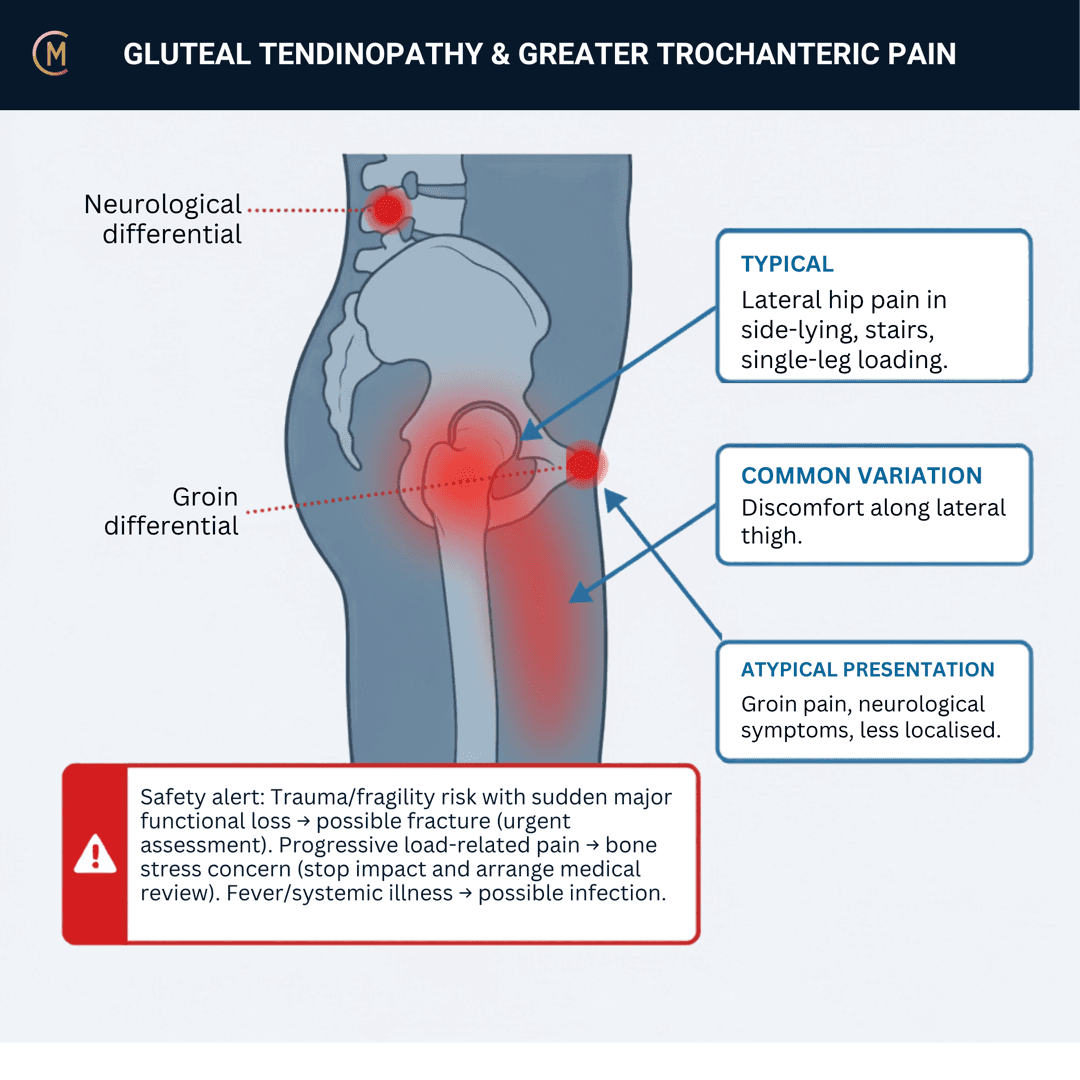
Who: Women 40–60, far more than men. LEAP mean age 54.8 (SD 8.8), 167/204 women [1]; pooled clinical series run 7:1 female [2].
What: Pain over the greater trochanter. Not the groin. Not the deep buttock.
How it behaves: Aggs: lying on that side, stairs, hills, single-leg stance, sitting low or cross-legged, standing hanging on one hip. Eases: taking the hip out of adduction — pillow between the knees, stand evenly, sit higher.
The one thing to take from this page:
Every position that hurts is the same position. Hip adduction compresses the gluteal tendons under the iliotibial band at the trochanter. Side-lying, crossing legs, hanging on one hip, the cross-body stretch — one mechanism, five names [3].
| Finding | Figure |
|---|---|
| Unilateral GTPS, women vs men aged 50–79 (n = 3,026) | 15.0% vs 6.6% |
| Bilateral, women vs men | 8.5% vs 1.9% |
| Female sex | OR 3.37 (95% CI 2.67–4.25) |
| Incidence in primary care | 1.8 per 1,000 per year |
| Still symptomatic at 1 year / 5 years | 36% / 29% |
| Probability of full-time work: GTPS vs severe hip OA vs asymptomatic | 0.29 · 0.52 · 0.68 |
([4], population-based, Multicenter Osteoarthritis Study [5], 164 patients from 39 GP databases [6].)
⚠️ No guideline exists for this condition. At all. Not Australian, not international — checked by PubMed search on 1 Sep 2026, not assumed. So this page is anchored to three syntheses instead: Kjeldsen et al. 2024 ([7], 6 RCTs, n = 733), Bremer et al. 2025 ([8], low-risk-of-bias trials only) and the LEAP trial [1]. A systematic review is not a guideline — no consensus panel, no evidence-to-recommendation process. And the irony is worth teaching: the best trial in the world on this condition is Australian, ran in Brisbane and Melbourne, was NHMRC-funded, and nobody has turned it into a standard.
Patterns > Labels. "Bursitis" names a sac nobody has shown to be the problem. A tendon that can't tolerate compression in adduction names the problem.
2 · SE — THE SUBJECTIVE PATTERN (the 70%)
Five stages, in order. This pattern is made here — the P/E tests a hypothesis you already hold.
MAIN PROBLEM
"I can't lie on that side. It wakes me up, and the stairs at work are getting worse."
Ask it directly: "Can you lie on that hip?" It is the highest-yield question in the subjective, and it is on every expert's list. Twenty expert clinicians interviewed about how they reason through this condition came back to three things — sleep quality, ability to walk, ability to sit and rise from sitting ([9], qualitative, no effect estimate anywhere in it).
BODY CHART
- P1: over the greater trochanter. They cover it with a flat hand, not a fingertip.
- P2: referred down the lateral thigh, usually stopping above the knee.
- Not groin (→ think joint). Not deep buttock or ischial (→ think deep gluteal syndrome or proximal hamstring).
- φp below the knee. Pain below the knee with neuro symptoms puts you on a different page.
BEHAVIOUR
- Coding: usually In, often P. Night pain in side-lying, weight-bearing pain that builds through the day.
- Morning stiffness is short — <30 min = M. If it is >30 min = In, ask harder about an inflammatory arthropathy.
- Irritability — the three parts. Resting symptoms present? Yes: it wakes them, often more than once. Vigour of the provoking activity? Low: rolling over, one flight of stairs. Time to settle? Slow. That grading sets your P/E. Do not run six provocation tests on a hip that woke the patient four times last night.
- Aggs: side-lying on it · stairs and hills · standing on one leg · sitting low or cross-legged · hanging on one hip.
- Eases: pillow between the knees · even stance · a higher seat · reducing the walking dose.
- 24-hr pattern: weight-bearing pain that builds through the day; morning stiffness under 30 minutes = M.
- Night: side-lying on it is in the Aggs and the coding line says it wakes them; the pillow between the knees is the Eases.
- Severity: VAS 0–10 at best / at worst / right now.
HISTORY
Gradual onset, usually no injury. Then three questions that are not about the hip:
| Question | Why |
|---|---|
| "How much walking, and what changed?" | Walking is the activity they nominate as most limited — 68% of 201 LEAP participants; running 27%, sitting 27%. Mean PSFS 4.6 (SD 1.9), about half of normal ability, with no difference by sex or activity level (p > 0.3) [10] |
| "Any back pain? Any knee pain?" | Low back pain raises the odds of genuine GTPS at OR 2.79 (95% CI 2.22–3.50); ipsilateral knee OA OR 3.47 (2.72–4.42). These co-exist far more than they exclude each other (Segal et al. 2007) |
| "What has this cost you?" | GTPS scored no better than severe hip OA on quality of life, Harris Hip Score or Oswestry, and had the lowest probability of full-time work of the three groups (Fearon et al. 2014) |
And one thing not to ask about. BMI was not associated with GTPS in the adjusted model — OR 1.10 (95% CI 0.80–1.52). Do not teach obesity as the cause from this literature.
SPECIAL / SCREENING QUESTIONS
- Bisphosphonates or other antiresorptives — and for how long. Three to five years or more is the atypical femoral fracture window [11].
- Osteoporosis, previous minimal-trauma fracture, long-term corticosteroid, menopause status.
- Night pain that does not change with position. This tendon is exquisitely position-dependent. Pain that ignores position is the flag.
- Unexplained weight loss, cancer history, fever, systemically unwell.
- Bladder, bowel, saddle, bilateral leg symptoms — clear the spine.
- "Can you manage your shoes and socks?" The single question that separates this from hip OA [12].
70/30 in practice. By the end of the S/E you should already be able to name the pattern, the discriminator and the one test you'd run to be wrong. Then check it with your educator.
Assessing this region? Download the Hip & Groin assessment template →
3 · HYPOTHESIS RANKING
Top three, one discriminating feature each. Rule out the dangerous one first.
| Rank | Pattern | The one discriminating feature |
|---|---|---|
| 1 | Gluteal tendinopathy / GTPS | Cannot lie on that side, pain localised to the trochanter, reproduced by resisted abduction and by 30 seconds of single-leg stance. Lateral hip pain is most commonly this [13] |
| 2 | Hip osteoarthritis | Difficulty managing shoes and socks. That one question separated GTPS from hip OA at OR 0.06 (95% CI 0.00–0.26) — if they can't reach their foot, think joint (Fearon et al. 2013). Note what does not help: hip internal rotation ROM did not differ by GTPS status across 3,026 adults |
| 3 | Referred lumbar / SIJ pain | Reproduced by lumbar or SIJ provocation, with negative local hip tests, worse with sitting and bending. The trap: low back pain raises the odds of genuine GTPS (OR 2.79) — so co-existence is the norm, not the exception |
And the dangerous one, which does not belong in a ranking at all — it belongs at the top of your screen: atypical femoral fracture or pelvic insufficiency fracture. See §4.
One more you'll meet on placement: external snapping hip. The ITB or glute max snaps visibly or palpably over the trochanter on flexion–extension with rotation, and it is often painless. Gluteal tendinopathy does not snap.
Name the pattern, name the discriminator, then check it with your educator. This page does not diagnose anyone.
4 · RED FLAGS — DON'T MISS THIS
Free forever. Safety is never gated, on this page or any other.
Start with the absence, because it is the finding
No study reports how often lateral hip pain is something dangerous. Not atypical femoral fracture, not pelvic insufficiency fracture, not metastasis, not septic bursitis. And no red-flag question or cluster has ever been tested for accuracy in this population. Everything below is inference from case-mix and drug history — reasoned, defensible, and completely unvalidated. Label it that way when you hand it over.
The only hip red-flag test with real numbers is not for this bone. Across a systematic review of hip tests, most physical examination tests had weak diagnostic properties; the exception was the patellar-pubic percussion test for occult hip fracture — pooled sensitivity 95% (95% CI 92–97), specificity 86% (78–92) [14]. It was validated for the femoral neck, not the trochanter. Use it for what it was built for.
The one that matches this patient exactly
Atypical femoral fracture. The demographic overlap is almost total: a postmenopausal woman on long-term osteoporosis medication with lateral hip and thigh pain.
- Stress fracture between the lesser trochanter and the metaphyseal flare, most commonly after three to five years or more of antiresorptive medication.
- Prodromal hip, groin, thigh or knee pain is present in more than half of cases, and is usually misdiagnosed [11].
- Look for a transverse line in the lateral cortex on plain film. Management includes withdrawing the bisphosphonate; intramedullary nailing for complete fractures and for incomplete fractures with a visible line.
- Honest caveat: that source is an instructional review. "More than one-half" is the only quantity in it. There is no pooled prevalence and no accuracy data.
The other bony one
Pelvic and acetabular insufficiency fractures are occurring at increasing rates, osteoporosis is the most prevalent risk factor, and they present as hip pain. Work-up starts with plain radiographs, then CT and/or MRI; management is primarily non-operative with early mobilisation [15]. No incidence figure, no accuracy data — a narrative review, and it is what exists.
The ordinary ones, still
- Night pain that does not change with position. Gluteal tendinopathy hurts in side-lying and settles when you take the hip out of adduction. Pain that ignores position is not this.
- Pain that is worsening on a genuinely reduced load, or that has started limiting walking over days rather than months.
- Systemically unwell, fever, unexplained weight loss, cancer history → this stops being a load problem.
- Progressive neurological symptoms, bladder or bowel change, saddle anaesthesia, bilateral leg symptoms → clear the spine, now.
- Trauma in an osteoporotic hip. Percuss it before you load it.
The rule: if the pain doesn't move when the position moves, stop testing the tendon.
5 · OE — THE OBJECTIVE (the 30%)
Members
Sections 5 to 7 are for members
The objective exam, management and pearls, plus the six-minute lesson and the debrief. Free with an account.
Sign in or join free6 · MX — MANAGEMENT ESSENTIALS
Members
Sections 5 to 7 are for members
The objective exam, management and pearls, plus the six-minute lesson and the debrief. Free with an account.
Sign in or join free7 · CLINICAL PEARLS + RETRIEVAL CHECK
Members
Sections 5 to 7 are for members
The objective exam, management and pearls, plus the six-minute lesson and the debrief. Free with an account.
Sign in or join freeMembers
The 5-minute lesson is for members
Twelve slides on this pattern: what you'll hear, what to examine, what to do. Free with an account.
Sign in or join freeGuideline anchor
NONE EXISTS. No clinical practice guideline for gluteal tendinopathy or greater trochanteric pain syndrome has ever been published — not Australian, not international.
More
Confirmed by PubMed search 1 Sep 2026. Anchored instead to three evidence syntheses: Kjeldsen et al. 2024 (PMID 38295551), Bremer et al. 2025 (PMID 40223303) and the LEAP trial, Mellor et al. 2018 (PMID 29720374).
No Australian guideline exists, and neither does an international one. ACSQHC has no clinical care standard for tendinopathy; RACGP publishes no equivalent. The irony is the teaching point: the best trial in the world on this condition is Australian — LEAP ran in Brisbane and Melbourne, NHMRC-funded, n=204 — and nobody has turned it into a standard.
Members
The evidence summary is for members
Verified diagnostic accuracy, where the evidence stands and what it doesn't settle. Free with an account.
Sign in or join freeSources · 30
ShowHide
Every source on this page resolves and title-verifies against PubMed. Newest first.
- 2018Mellor et al. (2018). Education plus exercise versus corticosteroid injection use versus a wait and see approach on global outcome and pain from gluteal tendinopathy: prospective, single blinded, randomised clinical trial. BMJ (Clinical research ed.), 361, k1662. https://doi.org/10.1136/bmj.k1662
- 2021Ladurner et al. (2021). Treatment of Gluteal Tendinopathy: A Systematic Review and Stage-Adjusted Treatment Recommendation. Orthopaedic journal of sports medicine, 9(7), 23259671211016850. https://doi.org/10.1177/23259671211016850
- 2015Grimaldi et al. (2015). Gluteal Tendinopathy: A Review of Mechanisms, Assessment and Management. Sports medicine (Auckland, N.Z.), 45(8), 1107-19. https://doi.org/10.1007/s40279-015-0336-5
- 2007Segal et al. (2007). Greater trochanteric pain syndrome: epidemiology and associated factors. Archives of physical medicine and rehabilitation, 88(8), 988-92. https://doi.org/10.1016/j.apmr.2007.04.014
- 2005Lievense et al. (2005). Prognosis of trochanteric pain in primary care. The British journal of general practice : the journal of the Royal College of General Practitioners, 55(512), 199-204. PubMed 15808035
- 2014Fearon et al. (2014). Greater trochanteric pain syndrome negatively affects work, physical activity and quality of life: a case control study. The Journal of arthroplasty, 29(2), 383-6. https://doi.org/10.1016/j.arth.2012.10.016
- 2024Kjeldsen et al. (2024). Exercise compared to a control condition or other conservative treatment options in patients with Greater Trochanteric Pain Syndrome: a systematic review and meta-analysis of randomized controlled trials. Physiotherapy, 123, 69-80. https://doi.org/10.1016/j.physio.2024.01.001
- 2025Bremer et al. (2025). The efficacy of gluteal tendinopathy treatments: A systematic review. Clinical rehabilitation, 39(5), 600-617. https://doi.org/10.1177/02692155251327298
- 2026Bremer et al. (2026). Best practice for patients with gluteal tendinopathy: A qualitative exploration of expert clinical reasoning and management. Physiotherapy, 132, 101871. https://doi.org/10.1016/j.physio.2025.101871
- 2026Grimaldi et al. (2026). Functional impact of gluteal tendinopathy: A secondary cross-sectional analysis of baseline data from the LEAP randomised clinical trial. Brazilian journal of physical therapy, 30(3), 101583. https://doi.org/10.1016/j.bjpt.2026.101583
- 2024Anderson et al. (2024). Update on Atypical Femoral Fractures. The Journal of bone and joint surgery. American volume, 106(19), 1819-1828. https://doi.org/10.2106/JBJS.23.01439
- 2013Fearon et al. (2013). Greater trochanteric pain syndrome: defining the clinical syndrome. British journal of sports medicine, 47(10), 649-53. https://doi.org/10.1136/bjsports-2012-091565
- 2021Chamberlain (2021). Hip Pain in Adults: Evaluation and Differential Diagnosis. American family physician, 103(2), 81-89. PubMed 33448767
- 2013Reiman et al. (2013). Diagnostic accuracy of clinical tests of the hip: a systematic review with meta-analysis. British journal of sports medicine, 47(14), 893-902. https://doi.org/10.1136/bjsports-2012-091035
- 2022Cantrell & Butler (2022). A Review on Management of Insufficiency Fractures of the Pelvis and Acetabulum. The Orthopedic clinics of North America, 53(4), 431-443. https://doi.org/10.1016/j.ocl.2022.06.007
- 2024Kinsella et al. (2024). Diagnostic Accuracy of Clinical Tests for Assessing Greater Trochanteric Pain Syndrome: A Systematic Review With Meta-analysis. The Journal of orthopaedic and sports physical therapy, 54(1), 26-49. https://doi.org/10.2519/jospt.2023.11890
- 2017Grimaldi et al. (2017). Utility of clinical tests to diagnose MRI-confirmed gluteal tendinopathy in patients presenting with lateral hip pain. British journal of sports medicine, 51(6), 519-524. https://doi.org/10.1136/bjsports-2016-096175
- 2024Fearon et al. (2024). ICON 2020-International Scientific Tendinopathy Symposium Consensus: the development of a core outcome set for gluteal tendinopathy. British journal of sports medicine, 58(5), 245-254. https://doi.org/10.1136/bjsports-2023-107150
- 2025Grimaldi et al. (2025). An examination of imaging findings in patients with clinically diagnosed gluteal tendinopathy: a secondary analysis of a randomised clinical trial. Archives of orthopaedic and trauma surgery, 145(1), 347. https://doi.org/10.1007/s00402-025-05964-z
- 2019Docking et al. (2019). Identification and differentiation of gluteus medius tendon pathology using ultrasound and magnetic resonance imaging. Musculoskeletal science & practice, 41, 1-5. https://doi.org/10.1016/j.msksp.2019.01.011
- 2024Patricio Cordeiro et al. (2024). Effects of exercise-based interventions on gluteal tendinopathy. Systematic review with meta-analysis. Scientific reports, 14(1), 3343. https://doi.org/10.1038/s41598-024-53283-x
- 2023Wilson et al. (2023). Education plus exercise for persistent gluteal tendinopathy improves quality of life and is cost-effective compared with corticosteroid injection and wait and see: economic evaluation of a randomised trial. Journal of physiotherapy, 69(1), 35-41. https://doi.org/10.1016/j.jphys.2022.11.007
- 2023Schenk et al. (2023). Natural History of Degenerative Hip Abductor Tendon Lesions. The American journal of sports medicine, 51(1), 160-168. https://doi.org/10.1177/03635465221135759
- 2024Rhim et al. (2024). Extracorporeal Shockwave Therapy for Greater Trochanteric Pain Syndrome: A Systematic Review with Meta-Analysis of Randomized Clinical Trials. JBJS reviews, 12(8). https://doi.org/10.2106/JBJS.RVW.24.00091
- 2025Atchia et al. (2025). Efficacy of Platelet-Rich Plasma Versus Placebo for the Treatment of Greater Trochanteric Pain Syndrome: A Double-Blinded Randomized Controlled Trial. The Journal of bone and joint surgery. American volume, 107(5), 444-451. https://doi.org/10.2106/JBJS.24.00763
- 2019Fitzpatrick et al. (2019). Leucocyte-Rich Platelet-Rich Plasma Treatment of Gluteus Medius and Minimus Tendinopathy: A Double-Blind Randomized Controlled Trial With 2-Year Follow-up. The American journal of sports medicine, 47(5), 1130-1137. https://doi.org/10.1177/0363546519826969
- 2022Gazendam et al. (2022). Comparative Efficacy of Nonoperative Treatments for Greater Trochanteric Pain Syndrome: A Systematic Review and Network Meta-Analysis of Randomized Controlled Trials. Clinical journal of sport medicine : official journal of the Canadian Academy of Sport Medicine, 32(4), 427-432. https://doi.org/10.1097/JSM.0000000000000924
- 2015Grimaldi & Fearon (2015). Gluteal Tendinopathy: Integrating Pathomechanics and Clinical Features in Its Management. The Journal of orthopaedic and sports physical therapy, 45(11), 910-22. https://doi.org/10.2519/jospt.2015.5829
- 2025Grimaldi et al. (2025). Gluteal tendinopathy masterclass: Refuting the myths and engaging with the evidence. Musculoskeletal science & practice, 76, 103253. https://doi.org/10.1016/j.msksp.2025.103253
- 2026Spencer et al. (2026). Low quality evidence supports surgery for gluteal tendon tears, no non-surgical evidence was identified: a systematic review. BMC musculoskeletal disorders, 27(1). https://doi.org/10.1186/s12891-026-09519-0
Mapped to this pattern
Generic measures that also apply
- Borg RPE
Borg Rating of Perceived Exertion Scale (6-20)
perceived exertion · 1 items · 1 min
- GROC
Global Rating of Change Scale
perceived change since baseline · 1 items · 1 min
- NPRS
Numeric Pain Rating Scale
pain intensity · 1 items · 1 min
- PGIC
Patient Global Impression of Change
perceived change since baseline · 1 items · 1 min
- PSFS
Patient-Specific Functional Scale
patient-generated function · 3 items · 2 min
- SANE
Single Assessment Numeric Evaluation
patient-rated function as a percentage of normal · 1 items · 1 min
- VAS
Visual Analogue Scale
pain intensity · 1 items · 1 min
- Borg CR10
Borg Category Ratio 10 Scale
perceived exertion or symptom intensity, ratio scale · 1 items · 1 min
- GAS
Goal Attainment Scaling
individualised goal achievement · 10 min
Did this page do its job?
CliniStudy is in beta. One tap is enough — it decides what gets fixed first.