
1 · SNAPSHOT
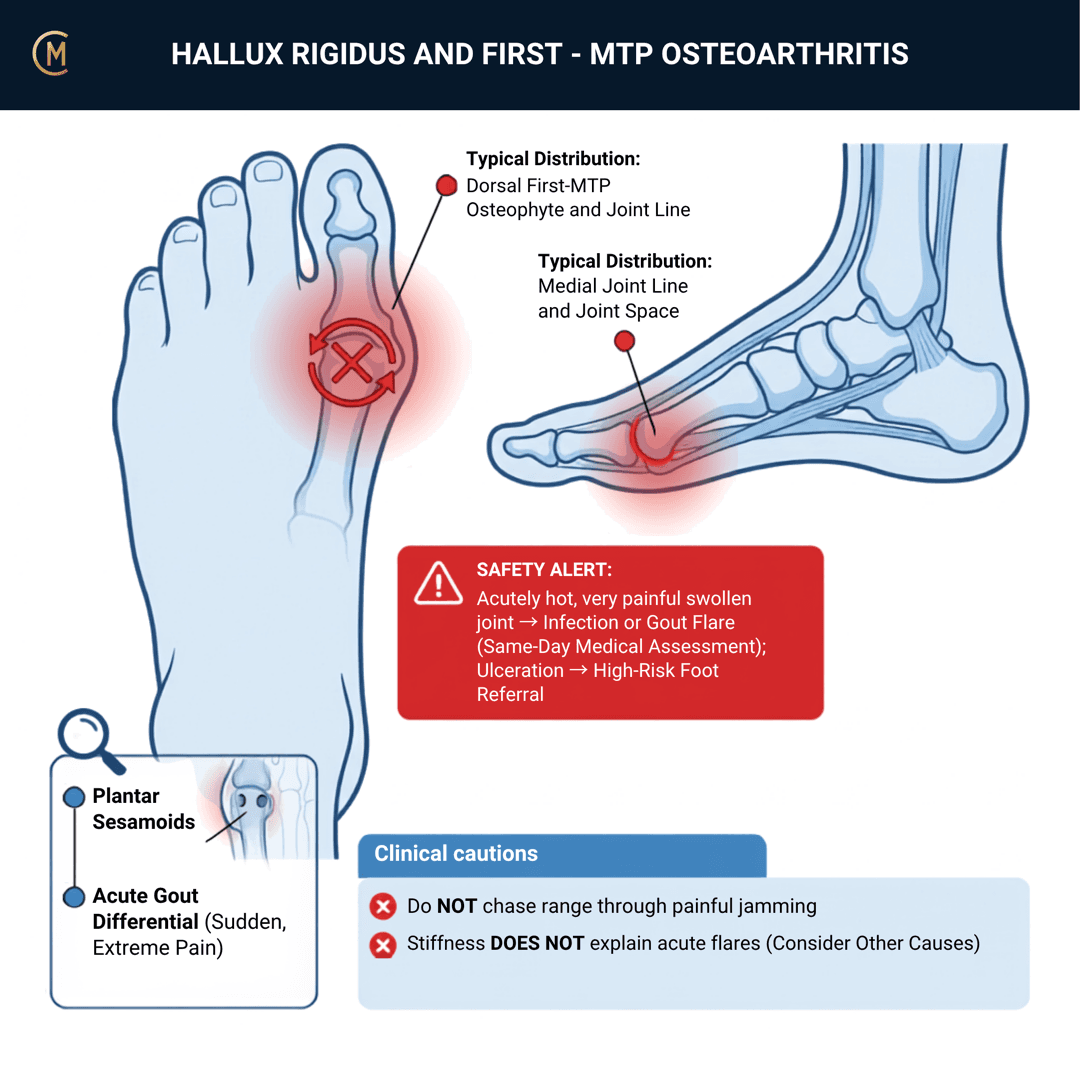
Who: Gradual onset. Runners, hill walkers, anyone who lives in push-off.
What: Osteoarthritis of the first MTP with progressive loss of dorsiflexion and a dorsal osteophyte.
How it behaves: Dorsal pain and stiffness, worse with push-off, hills and sprinting. Jamming or catching at terminal dorsiflexion. Shoe intolerance in a tight toe box, relief in a stiff-soled or rocker shoe. Start-up stiffness that eases, then flares after higher loads.
The one thing to take from this page:
You are not trying to open the joint. You are trying to stop asking it to open.
That single idea explains every part of the management — rocker sole, stiff shank, Morton extension or carbon plate, load management — and it is why forcing dorsiflexion is the wrong move.
Two numbers to handle carefully
| The number | The honest position |
|---|---|
| "Dorsiflexion often under 40°" | The figure you will commonly see. No source in our library verifies it as a threshold — measure it and track it, don't gate on it |
| Coughlin-Shurnas grade | The language you'll meet in reports. We haven't sighted the source paper, so no grade definition is quoted here. Classification reliability varies anyway |
⚠️ No Australian guideline exists. Anchored to the Cochrane review of non-surgical interventions [1], whose own finding is that the evidence is limited.
2 · SE — THE SUBJECTIVE PATTERN (the 70%)
Five stages, in your course's order.
MAIN PROBLEM
"It jams when I push off."
"Hills and running are the killers."
"It's stiff first thing, then it loosens, then it's sore that night."
BODY CHART
- Mark it dorsal, over the joint line. Dorsal is the diagnosis — medial is hallux valgus, plantar is sesamoid.
- Note any osteophyte prominence and whether the shoe rubs on it.
- In later cases, mark lateral deviation of the hallux too — the two conditions coexist.
BEHAVIOUR
| Fits hallux rigidus | Points elsewhere | |
|---|---|---|
| Aggs | Push-off, hills, sprinting, terminal dorsiflexion | Narrow shoes rubbing medially → hallux valgus |
| Eases | Stiff-soled or rocker shoes | Wide shoes → hallux valgus |
| Severity | VAS 0–10 at best / at worst / right now | — |
| Quality | Jamming, catching at end range | Acute red hot → gout |
| Pattern | Start-up stiffness that eases, flares after load | Sharp plantar pain on push-off → sesamoiditis |
Morning stiffness that eases within about 30 minutes codes M, and it fits osteoarthritis. Over 30 minutes, coded In, with other joints, sends this to a GP.
HISTORY
- Load history — running volume, hill work, a change in surface or shoes.
- Previous first MTP trauma, including a hyperextension injury. Turf toe is a differential and a cause.
- What footwear helps. If a stiff sole already helps, they have told you the diagnosis and the treatment.
SPECIAL / SCREENING QUESTIONS
- Acute red, hot, swollen joint — gout, and it is ruled out before loading.
- Multiple joints, morning stiffness >30 min (In), systemic features — inflammatory arthropathy.
- Numbness or burning into the toes — neuroma or nerve.
Assessing this region? Download the Ankle & Foot assessment template →
3 · HYPOTHESIS RANKING
| Competing pattern | The one discriminating feature |
|---|---|
| Turf toe | Acute hyperextension mechanism with plantar tenderness. Hallux rigidus is gradual, with a dorsal osteophyte and crepitus. |
| Sesamoiditis | Plantar first MTP tenderness with pain on resisted hallux flexion, not dorsal jamming. |
| Gout | Red, hot, swollen and acutely severe. Rule it out before loading. |
And the one that coexists
Hallux valgus. In later hallux rigidus the hallux deviates laterally, and the two conditions live in the same joint. Check which one is actually generating the pain — medial eminence rubbing and dorsal jamming need different footwear.
And the one that reframes the whole assessment
Load beyond walking. First MTP osteoarthritis alters plantar loading across tasks beyond simple walking [2], and older adults with it show altered pressure distribution generally (Zammit et al. 2008). So assess hills, stairs, running and push-off — not a corridor walk.
4 · RED FLAGS — DON'T MISS THIS
This section is free, on every pattern, forever. Safety is never gated.
| Finding | What it suggests | What you do |
|---|---|---|
| Acute red, hot, swollen 1st MTP | Gout, or septic arthritis | Same-day medical review. Do not load it. One normal blood or joint-fluid test doesn't clear infection — no single test reliably excludes it (Dey et al. 2023) [21] |
| Fever, systemically unwell with a hot joint | Septic arthritis | 🚑 Emergency |
| Morning stiffness >30 min (In), multiple joints, systemic features | Inflammatory arthropathy | GP referral |
| Acute hyperextension injury with plantar tenderness | Turf toe, possible plantar plate or sesamoid injury | Image, and see the turf toe page |
| Focal bony tenderness with a load spike | Stress fracture | Offload and image |
| Diabetes or neuropathy with callus or skin change | Neuropathic ulcer risk | 🚑 See the infection page |
| Rapid loss of range with severe pain | Not degenerative | Medical referral |
The rule: a gradually stiffening, load-related, non-inflamed joint is yours. Acutely hot, systemically unwell, or acutely injured is not.
Cross-links: Hallux valgus · Sesamoiditis · Turf toe
5 · OE — THE OBJECTIVE (the 30%)
Members
Sections 5 to 7 are for members
The objective exam, management and pearls, plus the six-minute lesson and the debrief. Free with an account.
Sign in or join free6 · MX — MANAGEMENT ESSENTIALS
Members
Sections 5 to 7 are for members
The objective exam, management and pearls, plus the six-minute lesson and the debrief. Free with an account.
Sign in or join free7 · CLINICAL PEARLS + RETRIEVAL CHECK
Members
Sections 5 to 7 are for members
The objective exam, management and pearls, plus the six-minute lesson and the debrief. Free with an account.
Sign in or join freeMembers
The 4-minute lesson is for members
Twelve slides on this pattern: what you'll hear, what to examine, what to do. Free with an account.
Sign in or join freeGuideline anchor
No Australian guideline covers hallux rigidus.
More
Anchored to the Cochrane review of non-surgical interventions for big-toe osteoarthritis (Munteanu et al. 2024, PMID 38884172), which is the highest-level synthesis available, supplemented by the conservative management update (Acker et al. 2024, PMID 39068017) and the shoe and orthoses review (Colò et al. 2020, PMID 33559617).
The Cochrane review is a synthesis, not a guideline, and its own finding is that the non-surgical evidence is limited. There is no consensus pathway. The staged approach on this page — offload the dorsal compression, keep capacity, escalate on function rather than on grade — comes from the reviews and is labelled as such.
Members
The evidence summary is for members
Verified diagnostic accuracy, where the evidence stands and what it doesn't settle. Free with an account.
Sign in or join freeSources · 19
ShowHide
Every source on this page resolves and title-verifies against PubMed. Newest first.
- 2024Munteanu et al. (2024). Non-surgical interventions for treating osteoarthritis of the big toe joint. The Cochrane database of systematic reviews, 6(6), CD007809. https://doi.org/10.1002/14651858.CD007809.pub3
- 2026Telfer et al. (2026). Effects of First Metatarsophalangeal Osteoarthritis on Plantar Pressures Across Multiple Activities. Journal of foot and ankle research, 19(1), e70146. https://doi.org/10.1002/jfa2.70146
- 2004Shamus et al. (2004). The effect of sesamoid mobilization, flexor hallucis strengthening, and gait training on reducing pain and restoring function in individuals with hallux limitus: a clinical trial. The Journal of orthopaedic and sports physical therapy, 34(7), 368-76. https://doi.org/10.2519/jospt.2004.34.7.368
- 2007Pons et al. (2007). Sodium hyaluronate in the treatment of hallux rigidus. A single-blind, randomized study. Foot & ankle international, 28(1), 38-42. https://doi.org/10.3113/FAI.2007.0007
- 2008Beeson et al. (2008). Classification systems for hallux rigidus: a review of the literature. Foot & ankle international, 29(4), 407-14. https://doi.org/10.3113/FAI.2008.0407
- 2008Zammit et al. (2008). Plantar pressure distribution in older people with osteoarthritis of the first metatarsophalangeal joint (hallux limitus/rigidus). Journal of orthopaedic research : official publication of the Orthopaedic Research Society, 26(12), 1665-9. https://doi.org/10.1002/jor.20700
- 2014Polzer et al. (2014). Hallux rigidus: Joint preserving alternatives to arthrodesis - a review of the literature. World journal of orthopedics, 5(1), 6-13. https://doi.org/10.5312/wjo.v5.i1.6
- 2017Kon Kam King et al. (2017). Comprehensive Review of Non-Operative Management of Hallux Rigidus. Cureus, 9(1), e987. https://doi.org/10.7759/cureus.987
- 2017Menz et al. (2017). Predictors of response to prefabricated foot orthoses or rocker-sole footwear in individuals with first metatarsophalangeal joint osteoarthritis. BMC musculoskeletal disorders, 18(1), 185. https://doi.org/10.1186/s12891-017-1558-5
- 2017Lam et al. (2017). Hallux rigidus: How do I approach it?. World journal of orthopedics, 8(5), 364-371. https://doi.org/10.5312/wjo.v8.i5.364
- 2017Ho & Baumhauer (2017). Hallux rigidus. EFORT open reviews, 2(1), 13-20. https://doi.org/10.1302/2058-5241.2.160031
- 2019Emmons & Carreira (2019). Outcomes Following Interposition Arthroplasty of the First Metatarsophalangeal Joint for the Treatment of Hallux Rigidus: A Systematic Review. Foot & ankle orthopaedics, 4(2), 2473011418814427. https://doi.org/10.1177/2473011418814427
- 2020Colò et al. (2020). The efficacy of shoe modifications and foot orthoses in treating patients with hallux rigidus: a comprehensive review of literature. Acta bio-medica : Atenei Parmensis, 91(14-S), e2020016. https://doi.org/10.23750/abm.v91i14-S.10969
- 2022Di Caprio et al. (2022). Hallux rigidus: current concepts review and treatment algorithm with special focus on interposition arthroplasty. Acta bio-medica : Atenei Parmensis, 93(5), e2022218. https://doi.org/10.23750/abm.v93i5.12811
- 2024Esser et al. (2024). Outcomes following minimally invasive dorsal cheilectomy for hallux rigidus: A systematic review. World journal of orthopedics, 15(6), 585-592. https://doi.org/10.5312/wjo.v15.i6.585
- 2024Acker et al. (2024). Hallux Rigidus: Update on Conservative Management. Foot and ankle clinics, 29(3), 405-415. https://doi.org/10.1016/j.fcl.2023.09.010
- 2024Fragnière et al. (2024). Primary Isolated Arthrodesis of the First Metatarsophalangeal Joint for Hallux Rigidus: Clinical, Radiologic, and Pedobarographic Evaluation. Foot & ankle orthopaedics, 9(3), 24730114241265344. https://doi.org/10.1177/24730114241265344
- 2024Butler et al. (2024). Limited Evidence to Support the Use of Intra-Articular Injection of Hyaluronic Acid for the Management of Hallux Rigidus: A Systematic Review. Foot & ankle orthopaedics, 9(3), 24730114241265109. https://doi.org/10.1177/24730114241265109
- 2024Arceri et al. (2024). Reviewing Evidence and Patient Outcomes of Cheilectomy for Hallux Rigidus: A Systematic Review and Meta-Analysis. Journal of clinical medicine, 13(23). https://doi.org/10.3390/jcm13237299
Mapped to this pattern
Generic measures that also apply
- Borg RPE
Borg Rating of Perceived Exertion Scale (6-20)
perceived exertion · 1 items · 1 min
- GROC
Global Rating of Change Scale
perceived change since baseline · 1 items · 1 min
- NPRS
Numeric Pain Rating Scale
pain intensity · 1 items · 1 min
- PGIC
Patient Global Impression of Change
perceived change since baseline · 1 items · 1 min
- PSFS
Patient-Specific Functional Scale
patient-generated function · 3 items · 2 min
- SANE
Single Assessment Numeric Evaluation
patient-rated function as a percentage of normal · 1 items · 1 min
- VAS
Visual Analogue Scale
pain intensity · 1 items · 1 min
- Borg CR10
Borg Category Ratio 10 Scale
perceived exertion or symptom intensity, ratio scale · 1 items · 1 min
- GAS
Goal Attainment Scaling
individualised goal achievement · 10 min
Did this page do its job?
CliniStudy is in beta. One tap is enough — it decides what gets fixed first.