
1 · SNAPSHOT
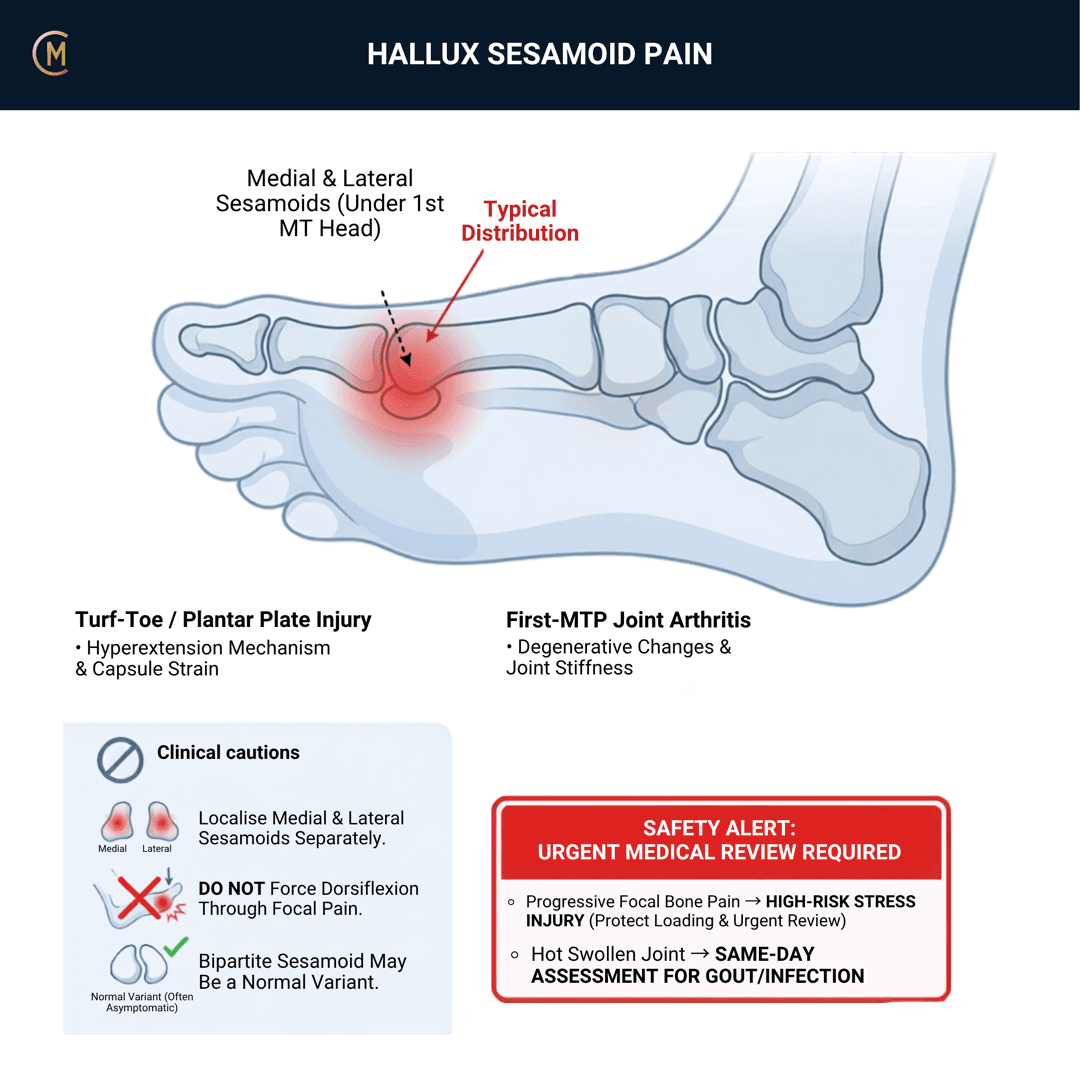
Who: Runners, especially forefoot strikers, dancers, jumpers, and anyone in high heels. Common in young athletes.
What: Load intolerance of the sesamoid complex under the first metatarsal head — or one of six specific things that present identically.
How it behaves: Localised plantar pain under the ball of the great toe. "Bruised." Worse with running, jumping, push-off and high heels. Eased by offloading and a supportive, stiff-soled shoe.
The one thing to take from this page:
"Sesamoiditis" is a reasonable starting label and a poor finishing one. Persistent focal pain here has a differential you have to actually go and check.
What sits underneath the label
| If it isn't settling, this is the list |
|---|
| Sesamoid stress fracture · fracture nonunion · avascular necrosis |
| Painful bipartite sesamoid · plantar plate / turf toe injury |
| Gout, inflammatory disease, or infection |
Image when there is: persistent focal pain · night or rest pain · swelling · traumatic onset · failure to improve · a high-demand athlete or dancer.
⚠️ No guideline exists, anywhere. Anchored to a systematic review with pooled individual data [1] and a Delphi consensus [2] — which is structured expert opinion, not evidence, and is labelled that way.
2 · SE — THE SUBJECTIVE PATTERN (the 70%)
Five stages, in your course's order.
MAIN PROBLEM
"It's like I've got a bruise under my big toe."
"It's fine walking, it's the push-off that gets it."
"Every time I go back to running it comes back."
BODY CHART
- Mark it plantar, under the first metatarsal head. Plantar is the diagnosis — dorsal is hallux rigidus, medial is hallux valgus.
- Medial or lateral sesamoid? They are separate bones and separate problems.
- Note any swelling or callus over the site.
BEHAVIOUR
| Fits sesamoiditis | Points elsewhere | |
|---|---|---|
| Aggs | Push-off, running, jumping, high heels, barefoot on hard floors | Dorsal jamming on hills → hallux rigidus |
| Eases | Offloading, stiff-soled shoes, heel raise | Wide shoes → hallux valgus |
| Severity | VAS 0–10 at best / at worst / right now | — |
| Quality | Bruised, sharp on push-off | Acute pop with immediate loss of push-off → turf toe |
| Onset | Gradual — or post-traumatic | Acute hyperextension → turf toe |
HISTORY
- Load history. Running volume, surface, footwear change, forefoot strike, dance hours, a return after a break. This is usually the exposure.
- Any single traumatic hyperextension event. If yes, this is a turf toe assessment, not a sesamoiditis one.
- How many times has this recurred? Repeated failed returns is a reason to image, not to load more slowly again.
SPECIAL / SCREENING QUESTIONS
- Night or rest pain — off the load-intolerance story.
- Acute red, hot, swollen — gout or infection.
- Bone health, energy availability, menstrual status where relevant — the stress fracture screen. Ask it in young athletes and dancers, who are the population this presents in.
Assessing this region? Download the Ankle & Foot assessment template →
3 · HYPOTHESIS RANKING
| Competing pattern | The one discriminating feature |
|---|---|
| Turf toe | Acute hyperextension injury with plantar capsule tenderness and immediate loss of push-off. Sesamoiditis is gradual. |
| Hallux rigidus | Dorsal first MTP pain and stiffness with reduced dorsiflexion and a dorsal osteophyte. Sesamoid pain is plantar. |
| Gout | Sudden severe red, hot, swollen first MTP, often with nocturnal onset. |
The list that matters more than the table
Sesamoiditis is a symptom label, and the imaging literature says so plainly — radiology should be looking for plantar plate or turf toe injury, fracture, infarct, arthritis and infection [3]. Add fracture nonunion (Artioli et al. 2025) and painful bipartite sesamoid (Nwawka et al. 2013).
The honest news: conservative care worked in less than half — 48.1% of sport-related medial sesamoid pain cases — and MRI in the non-responders found causes like bursitis, stress fracture or chondral lesions, but 42.8% of scans showed no specific abnormal findings [4]. So a conservative trial is right, and so is imaging the person it fails.
4 · RED FLAGS — DON'T MISS THIS
This section is free, on every pattern, forever. Safety is never gated.
| Finding | What it suggests | What you do |
|---|---|---|
| Acute red, hot, swollen 1st MTP | Gout, or septic arthritis | Same-day medical review. Do not load it |
| Fever, systemically unwell with a hot joint | Septic arthritis or infection | 🚑 Emergency |
| Night or rest pain, not load-related | Bone stress, infection, tumour | Image, medical referral |
| Traumatic hyperextension onset with a pop | Turf toe, plantar plate rupture | Image, and see the turf toe page |
| Persistent focal pain despite well-dosed offloading | Stress fracture, nonunion, AVN | Image — MRI |
| Focal pain + a load spike in a young athlete or dancer | Bone stress injury | Offload and image. Screen energy availability |
| Diabetes or neuropathy with a plantar pressure lesion | Neuropathic ulcer risk | 🚑 See the infection page |
| A deep ulcer under the sesamoid that probes to bone | Sesamoid osteomyelitis | Urgent medical referral — don't keep padding it. 15 of 18 in one series ended in excision, resection or amputation (Mauler et al. 2017) [21] |
The rule: load-related plantar pain that responds to offloading is yours. Persistent, nocturnal, traumatic, hot or systemic is not.
Cross-links: Turf toe · Hallux rigidus · Metatarsalgia
5 · OE — THE OBJECTIVE (the 30%)
Members
Sections 5 to 7 are for members
The objective exam, management and pearls, plus the six-minute lesson and the debrief. Free with an account.
Sign in or join free6 · MX — MANAGEMENT ESSENTIALS
Members
Sections 5 to 7 are for members
The objective exam, management and pearls, plus the six-minute lesson and the debrief. Free with an account.
Sign in or join free7 · CLINICAL PEARLS + RETRIEVAL CHECK
Members
Sections 5 to 7 are for members
The objective exam, management and pearls, plus the six-minute lesson and the debrief. Free with an account.
Sign in or join freeMembers
The 4-minute lesson is for members
Twelve slides on this pattern: what you'll hear, what to examine, what to do. Free with an account.
Sign in or join freeGuideline anchor
No guideline exists for sesamoiditis, in Australia or anywhere.
More
Anchored to the systematic review with pooled individual data on conservative care (Biz et al. 2025, PMID 40731844) and the Delphi content-validity recommendations for assessment and management (Stewart et al. 2024, PMID 38820171), which is the closest thing to a consensus statement this condition has.
A Delphi consensus is expert opinion structured, not evidence, and it is labelled that way here. The conservative-care evidence is limited but clinically consistent. There is no Australian guidance and no guideline anywhere.
Members
The evidence summary is for members
Verified diagnostic accuracy, where the evidence stands and what it doesn't settle. Free with an account.
Sign in or join freeSources · 20
ShowHide
Every source on this page resolves and title-verifies against PubMed. Newest first.
- 2025Biz et al. (2025). Conservative Treatment of Sesamoiditis: A Systematic Literature Review with Individual-Level Pooled Data Analysis. Medicina (Kaunas, Lithuania), 61(7). https://doi.org/10.3390/medicina61071215
- 2024Stewart et al. (2024). The development of recommendations for the assessment and management of sesamoiditis by podiatrists: A Delphi and content validity study. Journal of foot and ankle research, 17(2), e12025. https://doi.org/10.1002/jfa2.12025
- 2015Schein et al. (2015). Turf toe and sesamoiditis: what the radiologist needs to know. Clinical imaging, 39(3), 380-9. https://doi.org/10.1016/j.clinimag.2014.11.011
- 2024Choi et al. (2024). Atraumatic Sport-Related Medial Sesamoid Pain: Conservative Treatment Outcome and Magnetic Resonance Imaging Features. Clinics in orthopedic surgery, 16(4), 641-649. https://doi.org/10.4055/cios24037
- 2012Bichara et al. (2012). Sesamoidectomy for hallux sesamoid fractures. Foot & ankle international, 33(9), 704-6. https://doi.org/10.3113/FAI.2012.0704
- 2012Sharma et al. (2012). Utility of (99m)Tc-MDP SPECT-CT for the diagnosis of sesamoiditis as cause of metatarsalgia. Indian journal of nuclear medicine : IJNM : the official journal of the Society of Nuclear Medicine, India, 27(1), 45-7. https://doi.org/10.4103/0972-3919.108865
- 2013Nwawka et al. (2013). Sesamoids and accessory ossicles of the foot: anatomical variability and related pathology. Insights into imaging, 4(5), 581-93. https://doi.org/10.1007/s13244-013-0277-1
- 2014Sims & Kurup (2014). Painful sesamoid of the great toe. World journal of orthopedics, 5(2), 146-50. https://doi.org/10.5312/wjo.v5.i2.146
- 2018Shimozono et al. (2018). Sesamoidectomy for Hallux Sesamoid Disorders: A Systematic Review. The Journal of foot and ankle surgery : official publication of the American College of Foot and Ankle Surgeons, 57(6), 1186-1190. https://doi.org/10.1053/j.jfas.2018.03.044
- 2020Hallinan et al. (2020). High-Resolution MRI of the First Metatarsophalangeal Joint: Gross Anatomy and Injury Characterization. Radiographics : a review publication of the Radiological Society of North America, Inc, 40(4), 1107-1124. https://doi.org/10.1148/rg.2020190145
- 2020Lombard et al. (2020). Hallux sesamoid complex imaging: a practical diagnostic approach. Skeletal radiology, 49(12), 1889-1901. https://doi.org/10.1007/s00256-020-03507-8
- 2020Dean et al. (2020). Functional Outcome of Sesamoid Excision in Athletes. The American journal of sports medicine, 48(14), 3603-3609. https://doi.org/10.1177/0363546520962518
- 2021Andrews et al. (2021). Diagnosis and conservative management of great toe pathologies: a review. Postgraduate medicine, 133(4), 409-420. https://doi.org/10.1080/00325481.2021.1895587
- 2022Sugimoto et al. (2022). Hallux Sesamoid Injury Characteristics in Young Athletes Presented to the Sports Medicine Clinic. Clinical journal of sport medicine : official journal of the Canadian Academy of Sport Medicine, 32(3), e276-e280. https://doi.org/10.1097/JSM.0000000000000902
- 2022Carroll et al. (2022). Forefoot Injuries in Athletes: Integration of the Movement System. International journal of sports physical therapy, 17(1), 81-89. https://doi.org/10.26603/001c.30021
- 2022Chen et al. (2022). High-Resolution Ultrasound of the Forefoot and Common Pathologies. Diagnostics (Basel, Switzerland), 12(7). https://doi.org/10.3390/diagnostics12071541
- 2023Kaur et al. (2023). The assessment and management of sesamoiditis: a focus group study of podiatrists in Aotearoa New Zealand. Journal of foot and ankle research, 16(1), 29. https://doi.org/10.1186/s13047-023-00628-w
- 2023Lim & Liem (2023). First Metatarsophalangeal Joint Pain in Athletes: Diagnosis, Management, and Return to Play Considerations. Current sports medicine reports, 22(6), 217-223. https://doi.org/10.1249/JSR.0000000000001076
- 2025Artioli et al. (2025). Hallux Sesamoid Nonunion: A Comprehensive Systematic Review of Current Evidence. Journal of personalized medicine, 15(8). https://doi.org/10.3390/jpm15080342
- 2025Nakajima (2025). Avoiding Hallux Sesamoidectomy: A Narrative Review. Journal of clinical medicine, 14(21). https://doi.org/10.3390/jcm14217687
Mapped to this pattern
Generic measures that also apply
- Borg RPE
Borg Rating of Perceived Exertion Scale (6-20)
perceived exertion · 1 items · 1 min
- GROC
Global Rating of Change Scale
perceived change since baseline · 1 items · 1 min
- NPRS
Numeric Pain Rating Scale
pain intensity · 1 items · 1 min
- PGIC
Patient Global Impression of Change
perceived change since baseline · 1 items · 1 min
- PSFS
Patient-Specific Functional Scale
patient-generated function · 3 items · 2 min
- SANE
Single Assessment Numeric Evaluation
patient-rated function as a percentage of normal · 1 items · 1 min
- VAS
Visual Analogue Scale
pain intensity · 1 items · 1 min
- Borg CR10
Borg Category Ratio 10 Scale
perceived exertion or symptom intensity, ratio scale · 1 items · 1 min
- GAS
Goal Attainment Scaling
individualised goal achievement · 10 min
Did this page do its job?
CliniStudy is in beta. One tap is enough — it decides what gets fixed first.