
1 · SNAPSHOT
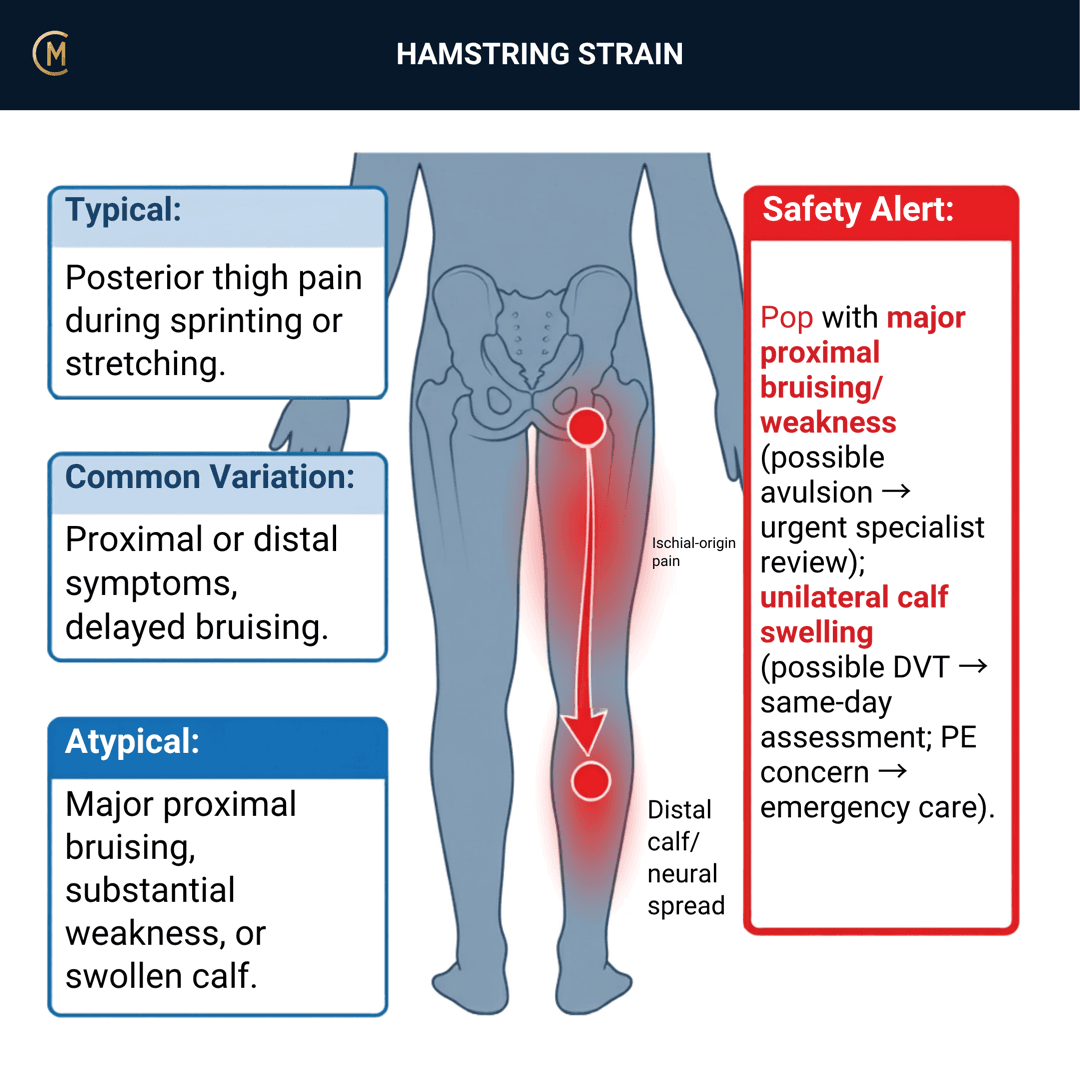
Who: Sprinting and kicking athletes. Recurrent in athletes with poor trunk or glute control.
What: Acute muscle strain, most often biceps femoris.
How it behaves: Sudden posterior thigh pain during sprinting or an overstretch. Sharp or grabbing, and it stops them. Eased by rest, compression, and gentle mobility.
The one thing to take from this page:
There is a real JOSPT clinical practice guideline for this, and a Journal of Physiotherapy appraisal of it. Read both. And know the uncomfortable headline: hamstring injury rates in professional football have been reported as rising across recent seasons, after a decade in which everyone did Nordics.
The honest headline
| What we've been told | What the literature says |
|---|---|
| "Eccentric control is the gold standard" | The effects of eccentric training and the Nordic hamstring exercise are heterogeneous, and the prevention literature has been critically revisited |
| "Nordics prevent hamstring injuries" | Rates in professional football have been reported as having increased |
| "Test Nordic strength pre-season to find who's at risk" | That has been examined directly. Read the result before you build a screening programme around it |
Eccentrics stay. The certainty goes.
2 · SE — THE SUBJECTIVE PATTERN (the 70%)
Five stages. Acute and traumatic reorders to main problem → body chart → history → behaviour.
MAIN PROBLEM
"I was at top speed and something grabbed."
"I went for the ball, over-reached, and felt it tear."
"I've done this before. Same leg."
BODY CHART
- Posterior thigh. Get them to point. High and lateral, mid-belly, or right up at the ischium?
- Mark how far up. Proximal and near the ischial tuberosity behaves differently and is a longer conversation.
- Any pain below the knee, into the calf or foot? Any pins and needles? That's a lumbar and neural question, not a muscle one.
HISTORY — and this is the best pearl on the pattern
Ask what they were doing at the moment it went. Clinical pearl: sprint-type versus stretch-type differ in healing.
| Sprint-type | Stretch-type | |
|---|---|---|
| Mechanism | Top-speed running, terminal swing | Over-lengthening — high kick, slide tackle, split |
| Usual muscle | Biceps femoris | Semimembranosus, often near the origin |
| Site | Higher and lateral | Higher and medial |
| Time loss | Often less | Often more. Say so early |
Read further: mechanisms from video analysis in professional players [1].
- Previous hamstring injury? Which leg, when, how long out, and did they finish the rehab?
- Where in the season? Load, fixture congestion, recent return from another injury.
- Sprint exposure. Have they been sprinting regularly, or only in matches?
BEHAVIOUR
- Aggs: sprinting, accelerating, lengthening, hills, sitting on it, stretching it.
- Eases: rest, compression, gentle mobility.
- Severity: VAS 0–10 at best / at worst / right now.
- Irritability: resting symptoms + vigour of the provoking activity + time to settle.
- Walking, stairs, driving, sitting tolerance — the practical measures for the first fortnight.
SPECIAL / SCREENING QUESTIONS
- Any back pain, or history of it?
- Any calf pain, swelling, or warmth? DVT.
- Night pain, rest pain, fever, weight loss?
- A sudden pop with a big bruise high in the thigh and difficulty walking? Think proximal avulsion.
Assessing this region? Download the Knee assessment template →
3 · HYPOTHESIS RANKING
| Competing pattern | The one discriminating feature |
|---|---|
| Proximal hamstring tendinopathy | Gradual onset, ache at the ischial tuberosity, worse with SITTING and uphill running. Not a sudden grab at speed. |
| Lumbar radicular / sciatic referral | Neural-type pain, positive SLR or slump, possible back history, and neuro findings. Clear this. |
| Deep gluteal syndrome | Deep buttock, worse sitting and in hip flexion/adduction/IR. |
| Adductor magnus strain | More medial, provoked by adduction as well as extension. |
| Ischial apophyseal avulsion | Adolescent, sudden, at the ischium. A different injury entirely. |
| Proximal hamstring avulsion | A pop, a large bruise, marked weakness, difficulty walking. Surgical conversation. |
| Referred from the SIJ or lumbar spine | Reproduced by spinal or pelvic provocation, not by resisted knee flexion. |
The ones that outrank the table
- DVT. Calf pain, swelling, warmth, immobility, recent travel or surgery.
- Proximal avulsion. Refer.
- Anything with night pain, systemic features, or no mechanism.
4 · RED FLAGS — DON'T MISS THIS
This section is free, on every pattern, forever. Safety is never gated.
| Finding | What it suggests | What you do |
|---|---|---|
| Calf pain, swelling, warmth, or asymmetry | DVT | Urgent medical review. Do not massage the leg |
| Recent immobilisation, long travel, surgery, oral contraceptive, malignancy | DVT risk profile | Raise your threshold |
| A pop with a large proximal bruise, marked weakness, difficulty walking | Proximal hamstring avulsion | Urgent orthopaedic / sports medicine review |
| Adolescent with sudden ischial pain | Apophyseal avulsion | Imaging and medical review |
| Progressive neurological symptoms, foot drop | Lumbar | URGENT |
| Saddle change | Cauda equina syndrome | EMERGENCY |
| Night pain, rest pain, fever, weight loss | Infection, tumour | Urgent medical review |
| Massive swelling, tense compartment, disproportionate pain | Compartment syndrome, large haematoma | EMERGENCY |
| No mechanism at all | Not a strain | Reassess |
The rule: a hamstring strain has a moment. If there is no moment, or the leg is swollen, warm and tender in the calf, you are not looking at a muscle.
Cross-links: Proximal hamstring tendinopathy · Lumbar radicular pain · Quadriceps strain · Septic arthritis / DVT / tumour
5 · OE — THE OBJECTIVE (the 30%)
Members
Sections 5 to 7 are for members
The objective exam, management and pearls, plus the six-minute lesson and the debrief. Free with an account.
Sign in or join free6 · MX — MANAGEMENT ESSENTIALS
Members
Sections 5 to 7 are for members
The objective exam, management and pearls, plus the six-minute lesson and the debrief. Free with an account.
Sign in or join free7 · CLINICAL PEARLS + RETRIEVAL CHECK
Members
Sections 5 to 7 are for members
The objective exam, management and pearls, plus the six-minute lesson and the debrief. Free with an account.
Sign in or join freeMembers
The 4-minute lesson is for members
Twelve slides on this pattern: what you'll hear, what to examine, what to do. Free with an account.
Sign in or join freeGuideline anchor
No Australian guideline. But there is a real physiotherapy clinical practice guideline — Hamstring Strain Injury in Athletes, JOSPT (Martin et al. 2022, PMID 35164536) — and it has been appraised in Journal of Physiotherapy (Zadro et al. 2023, PMID 36914523).
More
Read them together. Treatment and management have also been systematically reviewed (Poursalehian et al. 2023, PMID 37983561) and the prevention and rehabilitation literature critically revisited (Afonso et al. 2024, PMID 38071509).
The guideline is American and physiotherapy-specific. Read the Journal of Physiotherapy appraisal alongside it — that is exactly what the appraisal exists for. And note that the underlying literature is overwhelmingly male professional football; the female athlete has had to be written about separately.
Members
The evidence summary is for members
Verified diagnostic accuracy, where the evidence stands and what it doesn't settle. Free with an account.
Sign in or join freeSources · 20
ShowHide
Every source on this page resolves and title-verifies against PubMed. Newest first.
- 2023Jokela et al. (2023). Mechanisms of Hamstring Injury in Professional Soccer Players: Video Analysis and Magnetic Resonance Imaging Findings. Clinical journal of sport medicine : official journal of the Canadian Academy of Sport Medicine, 33(3), 217-224. https://doi.org/10.1097/JSM.0000000000001109
- 2024Mendiguchia et al. (2024). Anterior pelvic tilt increases hamstring strain and is a key factor to target for injury prevention and rehabilitation. Knee surgery, sports traumatology, arthroscopy : official journal of the ESSKA, 32(3), 573-582. https://doi.org/10.1002/ksa.12045
- 2024Bramah et al. (2024). Exploring the Role of Sprint Biomechanics in Hamstring Strain Injuries: A Current Opinion on Existing Concepts and Evidence. Sports medicine (Auckland, N.Z.), 54(4), 783-793. https://doi.org/10.1007/s40279-023-01925-x
- 2024Day et al. (2024). Correlation of Player and Imaging Characteristics With Severity and Missed Time in National Football League Professional Athletes With Hamstring Strain Injury: A Retrospective Review. The American journal of sports medicine, 52(11), 2709-2717. https://doi.org/10.1177/03635465241270281
- 2022Martin et al. (2022). Hamstring Strain Injury in Athletes. The Journal of orthopaedic and sports physical therapy, 52(3), CPG1-CPG44. https://doi.org/10.2519/jospt.2022.0301
- 2023Zadro (2023). Appraisal of Clinical Practice Guideline: Clinical Practice Guideline for hamstring strain injury in athletes. Journal of physiotherapy, 69(2), 128. https://doi.org/10.1016/j.jphys.2023.02.010
- 2023Poursalehian et al. (2023). Hamstring Injury Treatments and Management in Athletes: A Systematic Review of the Current Literature. JBJS reviews, 11(11), e23.00161. https://doi.org/10.2106/JBJS.RVW.23.00161
- 2025Giakoumis et al. (2025). Clinical Presentation and Rehabilitation Progression Following Hamstring Injury Assessed by BAMIC in Elite Track and Field. Scandinavian journal of medicine & science in sports, 35(10), e70136. https://doi.org/10.1111/sms.70136
- 2021Yagiz et al. (2021). Heterogeneous effects of eccentric training and nordic hamstring exercise on the biceps femoris fascicle length based on ultrasound assessment and extrapolation methods: A systematic review of randomised controlled trials with meta-analyses. PloS one, 16(11), e0259821. https://doi.org/10.1371/journal.pone.0259821
- 2021Opar et al. (2021). Is Pre-season Eccentric Strength Testing During the Nordic Hamstring Exercise Associated with Future Hamstring Strain Injury? A Systematic Review and Meta-analysis. Sports medicine (Auckland, N.Z.), 51(9), 1935-1945. https://doi.org/10.1007/s40279-021-01474-1
- 2024Afonso et al. (2024). Revisiting the hamstring injury prevention and rehabilitation literature: filling the gaps!. British journal of sports medicine, 58(5), 243-244. https://doi.org/10.1136/bjsports-2023-106878
- 2023Ekstrand et al. (2023). Hamstring injury rates have increased during recent seasons and now constitute 24% of all injuries in men's professional football: the UEFA Elite Club Injury Study from 2001/02 to 2021/22. British journal of sports medicine, 57(5), 292-298. https://doi.org/10.1136/bjsports-2021-105407
- 2022Gronwald et al. (2022). Hamstring injury patterns in professional male football (soccer): a systematic video analysis of 52 cases. British journal of sports medicine, 56(3), 165-171. https://doi.org/10.1136/bjsports-2021-104769
- 2022Vermeulen et al. (2022). Early versus delayed lengthening exercises for acute hamstring injury in male athletes: a randomised controlled clinical trial. British journal of sports medicine, 56(14), 792-800. https://doi.org/10.1136/bjsports-2020-103405
- 2022Hickey et al. (2022). Early introduction of high-intensity eccentric loading into hamstring strain injury rehabilitation. Journal of science and medicine in sport, 25(9), 732-736. https://doi.org/10.1016/j.jsams.2022.06.002
- 2022Hickey et al. (2022). Hamstring Strain Injury Rehabilitation. Journal of athletic training, 57(2), 125-135. https://doi.org/10.4085/1062-6050-0707.20
- 2022O'Sullivan et al. (2022). Hamstring Injury Rehabilitation and Prevention in the Female Athlete. International journal of sports physical therapy, 17(6), 1184-1193. https://doi.org/10.26603/001c.38254
- 2021Pieters et al. (2021). Return to Play After a Hamstring Strain Injury: It is Time to Consider Natural Healing. Sports medicine (Auckland, N.Z.), 51(10), 2067-2077. https://doi.org/10.1007/s40279-021-01494-x
- 2024Gendron et al. (2024). Prognosticating Return-To-Play Time Following a Hamstring Strain Injury Using Early Flexibility Asymmetry and Musculoskeletal Ultrasound Imaging Outcomes: An Exploratory Study Among Canadian University Football Players. Clinical journal of sport medicine : official journal of the Canadian Academy of Sport Medicine, 34(5), 436-443. https://doi.org/10.1097/JSM.0000000000001230
- 2026Bru-Ruiz et al. (2026). Establishing weighted criteria for return to play after hamstring injury: a systematic review and methodological quality analysis. BMC musculoskeletal disorders. https://doi.org/10.1186/s12891-026-10072-z
Mapped to this pattern
Generic measures that also apply
- Borg RPE
Borg Rating of Perceived Exertion Scale (6-20)
perceived exertion · 1 items · 1 min
- GROC
Global Rating of Change Scale
perceived change since baseline · 1 items · 1 min
- NPRS
Numeric Pain Rating Scale
pain intensity · 1 items · 1 min
- PGIC
Patient Global Impression of Change
perceived change since baseline · 1 items · 1 min
- PSFS
Patient-Specific Functional Scale
patient-generated function · 3 items · 2 min
- SANE
Single Assessment Numeric Evaluation
patient-rated function as a percentage of normal · 1 items · 1 min
- VAS
Visual Analogue Scale
pain intensity · 1 items · 1 min
- Borg CR10
Borg Category Ratio 10 Scale
perceived exertion or symptom intensity, ratio scale · 1 items · 1 min
- GAS
Goal Attainment Scaling
individualised goal achievement · 10 min
Did this page do its job?
CliniStudy is in beta. One tap is enough — it decides what gets fixed first.