
1 · SNAPSHOT
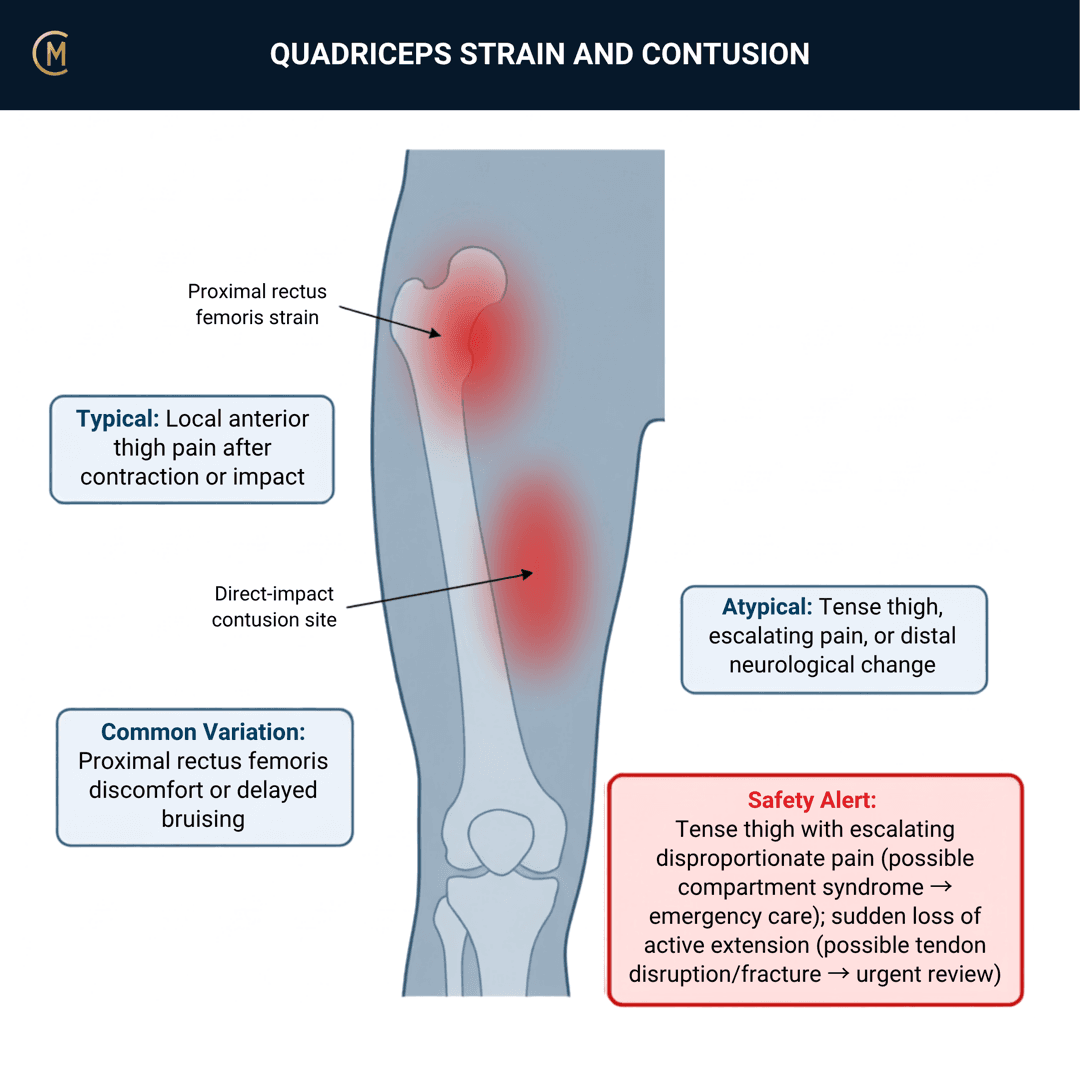
Who: Sprinting and kicking athletes. Australian football, soccer, athletics.
What: Two injuries under one heading.
How it behaves: Sudden anterior thigh pain during sprinting or kicking. Localised tenderness or a pulling sensation. Aggs: walking, running, squatting. Eased by rest, ice and compression — and read the warning on that line in section 4.
The one thing to take from this page:
A strain and a contusion are not the same injury. A strain's problem is recurrence — especially rectus femoris, which now has its own rehabilitation pathway. A contusion's problem is what grows or swells afterwards. Ask different questions and give different warnings.
One heading, two injuries
| STRAIN — a pull at speed | CONTUSION — a blow from outside | |
|---|---|---|
| Mechanism | Sprinting, kicking, over-lengthening | A knee, a helmet, a boot into the thigh |
| Muscle | Often rectus femoris | Usually vastus intermedius / lateralis |
| The problem | Recurrence, and the central tendon | What happens over the next days and weeks |
| Watch for | Re-injury on return | Compartment syndrome · myositis ossificans · Morel-Lavallée |
| Anchor | It has its own rehabilitation pathway | Case and review literature only |
2 · SE — THE SUBJECTIVE PATTERN (the 70%)
Five stages. Acute and traumatic reorders to main problem → body chart → history → behaviour.
MAIN PROBLEM
"I went to kick and something pulled at the front."
"I got a knee straight into the thigh and now I can't bend it."
"It's tight and I can't get my heel to my backside."
BODY CHART
- Anterior thigh. Get them to point, and note how proximal.
- Proximal, near the hip? That's a rectus femoris question and it matters — isolated full-thickness proximal rectus femoris injuries are described [1].
- Mark bruising and any lump.
- Mark the whole thigh circumference. Swelling that isn't localised is a different conversation.
HISTORY — and the first question splits the page
Was it a pull, or a blow?
- A pull: at what speed, doing what? Read further: indirect rectus femoris injury mechanisms on video [2], inciting events of lower-limb muscle injury [3].
- A blow: what hit them, how hard, was the knee flexed or extended, and could they keep playing?
- Previous quadriceps injury, same leg? Recurrence is the thing to prevent. Read further: return to full training and recurrence after rectus femoris injury [4].
- Load, fatigue, fixture congestion. Read further: risk factors [5].
BEHAVIOUR
- Aggs: sprinting, kicking, squatting, stairs, knee flexion (stretch), and for contusion, any attempt to bend the knee.
- Eases: rest, ice, compression. Note the warning in section 4 before you leave it there.
- Severity: VAS 0–10 at best / at worst / right now.
- Knee flexion range is the practical measure after a contusion. Track it.
- Irritability: resting symptoms + vigour of the provoking activity + time to settle.
SPECIAL / SCREENING QUESTIONS — especially after a blow
- Is the thigh getting tighter, or the pain getting worse rather than better? Compartment syndrome.
- Any numbness, pins and needles, or a foot that feels different?
- Is the swelling firm, or fluctuant and mobile under the skin? Morel-Lavallée.
- Any lump developing weeks later? Myositis ossificans.
- Any calf pain or swelling? DVT.
- Night pain, fever, weight loss?
Assessing this region? Download the Knee assessment template →
3 · HYPOTHESIS RANKING
| Competing pattern | The one discriminating feature |
|---|---|
| Rectus femoris strain | A pull at speed or on kicking, tender proximally or mid-belly, pain on hip flexion AND knee extension. |
| Vasti strain | Deeper, less proximal, no hip flexion component. |
| Quadriceps contusion | A direct blow. Diffuse, and knee flexion range is the limiting factor. |
| Quadriceps tendinopathy | Gradual, superior pole of the patella, worse with deep flexion and resisted extension. |
| Hip flexor / iliopsoas | Higher and more medial, into the groin, worse with resisted hip flexion. |
| Femoral stress fracture | Load spike, night or rest pain, focal bony tenderness, doesn't settle. |
| Avulsion (AIIS) in the adolescent | A sudden pull at the hip in a skeletally immature athlete. Imaging. |
The ones that outrank the table — and they follow a contusion
- Acute compartment syndrome. Described in a footballer with a quadriceps contusion [6]. Pain out of proportion, a tense thigh, worsening rather than settling.
- Morel-Lavallée lesion. Initially diagnosed as a quadriceps contusion in a published case [7]. A fluctuant, mobile collection.
- Myositis ossificans. Described, and it simulates malignancy on imaging [8][9]. A firm lump and stalled flexion range weeks later.
- DVT, infection, tumour. The chapter's red-flag pattern.
4 · RED FLAGS — DON'T MISS THIS
This section is free, on every pattern, forever. Safety is never gated.
This pattern needs a red-flag layer — and note that the classic subjective line, "eased by rest, ice, and compression," describes exactly what you would be doing while missing the first row of this table.
| Finding | What it suggests | What you do |
|---|---|---|
| Pain out of proportion, a tense swollen thigh, worsening not settling, pain on passive stretch | ACUTE COMPARTMENT SYNDROME | EMERGENCY. Described after quadriceps contusion |
| Numbness, paraesthesia, or motor loss distally | Compartment syndrome or nerve injury | EMERGENCY |
| A fluctuant, mobile swelling under the skin after a shearing blow | Morel-Lavallée lesion | Medical review — it has been mistaken for a contusion |
| A firm lump developing over weeks, with stalled knee flexion | Myositis ossificans | Medical review and imaging. It simulates malignancy |
| Persistent thigh pain months after a contusion | Reported specifically. Don't dismiss it | Medical review |
| Night pain, rest pain, fever, weight loss | Infection, tumour | Urgent medical review |
| Focal bony tenderness with a load-spike history | Femoral stress fracture | Imaging |
| Calf pain, swelling or warmth | DVT | Urgent medical review |
| Skeletally immature athlete with a sudden pull at the hip | AIIS avulsion | Imaging |
| Inability to straight-leg raise, palpable gap, high-riding patella | Tendon rupture | URGENT orthopaedic review |
The rule: a strain gets better. A contusion that is getting tighter, more painful, or lumpier is not following the script — and the first row of this table is a surgical emergency.
Cross-links: Hamstring strain · Patellar tendinopathy · Chronic exertional compartment syndrome · Septic arthritis / DVT / tumour
5 · OE — THE OBJECTIVE (the 30%)
Members
Sections 5 to 7 are for members
The objective exam, management and pearls, plus the six-minute lesson and the debrief. Free with an account.
Sign in or join free6 · MX — MANAGEMENT ESSENTIALS
Members
Sections 5 to 7 are for members
The objective exam, management and pearls, plus the six-minute lesson and the debrief. Free with an account.
Sign in or join free7 · CLINICAL PEARLS + RETRIEVAL CHECK
Members
Sections 5 to 7 are for members
The objective exam, management and pearls, plus the six-minute lesson and the debrief. Free with an account.
Sign in or join freeMembers
The 5-minute lesson is for members
Twelve slides on this pattern: what you'll hear, what to examine, what to do. Free with an account.
Sign in or join freeGuideline anchor
No Australian guideline.
More
The strongest anchor is new and specific — the Aspetar Rectus Femoris Injury Rehabilitation Pathway, published in JOSPT Open (Wallace et al. 2026, PMID 42686185) — with a criteria-based progressive rehabilitation programme for rectus femoris injury (González-de-la-Flor et al. 2024, PMID 39175620), risk factors systematically reviewed in JOSPT (Pietsch et al. 2022, PMID 35647880) and the Nature Reviews Disease Primers overview of traumatic muscle injury (Edouard et al. 2023, PMID 37857686). Australian epidemiology exists (Pietsch et al. 2024, PMID 37994173).
The Aspetar pathway is a rehabilitation pathway from an elite-sport institution, not a clinical practice guideline, and it covers the rectus femoris specifically rather than every quadriceps strain. There is no guideline for quadriceps contusion at all — the contusion content on this page is anchored to case and review literature.
Members
The evidence summary is for members
Verified diagnostic accuracy, where the evidence stands and what it doesn't settle. Free with an account.
Sign in or join freeSources · 20
ShowHide
Every source on this page resolves and title-verifies against PubMed. Newest first.
- 2023Knapik et al. (2023). Isolated, Full-Thickness Proximal Rectus Femoris Injury in Competitive Athletes: A Systematic Review of Injury Characteristics and Return to Play. Orthopaedic journal of sports medicine, 11(1), 23259671221144984. https://doi.org/10.1177/23259671221144984
- 2023Jokela et al. (2023). Indirect Rectus Femoris Injury Mechanisms in Professional Soccer Players: Video Analysis and Magnetic Resonance Imaging Findings. Clinical journal of sport medicine : official journal of the Canadian Academy of Sport Medicine, 33(5), 475-482. https://doi.org/10.1097/JSM.0000000000001131
- 2026Miralles-Iborra et al. (2026). Inciting Events of Lower-Limb Muscle Injury: A Systematic Review and Meta-analysis of Video-Based Studies. Sports medicine - open, 12(1). https://doi.org/10.1186/s40798-026-01090-1
- 2022McAleer et al. (2022). Time to return to full training and recurrence of rectus femoris injuries in elite track and field athletes 2010-2019; a 9-year study using the British Athletics Muscle Injury Classification. Scandinavian journal of medicine & science in sports, 32(7), 1109-1118. https://doi.org/10.1111/sms.14160
- 2022Pietsch & Pizzari (2022). Risk Factors for Quadriceps Muscle Strain Injuries in Sport: A Systematic Review. The Journal of orthopaedic and sports physical therapy, 52(6), 389-400. https://doi.org/10.2519/jospt.2022.10870
- 2024O'Toole et al. (2024). Acute Compartment Syndrome in a Football Player With Quadriceps Contusion and Successful Return to Sport: A Case Report. JBJS case connector, 14(2). https://doi.org/10.2106/JBJS.CC.23.00688
- 2015Weiss et al. (2015). Morel-LAvallee lesion initially diagnosed as quadriceps contusion: ultrasound, MRI, and importance of early intervention. The western journal of emergency medicine, 16(3), 438-41. https://doi.org/10.5811/westjem.2015.3.25148
- 2021Savvidou et al. (2021). Post-traumatic myositis ossificans: a benign lesion that simulates malignant bone and soft tissue tumours. EFORT open reviews, 6(7), 572-583. https://doi.org/10.1302/2058-5241.6.210002
- 2016Lee et al. (2016). MR imaging and ultrasonography findings of early myositis ossificans: a case report. Skeletal radiology, 45(10), 1413-7. https://doi.org/10.1007/s00256-016-2441-4
- 2022Katagiri et al. (2022). Epidemiology of MRI-detected muscle injury in athletes participating in the Tokyo 2020 Olympic Games. British journal of sports medicine, 57(4), 218-24. https://doi.org/10.1136/bjsports-2022-105827
- 2026Pietsch et al. (2026). Imaging and Clinical Factors Associated With Return to Play and Recurrence After Quadriceps Muscle Strain Injury. Sports health, 19417381261476889. https://doi.org/10.1177/19417381261476889
- 2026Wallace et al. (2026). The Aspetar Rectus Femoris Injury Rehabilitation Pathway. JOSPT open, 4(3), 354-366. https://doi.org/10.2519/josptopen.2026.0212
- 2024González-de-la-Flor & García-Pérez-de-Sevilla (2024). A criteria-based progressive rehabilitation program for rectus femoris strain in a recreational soccer player: a case report. Frontiers in bioengineering and biotechnology, 12, 1385786. https://doi.org/10.3389/fbioe.2024.1385786
- 2017Shimba et al. (2017). Surgical treatment of rectus femoris injury in soccer playing athletes: report of two cases. Revista brasileira de ortopedia, 52(6), 743-747. https://doi.org/10.1016/j.rboe.2017.01.001
- 2026Vicente et al. (2026). The Criteria and Design for Return-to-Play Following Muscle Injury in Football are Not Standardized: A Systematic Review Including Descriptive Analysis of RTP Criteria Distribution and Study Design Heterogeneity. Sports medicine (Auckland, N.Z.). https://doi.org/10.1007/s40279-026-02523-3
- 2019Algazwi et al. (2019). Exercise-Induced Bilateral Rectus Femoris Injury. American journal of physical medicine & rehabilitation, 98(11), e138-e139. https://doi.org/10.1097/PHM.0000000000001168
- 2023Edouard et al. (2023). Traumatic muscle injury. Nature reviews. Disease primers, 9(1), 56. https://doi.org/10.1038/s41572-023-00469-8
- 2024Pietsch et al. (2024). Epidemiology of quadriceps muscle strain injuries in elite male Australian football players. Scandinavian journal of medicine & science in sports, 34(1), e14542. https://doi.org/10.1111/sms.14542
- 2024Anderson & Bailowitz (2024). Persistent Left Thigh Pain After Remote Quadriceps Contusion. American journal of physical medicine & rehabilitation, 103(3), e26-e28. https://doi.org/10.1097/PHM.0000000000002379
- 2025Della Villa et al. (2025). A Higher Thigh Muscle Injury Incidence in Professional Male Soccer Players Returning to Play After Anterior Cruciate Ligament Reconstruction: Analysis of 110 Cases From the UEFA Elite Club Injury Study. The American journal of sports medicine, 53(10), 2440-2446. https://doi.org/10.1177/03635465251353213
Mapped to this pattern
Generic measures that also apply
- Borg RPE
Borg Rating of Perceived Exertion Scale (6-20)
perceived exertion · 1 items · 1 min
- GROC
Global Rating of Change Scale
perceived change since baseline · 1 items · 1 min
- NPRS
Numeric Pain Rating Scale
pain intensity · 1 items · 1 min
- PGIC
Patient Global Impression of Change
perceived change since baseline · 1 items · 1 min
- PSFS
Patient-Specific Functional Scale
patient-generated function · 3 items · 2 min
- SANE
Single Assessment Numeric Evaluation
patient-rated function as a percentage of normal · 1 items · 1 min
- VAS
Visual Analogue Scale
pain intensity · 1 items · 1 min
- Borg CR10
Borg Category Ratio 10 Scale
perceived exertion or symptom intensity, ratio scale · 1 items · 1 min
- GAS
Goal Attainment Scaling
individualised goal achievement · 10 min
Did this page do its job?
CliniStudy is in beta. One tap is enough — it decides what gets fixed first.