
1 · SNAPSHOT
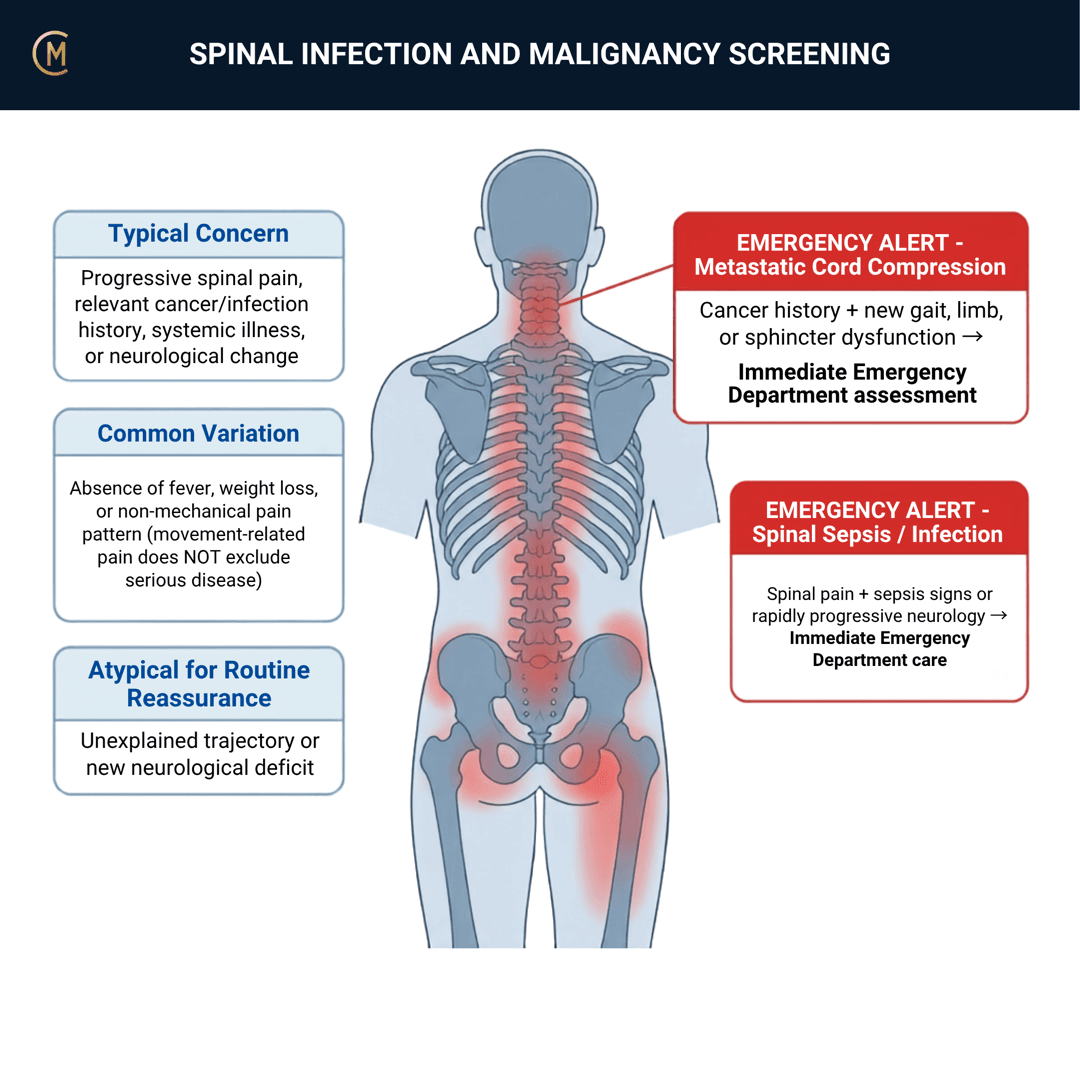
This entire page is free, permanently — all seven sections. Red flag content is never gated in CliniStudy.
Who: Anyone — but the risk sets matter. Prior cancer of any kind. Immunosuppression. Intravenous drug use. Recent infection, procedure or indwelling line.
What: Spinal or musculoskeletal infection (spondylodiscitis, vertebral osteomyelitis, epidural abscess) or malignancy (primary, or far more often metastatic).
How it behaves: Constant. Non-mechanical. Unrelieved by rest. Getting worse despite appropriate treatment.
The one thing to take from this page:
You are not screening with a checklist. You are noticing that the story doesn't cohere — flags arriving together, a course going the wrong way, in someone with a reason to be at risk.
You'll often be taught a red flag list. Here's what the evidence says about it.
| What you're taught | What the evidence shows |
|---|---|
| Tick the red flag boxes | Most individual red flags perform poorly on their own (Downie et al. 2013; Verhagen et al. 2017; Notarangelo et al. 2025) |
| Guidelines agree on the list | They don't. Consistency and evidential support vary widely across guidelines (Feller et al. 2024; Yusuf et al. 2019) |
| Fever means infection, no fever means no infection | Fever is frequently absent, and the classic triad is uncommon (Tetsuka et al. 2020; Durant et al. 2025) |
| All flags are equal | Prior cancer history is the exception — it carries weight on its own (Henschke et al. 2013) |
This does not mean stop screening. It means stop treating a ticked box as a test, and start reading the cluster and the clinical course.
⚠️ No Australian screening standard exists — and no validated screening set exists anywhere. Anchored to the IDSA vertebral osteomyelitis guideline [1] and the Cochrane malignancy review [2]. Both non-Australian.
2 · SE — THE SUBJECTIVE PATTERN (the 70%)
Five stages, in your course's order. On this pattern the history and the special questions carry almost all of it, and behaviour is where the alarm first sounds.
MAIN PROBLEM
"It's just there all the time and nothing touches it."
"It's worse than when I started with you."
"I've been waking at two or three every morning and I can't get comfortable."
BODY CHART
- Mark the pain, and mark whether it moves. Multi-region or migrating symptoms are part of this pattern.
- Note focal spinal tenderness as a point, not an area — disproportionate local tenderness matters here.
- Draw any mass or lymphadenopathy you find, and date the drawing.
BEHAVIOUR
This is where the alarm sounds first, usually before anyone says the word cancer.
| Mechanical | The answer that should stop you | |
|---|---|---|
| Aggs | Load, position, activity | Nothing in particular — it's just constant |
| Eases | Rest, unloading, a position | Nothing. Rest doesn't help |
| Night | Wakes on turning, resettles | Wakes and stays. Not positional |
| Course | Improving, or plateaued | Progressively worse |
M / In / P / Is coding that keeps failing is itself the finding.
HISTORY
- How long, and which direction? Progressive worsening over weeks in the absence of a mechanism is the shape that matters.
- How has it responded to appropriate treatment? Failure to improve is the one you are best placed to notice — but on its own it's a weak flag with a high false-positive rate (Henschke et al. 2013) [2]. Getting worse, or not improving alongside anything else on this page, is what should move you.
- Prior cancer — any type, any time. Ask it directly, ask it plainly, and record the answer either way.
- Recent infection, spinal procedure or injection, surgery, indwelling line, dental work.
- Intravenous drug use. Ask it without ceremony, as one item among several.
SPECIAL / SCREENING QUESTIONS
- Fever, chills, rigors, night sweats. Ask all four.
- Unexplained weight loss — how much, over how long, and was it intended.
- Fatigue and malaise out of proportion to the musculoskeletal problem.
- Immunosuppression — medication, treatment, or a condition their doctor manages.
- Bladder and bowel change, saddle change, progressive leg weakness — the cord and cauda equina screen runs alongside this one.
3 · HYPOTHESIS RANKING
| Competing pattern | The one discriminating feature |
|---|---|
| Mechanical musculoskeletal pain | Changes with load and position, eases with rest, and responds to treatment. This pattern does none of the three. |
| Inflammatory arthropathy | Morning stiffness >30 min (In) that eases with activity, onset under 40, alternating buttock pain — a different systemic pattern with a different destination (rheumatology, not emergency). |
| Spinal metastases | A cancer history plus new spinal pain. Image, don't mobilise. This is the single strongest item on the page. |
The two escalations inside the escalation
Metastatic spinal cord compression (MSCC). New or worsening spinal pain in a person with cancer — especially thoracic, localised, night or rest pain, or with any neurological change — is an oncological emergency. The neurological loss becomes fixed if you wait (Nair et al. 2014; Robson 2014; Gupta et al. 2026).
Spinal epidural abscess (SEA). Progresses rapidly, and the classic triad of back pain, fever and neurological deficit is uncommon. Diagnostic delay is the norm rather than the exception (Reihsaus et al. 2000; Alerhand and colleagues; Tetsuka et al. 2020; Durant et al. 2025; Long et al. 2022; Tande et al. 2026).
Neither is excluded by anything in your hands.
4 · RED FLAGS — DON'T MISS THIS
This section is free, on every pattern, forever. Safety is never gated.
The items that should move you
Prior cancer has the best accuracy data behind it (Verhagen et al. 2017) [7]. The infection flags have too little evidence to rate at all — a reason to act on them, not to discount them (Yusuf et al. 2019) [9].
| Finding | Why it matters | What you do |
|---|---|---|
| Prior cancer + new spinal pain | The strongest single item in the malignancy evidence | Same-day medical review + imaging |
| Progressive neurological deficit | Suspected MSCC or SEA | 🚑 Emergency, today |
| Fever, rigors, unwell + spinal pain | Suspected spinal infection | 🚑 Emergency, today |
| IV drug use, immunosuppression, recent procedure or line + spinal pain | The SEA risk set | Same-day medical review |
| Unexplained weight loss | Constitutional | Same-day medical review |
| Failure to improve as expected, getting worse on treatment | The course is wrong | Medical review — do not push on |
| Bladder / bowel / saddle change | Cord or cauda equina | 🚑 Emergency, today |
The three rules that survive everything else
1. A cluster beats a box. Individual red flags perform poorly alone. Flags arriving together, in a course going the wrong way, in someone with a reason to be at risk — that is the signal.
2. Absence clears nothing. No fever does not exclude infection. No cancer history does not exclude a first presentation. A normal early X-ray excludes neither.
3. Reassurance is not an alternative to referral. Do both. The concern is uncommon; the cost of missing it is high. Say that out loud and refer anyway.
Cross-links: Non-specific low back pain · Septic arthritis / DVT / tumour · Infection / osteomyelitis / ulcer
5 · OE — THE OBJECTIVE (the 30%)
Members
Sections 5 to 7 are for members
The objective exam, management and pearls, plus the six-minute lesson and the debrief. Free with an account.
Sign in or join free6 · MX — MANAGEMENT ESSENTIALS
Members
Sections 5 to 7 are for members
The objective exam, management and pearls, plus the six-minute lesson and the debrief. Free with an account.
Sign in or join free7 · CLINICAL PEARLS + RETRIEVAL CHECK
Members
Sections 5 to 7 are for members
The objective exam, management and pearls, plus the six-minute lesson and the debrief. Free with an account.
Sign in or join freeMembers
The 4-minute lesson is for members
Twelve slides on this pattern: what you'll hear, what to examine, what to do. Free with an account.
Sign in or join freeGuideline anchor
No Australian guideline covers screening for spinal infection or malignancy in a physiotherapy caseload.
More
Anchored to the Infectious Diseases Society of America guideline on native vertebral osteomyelitis (Berbari et al. 2015, PMID 26229122) for the infection limb, and to the Cochrane review of malignancy red flags in low back pain (Henschke et al. 2013, PMID 23450586) with the BMJ systematic review (Downie et al. 2013, PMID 24335669) for the malignancy limb. Both anchors are non-Australian and labelled as such on the page. The ACSQHC Low Back Pain Clinical Care Standard (2022) applies to the lumbar presentations: it lists the history items to screen (unexplained weight loss, previous malignancy, intravenous drug use, longstanding steroid use, recent serious illness or infection) and directs emergency referral for suspected spinal infection or tumour, but carries no accuracy data for those items.
There is no Australian screening standard here, and — more importantly — there is no validated screening set anywhere. The red flag lists in guidelines are consensus, not accuracy data, and several systematic reviews say so directly. This page teaches clustering and clinical course rather than a checklist, because that is what the evidence supports.
Members
The evidence summary is for members
Verified diagnostic accuracy, where the evidence stands and what it doesn't settle. Free with an account.
Sign in or join freeSources · 18
ShowHide
Every source on this page resolves and title-verifies against PubMed. Newest first.
- 2015Berbari et al. (2015). 2015 Infectious Diseases Society of America (IDSA) Clinical Practice Guidelines for the Diagnosis and Treatment of Native Vertebral Osteomyelitis in Adults. Clinical infectious diseases : an official publication of the Infectious Diseases Society of America, 61(6), e26-46. https://doi.org/10.1093/cid/civ482
- 2013Henschke et al. (2013). Red flags to screen for malignancy in patients with low-back pain. The Cochrane database of systematic reviews, 2013(2), CD008686. https://doi.org/10.1002/14651858.CD008686.pub2
- 2000Reihsaus et al. (2000). Spinal epidural abscess: a meta-analysis of 915 patients. Neurosurgical review, 23(4), 175-204; discussion 205. https://doi.org/10.1007/pl00011954
- 2013Downie et al. (2013). Red flags to screen for malignancy and fracture in patients with low back pain: systematic review. BMJ (Clinical research ed.), 347, f7095. https://doi.org/10.1136/bmj.f7095
- 2014Nair et al. (2014). How not to miss metastatic spinal cord compression. The British journal of general practice : the journal of the Royal College of General Practitioners, 64(626), e596-8. https://doi.org/10.3399/bjgp14X681589
- 2014Robson (2014). Metastatic spinal cord compression: a rare but important complication of cancer. Clinical medicine (London, England), 14(5), 542-5. https://doi.org/10.7861/clinmedicine.14-5-542
- 2017Verhagen et al. (2017). Most red flags for malignancy in low back pain guidelines lack empirical support: a systematic review. Pain, 158(10), 1860-1868. https://doi.org/10.1097/j.pain.0000000000000998
- 2018Lener et al. (2018). Management of spinal infection: a review of the literature. Acta neurochirurgica, 160(3), 487-496. https://doi.org/10.1007/s00701-018-3467-2
- 2019Yusuf et al. (2019). Red flags for the early detection of spinal infection in back pain patients. BMC musculoskeletal disorders, 20(1), 606. https://doi.org/10.1186/s12891-019-2949-6
- 2020Galliker et al. (2020). Low Back Pain in the Emergency Department: Prevalence of Serious Spinal Pathologies and Diagnostic Accuracy of Red Flags. The American journal of medicine, 133(1), 60-72.e14. https://doi.org/10.1016/j.amjmed.2019.06.005
- 2020Tetsuka et al. (2020). Spinal Epidural Abscess: A Review Highlighting Early Diagnosis and Management. JMA journal, 3(1), 29-40. https://doi.org/10.31662/jmaj.2019-0038
- 2022Maselli et al. (2022). The diagnostic value of Red Flags in thoracolumbar pain: a systematic review. Disability and rehabilitation, 44(8), 1190-1206. https://doi.org/10.1080/09638288.2020.1804626
- 2022Long et al. (2022). High risk and low prevalence diseases: Spinal epidural abscess. The American journal of emergency medicine, 53, 168-172. https://doi.org/10.1016/j.ajem.2022.01.008
- 2024Feller et al. (2024). Red flags for potential serious pathologies in people with neck pain: a systematic review of clinical practice guidelines. Archives of physiotherapy, 14, 105-115. https://doi.org/10.33393/aop.2024.3245
- 2025Durant et al. (2025). Diagnostic Delays Are Common, and Classic Presentations Are Rare in Spinal Epidural Abscess. The western journal of emergency medicine, 26(3), 692-699. https://doi.org/10.5811/westjem.24985
- 2025Notarangelo et al. (2025). Diagnostic Utility of Red Flags for Detecting Spinal Malignancies in Patients with Low Back Pain: A Scoping Review. Journal of clinical medicine, 14(20). https://doi.org/10.3390/jcm14207174
- 2026Gupta et al. (2026). Contemporary management strategies for spinal metastases: diagnosis, multidisciplinary approaches, and outcomes - a narrative review. Annals of medicine and surgery (2012), 88(1), 381-386. https://doi.org/10.1097/MS9.0000000000004209
- 2026Tande et al. (2026). Spinal Epidural Abscess. The New England journal of medicine, 394(16), 1621-1633. https://doi.org/10.1056/NEJMra2412728
Mapped to this pattern
Generic measures that also apply
- Borg RPE
Borg Rating of Perceived Exertion Scale (6-20)
perceived exertion · 1 items · 1 min
- GROC
Global Rating of Change Scale
perceived change since baseline · 1 items · 1 min
- NPRS
Numeric Pain Rating Scale
pain intensity · 1 items · 1 min
- PGIC
Patient Global Impression of Change
perceived change since baseline · 1 items · 1 min
- PSFS
Patient-Specific Functional Scale
patient-generated function · 3 items · 2 min
- SANE
Single Assessment Numeric Evaluation
patient-rated function as a percentage of normal · 1 items · 1 min
- VAS
Visual Analogue Scale
pain intensity · 1 items · 1 min
- Borg CR10
Borg Category Ratio 10 Scale
perceived exertion or symptom intensity, ratio scale · 1 items · 1 min
- GAS
Goal Attainment Scaling
individualised goal achievement · 10 min
Did this page do its job?
CliniStudy is in beta. One tap is enough — it decides what gets fixed first.