
1 · SNAPSHOT
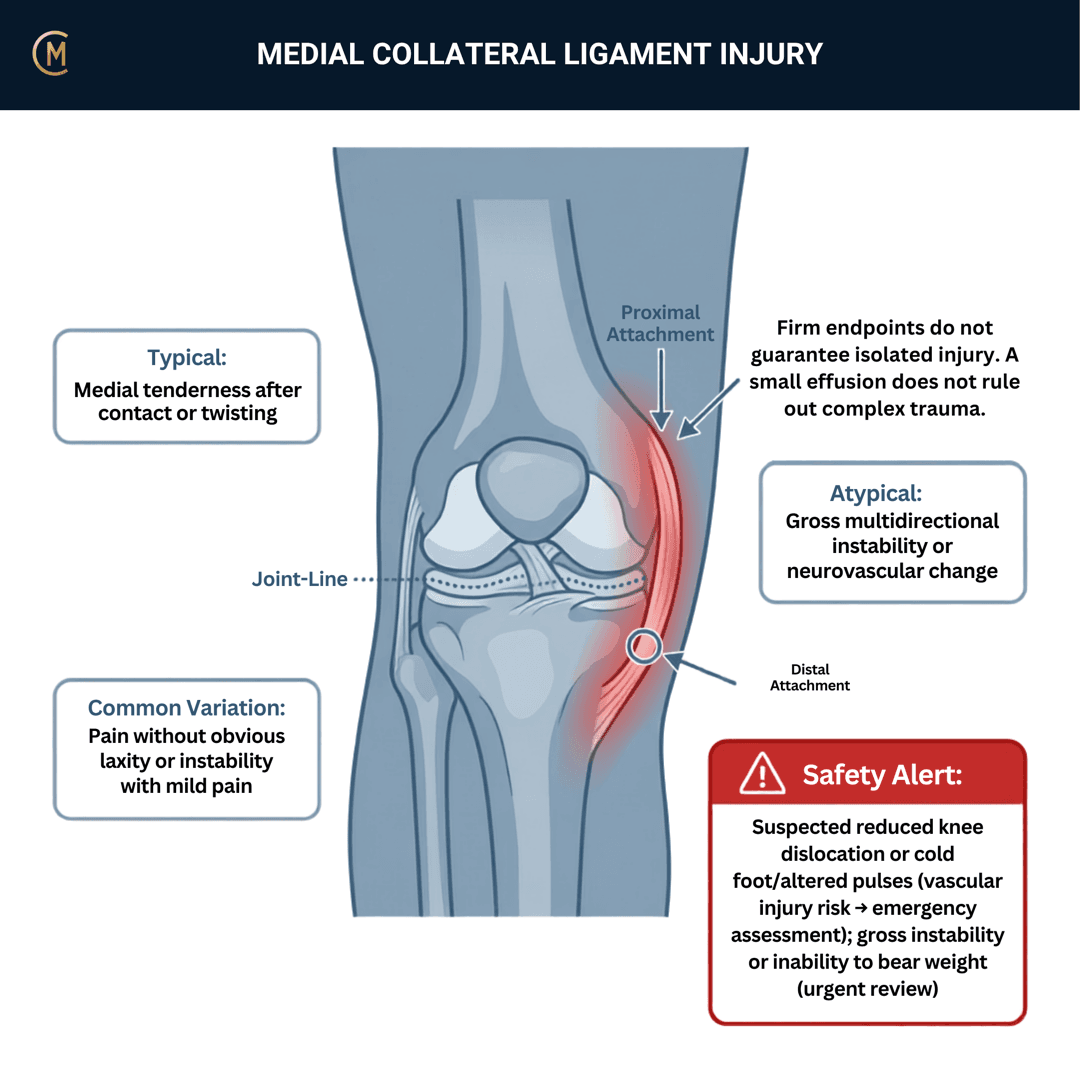
Who: Contact sport and skiing. Any age; adolescents have their own considerations.
What: Sprain of the superficial ± deep MCL after a valgus load.
How it behaves: Medial knee pain after a valgus load, contact or twist. Swelling and tenderness along the medial side. Feels unstable or "gives way." Eased by rest or bracing.
The one thing to take from this page:
An isolated MCL heals well and predictably. The entire clinical job is establishing that it's isolated — because MCL injury alongside ACL injury has been reported as common, and a combined injury is a completely different conversation.
Isolated or combined — the whole page
| Isolated MCL | Combined | |
|---|---|---|
| Valgus at 30° | Painful ± lax | Painful ± lax |
| Valgus at 0° | Stable | Lax — this is the finding |
| End feel | Firm | Soft or absent |
| Lachman | Negative | Positive |
| Effusion | Mild at most | Often large |
| Prognosis | Excellent | A different conversation, and a referral |
2 · SE — THE SUBJECTIVE PATTERN (the 70%)
Five stages. Acute and traumatic reorders to main problem → body chart → history → behaviour.
MAIN PROBLEM
"Someone fell across the outside of my knee."
"My ski caught and the knee went inwards."
"It's sore down the inside and it feels like it's going to give."
BODY CHART
- Medial, along the ligament. Get them to run a finger down it — femoral origin, mid-substance, or down at the tibia?
- Note the tibial end specifically. Distal grade III injuries have been described separately [1] and location changes the conversation.
- Any medial joint line pain? That's a meniscal question.
- Any diffuse whole-knee swelling? That's an intra-articular question.
HISTORY — this is where the combined injury declares itself
- Exact mechanism. Pure valgus, or valgus with rotation and a planted foot? Rotation raises the ACL question.
- A pop? How loud, and did anyone else hear it?
- How fast did it swell? Immediate and tense = intra-articular until proven otherwise.
- Could they keep playing?
- Any locking, catching, or a block to straightening?
- Previous knee injury or surgery, same knee.
- Age. Paediatric and adolescent MCL injuries have been described separately [2]; in a skeletally immature athlete, the physis is the differential.
BEHAVIOUR
- Aggs: valgus load, cutting, pivoting, twisting in bed, stairs, deep flexion.
- Eases: rest, bracing, keeping it straight.
- Night: twisting in bed is in the Aggs; sleep tolerance is one of the first-fortnight measures.
- Severity: VAS 0–10 at best / at worst / right now.
- Irritability: resting symptoms + vigour of the provoking activity + time to settle.
- Walking, stairs and sleep tolerance — the practical first-fortnight measures.
SPECIAL / SCREENING QUESTIONS
- Any calf pain or swelling? DVT — especially if braced or immobilised.
- Fever, hot swollen knee, systemic illness?
- Any numbness, pins and needles, or foot drop?
- Any inability to weight-bear at all?
Assessing this region? Download the Knee assessment template →
3 · HYPOTHESIS RANKING
| Competing pattern | The one discriminating feature |
|---|---|
| Combined ACL–MCL | Positive Lachman, laxity at 0°, large early effusion. Reported as common [3]. |
| Medial meniscus tear | Joint line tenderness, locking or catching, positive McMurray or Thessaly, block to extension. |
| Posteromedial corner injury | Laxity at 0°, rotational instability. Read further: examined alongside the MCL [4]. |
| PCL or multi-ligament | Posterior sag, dashboard mechanism. PCL involvement has been reported to lead to inferior outcomes. |
| Medial tibial plateau fracture | Bony tenderness, inability to weight-bear, high-energy mechanism. |
| Pes anserine / medial patellofemoral | No valgus mechanism, tender lower and more anterior. |
| Physeal injury (skeletally immature) | Tender over the physis rather than the ligament. Image before you brace. |
The one that reframes the page
It is common for the MCL not to be alone. High prevalence of superficial and deep MCL injury has been reported in ACL-injured knees (Cristiani et al. 2024), combined ACL–MCL injury has its own literature [5], and ten-year prognosis has been reported separately for isolated and combined injury [6]. The direction is what matters: don't promise "excellent" until you've cleared the rest of the knee.
4 · RED FLAGS — DON'T MISS THIS
This section is free, on every pattern, forever. Safety is never gated.
| Finding | What it suggests | What you do |
|---|---|---|
| Laxity on valgus stress at 0° extension | Combined ligamentous injury | Urgent orthopaedic review |
| Gross laxity in more than one plane | Multi-ligament knee injury | URGENT — and screen the neurovascular status. Up to 18% of multi-ligament knees carry a vascular injury; every one should get an ABPI, with arteriography if it's < 0.9 (Ng et al. 2020) [21] |
| Absent or diminished distal pulses, cold foot, foot drop | Neurovascular injury | EMERGENCY |
| Inability to weight-bear, focal bony tenderness, high-energy mechanism | Fracture | Imaging before rehabilitation |
| Immediate tense effusion | Haemarthrosis — ACL, fracture, dislocation | Urgent review |
| Locking or a true block to extension | Displaced meniscal tear | Orthopaedic review |
| Hot, red, swollen knee with fever | Septic arthritis | ED / same-day medical referral |
| Calf pain, swelling or warmth, especially if braced | DVT | Urgent medical review |
| Skeletally immature athlete | Physeal injury | Image before you brace |
| Knee dislocation, even if reduced spontaneously | Vascular injury until proven otherwise | EMERGENCY |
The rule: valgus laxity at 30° is an MCL. Valgus laxity at 0° is something bigger. Test both, every time, and check the pulses on anything that looks multi-ligament.
Cross-links: Acute ACL injury · Meniscus tear · PCL injury · Septic arthritis / DVT / tumour
5 · OE — THE OBJECTIVE (the 30%)
Members
Sections 5 to 7 are for members
The objective exam, management and pearls, plus the six-minute lesson and the debrief. Free with an account.
Sign in or join free6 · MX — MANAGEMENT ESSENTIALS
Members
Sections 5 to 7 are for members
The objective exam, management and pearls, plus the six-minute lesson and the debrief. Free with an account.
Sign in or join free7 · CLINICAL PEARLS + RETRIEVAL CHECK
Members
Sections 5 to 7 are for members
The objective exam, management and pearls, plus the six-minute lesson and the debrief. Free with an account.
Sign in or join freeMembers
The 5-minute lesson is for members
Twelve slides on this pattern: what you'll hear, what to examine, what to do. Free with an account.
Sign in or join freeGuideline anchor
No Australian guideline.
More
Anchored to the JOSPT clinical practice guideline — Knee Stability and Movement Coordination Impairments: Knee Ligament Sprain, Revision 2017 (Logerstedt et al. 2017, PMID 29089004), with its original edition (Logerstedt et al. 2010, PMID 20357420) — and its Journal of Physiotherapy appraisal (Nazari et al. 2018, PMID 30190216). Note the honest counterweight: management of MCL tears has been described as lacking consensus (Blaber et al. 2024, PMID 38913807).
The guideline is American, physiotherapy-specific and covers knee ligament sprain broadly rather than the MCL specifically — read the Journal of Physiotherapy appraisal alongside it. And note that a 2024 review concluded there is a lack of consensus on managing MCL tears, which is a fair description of the field.
Members
The evidence summary is for members
Verified diagnostic accuracy, where the evidence stands and what it doesn't settle. Free with an account.
Sign in or join freeSources · 20
ShowHide
Every source on this page resolves and title-verifies against PubMed. Newest first.
- 2021Acevedo et al. (2021). Distal Medial Collateral Ligament Grade III Injuries in Collegiate Football Players: Operative Management, Rehabilitation, and Return to Play. Journal of athletic training, 56(6), 565-571. https://doi.org/10.4085/1062-6050-465-19
- 2023Pearce et al. (2023). Pediatric and Adolescent Medial Collateral Ligament Injuries. Journal of the Pediatric Orthopaedic Society of North America, 5(4), 757. https://doi.org/10.55275/JPOSNA-2023-757
- 2024Cristiani et al. (2024). High Prevalence of Superficial and Deep Medial Collateral Ligament Injuries on Magnetic Resonance Imaging in Patients With Anterior Cruciate Ligament Tears. Arthroscopy : the journal of arthroscopic & related surgery : official publication of the Arthroscopy Association of North America and the International Arthroscopy Association, 40(1), 103-110. https://doi.org/10.1016/j.arthro.2023.05.029
- 2015Craft & Kurzweil (2015). Physical examination and imaging of medial collateral ligament and posteromedial corner of the knee. Sports medicine and arthroscopy review, 23(2), e1-6. https://doi.org/10.1097/JSA.0000000000000066
- 2019Elkin et al. (2019). Combined Anterior Cruciate Ligament and Medial Collateral Ligament Knee Injuries: Anatomy, Diagnosis, Management Recommendations, and Return to Sport. Current reviews in musculoskeletal medicine, 12(2), 239-244. https://doi.org/10.1007/s12178-019-09549-3
- 1997Lundberg & Messner (1997). Ten-year prognosis of isolated and combined medial collateral ligament ruptures. A matched comparison in 40 patients using clinical and radiographic evaluations. The American journal of sports medicine, 25(1), 2-6. https://doi.org/10.1177/036354659702500102
- 2022Meyer et al. (2022). Imaging of the medial collateral ligament of the knee: a systematic review. Archives of orthopaedic and trauma surgery, 142(12), 3721-3736. https://doi.org/10.1007/s00402-021-04200-8
- 2017Tanaka et al. (2017). Clinical interpretation of asymptomatic medial collateral ligament injury observed on magnetic resonance imaging in adolescent baseball players. Japanese journal of radiology, 35(6), 319-326. https://doi.org/10.1007/s11604-017-0636-9
- 2024Blaber et al. (2024). Lack of Consensus on the Management of Medial Collateral Ligament Tears in the Setting of Concomitant Anterior Cruciate Ligament Injury: A Critical Analysis. JBJS reviews, 12(6). https://doi.org/10.2106/JBJS.RVW.24.00036
- 2024Svantesson et al. (2024). Shedding light on the non-operative treatment of the forgotten side of the knee: rehabilitation of medial collateral ligament injuries-a systematic review. BMJ open sport & exercise medicine, 10(2), e001750. https://doi.org/10.1136/bmjsem-2023-001750
- 2020Williams et al. (2020). The medial collateral ligament: the neglected ligament. Knee surgery, sports traumatology, arthroscopy : official journal of the ESSKA, 28(12), 3698-3699. https://doi.org/10.1007/s00167-020-06116-z
- 2018Encinas-Ullán & Rodríguez-Merchán (2018). Isolated medial collateral ligament tears: An update on management. EFORT open reviews, 3(7), 398-407. https://doi.org/10.1302/2058-5241.3.170035
- 2024Shultz et al. (2024). Nonoperative Management, Repair, or Reconstruction of the Medial Collateral Ligament in Combined Anterior Cruciate and Medial Collateral Ligament Injuries-Which Is Best? A Systematic Review and Meta-analysis. The American journal of sports medicine, 52(2), 522-534. https://doi.org/10.1177/03635465231153157
- 2025Hunter et al. (2025). Randomized Clinical Feasibility Trial: Comparing a Restrictive and Protective Range-of-Motion Brace for the Nonsurgical Management of the Medial Collateral Ligament of the Knee. Clinical journal of sport medicine : official journal of the Canadian Academy of Sport Medicine, 35(4), 415-422. https://doi.org/10.1097/JSM.0000000000001361
- 2006Edson (2006). Conservative and postoperative rehabilitation of isolated and combined injuries of the medial collateral ligament. Sports medicine and arthroscopy review, 14(2), 105-10. https://doi.org/10.1097/01.jsa.0000212308.32076.f2
- 2017Logerstedt et al. (2017). Knee Stability and Movement Coordination Impairments: Knee Ligament Sprain Revision 2017. The Journal of orthopaedic and sports physical therapy, 47(11), A1-A47. https://doi.org/10.2519/jospt.2017.0303
- 2010Logerstedt et al. (2010). Knee stability and movement coordination impairments: knee ligament sprain. The Journal of orthopaedic and sports physical therapy, 40(4), A1-A37. https://doi.org/10.2519/jospt.2010.0303
- 2018Nazari (2018). Appraisal of Clinical Practice Guideline: Knee Stability and Movement Coordination Impairments: Knee Ligament Sprain. Journal of physiotherapy, 64(4), 271. https://doi.org/10.1016/j.jphys.2018.07.003
- 2014Roach et al. (2014). The epidemiology of medial collateral ligament sprains in young athletes. The American journal of sports medicine, 42(5), 1103-9. https://doi.org/10.1177/0363546514524524
- 2016Stanley et al. (2016). Sex Differences in the Incidence of Anterior Cruciate Ligament, Medial Collateral Ligament, and Meniscal Injuries in Collegiate and High School Sports: 2009-2010 Through 2013-2014. The American journal of sports medicine, 44(6), 1565-72. https://doi.org/10.1177/0363546516630927
Mapped to this pattern
- IKDC
International Knee Documentation Committee Subjective Knee Form
knee symptoms, function and sport activity · 18 items · 6 min
- KOOS
Knee Injury and Osteoarthritis Outcome Score
knee injury and osteoarthritis outcome · 42 items · 10 min
- Lysholm
Lysholm Knee Scoring Scale
knee symptoms after ligament injury · 8 items · 4 min
- Ottawa Knee
Ottawa Knee Rule
imaging decision rule · 5 items · 1 min
Generic measures that also apply
- Borg RPE
Borg Rating of Perceived Exertion Scale (6-20)
perceived exertion · 1 items · 1 min
- GROC
Global Rating of Change Scale
perceived change since baseline · 1 items · 1 min
- NPRS
Numeric Pain Rating Scale
pain intensity · 1 items · 1 min
- PGIC
Patient Global Impression of Change
perceived change since baseline · 1 items · 1 min
- PSFS
Patient-Specific Functional Scale
patient-generated function · 3 items · 2 min
- SANE
Single Assessment Numeric Evaluation
patient-rated function as a percentage of normal · 1 items · 1 min
- VAS
Visual Analogue Scale
pain intensity · 1 items · 1 min
- Borg CR10
Borg Category Ratio 10 Scale
perceived exertion or symptom intensity, ratio scale · 1 items · 1 min
- GAS
Goal Attainment Scaling
individualised goal achievement · 10 min
Did this page do its job?
CliniStudy is in beta. One tap is enough — it decides what gets fixed first.