
1 · SNAPSHOT
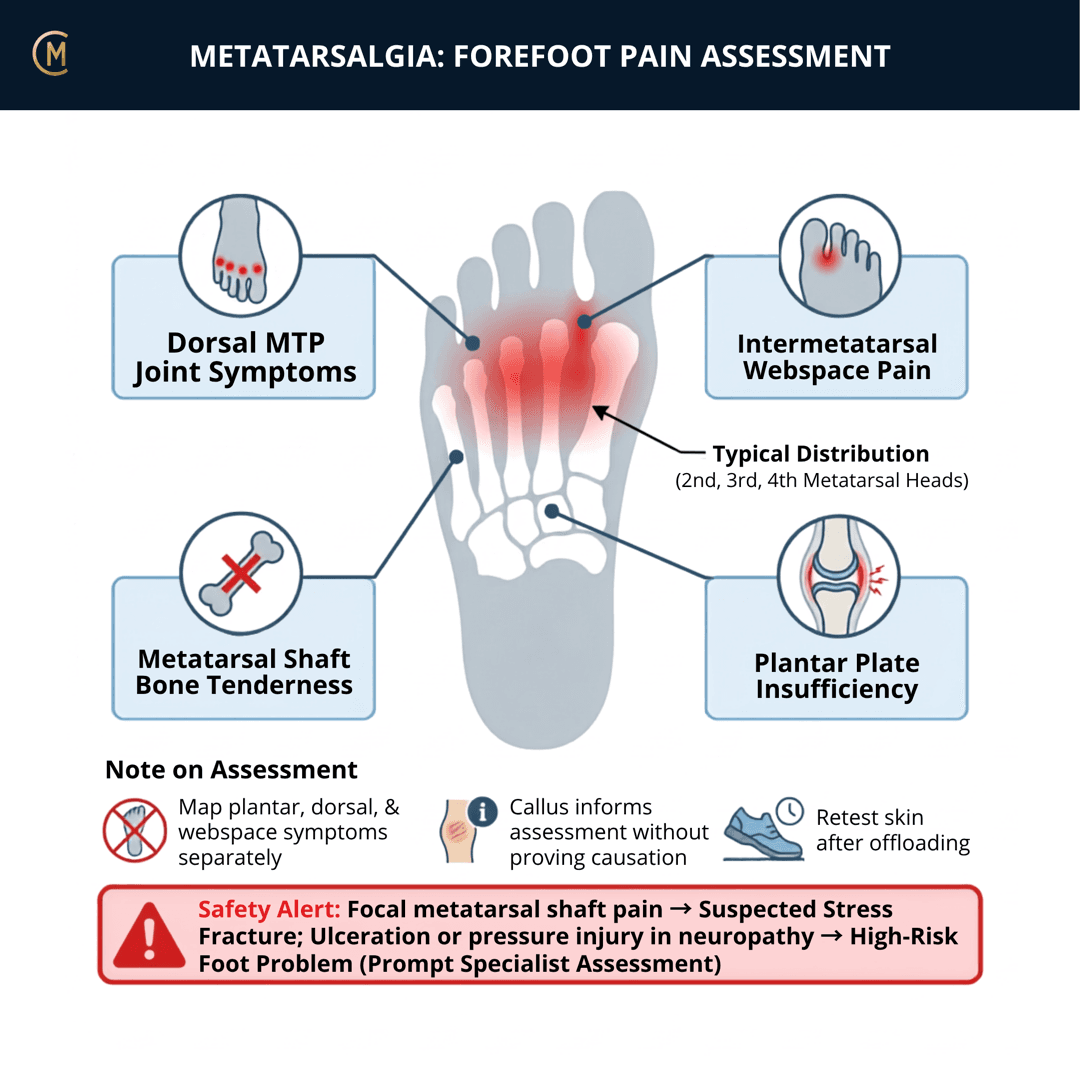
Who: Load or footwear change, high heels, runners, and anyone with a stiff first MTP or a tight calf shifting pressure laterally.
What: Pressure overload under the lesser metatarsal heads — or something specific underneath it.
How it behaves: Aching or burning under the metatarsal heads, commonly 2nd–3rd. "Like walking on pebbles." Worse with walking, running and high heels. Eased by rest and cushioned footwear.
The one thing to take from this page:
Metatarsalgia names a location and a sensation. It is where you start, not where you finish.
What it hides
| Driver | Its one discriminator |
|---|---|
| Mechanical overload | Callus at the pressure zone, no radiation, no sensory change |
| Plantar plate injury / lesser MTP instability | Toe drift, swelling, positive dorsal drawer |
| Morton's neuroma | Radiation into the toes, sensory change, webspace |
| Intermetatarsal bursitis | Webspace pain — mimics neuroma closely |
| Metatarsal stress fracture | Focal bony tenderness, load history, pain on percussion or hop |
| Freiberg's disease | Dorsal MT head pain, ↓ MTP range, young active patient |
And off the mechanical list entirely: inflammatory arthropathy, and referred pain.
⚠️ No guideline exists — and none should be expected. You cannot write a guideline for a symptom. The pressure-redistribution evidence is decent; the diagnostic work is yours.
2 · SE — THE SUBJECTIVE PATTERN (the 70%)
Five stages, in your course's order.
MAIN PROBLEM
"It feels like I'm walking on a pebble."
"There's a burning under the ball of my foot by the end of the day."
"It started when I changed shoes."
BODY CHART
- Mark which rays. 2nd and 3rd is the common mechanical pattern; the webspace is a different question.
- Does it radiate into the toes? Draw it if it does — that is the neuroma question, and it changes everything.
- Mark callus and pressure zones as areas.
- Note any toe drift or deformity and date the observation.
BEHAVIOUR
| Fits mechanical metatarsalgia | Points elsewhere | |
|---|---|---|
| Aggs | Walking distance, running, high heels, hard surfaces | Sudden spike with focal pain → stress fracture |
| Eases | Rest, cushioned footwear, taking shoes off | Taking shoes off gives dramatic relief → neuroma |
| Severity | VAS 0–10 at best / at worst / right now | — |
| Quality | Ache, burning under the heads | Sharp, electric, into the toes → neuroma |
| Sensory | Normal | Numb or tingling → neuroma |
HISTORY
- Load and footwear change. A new shoe, a new distance, a new surface, a new job on hard floors. This is usually the whole story.
- Bone health and load history — the stress fracture screen.
- Toe changes over time — has the second toe started to drift?
SPECIAL / SCREENING QUESTIONS
- Morning stiffness >30 min (In), other joints, systemic features — inflammatory arthropathy.
- Night pain, rest pain, or a pain that doesn't behave mechanically — off this page.
- Diabetes or neuropathy — changes the whole risk profile of a pressure lesion.
Assessing this region? Download the Ankle & Foot assessment template →
3 · HYPOTHESIS RANKING
| Competing pattern | The one discriminating feature |
|---|---|
| Morton's neuroma | Sharp burning radiating into the toes, "pebble in shoe", positive Mulder's click, sensory change in the webspace. |
| Sesamoiditis | Localised plantar 1st MTP pain on push-off, pain with resisted hallux flexion. |
| Freiberg's disease | Dorsal 2nd MT head pain with swelling and reduced MTP range, in an adolescent or young active patient. |
The three the table doesn't carry
Plantar plate injury and lesser MTP instability — toe drift, swelling, plantar plate tenderness, positive dorsal drawer (Kinter & Hodgkins 2020; Maas et al. 2016; Park et al. 2025).
Intermetatarsal bursitis — which mimics neuroma closely enough that it should be considered before anyone injects or refers for neuroma surgery (Larsen et al. 2023).
Metatarsal stress fracture — focal bony tenderness, a load history, and pain on percussion or hop.
And the escalation: pain that is focal, dorsal, traumatic, neurological, inflammatory, or simply not behaving mechanically belongs off this page.
4 · RED FLAGS — DON'T MISS THIS
This section is free, on every pattern, forever. Safety is never gated.
| Finding | What it suggests | What you do |
|---|---|---|
| Focal bony tenderness + load spike, pain on hop or percussion — in a distance runner or recruit the second or third MT is a common site, the same rays mechanical metatarsalgia favours (Sun et al. 2024) [21] | Metatarsal stress fracture | Offload and image |
| Night or rest pain, not mechanical | Bone stress, infection, tumour | Medical referral |
| Hot, red, swollen ± fever, or a diabetic foot with skin breach | Infection | 🚑 See the infection page |
| Morning stiffness >30 min (In), multiple joints, systemic features | Inflammatory arthropathy | GP referral |
| Progressive toe drift or deformity | Plantar plate failure | Protect the toe, refer if progressing |
| Numbness, or a foot with neuropathy and a pressure lesion | Neuropathic risk | See the diabetic foot pathway |
The rule: pressure pain that responds to offloading is yours. Focal bone pain, systemic features, or a numb foot with a pressure lesion is not.
Cross-links: Morton's neuroma · Stress fracture — metatarsal, navicular, calcaneal · Infection / osteomyelitis / ulcer
5 · OE — THE OBJECTIVE (the 30%)
Members
Sections 5 to 7 are for members
The objective exam, management and pearls, plus the six-minute lesson and the debrief. Free with an account.
Sign in or join free6 · MX — MANAGEMENT ESSENTIALS
Members
Sections 5 to 7 are for members
The objective exam, management and pearls, plus the six-minute lesson and the debrief. Free with an account.
Sign in or join free7 · CLINICAL PEARLS + RETRIEVAL CHECK
Members
Sections 5 to 7 are for members
The objective exam, management and pearls, plus the six-minute lesson and the debrief. Free with an account.
Sign in or join freeMembers
The 4-minute lesson is for members
Twelve slides on this pattern: what you'll hear, what to examine, what to do. Free with an account.
Sign in or join freeGuideline anchor
No guideline exists for metatarsalgia, in Australia or anywhere — which is unsurprising, because it is a symptom label rather than a diagnosis.
More
Anchored for management to the conservative treatment review of forefoot disorders (Park & Chang 2019, PMID 31620619) and the orthotic systematic reviews (Arias-Martin et al. 2018, PMID 29423640; Ruiz-Ramos et al. 2025, PMID 39399760), and for the differential to Afonso et al. 2023 (PMID 37230133).
No guideline exists and none should be expected, because metatarsalgia names a location and a sensation rather than a pathology. The management evidence here is about pressure redistribution, which is well studied; the diagnostic work of finding what is actually driving it is not guideline territory at all.
Members
The evidence summary is for members
Verified diagnostic accuracy, where the evidence stands and what it doesn't settle. Free with an account.
Sign in or join freeSources · 21
ShowHide
Every source on this page resolves and title-verifies against PubMed. Newest first.
- 2006Kang et al. (2006). Correlations between subjective treatment responses and plantar pressure parameters of metatarsal pad treatment in metatarsalgia patients: a prospective study. BMC musculoskeletal disorders, 7, 95. https://doi.org/10.1186/1471-2474-7-95
- 2014DiPreta (2014). Metatarsalgia, lesser toe deformities, and associated disorders of the forefoot. The Medical clinics of North America, 98(2), 233-51. https://doi.org/10.1016/j.mcna.2013.10.003
- 2014Schuh et al. (2014). Comparison of plantar-pressure distribution and clinical impact of anatomically shaped sandals, off-the-shelf sandals and normal walking shoes in patients with central metatarsalgia. International orthopaedics, 38(11), 2281-8. https://doi.org/10.1007/s00264-014-2508-6
- 2016Maas et al. (2016). Metatarsophalangeal joint stability: a systematic review on the plantar plate of the lesser toes. Journal of foot and ankle research, 9, 32. https://doi.org/10.1186/s13047-016-0165-2
- 2016Hähni et al. (2016). The effect of foot orthoses with forefoot cushioning or metatarsal pad on forefoot peak plantar pressure in running. Journal of foot and ankle research, 9, 44. https://doi.org/10.1186/s13047-016-0176-z
- 2017Duan et al. (2017). Role of magnetic resonance imaging versus ultrasound for detection of plantar plate tear. Journal of orthopaedic surgery and research, 12(1), 14. https://doi.org/10.1186/s13018-016-0507-6
- 2018Federer et al. (2018). Conservative Management of Metatarsalgia and Lesser Toe Deformities. Foot and ankle clinics, 23(1), 9-20. https://doi.org/10.1016/j.fcl.2017.09.003
- 2018Arias-Martín et al. (2018). Effectiveness of custom-made foot orthoses for treating forefoot pain: a systematic review. International orthopaedics, 42(8), 1865-1875. https://doi.org/10.1007/s00264-018-3817-y
- 2019Gougoulias et al. (2019). Morton's interdigital neuroma: instructional review. EFORT open reviews, 4(1), 14-24. https://doi.org/10.1302/2058-5241.4.180025
- 2019Park & Chang (2019). Forefoot disorders and conservative treatment. Yeungnam University journal of medicine, 36(2), 92-98. https://doi.org/10.12701/yujm.2019.00185
- 2020Kinter & Hodgkins (2020). Lesser Metatarsophalangeal Instability: Diagnosis and Conservative Management of a Common Cause of Metatarsalgia. Sports health, 12(4), 390-394. https://doi.org/10.1177/1941738120904944
- 2021Albano et al. (2021). Plantar forefoot pain: ultrasound findings before and after treatment with custom-made foot orthoses. La Radiologia medica, 126(7), 963-970. https://doi.org/10.1007/s11547-021-01354-8
- 2022Carroll et al. (2022). Forefoot Injuries in Athletes: Integration of the Movement System. International journal of sports physical therapy, 17(1), 81-89. https://doi.org/10.26603/001c.30021
- 2022Baker et al. (2022). Treatment of Lesser Metatarsophalangeal Joint Instability With Plantar Plate Repair: A Systematic Review and Meta-Analysis. The Journal of foot and ankle surgery : official publication of the American College of Foot and Ankle Surgeons, 61(5), 1114-1118. https://doi.org/10.1053/j.jfas.2022.02.002
- 2022Yi et al. (2022). Comparison of the Forefoot Pressure-Relieving Effects of Foot Orthoses. Yonsei medical journal, 63(9), 864-872. https://doi.org/10.3349/ymj.2022.63.9.864
- 2023Larsen et al. (2023). Diagnostic Considerations of Intermetatarsal Bursitis: A Systematic Review. Diagnostics (Basel, Switzerland), 13(2). https://doi.org/10.3390/diagnostics13020211
- 2023Afonso et al. (2023). Differential Diagnosis of Metatarsalgia. Seminars in musculoskeletal radiology, 27(3), 337-350. https://doi.org/10.1055/s-0043-1764388
- 2025Ruiz-Ramos et al. (2025). Effectiveness of bespoke or customised orthotic treatment in plantar pressure reduction of the central metatarsals: A systematic review and meta-analysis. Journal of orthopaedics, 59, 111-118. https://doi.org/10.1016/j.jor.2023.12.006
- 2025Palka et al. (2025). Radiological approach to metatarsalgia in current practice: an educational review. Insights into imaging, 16(1), 94. https://doi.org/10.1186/s13244-025-01945-3
- 2025Park et al. (2025). Diagnosing Plantar Plate Injuries: A Narrative Review of Clinical and Imaging Approaches. Diagnostics (Basel, Switzerland), 15(17). https://doi.org/10.3390/diagnostics15172188
- 2024Sun et al. (2024). Risk factors of metatarsal stress fracture associated with repetitive sports activities: a systematic review. Frontiers in bioengineering and biotechnology, 12, 1435807. https://doi.org/10.3389/fbioe.2024.1435807
Mapped to this pattern
Generic measures that also apply
- Borg RPE
Borg Rating of Perceived Exertion Scale (6-20)
perceived exertion · 1 items · 1 min
- GROC
Global Rating of Change Scale
perceived change since baseline · 1 items · 1 min
- NPRS
Numeric Pain Rating Scale
pain intensity · 1 items · 1 min
- PGIC
Patient Global Impression of Change
perceived change since baseline · 1 items · 1 min
- PSFS
Patient-Specific Functional Scale
patient-generated function · 3 items · 2 min
- SANE
Single Assessment Numeric Evaluation
patient-rated function as a percentage of normal · 1 items · 1 min
- VAS
Visual Analogue Scale
pain intensity · 1 items · 1 min
- Borg CR10
Borg Category Ratio 10 Scale
perceived exertion or symptom intensity, ratio scale · 1 items · 1 min
- GAS
Goal Attainment Scaling
individualised goal achievement · 10 min
Did this page do its job?
CliniStudy is in beta. One tap is enough — it decides what gets fixed first.