
1 · SNAPSHOT
The one where rehab genuinely is the treatment, and the one students most often improvise.
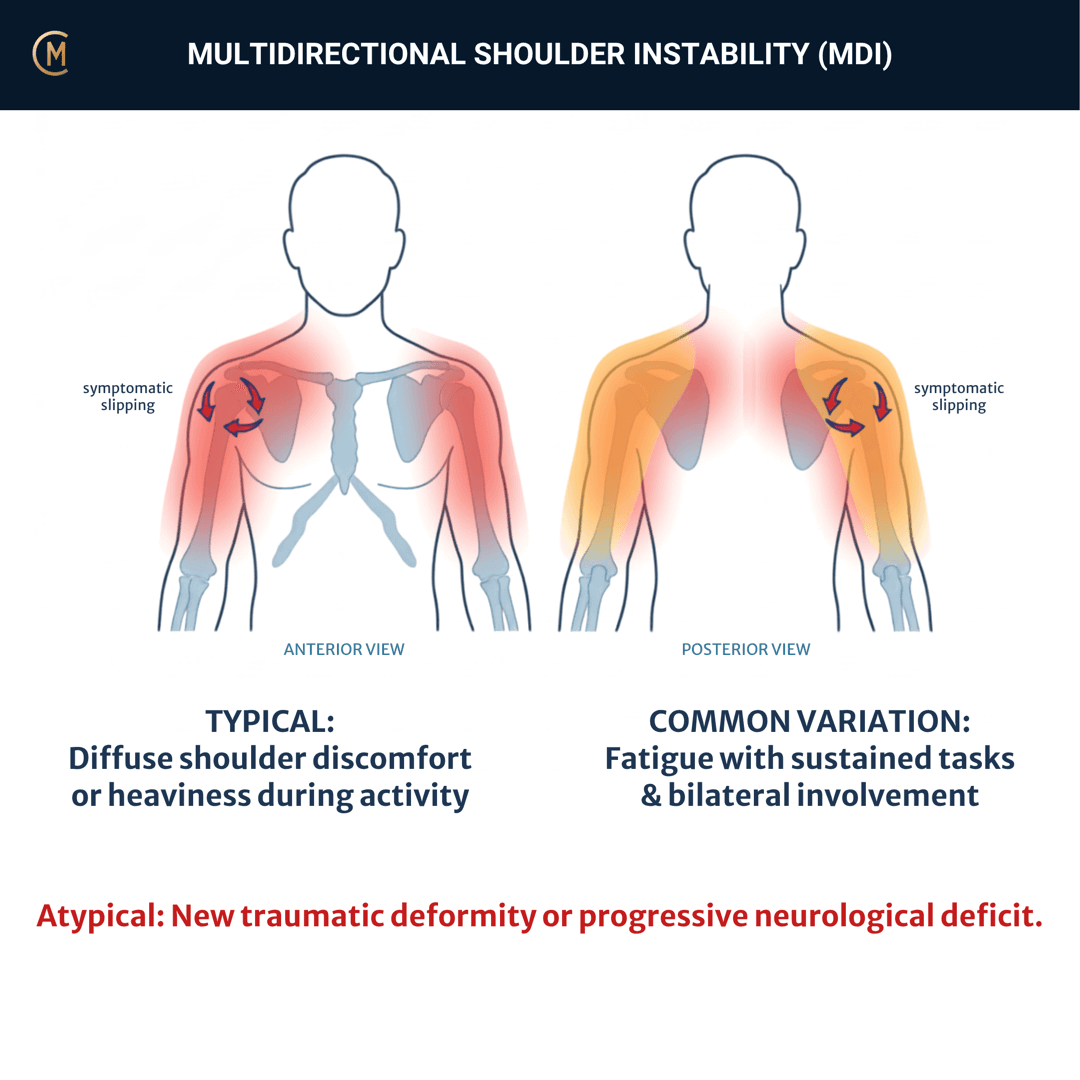
Illness script in one line: a young, often hypermobile person whose shoulder feels loose in more than one direction, with fatigue, slipping or heaviness under low load or overhead, and a long history of poor control rather than one injury.
Caseload frequency: regular, and often already carrying a bag of failed treatments. Read further: patient characteristics, comorbidities and disability in atraumatic shoulder instability [1], a comprehensive review [2].
There is a named programme, and it came out of Australian physiotherapy
A common teaching is "long-term rehab: RC and scapular control, proprioception, closed-chain stability." That's right, and it's also what every student says. The upgrade is that this condition has a published, staged, named programme.
Read further: the Watson MDI rehabilitation programme in two parts [3][4], its effects [5], a randomised comparison of two exercise rehabilitation programmes [6], a systematic review of physiotherapy programmes for atraumatic shoulder instability [7], the role of structured physiotherapy [8].
You are not inventing a programme for this patient. Go and read one.
2 · SE — THE SUBJECTIVE PATTERN (the 70%)
MAIN PROBLEM
"It just feels loose." Or: heavy · tired · like it's going to come out · it slips and goes back.
Note what's absent: a mechanism. A long history of poor control rather than one key injury is the discriminator.
BODY CHART
- Diffuse, hard to localise. They'll wave over the whole shoulder rather than point.
- ± upper trapezius and neck ache from guarding.
- ± paraesthesia with sustained overhead or carrying. Ask about it; see section 4.
- Often bilateral. Ask about the other shoulder specifically — students don't.
BEHAVIOUR
- Aggs: low load, sustained. Carrying a bag, hanging washing, holding a hairdryer, reaching into a cupboard, the end of a session rather than the start.
- Eases: putting the arm down. Support.
- The signature is FATIGUE, not a position. Anterior and posterior instability have a position; MDI has a duration.
- Coding: typically In, low irritability. They rarely have night pain unless they've been treated aggressively.
HISTORY — five questions
- Was there ever an injury? If there's a clear traumatic first event, re-rank towards anterior or posterior instability.
- Both shoulders? Other joints? Knees, elbows, fingers, ankles.
- Can they make it slip on purpose? Ask it plainly and without judgement. See section 4 — this answer changes the management.
- Sport or occupation: swimming, gymnastics, dance, circus, throwing, overhead work. Rehabilitation has been delivered by telehealth to circus arts performers [9].
- What have they been told, what have they tried, and what happened? Many have been through stretching-based or generic programmes that made them worse.
SPECIAL / SCREENING QUESTIONS — and this is where the referral pearl lives
Ask about mood, anxiety, and how much the shoulder is running their life. Psychosocial factors have been reported to play a greater role in preoperative symptoms in atraumatic instability than in traumatic instability, in a multicentre study [10].
The classic pearl — "refer if hypermobility spectrum or anxiety limits progress" — is right, and this moves it from a referral trigger to a first-session assessment domain.
Plus: family history of joint or vascular problems, easy bruising, skin fragility, and any neurological symptoms.
Assessing this region? Download the Shoulder assessment template →
3 · HYPOTHESIS RANKING
Top three, and the one feature that separates each
| Pattern | The discriminating feature |
|---|---|
| 1. Multidirectional instability | Atraumatic, often bilateral, generalised hypermobility, symptoms with SUSTAINED LOW LOAD, loose in more than one direction. |
| 2. Anterior instability | A traumatic event and apprehension in abduction and external rotation. A position, not a duration. |
| 3. Posterior instability | Push-specific symptoms — bench press, blocking. Also a position. MDI commonly has a posterior component; the difference is whether it's only posterior. |
Also on the list
| Pattern | The discriminating feature |
|---|---|
| Rotator cuff–related shoulder pain | Load-related and overhead, no looseness, no hypermobility, older. |
| SLAP lesion | Clicking and catching in a throwing athlete. Coexists. |
| Cervical or thoracic contribution | Hypermobile patients are hypermobile everywhere. Screen the neck. Cross-link the cervical instability page. |
| Muscle-patterning / positional instability | They can demonstrate it. Section 4 — this is managed differently. |
| Hypermobility spectrum disorder or hEDS | Systemic features. Section 4. |
4 · RED FLAGS — DON'T MISS THIS
Free forever. Safety is never behind a paywall.
MDI looks benign — which is exactly why it needs a red-flag layer.
| Finding | What it means |
|---|---|
| A NEW traumatic event on top of known MDI | A structural lesion is now possible. Re-image, re-rank. Don't fold it into the old story. |
| A stuck, painful shoulder after a seizure, electroshock, alcohol-related injury or car crash | Locked posterior dislocation until proven otherwise — the first doctor missed it in the majority of one series. Same-day X-ray, including an axillary view (Hawkins et al. 1987) [21]. |
| Neurological symptoms — paraesthesia, weakness, or symptoms into the hand | Screen the neck and the thoracic outlet. Hypermobile patients are hypermobile at the neck too. |
| Systemic hypermobility features: skin fragility, easy bruising, atrophic scarring, family history of arterial or bowel rupture, joint dislocations at multiple sites | Hypermobility spectrum disorder or Ehlers-Danlos. Medical referral. The vascular type is the one that matters. Paediatric joint hypermobility has a diagnostic framework [11]. |
| Cardiac symptoms, marfanoid habitus, lens or vision problems | Medical referral before you load them. |
| Significant distress, or the shoulder dominating their life out of proportion to the findings | Not a red flag in the danger sense — a management flag. Psychosocial factors have been reported to play a greater role here than in traumatic instability. |
The subgroup that gets missed, and it matters
Ask: "can you make it move like that on purpose?"
A patient who can demonstrate the subluxation on demand, without an obvious structural cause, is a different subgroup — a muscle-patterning or positional presentation. Standard progressive strengthening can reinforce the pattern and make them worse. These patients need movement re-education and, often, psychological co-management — not a heavier programme.
Ask the question plainly and without judgement. Most will show you if you ask. And if the answer is yes, check it with your educator before you prescribe anything.
Any red flag: stop, escalate, and check it with your educator.
5 · OE — THE OBJECTIVE (the 30%)
Members
Sections 5 to 7 are for members
The objective exam, management and pearls, plus the six-minute lesson and the debrief. Free with an account.
Sign in or join free6 · MX — MANAGEMENT ESSENTIALS
Members
Sections 5 to 7 are for members
The objective exam, management and pearls, plus the six-minute lesson and the debrief. Free with an account.
Sign in or join free7 · CLINICAL PEARLS + RETRIEVAL CHECK
Members
Sections 5 to 7 are for members
The objective exam, management and pearls, plus the six-minute lesson and the debrief. Free with an account.
Sign in or join freeMembers
The 4-minute lesson is for members
Twelve slides on this pattern: what you'll hear, what to examine, what to do. Free with an account.
Sign in or join freeGuideline anchor
No Australian guideline — but the closest thing to a protocol for this condition came out of Australian physiotherapy.
More
The treatment anchor is the Watson MDI rehabilitation programme, published in two parts in Shoulder & Elbow (Watson et al. 2016, PMID 27660660; Watson et al. 2017, PMID 28572850) with its effects reported in the Journal of Shoulder and Elbow Surgery (Watson et al. 2018, PMID 28947382) and compared against a second exercise programme in a randomised trial in the American Journal of Sports Medicine (Warby et al. 2018, PMID 29048942). Physiotherapy treatment programmes for atraumatic shoulder instability have been systematically reviewed in Shoulder & Elbow (Griffin et al. 2023, PMID 37538527).
These are published rehabilitation programmes and trials, not a clinical practice guideline. No guideline exists for this condition.
Members
The evidence summary is for members
Verified diagnostic accuracy, where the evidence stands and what it doesn't settle. Free with an account.
Sign in or join freeSources · 20
ShowHide
Every source on this page resolves and title-verifies against PubMed. Newest first.
- 2021Lebe et al. (2021). Atraumatic shoulder instability: patient characteristics, comorbidities, and disability. JSES international, 5(6), 955-959. https://doi.org/10.1016/j.jseint.2021.08.001
- 2026Varathan et al. (2026). Up to date comprehensive review of atraumatic shoulder instability: anatomy, causes, management, and psychosocial considerations. The Journal of sports medicine and physical fitness, 66(8), 941-948. https://doi.org/10.23736/S0022-4707.25.17424-0
- 2016Watson et al. (2016). The treatment of multidirectional instability of the shoulder with a rehabilitation program: Part 1. Shoulder & elbow, 8(4), 271-8. https://doi.org/10.1177/1758573216652086
- 2017Watson et al. (2017). The treatment of multidirectional instability of the shoulder with a rehabilitation programme: Part 2. Shoulder & elbow, 9(1), 46-53. https://doi.org/10.1177/1758573216652087
- 2018Watson et al. (2018). The effects of a conservative rehabilitation program for multidirectional instability of the shoulder. Journal of shoulder and elbow surgery, 27(1), 104-111. https://doi.org/10.1016/j.jse.2017.07.002
- 2018Warby et al. (2018). Comparison of 2 Exercise Rehabilitation Programs for Multidirectional Instability of the Glenohumeral Joint: A Randomized Controlled Trial. The American journal of sports medicine, 46(1), 87-97. https://doi.org/10.1177/0363546517734508
- 2023Griffin et al. (2023). A systematic review to compare physiotherapy treatment programmes for atraumatic shoulder instability. Shoulder & elbow, 15(4), 448-460. https://doi.org/10.1177/17585732221080730
- 2020Scott et al. (2020). The role of structured physiotherapy in treating patients with atraumatic shoulder instability: Medium term results from a case series. Shoulder & elbow, 12(1), 63-70. https://doi.org/10.1177/1758573218825392
- 2022Ganderton et al. (2022). Rehabilitation for atraumatic shoulder instability in circus arts performers: delivery via telehealth. Journal of shoulder and elbow surgery, 31(5), e246-e257. https://doi.org/10.1016/j.jse.2021.10.033
- 2023Nichols et al. (2023). Psychosocial factors play a greater role in preoperative symptoms for patients with atraumatic shoulder instability: data from the MOON-Shoulder Instability group. Journal of shoulder and elbow surgery, 32(3), 533-538. https://doi.org/10.1016/j.jse.2022.08.011
- 2023Tofts et al. (2023). Pediatric joint hypermobility: a diagnostic framework and narrative review. Orphanet journal of rare diseases, 18(1), 104. https://doi.org/10.1186/s13023-023-02717-2
- 2021Malek et al. (2021). The Beighton Score as a measure of generalised joint hypermobility. Rheumatology international, 41(10), 1707-1716. https://doi.org/10.1007/s00296-021-04832-4
- 2021Spanhove et al. (2021). Muscle activity and scapular kinematics in individuals with multidirectional shoulder instability: A systematic review. Annals of physical and rehabilitation medicine, 64(1), 101457. https://doi.org/10.1016/j.rehab.2020.10.008
- 2020Spanhove et al. (2020). The effect of five isometric exercises on glenohumeral translations in healthy subjects and patients with the hypermobility type of the ehlers-danlos syndrome (heds) or hypermobility spectrum disorder (hsd) with multidirectional shoulder instability: an observational study. Physiotherapy, 107, 11-18. https://doi.org/10.1016/j.physio.2019.06.010
- 2025Diep et al. (2025). Imaging modalities for atraumatic shoulder hypermobility: a scoping review. Skeletal radiology, 54(6), 1179-1194. https://doi.org/10.1007/s00256-024-04816-y
- 2021Coulthard et al. (2021). Management of atraumatic shoulder instability in physiotherapy (MASIP): a survey of physiotherapy practice. BMC musculoskeletal disorders, 22(1), 840. https://doi.org/10.1186/s12891-021-04677-9
- 2026Shimizu et al. (2026). Figure-of-Eight Taping Combined with Rehabilitation for Multidirectional Shoulder Instability in a School-Age Female Karate Athlete: A Case Report. International journal of sports physical therapy, 21(7), 693-701. https://doi.org/10.26603/001c.163284
- 2026Dalrymple et al. (2026). Arthroscopic stabilization for atraumatic shoulder instability: minimum two-year outcomes. JSES international, 10(3), 101658. https://doi.org/10.1016/j.jseint.2026.101658
- 2021Mitchell et al. (2021). Clinical Outcomes, Survivorship, and Return to Sport After Arthroscopic Capsular Repair With Suture Anchors for Adolescent Multidirectional Shoulder Instability: Results at 6-Year Follow-up. Orthopaedic journal of sports medicine, 9(2), 2325967121993879. https://doi.org/10.1177/2325967121993879
- 2026Silva et al. (2026). Management of Failed Multidirectional Shoulder Instability Surgery: To Revise or Not to Revise. Journal of pediatric orthopedics, 46(2), e172-e178. https://doi.org/10.1097/BPO.0000000000003102
Mapped to this pattern
Generic measures that also apply
- Borg RPE
Borg Rating of Perceived Exertion Scale (6-20)
perceived exertion · 1 items · 1 min
- GROC
Global Rating of Change Scale
perceived change since baseline · 1 items · 1 min
- NPRS
Numeric Pain Rating Scale
pain intensity · 1 items · 1 min
- PGIC
Patient Global Impression of Change
perceived change since baseline · 1 items · 1 min
- PSFS
Patient-Specific Functional Scale
patient-generated function · 3 items · 2 min
- SANE
Single Assessment Numeric Evaluation
patient-rated function as a percentage of normal · 1 items · 1 min
- VAS
Visual Analogue Scale
pain intensity · 1 items · 1 min
- Borg CR10
Borg Category Ratio 10 Scale
perceived exertion or symptom intensity, ratio scale · 1 items · 1 min
- GAS
Goal Attainment Scaling
individualised goal achievement · 10 min
Did this page do its job?
CliniStudy is in beta. One tap is enough — it decides what gets fixed first.