
1 · SNAPSHOT
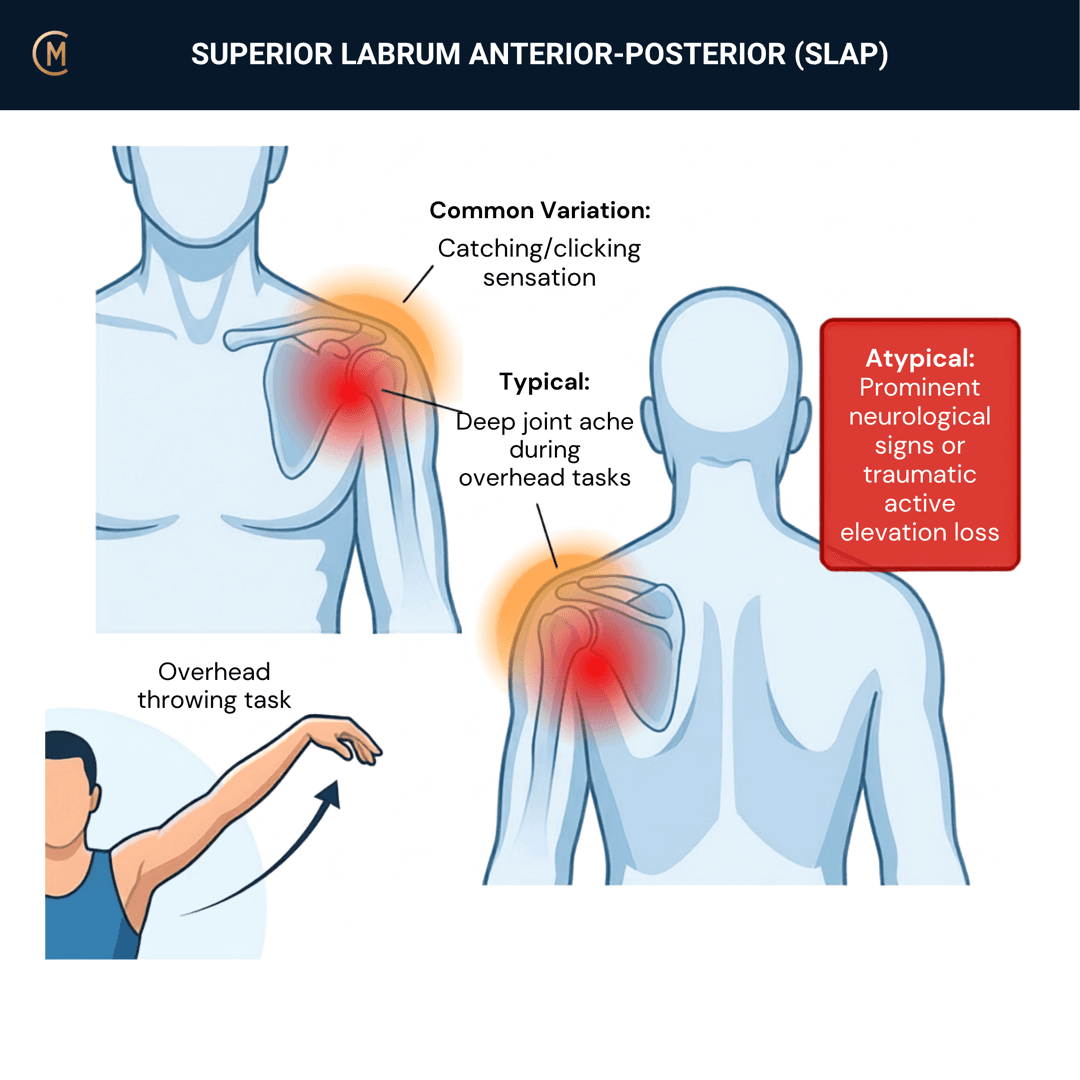
The diagnosis you can't confirm, in the athlete whose scan will show it anyway.
Illness script in one line: deep, poorly localised shoulder pain with clicking or catching in a throwing or overhead athlete, worse with eccentric deceleration and cross-body reach, sometimes after a traction injury or a dislocation.
Caseload frequency: the story is common in throwing and overhead athletes. Read further: shoulder injuries in the overhead-throwing athlete [1].
Two facts that reframe the whole page
1. The special tests don't confirm it. Read further: clinical tests for identifying SLAP lesions [2], which shoulder examination tests provide the most value [3], shoulder physical examination tests [4], current practice for the diagnosis of a SLAP lesion [5]. No verified accuracy figures exist in our library. Even diagnostic arthroscopy has been reported to fail to fully evaluate the biceps-labral complex [6].
2. The scan finds it in people who don't hurt. The prevalence of shoulder MRI abnormalities in asymptomatic professional and collegiate athletes has been examined [7], and the meniscoid superior labrum described as a normal variant that mimics a tear [8].
Labral tears are rarely isolated. Assess the cuff and the capsule. Read that as the whole diagnostic position — you are treating an overhead athlete with a painful shoulder, in whom the labrum is one finding among several.
2 · SE — THE SUBJECTIVE PATTERN (the 70%)
MAIN PROBLEM
"Something's catching in there." Or: it clicks · it clunks · I've lost velocity · it goes dead on release.
In a thrower, ask about PERFORMANCE before pain. Loss of velocity, loss of control, or "dead arm" is often the first complaint and the patient will bury it under "it's a bit sore".
BODY CHART
- Deep. They can't point to it. They'll grip the whole shoulder or reach behind it.
- ± anterior, into the bicipital groove.
- Rarely below the elbow.
BEHAVIOUR
- Aggs: the late cocking and deceleration phases of throwing; overhead lifting; cross-body reach; pulling something towards them with the arm out.
- Eases: stopping throwing. And it often settles between sessions, which is why it runs for a season.
- The signature: it hurts in the same PHASE of the same movement every time, and it clicks.
- Irritability: typically low off the field, higher during a throwing block.
- Severity: VAS 0–10 at best / at worst / right now.
HISTORY — five questions
- A traction injury or a dislocation? It changes the differential towards a concurrent instability lesion.
- Throwing volume, and the trend. Pitch or throw count, sessions per week, the change in the last eight weeks.
- Loss of velocity, accuracy or endurance. Ask it as a performance question, not a pain question.
- Age. In a skeletally immature thrower, think proximal humeral epiphysitis before you think labrum. Cross-link Little Leaguer's shoulder.
- Have they had a scan, and what did it say? See section 1 — a labral finding in a thrower is close to expected.
SPECIAL / SCREENING QUESTIONS
Night pain unrelieved by position, constitutional symptoms, neurological symptoms, and any dislocation history.
Assessing this region? Download the Shoulder assessment template →
3 · HYPOTHESIS RANKING
The pearl is the ranking
Clinical pearl: "Labral tears rarely isolated — assess RC and capsule."
Don't rank this as a single diagnosis. Rank it as a set of findings in a throwing shoulder.
| Pattern | The discriminating feature |
|---|---|
| 1. SLAP / biceps-labral complex | Deep, poorly localised, clicking, worse in deceleration and cross-body reach. Diagnosis and management of the biceps-labral complex are discussed as one thing [9]. |
| 2. Internal impingement / posterior cuff overload | Posterior shoulder pain in late cocking, with GIRD and posterior tightness. Read further: surgical management in overhead athletes [10]. Coexists with SLAP more often than not. |
| 3. Anterior instability, subtle | Apprehension in abduction and external rotation. A SLAP may follow a dislocation. |
Also on the list
| Pattern | The discriminating feature |
|---|---|
| Biceps tendinopathy | Anterior, bicipital groove, resisted elbow flexion and supination. Coexists. Its own page. |
| Rotator cuff–related shoulder pain | Lateral, painful arc, load-related. |
| Posterior instability | Push-specific. |
| Little Leaguer's shoulder | Skeletally immature thrower. Proximal humeral physis, not labrum. Its own page. |
| Suprascapular nerve entrapment | Posterior ache with weak external rotation and wasting. |
4 · RED FLAGS — DON'T MISS THIS
Free forever. Safety is never behind a paywall.
Most of these are "wrong page" flags rather than danger flags — which is the honest shape of this one.
| Finding | What it means |
|---|---|
| A skeletally immature thrower with gradual shoulder pain and lost velocity | Proximal humeral epiphysitis (Little Leaguer's shoulder), not a labral tear. Its own page. Stop throwing. |
| A traumatic dislocation with ongoing symptoms | A concurrent instability lesion. Re-rank to the anterior instability page and get an opinion. |
| Sudden anterior pain with a pop and a visible bulge in the arm | Long head of biceps rupture. Medical review. |
| Any neurological deficit, wasting, or symptoms below the elbow | Screen the neck and the suprascapular nerve. Escalate. |
| An overhead athlete with arm pain, paraesthesia or weakness plus signs of arm ischaemia, or deltoid or teres minor wasting | Quadrilateral space syndrome: the posterior circumflex humeral artery can throw emboli into the arm. Ischaemia is an emergency; wasting needs a medical opinion (Zurkiya 2021) [21]. |
| A suspected clot in the arm of a young, active thrower | Effort thrombosis (Paget-Schroetter) of the subclavian vein, from repetitive arm use. Same-day medical review (Habibollahi et al. 2021) [22]. |
| Night pain unrelieved by position, constitutional symptoms | The general shoulder red flags. Cross-link the Pancoast page. |
| Progressive loss of range without a mechanical explanation | Re-rank and escalate. |
The flag that belongs to this page specifically
A thrower who has been managed for months on the strength of a scan finding, with no change, has usually had the wrong target treated — not the wrong dose. Re-rank before you re-load.
Any red flag: stop, escalate, and check it with your educator.
5 · OE — THE OBJECTIVE (the 30%)
Members
Sections 5 to 7 are for members
The objective exam, management and pearls, plus the six-minute lesson and the debrief. Free with an account.
Sign in or join free6 · MX — MANAGEMENT ESSENTIALS
Members
Sections 5 to 7 are for members
The objective exam, management and pearls, plus the six-minute lesson and the debrief. Free with an account.
Sign in or join free7 · CLINICAL PEARLS + RETRIEVAL CHECK
Members
Sections 5 to 7 are for members
The objective exam, management and pearls, plus the six-minute lesson and the debrief. Free with an account.
Sign in or join freeMembers
The 5-minute lesson is for members
Twelve slides on this pattern: what you'll hear, what to examine, what to do. Free with an account.
Sign in or join freeGuideline anchor
No Australian guideline, and no guideline anywhere — the surgeons don't agree either.
More
Current practice for the diagnosis of a SLAP lesion has been systematically reviewed alongside a physician survey (Kibler et al. 2015, PMID 26321113). The diagnostic-test anchors are a meta-analysis of clinical tests for identifying SLAP lesions in Physical Therapy in Sport (Walton et al. 2008, PMID 19083717), the BJSM review of which shoulder examination tests provide the most value (Hegedus et al. 2012, PMID 22773322) and a systematic review with meta-analysis of shoulder physical examination tests (Gismervik et al. 2017, PMID 28122541). The non-operative anchor is a review of non-operative treatment of the biceps-labral complex (Sudah et al. 2023, PMID 37003658), with a science-based approach to preventing shoulder injuries in overhead athletes in the Brazilian Journal of Physical Therapy (Cools et al. 2015, PMID 26537804).
There is no clinical practice guideline for SLAP lesions. The systematic review of current diagnostic practice includes a physician survey precisely because practice varies.
Members
The evidence summary is for members
Verified diagnostic accuracy, where the evidence stands and what it doesn't settle. Free with an account.
Sign in or join freeSources · 20
ShowHide
Every source on this page resolves and title-verifies against PubMed. Newest first.
- 2018Lin et al. (2018). Shoulder Injuries in the Overhead-Throwing Athlete: Epidemiology, Mechanisms of Injury, and Imaging Findings. Radiology, 286(2), 370-387. https://doi.org/10.1148/radiol.2017170481
- 2008Walton & Sadi (2008). Identifying SLAP lesions: a meta-analysis of clinical tests and exercise in clinical reasoning. Physical therapy in sport : official journal of the Association of Chartered Physiotherapists in Sports Medicine, 9(4), 167-76. https://doi.org/10.1016/j.ptsp.2008.07.001
- 2012Hegedus et al. (2012). Which physical examination tests provide clinicians with the most value when examining the shoulder? Update of a systematic review with meta-analysis of individual tests. British journal of sports medicine, 46(14), 964-78. https://doi.org/10.1136/bjsports-2012-091066
- 2017Gismervik et al. (2017). Physical examination tests of the shoulder: a systematic review and meta-analysis of diagnostic test performance. BMC musculoskeletal disorders, 18(1), 41. https://doi.org/10.1186/s12891-017-1400-0
- 2015Kibler & Sciascia (2015). Current Practice for the Diagnosis of a SLAP Lesion: Systematic Review and Physician Survey. Arthroscopy : the journal of arthroscopic & related surgery : official publication of the Arthroscopy Association of North America and the International Arthroscopy Association, 31(12), 2456-69. https://doi.org/10.1016/j.arthro.2015.06.033
- 2015Taylor et al. (2015). Diagnostic glenohumeral arthroscopy fails to fully evaluate the biceps-labral complex. Arthroscopy : the journal of arthroscopic & related surgery : official publication of the Arthroscopy Association of North America and the International Arthroscopy Association, 31(2), 215-24. https://doi.org/10.1016/j.arthro.2014.10.017
- 2019Hacken et al. (2019). Prevalence of MRI Shoulder Abnormalities in Asymptomatic Professional and Collegiate Ice Hockey Athletes. Orthopaedic journal of sports medicine, 7(10), 2325967119876865. https://doi.org/10.1177/2325967119876865
- 2016Simão et al. (2016). Magnetic resonance imaging evaluation of meniscoid superior labrum: normal variant or superior labral tear. Radiologia brasileira, 49(4), 220-224. https://doi.org/10.1590/0100-3984.2015.0083
- 2017Thorsness & Romeo (2017). Diagnosis and Management of the Biceps-Labral Complex. Instructional course lectures, 66, 65-77. PubMed 28594489
- 2026Challoumas et al. (2026). Surgical management of internal impingement in overhead athletes: a systematic review. Clinics in shoulder and elbow, 29(1), 115-133. https://doi.org/10.5397/cise.2025.01123
- 2018Keller et al. (2018). Glenohumeral Internal Rotation Deficit and Risk of Upper Extremity Injury in Overhead Athletes: A Meta-Analysis and Systematic Review. Sports health, 10(2), 125-132. https://doi.org/10.1177/1941738118756577
- 2025Minhaj et al. (2025). Glenohumeral Internal Rotation Deficit and Risk of Upper Extremity Injury in Overhead Athletes: Systematic Review. Archives of physical medicine and rehabilitation, 106(1), 91-97. https://doi.org/10.1016/j.apmr.2024.05.027
- 2023Sudah et al. (2023). Nonoperative Treatment of the Biceps-Labral Complex. Physical medicine and rehabilitation clinics of North America, 34(2), 365-375. https://doi.org/10.1016/j.pmr.2022.12.004
- 2018Hashiguchi et al. (2018). Factors influencing outcomes of nonsurgical treatment for baseball players with SLAP lesion. Asia-Pacific journal of sports medicine, arthroscopy, rehabilitation and technology, 14, 6-9. https://doi.org/10.1016/j.asmart.2018.08.001
- 2015Cools et al. (2015). Prevention of shoulder injuries in overhead athletes: a science-based approach. Brazilian journal of physical therapy, 19(5), 331-9. https://doi.org/10.1590/bjpt-rbf.2014.0109
- 2025Rowe et al. (2025). Return to Play After Arthroscopic Superior Labral Repair: A Systematic Review. The American journal of sports medicine, 53(3), 727-733. https://doi.org/10.1177/03635465241246122
- 2022DeFroda et al. (2022). Moderate Return to Play and Previous Performance After SLAP Repairs in Competitive Overhead Athletes: A Systematic Review. Arthroscopy : the journal of arthroscopic & related surgery : official publication of the Arthroscopy Association of North America and the International Arthroscopy Association, 38(10), 2909-2918. https://doi.org/10.1016/j.arthro.2022.03.026
- 2019Thayaparan et al. (2019). Return to Sport After Arthroscopic Superior Labral Anterior-Posterior Repair: A Systematic Review. Sports health, 11(6), 520-527. https://doi.org/10.1177/1941738119873892
- 2022Shin et al. (2022). Biceps Tenodesis Versus Superior Labral Anterior and Posterior (SLAP) Lesion Repair for the Treatment of SLAP Lesion in Overhead Athletes: A Systematic Review and Meta-analysis. The American journal of sports medicine, 50(14), 3987-3997. https://doi.org/10.1177/03635465211039822
- 2022Feldman (2022). Editorial Commentary: Indications for Shoulder SLAP Lesion Repair Versus Biceps Tenodesis Depend on Patient Age, Tear Type and Location, and Quality of Tissue. Arthroscopy : the journal of arthroscopic & related surgery : official publication of the Arthroscopy Association of North America and the International Arthroscopy Association, 38(6), 1810-1811. https://doi.org/10.1016/j.arthro.2022.01.031
Mapped to this pattern
Generic measures that also apply
- Borg RPE
Borg Rating of Perceived Exertion Scale (6-20)
perceived exertion · 1 items · 1 min
- GROC
Global Rating of Change Scale
perceived change since baseline · 1 items · 1 min
- NPRS
Numeric Pain Rating Scale
pain intensity · 1 items · 1 min
- PGIC
Patient Global Impression of Change
perceived change since baseline · 1 items · 1 min
- PSFS
Patient-Specific Functional Scale
patient-generated function · 3 items · 2 min
- SANE
Single Assessment Numeric Evaluation
patient-rated function as a percentage of normal · 1 items · 1 min
- VAS
Visual Analogue Scale
pain intensity · 1 items · 1 min
- Borg CR10
Borg Category Ratio 10 Scale
perceived exertion or symptom intensity, ratio scale · 1 items · 1 min
- GAS
Goal Attainment Scaling
individualised goal achievement · 10 min
Did this page do its job?
CliniStudy is in beta. One tap is enough — it decides what gets fixed first.