
1 · SNAPSHOT
Who: Active 10–15 year olds, through the growth spurt. Jumping and running sports.
What: Traction overload at the tibial tuberosity apophysis.
How it behaves: Gradual, focal anterior knee pain. Worse with jumping, running, squatting, kneeling. A "lump" below the kneecap. Relieved by rest.
The one thing to take from this page:
The diagnosis takes ten seconds — one finger on the tuberosity. What takes skill is not promising a family it's benign and self-limiting, because for some adolescents it isn't.
Three lumps, three pages
| Where your finger lands | The pattern |
|---|---|
| Tibial tuberosity | Osgood-Schlatter — this page |
| Inferior pole of patella | Sinding-Larsen-Johansson — same age, same sports |
| Mid-tendon, skeletally mature | Patellar tendinopathy |
⚠️ No Australian guideline exists, and the conservative treatment evidence is described as limited and heterogeneous in two systematic reviews. The management model here is a well-supported clinical structure, not a trial-backed protocol.
2 · SE — THE SUBJECTIVE PATTERN (the 70%)
Five stages, in your course's order. You will have the diagnosis in the first thirty seconds. Spend the rest of the subjective on the load, the growth, and what the family already believes.
MAIN PROBLEM
"I've got a lump under my kneecap and it hurts when I run."
"He's been limping after footy."
"She can't kneel."
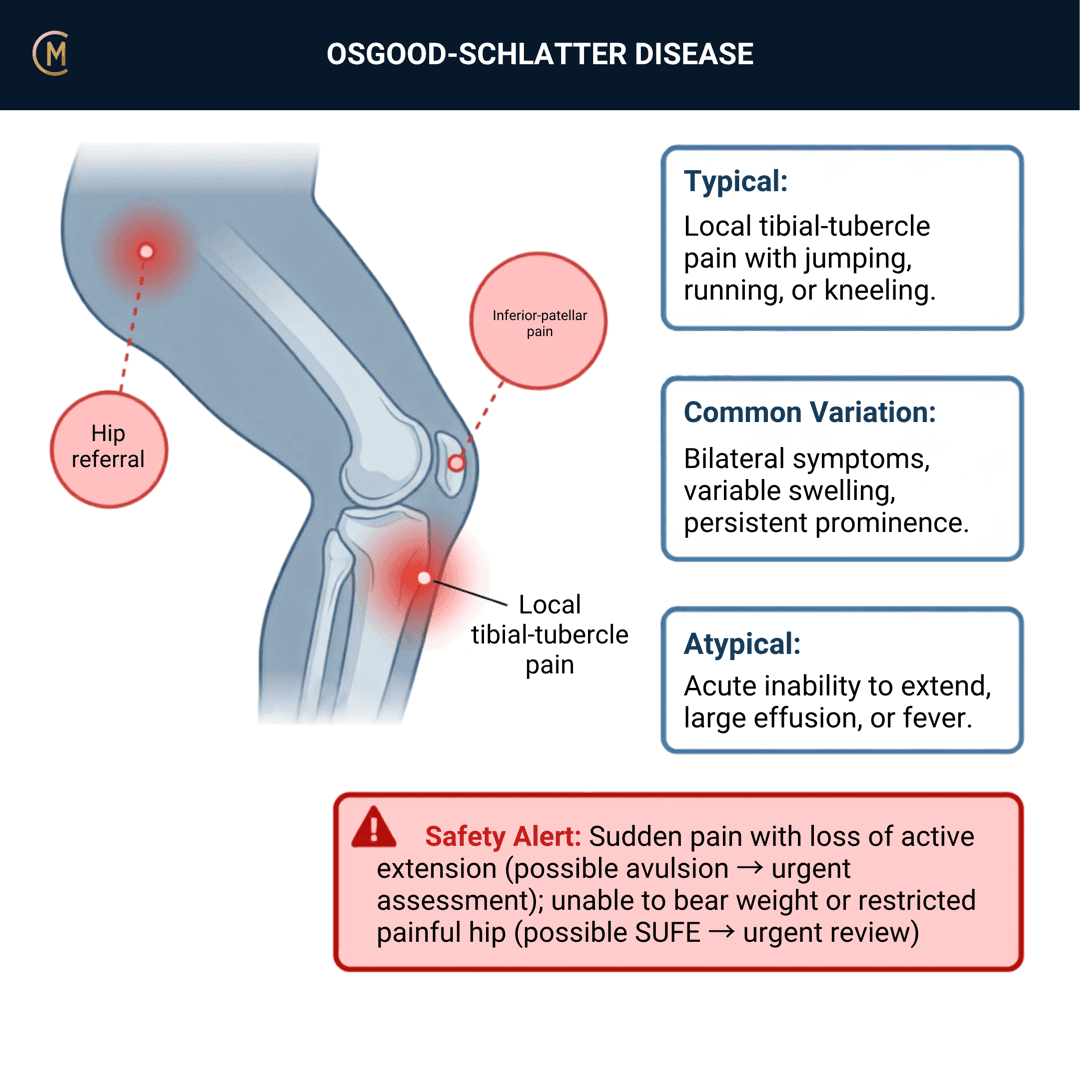
BODY CHART
Chart interpretation: The main distribution is the tibial tubercle. Inferior-patellar pain and hip referral are alternative explanations, not part of the typical tibial-tubercle distribution. Suspected SUFE requires urgent orthopaedic assessment and non-weight-bearing.
- One finger, on the tibial tuberosity. If they can't localise it that precisely, reconsider.
- Mark the inferior pole separately — that is Sinding-Larsen-Johansson.
- Diffuse peri-patellar? That is patellofemoral pain.
- Bilateral is common and does not change the reasoning.
BEHAVIOUR
| Fits OSD | Points elsewhere | |
|---|---|---|
| Aggs | Jumping, running, squatting, kneeling, stairs | Prolonged sitting, diffuse ache → PFP |
| Eases | Rest, ice, offloading | Nothing eases it → screen |
| Severity | VAS 0–10 at best / at worst / right now | — |
| Onset | Gradual, tracks a load or growth spike | Acute, after a jump, can't extend → tubercle avulsion |
| Night | Sore after activity | Night pain, rest pain → screen |
| Swelling | Local prominence at the tuberosity | Joint effusion → intra-articular, different page |
HISTORY — load and growth together
- What changed? Season start, a carnival, a new sport, two teams.
- Has he grown recently? Ask the parent. Developmental stage is a prospective risk factor [1].
- How many sessions, how many sports, how many teams.
- What have they already been told, and what have they already stopped doing? Boom-bust rest cycles are common by the time you see them.
SPECIAL / SCREENING QUESTIONS
- Night pain, rest pain, fever, feeling unwell, weight loss? This is an adolescent with bone pain. Ask it every time.
- Any locking, giving way, or true effusion?
- Did it start with a single event?
- How is this affecting them beyond sport? Adolescents with longstanding knee pain report reduced quality of life [2] — and nobody asks.
Assessing this region? Download the Knee assessment template →
3 · HYPOTHESIS RANKING
| Competing pattern | The one discriminating feature |
|---|---|
| Sinding-Larsen-Johansson syndrome | Same age, same sports — but tenderness at the inferior patellar pole, not the tuberosity. |
| Patellar tendinopathy | Skeletally mature, tender inferior pole or mid-tendon, positive decline squat. |
| Patellofemoral pain | Diffuse peri-patellar pain with stairs and prolonged sitting rather than a focal tender lump. |
| Referred hip pathology | Always screen the hip in an adolescent with knee pain. SUFE and Perthes present as knee pain. |
The two that outrank the table
Tibial tubercle avulsion fracture. Acute onset during a jump, inability to extend, marked swelling. Different mechanism, different urgency, image it.
Bone tumour or infection. Night pain, rest pain, systemic symptoms. Rare, and the reason the screening questions are not optional in an adolescent with bone pain.
And the association worth knowing about
Risk is multifactorial — growth and maturation, sport load, flexibility, strength, morphology and mechanics all interact [3], with biomechanical alterations described in landing, shock absorption and lower-limb control [4] and a patellar alignment association reported [5]. None of that is a reason to image a routine case. It is a reason to look at how they land.
4 · RED FLAGS — DON'T MISS THIS
This section is free, on every pattern, forever. Safety is never gated.
| Finding | What it suggests | What you do |
|---|---|---|
| Night pain or pain at rest | Bone tumour, infection | Image. Medical review |
| Fever, unwell, weight loss | Infection, systemic disease | Medical review, same day |
| Hot, swollen, exquisitely painful knee | Septic arthritis | Emergency |
| Acute onset during a jump, can't extend — a history of OSD is a predisposing factor, not reassurance (Yao et al. 2025) [21] | Tibial tubercle avulsion fracture | Image. Orthopaedic review. Check the leg for compartment syndrome, present in 3.57% of these fractures (Pretell-Mazzini et al. 2016) [22] |
| True joint effusion | Intra-articular pathology | Reassess — this isn't apophysitis |
| Locking or true giving way | Intra-articular pathology | Reassess |
| Limp with hip or groin pain | SUFE, Perthes | Suspected SUFE: urgent orthopaedic assessment; keep non-weight-bearing |
| Pain not at the tuberosity | Wrong diagnosis | Re-examine |
The rule: focal tuberosity pain that tracks load, in a growing adolescent with a clean systemic screen and no effusion, is yours. Anything intra-articular, systemic, nocturnal or acutely traumatic is not.
Cross-links: Sinding-Larsen-Johansson syndrome · Patellofemoral pain · Sever's disease
5 · OE — THE OBJECTIVE (the 30%)
Members
Sections 5 to 7 are for members
The objective exam, management and pearls, plus the six-minute lesson and the debrief. Free with an account.
Sign in or join free6 · MX — MANAGEMENT ESSENTIALS
Members
Sections 5 to 7 are for members
The objective exam, management and pearls, plus the six-minute lesson and the debrief. Free with an account.
Sign in or join free7 · CLINICAL PEARLS + RETRIEVAL CHECK
Members
Sections 5 to 7 are for members
The objective exam, management and pearls, plus the six-minute lesson and the debrief. Free with an account.
Sign in or join freeMembers
The 4-minute lesson is for members
Twelve slides on this pattern: what you'll hear, what to examine, what to do. Free with an account.
Sign in or join freeGuideline anchor
No Australian guideline covers Osgood-Schlatter disease.
More
Anchored to the prospective cohort of education, activity modification and progressive strengthening (Rathleff et al. 2020, PMID 32284945) for the management model; to the 24-month prognostic cohort (Holden et al. 2021, PMID 34435066) for what you tell the family; and to the 2026 treatment systematic review (Ndjonko et al. 2026, PMID 41788553) for where the evidence currently sits.
None of these is an Australian document and none is a guideline. The treatment evidence is explicitly described as limited and heterogeneous in two systematic reviews, so the management model on this page is a well-supported clinical structure rather than a trial-backed protocol.
Members
The evidence summary is for members
Verified diagnostic accuracy, where the evidence stands and what it doesn't settle. Free with an account.
Sign in or join freeSources · 20
ShowHide
Every source on this page resolves and title-verifies against PubMed. Newest first.
- 2023Takei et al. (2023). Developmental stage and lower quadriceps flexibilities and decreased gastrocnemius flexibilities are predictive risk factors for developing Osgood-Schlatter disease in adolescent male soccer players. Knee surgery, sports traumatology, arthroscopy : official journal of the ESSKA, 31(8), 3330-3338. https://doi.org/10.1007/s00167-023-07378-z
- 2023Djurtoft et al. (2023). Quality of life in adolescents with longstanding non-traumatic knee pain: An analysis of 316 adolescents with Patellofemoral Pain and Osgood-Schlatter Disease. Physical therapy in sport : official journal of the Association of Chartered Physiotherapists in Sports Medicine, 61, 156-164. https://doi.org/10.1016/j.ptsp.2023.04.001
- 2022Lucenti et al. (2022). The Etiology and Risk Factors of Osgood-Schlatter Disease: A Systematic Review. Children (Basel, Switzerland), 9(6). https://doi.org/10.3390/children9060826
- 2025Rodrigues et al. (2025). Biomechanical alterations in Osgood-Schlatter disease: a systematic review. Research in sports medicine (Print), 33(3), 352-367. https://doi.org/10.1080/15438627.2025.2467400
- 2026Huibao et al. (2026). The association between patellar malalignment and Osgood-Schlatter disease in children. Frontiers in pediatrics, 14, 1753322. https://doi.org/10.3389/fped.2026.1753322
- 2020Ladenhauf et al. (2020). Osgood-Schlatter disease: a 2020 update of a common knee condition in children. Current opinion in pediatrics, 32(1), 107-112. https://doi.org/10.1097/MOP.0000000000000842
- 2022Corbi et al. (2022). Osgood-Schlatter Disease: Appearance, Diagnosis and Treatment: A Narrative Review. Healthcare (Basel, Switzerland), 10(6). https://doi.org/10.3390/healthcare10061011
- 2024Holden et al. (2024). Understanding the Interactions Between Loading, Pain Dynamics, and Imaging Characteristics for Osgood Schlatter: A Cross-Sectional Study. Scandinavian journal of medicine & science in sports, 34(9), e14729. https://doi.org/10.1111/sms.14729
- 2024Sørensen et al. (2024). A comprehensive MRI investigation to identify potential biomarkers of Osgood Schlatter disease in adolescents: A cross sectional study comparing Osgood Schlatter disease with controls. Scandinavian journal of medicine & science in sports, 34(5), e14634. https://doi.org/10.1111/sms.14634
- 2025Dinescu et al. (2025). Tibial tuberosity maturation assessment by ultrasonography and screening for Osgood-Schlatter disease in male and female children and adolescent athletes: a cross-sectional study. Research in sports medicine (Print), 33(4), 512-524. https://doi.org/10.1080/15438627.2025.2479154
- 2020Rathleff et al. (2020). Activity Modification and Knee Strengthening for Osgood-Schlatter Disease: A Prospective Cohort Study. Orthopaedic journal of sports medicine, 8(4), 2325967120911106. https://doi.org/10.1177/2325967120911106
- 2024Rathleff et al. (2024). Association of Self-Reported Improvement After 4 Weeks and Outcomes After 52 Weeks Among Adolescents With Patellofemoral Pain and Osgood-Schlatter Disease. Orthopaedic journal of sports medicine, 12(10), 23259671241280581. https://doi.org/10.1177/23259671241280581
- 2021Holden et al. (2021). Is the Prognosis of Osgood-Schlatter Poorer Than Anticipated? A Prospective Cohort Study With 24-Month Follow-up. Orthopaedic journal of sports medicine, 9(8), 23259671211022239. https://doi.org/10.1177/23259671211022239
- 2022Gaulrapp & Nührenbörger (2022). The Osgood-Schlatter disease: a large clinical series with evaluation of risk factors, natural course, and outcomes. International orthopaedics, 46(2), 197-204. https://doi.org/10.1007/s00264-021-05178-z
- 2025Krommes et al. (2025). Long-Term Knee Health in Adults with a History of Adolescent Osgood-Schlatter: A National Cohort Study of Patients in Secondary Care in Denmark 1977-2020. Sports medicine (Auckland, N.Z.), 55(7), 1769-1781. https://doi.org/10.1007/s40279-025-02214-5
- 2022van Leeuwen et al. (2022). Incidence and management of Osgood-Schlatter disease in general practice: retrospective cohort study. The British journal of general practice : the journal of the Royal College of General Practitioners, 72(717), e301-e306. https://doi.org/10.3399/BJGP.2021.0386
- 2021Neuhaus et al. (2021). A systematic review on conservative treatment options for OSGOOD-Schlatter disease. Physical therapy in sport : official journal of the Association of Chartered Physiotherapists in Sports Medicine, 49, 178-187. https://doi.org/10.1016/j.ptsp.2021.03.002
- 2026Ndjonko et al. (2026). Treatments for Osgood Schlatter Disease: A Systematic Review of the Literature. Orthopaedic journal of sports medicine, 14(3), 23259671251387354. https://doi.org/10.1177/23259671251387354
- 2020Bezuglov et al. (2020). Conservative treatment of Osgood-Schlatter disease among young professional soccer players. International orthopaedics, 44(9), 1737-1743. https://doi.org/10.1007/s00264-020-04572-3
- 2024Chandra et al. (2024). Diagnosis and Management of Osgood Schlatter Disease. Orthopedic reviews, 16, 121395. https://doi.org/10.52965/001c.121395
Mapped to this pattern
Generic measures that also apply
- Borg RPE
Borg Rating of Perceived Exertion Scale (6-20)
perceived exertion · 1 items · 1 min
- GROC
Global Rating of Change Scale
perceived change since baseline · 1 items · 1 min
- NPRS
Numeric Pain Rating Scale
pain intensity · 1 items · 1 min
- PGIC
Patient Global Impression of Change
perceived change since baseline · 1 items · 1 min
- PSFS
Patient-Specific Functional Scale
patient-generated function · 3 items · 2 min
- SANE
Single Assessment Numeric Evaluation
patient-rated function as a percentage of normal · 1 items · 1 min
- VAS
Visual Analogue Scale
pain intensity · 1 items · 1 min
- Borg CR10
Borg Category Ratio 10 Scale
perceived exertion or symptom intensity, ratio scale · 1 items · 1 min
- GAS
Goal Attainment Scaling
individualised goal achievement · 10 min
Did this page do its job?
CliniStudy is in beta. One tap is enough — it decides what gets fixed first.