
1 · SNAPSHOT
The placement caseload where doing less than you want to is the skill.
Illness script in one line: a patient a few weeks out from shoulder surgery, sore, stiff, sleeping badly, frightened of the arm, and holding a piece of paper you didn't write.
Caseload frequency: high on any outpatient MSK placement, and rising with arthroplasty volume.
"The protocol" is not a thing
A common management line is "adhere strictly to surgical timelines and protocols." That's right. The problem is that the protocols disagree with each other.
Publicly available anatomic total shoulder arthroplasty rehabilitation protocols have been shown to have high variability [1], and rotator cuff repair rehabilitation considerations and their respective guidelines reviewed narratively [2].
And the fix happens to be the title of a paper: surgeon–therapist communication must be improved in rotator cuff repair rehabilitation [3].
There is no "the protocol". There is only this surgeon's, for this repair, on this patient. Get it in writing, and if you can't, ring them.
2 · SE — THE SUBJECTIVE PATTERN
MAIN PROBLEM
"They said to come and see you." Often that's the whole brief.
The first question is not about pain
"Time since surgery critical for load tolerance." Make it the first question and build the session around the answer.
Then get the rest — and if the patient doesn't know, the operation note does:
| Ask | Why it changes what you do |
|---|---|
| What exactly was done? | Cuff repair, stabilisation, decompression, labral repair, anatomic or reverse arthroplasty — completely different pages. |
| How big was the tear, and what was the tissue like? | Drives the surgeon's caution on early motion. |
| Anything else done at the same time? | Biceps tenodesis, subscapularis takedown, remplissage — each adds its own restriction. |
| Sling: what type, how long, and when do they come out of it? | Sling has been compared with brace immobilisation after arthroscopic cuff repair [4]. |
| When passive, when active-assisted, when active, when resisted? | The four gates. Get all four. |
| Any specific restrictions? | Especially for stabilisation and reverse arthroplasty. |
BODY CHART, BEHAVIOUR, HISTORY
- Surgical site, deltoid, and often the neck and scapular region from guarding.
- Night pain and sleep disturbance are near-universal early. Ask about it and address it — it's often the thing they most want fixed.
- Aggs: coming out of the sling, dressing, rolling in bed, the arm hanging unsupported.
- Eases: support, the sling, propped sleeping.
- Severity: VAS 0–10 at best / at worst / right now.
SPECIAL / SCREENING QUESTIONS — post-op ones
Fever, wound discharge, spreading redness, increasing rather than settling pain, calf pain or swelling, breathlessness, and any new numbness or weakness. Section 4.
And the one that gets flagged but not measured
"Fear or hesitation to move arm." Kinesiophobia has been reported to affect shoulder function after repair of a rotator cuff tear [5] and its relationship with return to sport after shoulder surgery examined [6]. Read further: patient experience of rehabilitation after cuff repair [7]. Screen it. Don't just note it.
Assessing this region? Download the Shoulder assessment template →
3 · HYPOTHESIS RANKING
The diagnosis is on the operation note. Your ranking is: is this normal for the phase?
| Question | What you're deciding |
|---|---|
| 1. Is this a normal post-operative course? | Pain settling week on week, range returning within the protocol, sleep improving, no systemic features. Patient education on the normal phases of recovery is the treatment for most of this. |
| 2. Is this stiffness that needs addressing, or protection that needs respecting? | The central judgement on this page, and it is not yours alone to make. See section 6. |
| 3. Is something wrong? | Re-tear, infection, stress fracture, neurological or thromboembolic complication. Section 4. |
Then, the phase-specific patterns
| Phase | What you're seeing |
|---|---|
| Weeks 0–6 | Pain, swelling, sleep disturbance, muscle inhibition, guarding. |
| Weeks 6–12 | Stiffness declaring itself, or motion returning. Muscle inhibition persisting. |
| Months 3–6 | Strength deficits, scapular dyskinesis, and fear. |
| Months 6–12 | Return to work and sport decisions. Criteria, not the calendar. Section 6. |
4 · RED FLAGS — DON'T MISS THIS
Free forever. Safety is never behind a paywall.
A post-operative caseload has its own red flags, and a student will meet them.
| Finding | What it means |
|---|---|
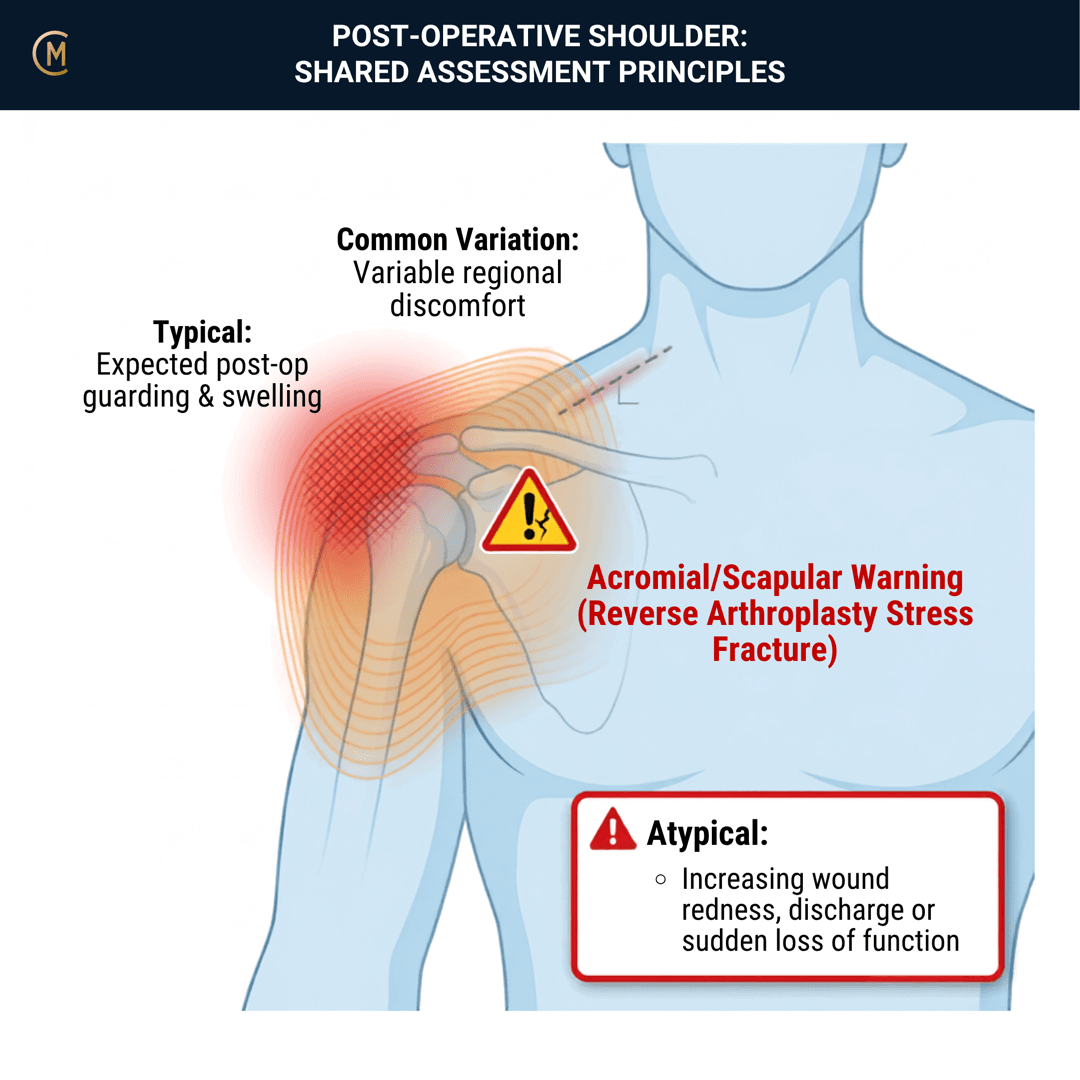
| Fever, wound discharge, spreading redness, increasing rather than settling pain | INFECTION. Same-day surgical review. Do not treat. |
| Pain and stiffness that won't settle after surgery, even with no fever or wound signs | Possible low-grade infection. P. acnes grew in 23.5% of revision arthroscopies done for pain, stiffness or weakness (Horneff et al. 2015) [21]. Tell the surgeon before you read it as stiffness to push through. |
| A sudden loss of ACTIVE elevation after a period of improvement, with passive range preserved | RE-TEAR. Stop, don't push, contact the surgeon. |
| Calf pain or swelling, breathlessness, chest pain | VTE. EMERGENCY. |
| New numbness, weakness or sensory change in the arm or hand | Neurological. Escalate. |
| New pain over the acromion or the scapular spine after a REVERSE total shoulder arthroplasty, with loss of function | ACROMIAL OR SCAPULAR STRESS FRACTURE. Read further: predictors [8]. Escalate. |
| A sudden change in the shape or function of an arthroplasty, especially with the arm in extension, adduction and internal rotation | Dislocation. Urgent. |
| Pain that is worse each week rather than better, at any stage | Escalate. The trajectory is the finding. |
The rule
In the first twelve weeks, the question is never "how do I push through this?" It's "does the surgeon know?"
Any red flag: stop, escalate, and check it with your educator.
5 · OE — THE OBJECTIVE
Members
Sections 5 to 7 are for members
The objective exam, management and pearls, plus the six-minute lesson and the debrief. Free with an account.
Sign in or join free6 · MX — MANAGEMENT ESSENTIALS
Members
Sections 5 to 7 are for members
The objective exam, management and pearls, plus the six-minute lesson and the debrief. Free with an account.
Sign in or join free7 · CLINICAL PEARLS + RETRIEVAL CHECK
Members
Sections 5 to 7 are for members
The objective exam, management and pearls, plus the six-minute lesson and the debrief. Free with an account.
Sign in or join freeMembers
The 4-minute lesson is for members
Twelve slides on this pattern: what you'll hear, what to examine, what to do. Free with an account.
Sign in or join freeGuideline anchor
No Australian guideline, and — more usefully — no single protocol either.
More
Publicly available anatomic total shoulder arthroplasty rehabilitation protocols have been shown to have high variability (Mehta et al. 2024, PMID 38966826) and rotator cuff repair rehabilitation considerations and their respective guidelines reviewed narratively (Ezell et al. 2021, PMID 37588949). The communication anchor is a study finding that surgeon–therapist communication must be improved in rotator cuff repair rehabilitation (Schultzel et al. 2021, PMID 33970072). The early-motion anchors are a systematic review of conservative versus accelerated rehabilitation after rotator cuff repair (Longo et al. 2021, PMID 34303366) and studies of early versus delayed mobilisation (Hu et al. 2023, PMID 38049792; Chang et al. 2015, PMID 25143489).
There is no clinical practice guideline for post-operative shoulder rehabilitation. The papers anchoring this page document how much protocols vary — which is the point.
Members
The evidence summary is for members
Verified diagnostic accuracy, where the evidence stands and what it doesn't settle. Free with an account.
Sign in or join freeSources · 20
ShowHide
Every source on this page resolves and title-verifies against PubMed. Newest first.
- 2024Mehta et al. (2024). Publicly Available Anatomic Total Shoulder Arthroplasty Rehabilitation Protocols Show High Variability and Frequent Divergence from the 2020 ASSET Recommendations. International journal of sports physical therapy, 19(7), 856-867. https://doi.org/10.26603/001c.118926
- 2021Ezell & Malcarney (2021). Rotator cuff repair rehabilitation considerations and respective guidelines: a narrative review. JSES reviews, reports, and techniques, 1(3), 179-185. https://doi.org/10.1016/j.xrrt.2021.04.009
- 2021Schultzel et al. (2021). Surgeon-Therapist Communication Must Be Improved in Rotator Cuff Repair Rehabilitation: An Electronic Survey of Physical Therapists on Postoperative Rehabilitation Protocols and Communication with Treating Surgeons. The Permanente journal, 25. https://doi.org/10.7812/TPP/20.088
- 2025Schönweger et al. (2025). Sling Is Not Inferior to Brace Immobilization After Arthroscopic Rotator Cuff Repair: A Randomized Controlled Trial. Arthroscopy : the journal of arthroscopic & related surgery : official publication of the Arthroscopy Association of North America and the International Arthroscopy Association, 41(7), 2283-2293. https://doi.org/10.1016/j.arthro.2024.12.023
- 2022Wang et al. (2022). Kinesiophobia could affect shoulder function after repair of rotator cuff tears. BMC musculoskeletal disorders, 23(1), 714. https://doi.org/10.1186/s12891-022-05679-x
- 2019Vascellari et al. (2019). The Relationship between Kinesiophobia and Return to Sport after Shoulder Surgery for Recurrent Anterior Instability. Joints, 7(4), 148-154. https://doi.org/10.1055/s-0041-1730975
- 2021Stephens et al. (2021). Rehabilitation following rotator cuff repair: A nested qualitative study exploring the perceptions and experiences of participants in a randomised controlled trial. Clinical rehabilitation, 35(6), 911-919. https://doi.org/10.1177/0269215520984025
- 2021Mahendraraj et al. (2021). Predictors of acromial and scapular stress fracture after reverse shoulder arthroplasty: a study by the ASES Complications of RSA Multicenter Research Group. Journal of shoulder and elbow surgery, 30(10), 2296-2305. https://doi.org/10.1016/j.jse.2021.02.008
- 2021Longo et al. (2021). Conservative versus accelerated rehabilitation after rotator cuff repair: a systematic review and meta-analysis. BMC musculoskeletal disorders, 22(1), 637. https://doi.org/10.1186/s12891-021-04397-0
- 2023Hu et al. (2023). Early versus delayed mobilization for arthroscopic rotator cuff repair (small to large sized tear): a meta-analysis of randomized controlled trials. BMC musculoskeletal disorders, 24(1), 938. https://doi.org/10.1186/s12891-023-07075-5
- 2015Chang et al. (2015). Early Versus Delayed Passive Range of Motion Exercise for Arthroscopic Rotator Cuff Repair: A Meta-analysis of Randomized Controlled Trials. The American journal of sports medicine, 43(5), 1265-73. https://doi.org/10.1177/0363546514544698
- 2019Sheps et al. (2019). Early Active Motion Versus Sling Immobilization After Arthroscopic Rotator Cuff Repair: A Randomized Controlled Trial. Arthroscopy : the journal of arthroscopic & related surgery : official publication of the Arthroscopy Association of North America and the International Arthroscopy Association, 35(3), 749-760.e2. https://doi.org/10.1016/j.arthro.2018.10.139
- 2025Hao et al. (2025). Effects of early exercise and immobilization after arthroscopic rotator cuff repair surgery: a systematic review and meta-analysis of randomized controlled trials. BMC musculoskeletal disorders, 26(1), 254. https://doi.org/10.1186/s12891-025-08500-7
- 2009Baumgarten et al. (2009). Rotator Cuff Repair Rehabilitation: A Level I and II Systematic Review. Sports health, 1(2), 125-30. https://doi.org/10.1177/1941738108331200
- 2023Howard et al. (2023). Optimizing Outcomes After Reverse Total Shoulder Arthroplasty: Rehabilitation, Expected Outcomes, and Maximizing Return to Activities. Current reviews in musculoskeletal medicine, 16(4), 145-153. https://doi.org/10.1007/s12178-023-09823-5
- 2025Torrens et al. (2025). Three-week immobilization vs. no immobilization in primary reverse total shoulder arthroplasty: a randomized controlled trial. Journal of shoulder and elbow surgery, 34(11), 2543-2549. https://doi.org/10.1016/j.jse.2025.02.015
- 2017Wolff & Rosenzweig (2017). Anatomical and biomechanical framework for shoulder arthroplasty rehabilitation. Journal of hand therapy : official journal of the American Society of Hand Therapists, 30(2), 167-174. https://doi.org/10.1016/j.jht.2017.05.009
- 2021Haunschild et al. (2021). Return to Work After Primary Rotator Cuff Repair: A Systematic Review and Meta-analysis. The American journal of sports medicine, 49(8), 2238-2247. https://doi.org/10.1177/0363546520975426
- 2022Bravi et al. (2022). Criteria for Return-to-Play (RTP) after Rotator Cuff Surgery: A Systematic Review of Literature. Journal of clinical medicine, 11(8). https://doi.org/10.3390/jcm11082244
- 2023Kholinne et al. (2023). Return to physical activities after arthroscopic rotator cuff repair: a systematic review and meta-analysis. European journal of orthopaedic surgery & traumatology : orthopedie traumatologie, 33(6), 2645-2654. https://doi.org/10.1007/s00590-023-03490-5
Mapped to this pattern
- ASES
American Shoulder and Elbow Surgeons Standardized Shoulder Assessment Form
shoulder pain and function · 11 items · 5 min
- SST
Simple Shoulder Test
shoulder function · 12 items · 2 min
- Wells DVT
Wells Criteria for DVT
DVT pre-test probability · 10 items · 3 min
- WORC
Western Ontario Rotator Cuff Index
rotator cuff disease quality of life · 21 items · 8 min
Generic measures that also apply
- Borg RPE
Borg Rating of Perceived Exertion Scale (6-20)
perceived exertion · 1 items · 1 min
- GROC
Global Rating of Change Scale
perceived change since baseline · 1 items · 1 min
- NPRS
Numeric Pain Rating Scale
pain intensity · 1 items · 1 min
- PGIC
Patient Global Impression of Change
perceived change since baseline · 1 items · 1 min
- PSFS
Patient-Specific Functional Scale
patient-generated function · 3 items · 2 min
- SANE
Single Assessment Numeric Evaluation
patient-rated function as a percentage of normal · 1 items · 1 min
- VAS
Visual Analogue Scale
pain intensity · 1 items · 1 min
- Borg CR10
Borg Category Ratio 10 Scale
perceived exertion or symptom intensity, ratio scale · 1 items · 1 min
- GAS
Goal Attainment Scaling
individualised goal achievement · 10 min
Did this page do its job?
CliniStudy is in beta. One tap is enough — it decides what gets fixed first.