
1 · SNAPSHOT
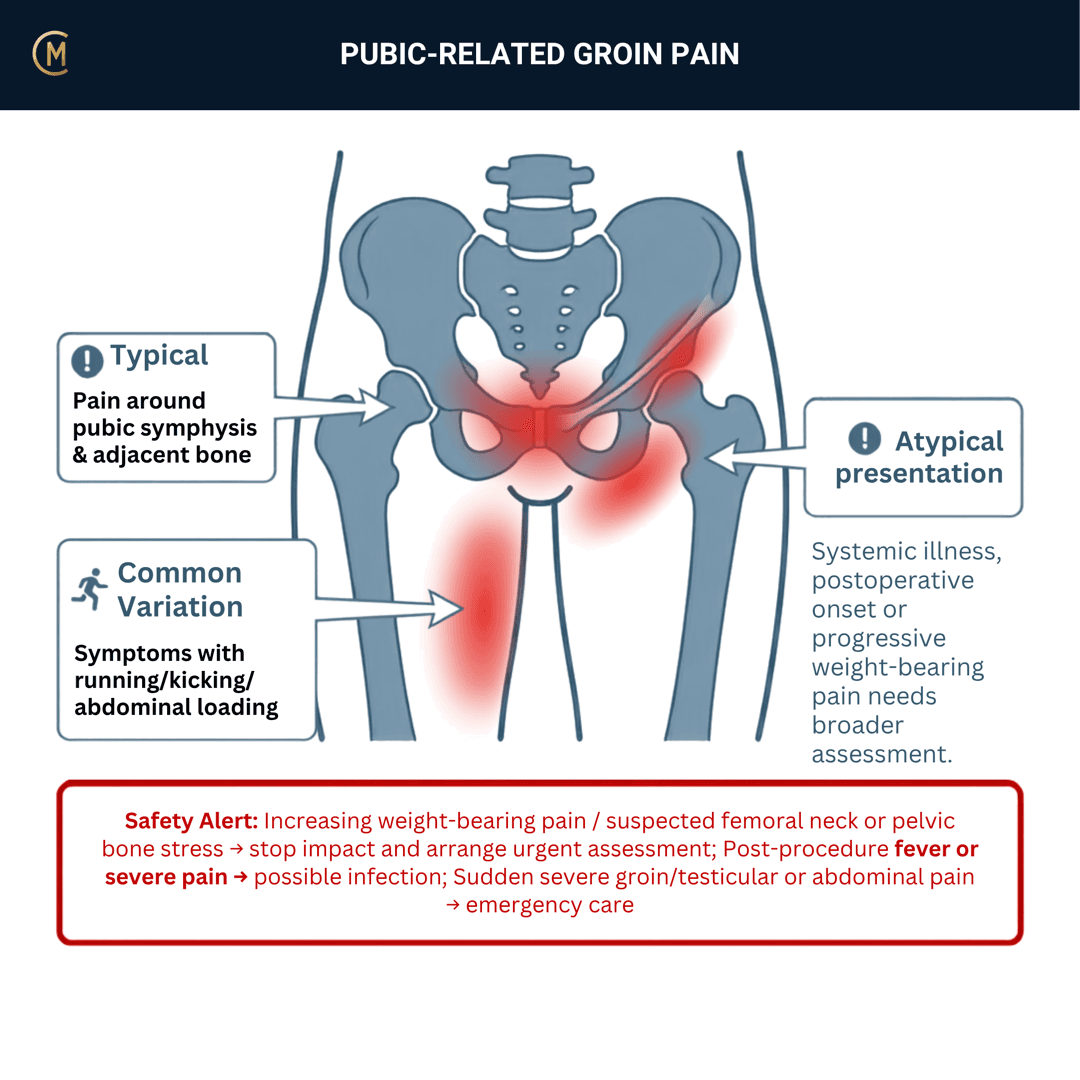
Who: Field-sport athletes after a training spike. Kicking, sprinting, change of direction.
What: Pubic-related groin pain, the third Doha entity.
How it behaves: Central pubic or lower abdominal pain. Worse with kicking, sit-ups, sprinting and direction change. May radiate into the adductors or abdominals. Insidious onset. Aggravated by twisting or core strain.
The one thing to take from this page:
Tenderness, not a test count. Doha defines pubic-related groin pain by local tenderness at the symphysis and the bone right beside it, with no particular resistance test required [16]. Squeeze and sit-up can both hurt here, but neither makes the call.
Where it sits in the Doha map
| Finding | Entity |
|---|---|
| Squeeze positive, tender adductor origin | Adductor-related |
| Tender symphysis and adjacent bone; no particular resistance test | Pubic-related — this page |
| Cough / sneeze, resisted sit-up, tender canal | Inguinal-related |
| Resisted hip flexion, tender deep to inguinal ligament | Iliopsoas-related |
⚠️ No guideline, no Australian document, and no randomised evidence on this page. The management literature is reviews and case-level work.
2 · SE — THE SUBJECTIVE PATTERN (the 70%)
Five stages, in your course's order. One question separates the two versions of this diagnosis: is this an athlete with a load story, or not?
MAIN PROBLEM
"It's right in the middle, at the front of my pelvis."
"Kicking and sit-ups both set it off."
"It's been creeping up since pre-season."
BODY CHART
- Central, at the pubic symphysis. Not lateralised to one adductor origin.
- Mark the radiation — into adductors, into lower abdominals, or both.
- Mark the adductor origin, the inguinal canal and deep anterior separately. The other three entities.
- Any testicular, scrotal or urinary symptoms? Mark and ask.
BEHAVIOUR
| Fits pubic-related | Points elsewhere | |
|---|---|---|
| Aggs | Kicking, sprinting, sit-ups, direction change, twisting | Cutting with adductor tenderness only → adductor-related |
| Onset | Insidious, after a training spike | No load story at all → think infective, post-procedural |
| Eases | Rest | Nothing eases it, systemically unwell → screen |
| Severity | VAS 0–10 at best / at worst / right now | — |
| Course | Slow | Rapid, with fever → infection |
| Weight-bearing | Painful hop | Can't weight-bear → bone stress |
HISTORY
- The training spike. Volume, intensity, pre-season ramp — get the specifics.
- Kicking volume and kicking leg.
- Sit-up and core programme volume. Often the missed contributor.
- Any recent pelvic, urological or abdominal procedure? Any recent infection? Ask this even in athletes.
- Low energy availability, menstrual disturbance, weight loss?
SPECIAL / SCREENING QUESTIONS
- Fever, rigors, feeling unwell, night sweats?
- Urinary symptoms, discharge, or a recent catheter or scope?
- Can they weight-bear and hop?
- Any lump, bulge, or cough impulse?
Assessing this region? Download the Hip & Groin assessment template →
3 · HYPOTHESIS RANKING
| Competing pattern | The one discriminating feature |
|---|---|
| Adductor-related groin pain | Tenderness localised to the adductor origin, not central at the symphysis. Where it's tender is the discriminator, not the sit-up. |
| Inguinal-related groin pain | Tender pubic tubercle, conjoint tendon or canal; pain with cough and sneeze. |
| Hip-related pain (FAI) | Deep anterior pinch, FADIR, reduced IR in flexion — and it commonly coexists; cam-type morphology has been reported in association with osteitis pubis [1]. |
| Osteitis condensans ilii | A different pelvic sclerosing entity, described alongside osteitis pubis as a diagnostic complexity [2]. |
| Lumbar and sacroiliac referral | Osteitis pubis has been discussed explicitly as a differential against spinal disease [3]. |
The two that outrank the table
Infective or post-procedural osteitis pubis. Fever, systemic illness, a recent urological or pelvic procedure, or a non-athlete with no load story. Documented after prostate procedures [4] and after infection [5], with its own endourological management literature [6].
Pubic ramus or femoral neck stress fracture. Inability to weight-bear or hop, night pain, RED-S risk.
And the coexistence rule
Adductor lesions on MRI have been described in athletes with osteitis pubis [7]. So this rarely comes alone. Run the whole Doha sequence and treat what you find.
4 · RED FLAGS — DON'T MISS THIS
This section is free, on every pattern, forever. Safety is never gated.
| Finding | What it suggests | What you do |
|---|---|---|
| Fever, rigors, night sweats with pubic pain | Infective osteitis pubis / osteomyelitis | Urgent medical review |
| Recent urological, pelvic or abdominal procedure | Post-procedural osteitis pubis; septic pubic symphysis, especially after pelvic surgery [21] | Medical review |
| Non-athlete with pubic pain and no load story | Infective, inflammatory, or malignant | Medical review |
| Urinary symptoms, discharge, recent catheter or scope | Infective source | Medical review |
| Unable to weight-bear or hop | Pubic ramus or femoral neck stress fracture | Urgent imaging. Do not load |
| RED-S profile — low energy availability, menstrual disturbance | Bone stress injury | Image and refer |
| A palpable bulge or cough impulse | Inguinal hernia | Medical review |
| Night pain, weight loss, cancer history | Malignancy | Medical review |
The rule: insidious central pubic pain in an athlete with a training spike, who can hop and is systemically well, is yours. Fever, a recent procedure, no load story, or an inability to weight-bear is not.
Cross-links: Adductor-related groin pain · Athletic pubalgia / inguinal-related · Femoroacetabular impingement · Hip / pelvic stress fracture
5 · OE — THE OBJECTIVE (the 30%)
Members
Sections 5 to 7 are for members
The objective exam, management and pearls, plus the six-minute lesson and the debrief. Free with an account.
Sign in or join free6 · MX — MANAGEMENT ESSENTIALS
Members
Sections 5 to 7 are for members
The objective exam, management and pearls, plus the six-minute lesson and the debrief. Free with an account.
Sign in or join free7 · CLINICAL PEARLS + RETRIEVAL CHECK
Members
Sections 5 to 7 are for members
The objective exam, management and pearls, plus the six-minute lesson and the debrief. Free with an account.
Sign in or join freeMembers
The 4-minute lesson is for members
Twelve slides on this pattern: what you'll hear, what to examine, what to do. Free with an account.
Sign in or join freeGuideline anchor
No treatment guideline exists.
More
Anchored to the Doha agreement (Weir et al. 2015, PMID 26031643), which names pubic-related groin pain as one of four defined clinical entities and supplies the examination, and to the rehabilitation and return-to-training review (Via et al. 2019, PMID 30613167).
The Doha agreement is terminology and definitions, not treatment. There is no Australian document, no treatment guideline, and no randomised evidence on this page — the management literature is reviews and case-level work.
Members
The evidence summary is for members
Verified diagnostic accuracy, where the evidence stands and what it doesn't settle. Free with an account.
Sign in or join freeSources · 20
ShowHide
Every source on this page resolves and title-verifies against PubMed. Newest first.
- 2019Akgün & Agirman (2019). Association between cam-type femoroacetabular impingement and osteitis pubis in non-athletic population on magnetic resonance imaging. Journal of orthopaedic surgery and research, 14(1), 329. https://doi.org/10.1186/s13018-019-1368-6
- 2024Nimodia et al. (2024). Exploring Diagnostic Complexities: A Case Report of Osteitis Condensans Ilii and Osteitis Pubis. Cureus, 16(8), e67543. https://doi.org/10.7759/cureus.67543
- 2025Jordan et al. (2025). [Osteitis pubis and spinal diseases : Differential diagnosis of groin pain]. Chirurgie (Heidelberg, Germany), 96(8), 641-649. https://doi.org/10.1007/s00104-025-02284-1
- 2023Smani et al. (2023). Osteitis pubis following holmium laser enucleation of the prostate. BMJ case reports, 16(10). https://doi.org/10.1136/bcr-2023-257637
- 2023Fernández-Vecilla et al. (2023). Osteitis pubis following tonsillopharyngitis. Enfermedades infecciosas y microbiologia clinica (English ed.), 41(8), 513-515. https://doi.org/10.1016/j.eimce.2023.04.005
- 2021Madhusoodanan et al. (2021). Endourological management of osteitis pubis secondary to a calcified prostate ossifying into the pubic symphysis. BMJ case reports, 14(5). https://doi.org/10.1136/bcr-2021-242009
- 2025Eraslan & Kose (2025). Prevalence and patterns of adductor lesions on MRI in athletes with osteitis pubis. Journal of orthopaedics and traumatology : official journal of the Italian Society of Orthopaedics and Traumatology, 26(1), 65. https://doi.org/10.1186/s10195-025-00875-6
- 2023Mohammad & Elsais (2023). Comparison of hip abductor and adductor muscle performance between healthy and osteitis pubis professional footballers. Irish journal of medical science, 192(2), 685-691. https://doi.org/10.1007/s11845-022-03010-0
- 2026Beyer et al. (2026). Prevalence, determinants, and clinical relevance of MRI signs of osteitis pubis in the large population-based cohort SHIP. European journal of radiology, 202, 112960. https://doi.org/10.1016/j.ejrad.2026.112960
- 2017Toslak et al. (2017). Evaluation of Diffusion-weighted MR Imaging as a Technique for Detecting Bone Marrow Edema in Patients with Osteitis Pubis. Magnetic resonance in medical sciences : MRMS : an official journal of Japan Society of Magnetic Resonance in Medicine, 16(4), 317-324. https://doi.org/10.2463/mrms.mp.2016-0104
- 2022Amer et al. (2022). The challenges in diagnosis and management of osteitis pubis: An algorithm based on current evidence. BJUI compass, 3(4), 267-276. https://doi.org/10.1002/bco2.127
- 2019Via et al. (2019). Management of osteitis pubis in athletes: rehabilitation and return to training - a review of the most recent literature. Open access journal of sports medicine, 10, 1-10. https://doi.org/10.2147/OAJSM.S155077
- 2020Feldman et al. (2020). Management of a nonathlete with a traumatic groin strain and osteitis pubis using manual therapy and therapeutic exercise: A case report. Physiotherapy theory and practice, 36(6), 753-760. https://doi.org/10.1080/09593985.2018.1492658
- 2022Athanasiou et al. (2022). Osteitis Pubis in Athletes: A Literature Review of Current Surgical Treatment. Cureus, 14(3), e22976. https://doi.org/10.7759/cureus.22976
- 2026Jha (2026). Editorial Commentary: Refractory Osteitis Pubis Appears to Respond Favorably to Endoscopic Pubic Symphysectomy. Arthroscopy : the journal of arthroscopic & related surgery : official publication of the Arthroscopy Association of North America and the International Arthroscopy Association, 42(5), 886-887. https://doi.org/10.1002/arj.70104
- 2015Weir et al. (2015). Doha agreement meeting on terminology and definitions in groin pain in athletes. British journal of sports medicine, 49(12), 768-74. https://doi.org/10.1136/bjsports-2015-094869
- 2021Dempsey et al. (2021). Nomenclature for groin pain in athletes. The British journal of radiology, 94(1126), 20201333. https://doi.org/10.1259/bjr.20201333
- 2022Rodrigues et al. (2022). PELVIC INCIDENCE AND OSTEITIS PUBIS IN PROFESSIONAL SOCCER PLAYERS. Acta ortopedica brasileira, 30(1), e244380. https://doi.org/10.1590/1413-785220223001e244380
- 2023Dharmshaktu (2023). Primary care level prevalence of osteitis pubis in non-athlete patients in hill region: A short communication and a proposal for simple radiological grading. Journal of family medicine and primary care, 12(4), 783-787. https://doi.org/10.4103/jfmpc.jfmpc_105_21
- 2024Heijboer et al. (2024). Clinical examination tests for adductor- and pubic-related groin pain in athletes with longstanding groin pain: Inter-examiner reliability and prevalence of positive tests. Physical therapy in sport : official journal of the Association of Chartered Physiotherapists in Sports Medicine, 66, 9-16. https://doi.org/10.1016/j.ptsp.2023.12.008
Mapped to this pattern
Generic measures that also apply
- Borg RPE
Borg Rating of Perceived Exertion Scale (6-20)
perceived exertion · 1 items · 1 min
- GROC
Global Rating of Change Scale
perceived change since baseline · 1 items · 1 min
- NPRS
Numeric Pain Rating Scale
pain intensity · 1 items · 1 min
- PGIC
Patient Global Impression of Change
perceived change since baseline · 1 items · 1 min
- PSFS
Patient-Specific Functional Scale
patient-generated function · 3 items · 2 min
- SANE
Single Assessment Numeric Evaluation
patient-rated function as a percentage of normal · 1 items · 1 min
- VAS
Visual Analogue Scale
pain intensity · 1 items · 1 min
- Borg CR10
Borg Category Ratio 10 Scale
perceived exertion or symptom intensity, ratio scale · 1 items · 1 min
- GAS
Goal Attainment Scaling
individualised goal achievement · 10 min
Did this page do its job?
CliniStudy is in beta. One tap is enough — it decides what gets fixed first.