
1 · SNAPSHOT
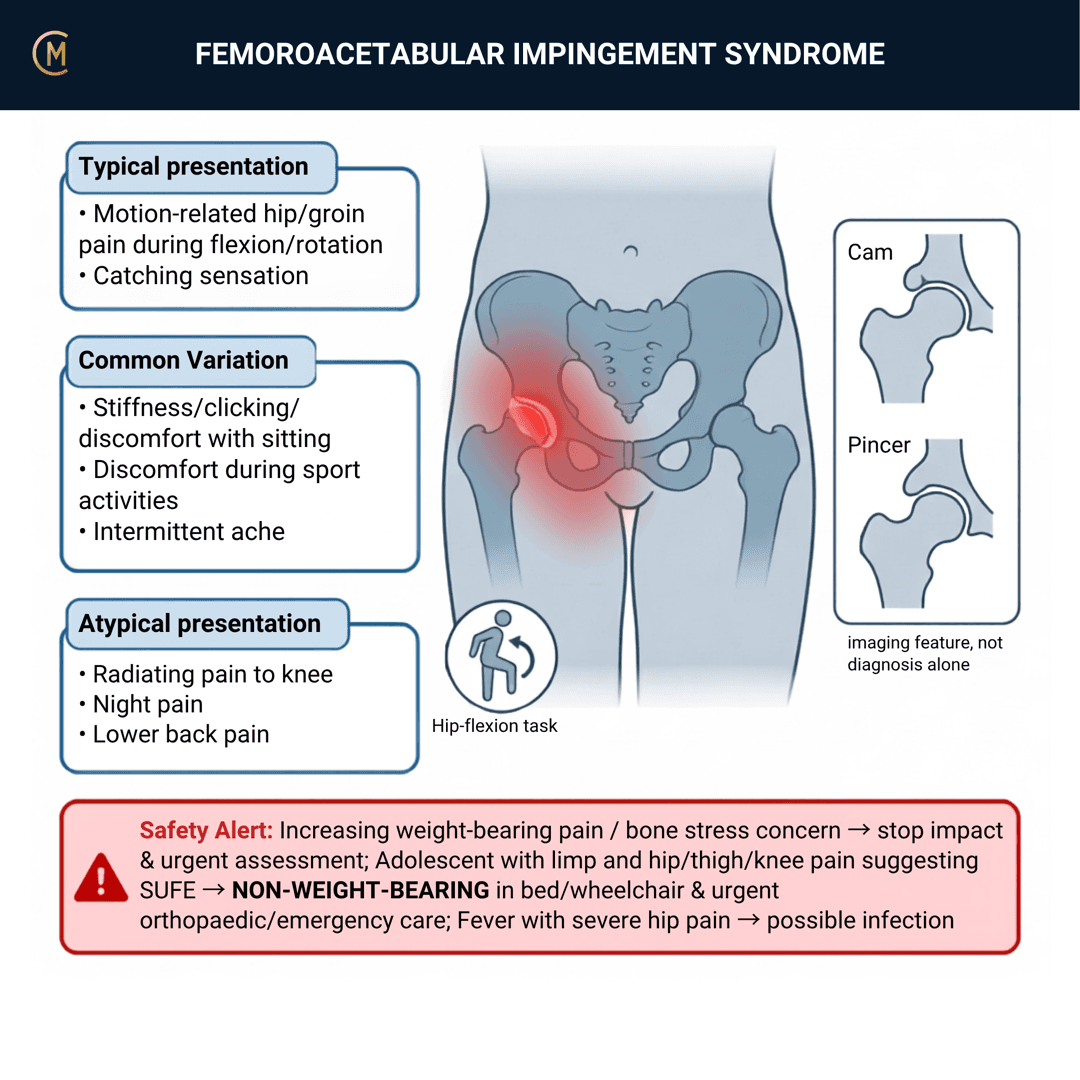
Who: Young, active adults. Cutting, pivoting and deep-flexion sports; also anyone who sits a lot and squats heavy.
What: FAI syndrome — a motion-related clinical disorder of the hip.
How it behaves: Deep anterior groin pain or a "pinch" with hip flexion or rotation. Worse with prolonged sitting, squatting, pivoting. Clicking or catching possible. Eased by rest and by avoiding flexion.
The one thing to take from this page:
It is a syndrome, not a shape. Symptoms AND signs AND imaging findings — all three. Cam morphology on a scan without symptoms and signs is a shape, and telling someone it's a diagnosis changes what they believe about their hip for years.
The Warwick triad
| Component | What it means |
|---|---|
| Symptoms | Motion- or position-related hip or groin pain; may include clicking, catching, locking, stiffness, giving way |
| Signs | Positive FADIR, reduced internal rotation in flexion |
| Imaging findings | Cam or pincer morphology |
| All three | = FAI syndrome. Any two = something else, or nothing |
⚠️ No Australian guideline exists. The anchors are international consensus statements, not graded practice guidelines. An Australian randomised trial exists; a guideline does not.
2 · SE — THE SUBJECTIVE PATTERN (the 70%)
Five stages, in your course's order. You are looking for a position-related joint story, and screening hard for the two things that aren't this.
MAIN PROBLEM
"It pinches deep in my groin when I squat."
"Sitting in the car kills it."
"It catches when I turn."
BODY CHART
- Deep and anterior. The C-sign — cupping the hip between thumb and fingers — is the classic gesture.
- Not the adductor origin, not the symphysis, not the inguinal canal. Those are three different pages.
- Mark lateral hip separately — gluteal tendinopathy coexists.
- Mark buttock and posterior thigh — that opens the lumbar and deep gluteal questions.
BEHAVIOUR
| Fits FAI syndrome | Points elsewhere | |
|---|---|---|
| Aggs | Deep flexion, prolonged sitting, squatting, pivoting | Cutting and kicking with adductor tenderness → adductor-related |
| Severity | VAS 0–10 at best / at worst / right now | — |
| Symptoms | Pinch, click, catch, stiffness, giving way | True locking → labral or loose body |
| Onset | Gradual, load-related | Weight-bearing pain, can't hop → bone stress |
| Age | Young, active | Older, morning stiffness, capsular restriction → hip OA |
| Night | Sore after load | Night or rest pain → screen |
HISTORY
- What positions? Get specific — car seat, squat depth, bike fit, dance position.
- Training and load change.
- Sport type — cutting, pivoting and deep-flexion sports carry the pattern.
- What have they already been told, and have they had a scan? This matters more here than almost anywhere, because an imaging report has usually done the talking already.
- Adolescent with a limp or hip pain? That is a slipped capital femoral epiphysis question.
SPECIAL / SCREENING QUESTIONS
- Can they hop? Weight-bearing pain, night pain, RED-S profile → bone stress.
- Night pain, rest pain, fever, weight loss?
- True mechanical locking — the hip stuck, needing manipulation to free?
- Any bowel, bladder, or bilateral leg symptoms?
Assessing this region? Download the Hip & Groin assessment template →
3 · HYPOTHESIS RANKING
| Competing pattern | The one discriminating feature |
|---|---|
| Hip labral tear ± chondral lesion | Overlapping, and commonly coexists. True catching, locking or giving way points more to labral involvement. |
| Adductor-related groin pain | Tender adductor origin, positive squeeze. Tendon, not joint. |
| Iliopsoas-related pain | Tender deep to the inguinal ligament, pain on resisted hip flexion. |
| Hip osteoarthritis | Older, capsular restriction with a bony end-feel, morning stiffness. Same joint, not simply an earlier stage: in adults 55 and over, cam morphology was linked to new radiographic hip OA but not to new clinical hip OA [23]. |
| Lumbar or deep gluteal referral | Buttock-dominant, neural behaviour, and the hip tests don't reproduce it. |
The two that outrank the table
Femoral neck stress fracture. Same population, same location. Weight-bearing pain, inability to hop, night pain, or a RED-S risk profile means imaging before rehabilitation.
Slipped capital femoral epiphysis, in an adolescent. Limp, hip or knee pain, restricted internal rotation. Knee pain in a child can come from the hip — it belongs on this page too.
And the framing that decides how you use the scan
Hip-related pain in young and middle-aged active adults has its own consensus on classification and diagnostic criteria [1], which places FAI syndrome alongside acetabular dysplasia, labral pathology and other intra-articular causes rather than treating it as the default label for a sore young hip.
4 · RED FLAGS — DON'T MISS THIS
This section is free, on every pattern, forever. Safety is never gated.
| Finding | What it suggests | What you do |
|---|---|---|
| Groin pain with inability to weight-bear or hop | Femoral neck stress fracture | Urgent imaging. Do not load. Radiographs are often normal, so a clear X-ray doesn't end it — MRI is the test (Bernstein et al. 2022) [21] |
| Night pain or rest pain | Bone stress, infection, tumour | Image |
| RED-S profile — low energy availability, menstrual disturbance, weight loss | Bone stress injury | Image and refer |
| Adolescent with a limp, hip or knee pain, restricted IR | Slipped capital femoral epiphysis | Urgent imaging and orthopaedic review |
| Fever, unwell, hot painful hip | Septic arthritis | Emergency |
| Young adult hip pain with IV drug use, alcohol excess or corticosteroid use in the history | Fracture, infection or ischaemic necrosis must be ruled out early | Image and refer early — they need treatment before the joint is damaged (Troum & Crues 2004) [22] |
| True mechanical locking | Labral tear, loose body | Orthopaedic review |
| Progressive night pain with a cancer history | Metastatic disease | Medical review |
| Sudden severe pain with functional loss | Fracture, avulsion | Image |
The rule: position-related deep anterior hip pain in someone who can hop, with a clean systemic screen, is yours. Weight-bearing pain, night pain, an adolescent limp, systemic symptoms or true locking is not.
Cross-links: Hip labral tear · Adductor-related groin pain · Iliopsoas-related pain · Hip osteoarthritis
5 · OE — THE OBJECTIVE (the 30%)
Members
Sections 5 to 7 are for members
The objective exam, management and pearls, plus the six-minute lesson and the debrief. Free with an account.
Sign in or join free6 · MX — MANAGEMENT ESSENTIALS
Members
Sections 5 to 7 are for members
The objective exam, management and pearls, plus the six-minute lesson and the debrief. Free with an account.
Sign in or join free7 · CLINICAL PEARLS + RETRIEVAL CHECK
Members
Sections 5 to 7 are for members
The objective exam, management and pearls, plus the six-minute lesson and the debrief. Free with an account.
Sign in or join freeMembers
The 4-minute lesson is for members
Twelve slides on this pattern: what you'll hear, what to examine, what to do. Free with an account.
Sign in or join freeGuideline anchor
No Australian guideline covers FAI syndrome.
More
Anchored to the Warwick Agreement (Griffin et al. 2016, PMID 27629403) for the definition — symptoms AND signs AND imaging findings; to the consensus on classification and diagnostic criteria for hip-related pain in young and middle-aged adults (Reiman et al. 2020, PMID 31959678) for where this sits among the other hip-related presentations; and to the two randomised trials of arthroscopy versus structured conservative care (Griffin et al. 2018, PMID 29893223; Palmer et al. 2019, PMID 30733197) for the surgical conversation.
Both anchors are international consensus statements, not Australian documents and not clinical practice guidelines with graded recommendations. An Australian multi-centre randomised trial comparing arthroscopy with physiotherapy exists (Hunter et al. 2021) and a 2025 survey of contemporary practice includes Australian clinicians — but there is no Australian guideline.
Members
The evidence summary is for members
Verified diagnostic accuracy, where the evidence stands and what it doesn't settle. Free with an account.
Sign in or join freeSources · 21
ShowHide
Every source on this page resolves and title-verifies against PubMed. Newest first.
- 2020Reiman et al. (2020). Consensus recommendations on the classification, definition and diagnostic criteria of hip-related pain in young and middle-aged active adults from the International Hip-related Pain Research Network, Zurich 2018. British journal of sports medicine, 54(11), 631-641. https://doi.org/10.1136/bjsports-2019-101453
- 2020Pålsson et al. (2020). Combining results from hip impingement and range of motion tests can increase diagnostic accuracy in patients with FAI syndrome. Knee surgery, sports traumatology, arthroscopy : official journal of the ESSKA, 28(10), 3382-3392. https://doi.org/10.1007/s00167-020-06005-5
- 2022Wong et al. (2022). Physical Examination of the Hip: Assessment of Femoroacetabular Impingement, Labral Pathology, and Microinstability. Current reviews in musculoskeletal medicine, 15(2), 38-52. https://doi.org/10.1007/s12178-022-09745-8
- 2025Zhang et al. (2025). Hip muscle changes in femoroacetabular impingement: a systematic review and meta-analysis. Journal of orthopaedic surgery and research, 20(1), 717. https://doi.org/10.1186/s13018-025-06135-x
- 2021Palmer (2021). Femoroacetabular Impingement (FAI): Counterpoint-Do Not Equate FAI Morphology With FAI Syndrome. AJR. American journal of roentgenology, 217(6), 1297-1298. https://doi.org/10.2214/AJR.21.26181
- 2020Mascarenhas et al. (2020). The Lisbon Agreement on Femoroacetabular Impingement Imaging-part 1: overview. European radiology, 30(10), 5281-5297. https://doi.org/10.1007/s00330-020-06822-9
- 2024Radha et al. (2024). Best practice guidelines for clinical and radiological assessment of patients with femoroacetabular impingement. Results from the ISHA International Delphi Consensus Project-Phase 2. Journal of hip preservation surgery, 11(1), 44-50. https://doi.org/10.1093/jhps/hnad028
- 2021Terrell et al. (2021). Therapeutic Exercise Approaches to Nonoperative and Postoperative Management of Femoroacetabular Impingement Syndrome. Journal of athletic training, 56(1), 31-45. https://doi.org/10.4085/1062-6050-0488.19
- 2020Hoit et al. (2020). Physiotherapy as an Initial Treatment Option for Femoroacetabular Impingement: A Systematic Review of the Literature and Meta-analysis of 5 Randomized Controlled Trials. The American journal of sports medicine, 48(8), 2042-2050. https://doi.org/10.1177/0363546519882668
- 2023Pasculli et al. (2023). Non-operative Management and Outcomes of Femoroacetabular Impingement Syndrome. Current reviews in musculoskeletal medicine, 16(11), 501-513. https://doi.org/10.1007/s12178-023-09863-x
- 2025Dancy et al. (2025). Femoroacetabular Impingement: Critical Analysis Review of Current Nonoperative Treatments. JBJS reviews, 13(4). https://doi.org/10.2106/JBJS.RVW.24.00211
- 2026Hibbert et al. (2026). Evaluating a 3-Month Physical Impairment and Functional Performance-Based Rehabilitation Program After Hip Arthroscopy for Femoroacetabular Impingement (FAI) Syndrome. The Journal of orthopaedic and sports physical therapy, 56(7), 456-464. https://doi.org/10.2519/jospt.2026.13775
- 2025Lawrenson et al. (2025). Diagnosis and management of femoroacetabular impingement syndrome (FAIS): a survey of contemporary physiotherapy practice. BMC musculoskeletal disorders, 26(1), 924. https://doi.org/10.1186/s12891-025-08708-7
- 2018Griffin et al. (2018). Hip arthroscopy versus best conservative care for the treatment of femoroacetabular impingement syndrome (UK FASHIoN): a multicentre randomised controlled trial. Lancet (London, England), 391(10136), 2225-2235. https://doi.org/10.1016/S0140-6736(18)31202-9
- 2019Palmer et al. (2019). Arthroscopic hip surgery compared with physiotherapy and activity modification for the treatment of symptomatic femoroacetabular impingement: multicentre randomised controlled trial. BMJ (Clinical research ed.), 364, l185. https://doi.org/10.1136/bmj.l185
- 2022Zhu et al. (2022). Conservative therapy versus arthroscopic surgery of femoroacetabular impingement syndrome (FAI): a systematic review and meta-analysis. Journal of orthopaedic surgery and research, 17(1), 296. https://doi.org/10.1186/s13018-022-03187-1
- 2021Hunter et al. (2021). Multi-centre randomised controlled trial comparing arthroscopic hip surgery to physiotherapist-led care for femoroacetabular impingement (FAI) syndrome on hip cartilage metabolism: the Australian FASHIoN trial. BMC musculoskeletal disorders, 22(1), 697. https://doi.org/10.1186/s12891-021-04576-z
- 2016Griffin et al. (2016). The Warwick Agreement on femoroacetabular impingement syndrome (FAI syndrome): an international consensus statement. British journal of sports medicine, 50(19), 1169-76. https://doi.org/10.1136/bjsports-2016-096743
- 2022Dijkstra et al. (2022). Oxford consensus on primary cam morphology and femoroacetabular impingement syndrome: part 1-definitions, terminology, taxonomy and imaging outcomes. British journal of sports medicine, 57(6), 325-41. https://doi.org/10.1136/bjsports-2022-106085
- 2022Dijkstra et al. (2022). Oxford consensus on primary cam morphology and femoroacetabular impingement syndrome: part 2-research priorities on conditions affecting the young person's hip. British journal of sports medicine, 57(6), 342-58. https://doi.org/10.1136/bjsports-2022-106092
- 2023Runhaar et al. (2023). Risk Factors and Population-Attributable Fractions for Incident Hip Osteoarthritis. HSS journal : the musculoskeletal journal of Hospital for Special Surgery, 19(4), 407-412. https://doi.org/10.1177/15563316231192461
Mapped to this pattern
- HOOS
Hip Disability and Osteoarthritis Outcome Score
hip disability and osteoarthritis outcome · 40 items · 10 min
- iHOT-12
International Hip Outcome Tool
young active hip quality of life · 12 items · 4 min
- HOS
Hip Outcome Score
hip function in an active population · 28 items · 7 min
- NAHS
Non-Arthritic Hip Score
pre-arthritic hip function · 20 items · 6 min
Generic measures that also apply
- Borg RPE
Borg Rating of Perceived Exertion Scale (6-20)
perceived exertion · 1 items · 1 min
- GROC
Global Rating of Change Scale
perceived change since baseline · 1 items · 1 min
- NPRS
Numeric Pain Rating Scale
pain intensity · 1 items · 1 min
- PGIC
Patient Global Impression of Change
perceived change since baseline · 1 items · 1 min
- PSFS
Patient-Specific Functional Scale
patient-generated function · 3 items · 2 min
- SANE
Single Assessment Numeric Evaluation
patient-rated function as a percentage of normal · 1 items · 1 min
- VAS
Visual Analogue Scale
pain intensity · 1 items · 1 min
- Borg CR10
Borg Category Ratio 10 Scale
perceived exertion or symptom intensity, ratio scale · 1 items · 1 min
- GAS
Goal Attainment Scaling
individualised goal achievement · 10 min
Did this page do its job?
CliniStudy is in beta. One tap is enough — it decides what gets fixed first.