
1 · SNAPSHOT
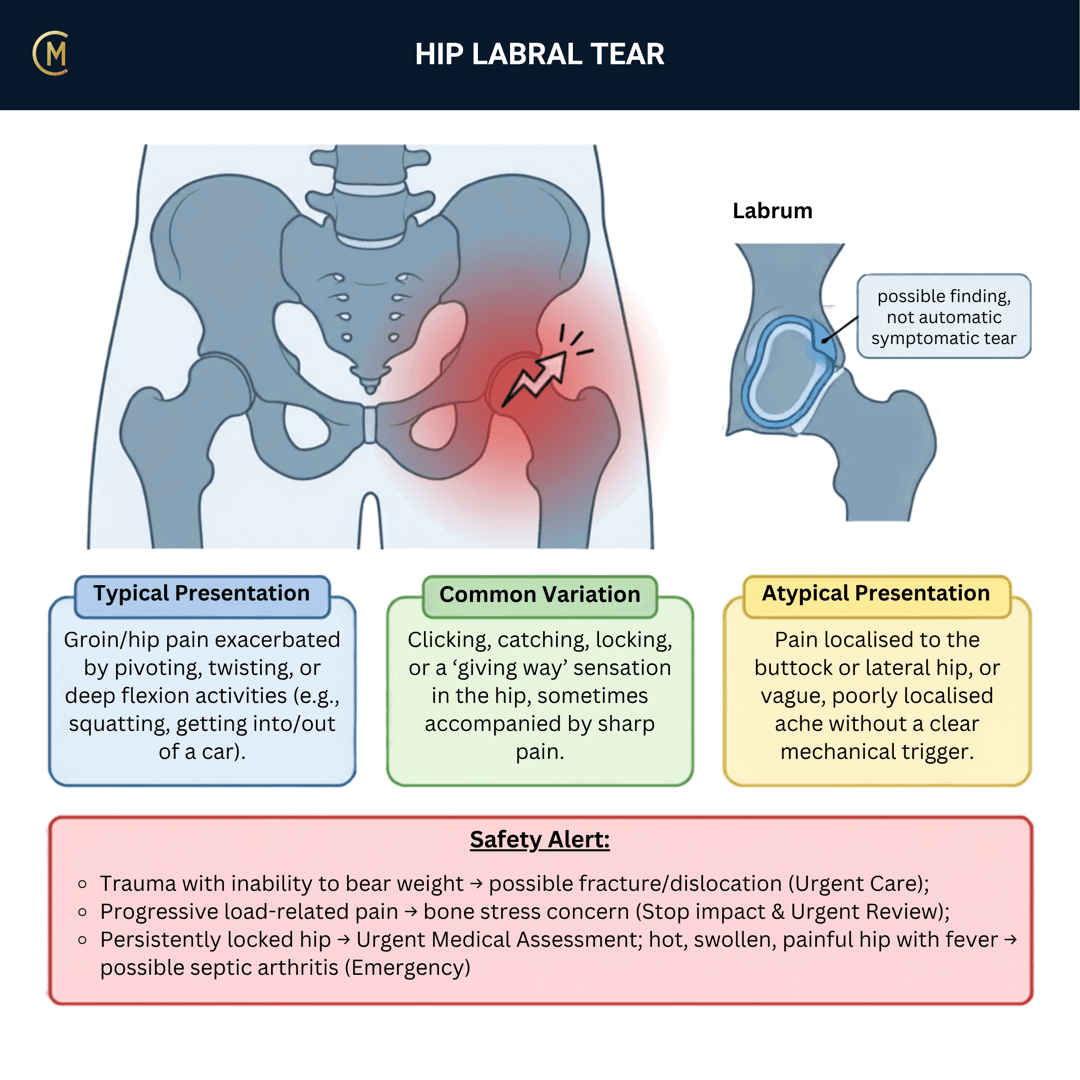
Who: Young to middle-aged. Running, field and rotational sport. Dancers.
What: Acetabular labral pathology, frequently with chondral involvement, sitting inside hip-related pain alongside FAI syndrome.
How it behaves: Anterior groin pain ± catching, clicking, locking or "giving way." Worse with pivoting, twisting and deep flexion — squats, getting out of the car.
The one thing to take from this page:
Labral tears are common in people with no hip pain at all. The finding doesn't separate the groups — the symptoms and the function do. Symptoms + function trump imaging.
The same finding, both groups
| People with hip pain | People without hip pain | |
|---|---|---|
| Labral findings on imaging | Common | Common |
| What separates them | Symptoms. Function. Not the picture | |
| Asymptomatic athletes | — | Studied specifically. Same story |
⚠️ No guideline exists, and there is no randomised evidence on this page comparing repair with non-operative management. The comparative literature is cohort-level.
2 · SE — THE SUBJECTIVE PATTERN (the 70%)
Five stages, in your course's order. The mechanical symptoms are what earn this page over FAI syndrome — and they are also the ones patients over-report.
MAIN PROBLEM
"It catches and clicks in my groin."
"Twisting sets it off."
"It feels like it's going to give way."
BODY CHART
- Anterior groin, deep. The C-sign grip again.
- Mark lateral hip — coexisting gluteal tendinopathy.
- Mark the adductor origin, symphysis and inguinal canal — the extra-articular entities are still on the list.
- Buttock-dominant? Lumbar and SIJ.
BEHAVIOUR
| Fits labral pathology | Points elsewhere | |
|---|---|---|
| Aggs | Pivoting, twisting, deep flexion, getting out of the car | Cutting and kicking with adductor tenderness → adductor-related |
| Severity | VAS 0–10 at best / at worst / right now | — |
| Symptoms | Catching, clicking, locking, giving way | Pinch without mechanical symptoms → FAI syndrome dominant |
| Onset | Gradual, or a traumatic twist | Sudden with functional loss → fracture, avulsion |
| Age | Young to middle-aged | Older with capsular restriction → hip OA and chondral change |
| Weight-bearing | Painful but able | Can't hop → bone stress |
HISTORY
- Traumatic twist, or gradual? Both stories occur.
- Previous FAI-type symptoms? Common, and it is the same problem.
- Sport and position — pivoting, cutting, dance, deep flexion.
- What did the scan say, and who told them what? This is the barrier you will spend the appointment on.
- Has anyone offered surgery?
SPECIAL / SCREENING QUESTIONS
- True mechanical locking — the hip stuck, needing manipulation to free? That is different from clicking.
- Can they hop? Night pain, RED-S profile → bone stress.
- Adolescent with a traumatic mechanism? A missed posterior wall fracture alongside a labral tear has been reported in an adolescent athlete — trauma changes the imaging question.
- Fever, weight loss, cancer history?
Assessing this region? Download the Hip & Groin assessment template →
3 · HYPOTHESIS RANKING
| Competing pattern | The one discriminating feature |
|---|---|
| FAI syndrome | Overlaps almost completely. Morphology plus symptoms plus signs. Treat as one hip-related pain problem, not two diagnoses. |
| Hip osteoarthritis / chondral lesion | Older, capsular restriction — and chondral involvement changes the prognosis conversation. |
| Adductor- or iliopsoas-related groin pain | Tender at the tendon, pain on the matching resisted test. Extra-articular. |
| Lumbar or SIJ referral | Back or buttock behaviour; the hip tests don't reproduce it. |
| Ballet and dance populations | Worth naming separately. Read further: prevalence in professional ballet dancers alongside sporting participants [1]. |
The two that outrank the table
Femoral neck stress fracture. Same population, same location, and the one you cannot miss.
A missed fracture alongside the labral finding. A posterior wall fracture missed alongside a labral tear in an adolescent athlete is a reported failure mode — a traumatic mechanism changes what the imaging needs to answer.
And the pearl that decides the plan
Watch for early osteoarthritic and chondral signs in older athletes. It matters because chondral involvement changes what you tell them about the future — not just what you do this week.
4 · RED FLAGS — DON'T MISS THIS
This section is free, on every pattern, forever. Safety is never gated.
| Finding | What it suggests | What you do |
|---|---|---|
| Groin pain with inability to weight-bear or hop | Femoral neck stress fracture | Urgent imaging. Do not load |
| Night pain or rest pain | Bone stress, infection, tumour | Image |
| RED-S profile — low energy availability, menstrual disturbance | Bone stress injury | Image and refer |
| Traumatic mechanism in an adolescent | Fracture alongside the labral finding | Image properly |
| Adolescent with a limp and restricted IR | Slipped capital femoral epiphysis | Urgent imaging and orthopaedic review |
| True mechanical locking | Displaced tear, loose body | Orthopaedic review |
| Hot, swollen, exquisitely painful hip with fever | Septic arthritis | Emergency |
| Cancer history with new hip pain | Metastatic disease | Medical review |
| Young adult hip pain with IV drug use, alcohol excess or corticosteroid use in the history | Fracture, infection or ischaemic necrosis must be ruled out early | Image and refer before you treat it as labral (Troum & Crues 2004) [21] |
The rule: position- and rotation-related groin pain with mechanical symptoms, in someone who can hop with a clean systemic screen, is yours. Weight-bearing pain, night pain, a traumatic adolescent hip or true locking is not.
Cross-links: Femoroacetabular impingement · Hip osteoarthritis · Adductor-related groin pain · Iliopsoas-related pain
5 · OE — THE OBJECTIVE (the 30%)
Members
Sections 5 to 7 are for members
The objective exam, management and pearls, plus the six-minute lesson and the debrief. Free with an account.
Sign in or join free6 · MX — MANAGEMENT ESSENTIALS
Members
Sections 5 to 7 are for members
The objective exam, management and pearls, plus the six-minute lesson and the debrief. Free with an account.
Sign in or join free7 · CLINICAL PEARLS + RETRIEVAL CHECK
Members
Sections 5 to 7 are for members
The objective exam, management and pearls, plus the six-minute lesson and the debrief. Free with an account.
Sign in or join freeMembers
The 4-minute lesson is for members
Twelve slides on this pattern: what you'll hear, what to examine, what to do. Free with an account.
Sign in or join freeGuideline anchor
No guideline covers hip labral tears.
More
Anchored to the consensus on classification and diagnostic criteria for hip-related pain in young and middle-aged active adults (Reiman et al. 2020, PMID 31959678), which places labral pathology inside hip-related pain rather than beside it; to the Warwick Agreement (Griffin et al. 2016, PMID 27629403); and above all to the asymptomatic-prevalence literature (Register et al. 2012, PMID 23104610; Heerey et al. 2018, PMID 29540366; Heerey et al. 2019, PMID 30972659), which is why the page's first pearl carries the whole page.
Both anchors are consensus statements, not guidelines, and neither is Australian. There is no randomised evidence on this page comparing repair with non-operative management; the comparative literature is cohort-level.
Members
The evidence summary is for members
Verified diagnostic accuracy, where the evidence stands and what it doesn't settle. Free with an account.
Sign in or join freeSources · 20
ShowHide
Every source on this page resolves and title-verifies against PubMed. Newest first.
- 2016Mayes et al. (2016). Similar Prevalence of Acetabular Labral Tear in Professional Ballet Dancers and Sporting Participants. Clinical journal of sport medicine : official journal of the Canadian Academy of Sport Medicine, 26(4), 307-13. https://doi.org/10.1097/JSM.0000000000000257
- 2015Reiman et al. (2015). Diagnostic accuracy of clinical tests for the diagnosis of hip femoroacetabular impingement/labral tear: a systematic review with meta-analysis. British journal of sports medicine, 49(12), 811. https://doi.org/10.1136/bjsports-2014-094302
- 2014Reiman et al. (2014). Examination of acetabular labral tear: a continued diagnostic challenge. British journal of sports medicine, 48(4), 311-9. https://doi.org/10.1136/bjsports-2012-091994
- 2009Troelsen et al. (2009). What is the role of clinical tests and ultrasound in acetabular labral tear diagnostics?. Acta orthopaedica, 80(3), 314-8. https://doi.org/10.3109/17453670902988402
- 2019Gao et al. (2019). The Diagnostic Value of Ultrasound in Anterosuperior Acetabular Labral Tear. Arthroscopy : the journal of arthroscopic & related surgery : official publication of the Arthroscopy Association of North America and the International Arthroscopy Association, 35(9), 2591-2597. https://doi.org/10.1016/j.arthro.2019.02.052
- 2022Fu et al. (2022). Quantitative and Qualitative Ultrasound Evaluation for the Diagnosis of an Anterosuperior Acetabular Labral Tear. Ultrasound in medicine & biology, 48(5), 924-932. https://doi.org/10.1016/j.ultrasmedbio.2022.01.016
- 2013Ha et al. (2013). The diagnostic value of direct CT arthrography using MDCT in the evaluation of acetabular labral tear: with arthroscopic correlation. Skeletal radiology, 42(5), 681-8. https://doi.org/10.1007/s00256-012-1528-9
- 2014Liem et al. (2014). Nonoperative management of acetabular labral tear in a skeletally immature figure skater. PM & R : the journal of injury, function, and rehabilitation, 6(10), 951-5. https://doi.org/10.1016/j.pmrj.2014.04.001
- 2015Khoo-Summers & Bloom (2015). Examination and treatment of a professional ballet dancer with a suspected acetabular labral tear: A case report. Manual therapy, 20(4), 623-9. https://doi.org/10.1016/j.math.2015.01.015
- 2016Narveson et al. (2016). Management of a Patient With Acute Acetabular Labral Tear and Femoral Acetabular Impingement With Intra-articular Steroid Injection and a Neuromotor Training Program. The Journal of orthopaedic and sports physical therapy, 46(11), 965-975. https://doi.org/10.2519/jospt.2016.6573
- 2023Hyland SS et al. (2023). Comparative analysis between operative and non-operative acetabular labral tear injuries in division 1 collegiate athletes. Scientific reports, 13(1), 9461. https://doi.org/10.1038/s41598-023-36454-0
- 2026Woodrow et al. (2026). Impact of Acetabular Labral Tear Location on Patient-Reported Outcomes and Conversion to Total Hip Arthroplasty After Hip Arthroscopy With an 8-Year Minimum Follow-up. Orthopaedic journal of sports medicine, 14(4), 23259671261432671. https://doi.org/10.1177/23259671261432671
- 2026Chenna et al. (2026). Long-term Outcomes and Conversion to Total Hip Arthroplasty Based on Acetabular Labral Tear Size: Minimum 8-Year Follow-up. Orthopaedic journal of sports medicine, 14(2), 23259671251410207. https://doi.org/10.1177/23259671251410207
- 2012Register et al. (2012). Prevalence of abnormal hip findings in asymptomatic participants: a prospective, blinded study. The American journal of sports medicine, 40(12), 2720-4. https://doi.org/10.1177/0363546512462124
- 2016Griffin et al. (2016). The Warwick Agreement on femoroacetabular impingement syndrome (FAI syndrome): an international consensus statement. British journal of sports medicine, 50(19), 1169-76. https://doi.org/10.1136/bjsports-2016-096743
- 2018Heerey et al. (2018). What is the prevalence of imaging-defined intra-articular hip pathologies in people with and without pain? A systematic review and meta-analysis. British journal of sports medicine, 52(9), 581-593. https://doi.org/10.1136/bjsports-2017-098264
- 2019Heerey et al. (2019). What is the Prevalence of Hip Intra-Articular Pathologies and Osteoarthritis in Active Athletes with Hip and Groin Pain Compared with Those Without? A Systematic Review and Meta-Analysis. Sports medicine (Auckland, N.Z.), 49(6), 951-972. https://doi.org/10.1007/s40279-019-01092-y
- 2020Reiman et al. (2020). Consensus recommendations on the classification, definition and diagnostic criteria of hip-related pain in young and middle-aged active adults from the International Hip-related Pain Research Network, Zurich 2018. British journal of sports medicine, 54(11), 631-641. https://doi.org/10.1136/bjsports-2019-101453
- 2022Kwon et al. (2022). Acetabular labral tear is associated with high pelvic incidence with or without femoroacetabular impingement morphology. Knee surgery, sports traumatology, arthroscopy : official journal of the ESSKA, 30(10), 3526-3534. https://doi.org/10.1007/s00167-022-06881-z
- 2025Dhillon & Kraeutler (2025). Why Do You Focus on the Acetabular Labral Tear? You Can't See the Forest for the Trees. Arthroscopy : the journal of arthroscopic & related surgery : official publication of the Arthroscopy Association of North America and the International Arthroscopy Association, 41(3), 539-540. https://doi.org/10.1016/j.arthro.2024.10.052
Mapped to this pattern
Generic measures that also apply
- Borg RPE
Borg Rating of Perceived Exertion Scale (6-20)
perceived exertion · 1 items · 1 min
- GROC
Global Rating of Change Scale
perceived change since baseline · 1 items · 1 min
- NPRS
Numeric Pain Rating Scale
pain intensity · 1 items · 1 min
- PGIC
Patient Global Impression of Change
perceived change since baseline · 1 items · 1 min
- PSFS
Patient-Specific Functional Scale
patient-generated function · 3 items · 2 min
- SANE
Single Assessment Numeric Evaluation
patient-rated function as a percentage of normal · 1 items · 1 min
- VAS
Visual Analogue Scale
pain intensity · 1 items · 1 min
- Borg CR10
Borg Category Ratio 10 Scale
perceived exertion or symptom intensity, ratio scale · 1 items · 1 min
- GAS
Goal Attainment Scaling
individualised goal achievement · 10 min
Did this page do its job?
CliniStudy is in beta. One tap is enough — it decides what gets fixed first.