
1 · SNAPSHOT
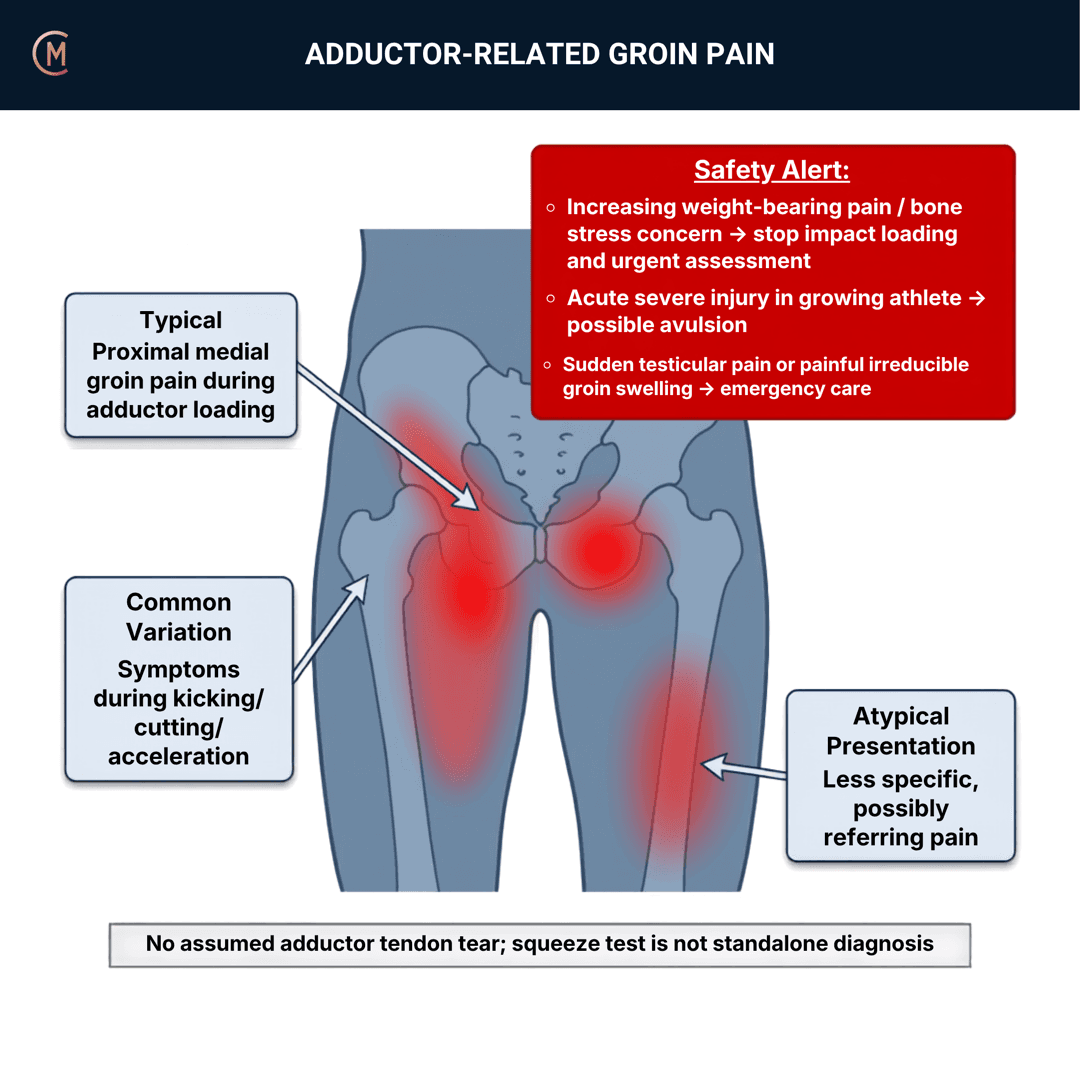
Who: Field-sport athletes. Soccer, AFL, rugby, hockey — anything with cutting and kicking.
What: Adductor-related groin pain, one of the four defined clinical entities in the Doha taxonomy.
How it behaves: Localised groin pain near the pubic symphysis or adductor origin. Worse with cutting, kicking and change of direction. Gradual onset, may follow acute overload. Eased by rest.
The one thing to take from this page:
Learn the Doha map, not the four labels. Four groin entities, one structured examination — and athletes commonly meet criteria for more than one at the same time, so "which one is it" is usually the wrong question.
The Doha map
| Entity | Where it's tender | What reproduces it |
|---|---|---|
| Adductor-related — this page | Adductor origin | Resisted adduction (squeeze) |
| Pubic-related | Pubic symphysis | Squeeze and sit-up |
| Inguinal-related | Inguinal canal, pubic tubercle | Cough, sneeze, resisted sit-up |
| Iliopsoas-related | Deep to inguinal ligament | Resisted hip flexion |
| Hip-related | The joint | FADIR, ↓ IR in flexion |
⚠️ No Australian guideline exists, and the Doha agreement is a terminology consensus — it tells you what to call things and how to examine, not what to do.
2 · SE — THE SUBJECTIVE PATTERN (the 70%)
Five stages, in your course's order. The subjective narrows you to the groin. The objective decides which entities are in play — so keep the subjective focused on load, mechanism and screening.
MAIN PROBLEM
"It's my groin when I change direction."
"Kicking sets it off."
"It's been building for a few weeks."
BODY CHART
- Localised at the adductor origin, near the pubic symphysis.
- Mark the symphysis separately — central pain is pubic-related.
- Mark the inguinal canal and pubic tubercle — that is inguinal-related.
- Mark deep anterior — iliopsoas-related, or the joint.
- Mark any testicular or scrotal symptoms. That is a different conversation and it needs asking.
BEHAVIOUR
| Fits adductor-related | Points elsewhere | |
|---|---|---|
| Aggs | Cutting, kicking, change of direction, acceleration | Cough, sneeze, sit-ups → inguinal-related |
| Onset | Gradual, may follow acute overload | Sudden with a tearing sensation → acute adductor injury |
| Eases | Rest, supported standing | Nothing eases it → screen |
| Severity | VAS 0–10 at best / at worst / right now | — |
| Weight-bearing | Able to run, painful | Can't weight-bear or hop → bone stress |
| Night | Sore after activity | Night pain → screen |
HISTORY
- Training load — volume, intensity, surface, and what changed. A spike is the usual story.
- Pre-season, in-season, or return from a break?
- Previous groin injury? Prior symptoms carry into the risk profile [1].
- Kicking leg or standing leg?
- Any period of low energy availability, weight loss, or disordered eating? That is the bone-stress question, asked plainly.
SPECIAL / SCREENING QUESTIONS
- Can they hop on it? Ask before you test it.
- Night pain, rest pain, fever, weight loss?
- Any lump, bulge, or symptoms with coughing?
- Testicular pain, urinary symptoms, or abdominal symptoms?
- In an adolescent — a single explosive kick or sprint with sudden pain? That is an apophyseal avulsion.
Assessing this region? Download the Hip & Groin assessment template →
3 · HYPOTHESIS RANKING
| Competing pattern | The one discriminating feature |
|---|---|
| Pubic-related groin pain | Central, at the symphysis — and the sit-up test is positive alongside the squeeze. |
| Inguinal-related (athletic pubalgia) | Tender at the pubic tubercle, conjoint tendon or inguinal canal; pain with cough, sneeze and resisted sit-up. |
| Iliopsoas-related | Tender deep to the inguinal ligament; pain on resisted hip flexion. |
| Hip-related (FAI, labral) | Deep anterior pain, positive FADIR, reduced internal rotation in flexion. It's the joint. |
| Inguinal hernia | A palpable bulge or impulse on cough. A surgical question, not a physio one. |
The one that outranks the table
Pubic ramus or femoral neck stress fracture. Weight-bearing pain, inability to hop, night pain, or a RED-S risk profile moves you off this page and into imaging. A femoral neck stress fracture managed as a groin strain is the worst outcome available on this differential.
And the reframe that changes your examination
These entities are not mutually exclusive. Applying the Doha criteria to a cohort of athletes with groin pain found a high prevalence of multiple entities in the same athlete [2]. So examine for all of them every time, and treat what you find in the proportion you find it.
4 · RED FLAGS — DON'T MISS THIS
This section is free, on every pattern, forever. Safety is never gated.
| Finding | What it suggests | What you do |
|---|---|---|
| Groin pain with inability to weight-bear or hop | Femoral neck stress fracture | Urgent imaging — a normal X-ray doesn't clear it; MRI is the test (Bernstein et al. 2022) [21]. Do not load |
| Night pain or rest pain in a runner or endurance athlete | Bone stress injury | Image |
| RED-S risk profile — low energy availability, menstrual disturbance, weight loss | Bone stress injury | Image and refer |
| A palpable bulge or cough impulse | Inguinal hernia | Medical review |
| Fever, unwell, systemic symptoms | Infection | Medical review, same day |
| Testicular, scrotal or urinary symptoms | Urological pathology | Medical review |
| Adolescent, sudden pain during an explosive kick or sprint | Apophyseal avulsion | Image |
| Progressive pain despite genuine deload, or an 'adductor strain' that keeps coming back | Reconsider the whole diagnosis — a pubic stress fracture has presented as an adductor longus strain (Marshall & Gringmuth 2019) [22] | Image |
The rule: load-related groin pain at the adductor origin in an athlete who can hop, with a clean systemic screen, is yours. Weight-bearing pain, night pain, a bulge, systemic symptoms or a RED-S profile is not.
Cross-links: Pubic-related groin pain · Athletic pubalgia / inguinal-related · Iliopsoas-related pain · Femoroacetabular impingement
5 · OE — THE OBJECTIVE (the 30%)
Members
Sections 5 to 7 are for members
The objective exam, management and pearls, plus the six-minute lesson and the debrief. Free with an account.
Sign in or join free6 · MX — MANAGEMENT ESSENTIALS
Members
Sections 5 to 7 are for members
The objective exam, management and pearls, plus the six-minute lesson and the debrief. Free with an account.
Sign in or join free7 · CLINICAL PEARLS + RETRIEVAL CHECK
Members
Sections 5 to 7 are for members
The objective exam, management and pearls, plus the six-minute lesson and the debrief. Free with an account.
Sign in or join freeMembers
The 4-minute lesson is for members
Twelve slides on this pattern: what you'll hear, what to examine, what to do. Free with an account.
Sign in or join freeGuideline anchor
No Australian guideline covers groin pain in athletes, and no treatment guideline of any nationality does.
More
Anchored to the Doha agreement on terminology and definitions (Weir et al. 2015, PMID 26031643) for the classification the whole groin block is built on, to the foundational active-training randomised trial (Hölmich et al. 1999, PMID 9989713) for first-line management, and to the adductor strengthening prevention cluster-randomised trial (Harøy et al. 2019, PMID 29891614) for prevention.
The Doha agreement is a terminology and definitions consensus, not a treatment guideline — it tells you what to call things and how to examine for them, not what to do. No Australian document exists. The management evidence is trials and reviews, and the systematic reviews describe the treatment literature's quality as limited.
Members
The evidence summary is for members
Verified diagnostic accuracy, where the evidence stands and what it doesn't settle. Free with an account.
Sign in or join freeSources · 20
ShowHide
Every source on this page resolves and title-verifies against PubMed. Newest first.
- 2022Esteve et al. (2022). Past-season, pre-season and in-season risk assessment of groin problems in male football players: a prospective full-season study. British journal of sports medicine, 56(9), 484-489. https://doi.org/10.1136/bjsports-2020-102606
- 2018Taylor et al. (2018). Multidisciplinary Assessment of 100 Athletes With Groin Pain Using the Doha Agreement: High Prevalence of Adductor-Related Groin Pain in Conjunction With Multiple Causes. Clinical journal of sport medicine : official journal of the Canadian Academy of Sport Medicine, 28(4), 364-369. https://doi.org/10.1097/JSM.0000000000000469
- 2011Delahunt et al. (2011). The thigh adductor squeeze test: 45° of hip flexion as the optimal test position for eliciting adductor muscle activity and maximum pressure values. Manual therapy, 16(5), 476-80. https://doi.org/10.1016/j.math.2011.02.014
- 2020Beddows et al. (2020). Normal values for hip muscle strength and range of motion in elite, sub-elite and amateur male field hockey players. Physical therapy in sport : official journal of the Association of Chartered Physiotherapists in Sports Medicine, 46, 169-176. https://doi.org/10.1016/j.ptsp.2020.08.014
- 2015Pesquer et al. (2015). Imaging of adductor-related groin pain. Diagnostic and interventional imaging, 96(9), 861-9. https://doi.org/10.1016/j.diii.2014.12.008
- 2014Drew et al. (2014). Imaging and clinical tests for the diagnosis of long-standing groin pain in athletes. A systematic review. Physical therapy in sport : official journal of the Association of Chartered Physiotherapists in Sports Medicine, 15(2), 124-9. https://doi.org/10.1016/j.ptsp.2013.11.002
- 2024Heijboer et al. (2024). Clinical examination tests for adductor- and pubic-related groin pain in athletes with longstanding groin pain: Inter-examiner reliability and prevalence of positive tests. Physical therapy in sport : official journal of the Association of Chartered Physiotherapists in Sports Medicine, 66, 9-16. https://doi.org/10.1016/j.ptsp.2023.12.008
- 2017Tak et al. (2017). Is lower hip range of motion a risk factor for groin pain in athletes? A systematic review with clinical applications. British journal of sports medicine, 51(22), 1611-1621. https://doi.org/10.1136/bjsports-2016-096619
- 2025Martins et al. (2025). Risk Factors Associated with Groin Pain in Athletes: A Systematic Review. Life (Basel, Switzerland), 15(11). https://doi.org/10.3390/life15111688
- 1999Hölmich et al. (1999). Effectiveness of active physical training as treatment for long-standing adductor-related groin pain in athletes: randomised trial. Lancet (London, England), 353(9151), 439-43. https://doi.org/10.1016/S0140-6736(98)03340-6
- 2011Hölmich et al. (2011). Continued significant effect of physical training as treatment for overuse injury: 8- to 12-year outcome of a randomized clinical trial. The American journal of sports medicine, 39(11), 2447-51. https://doi.org/10.1177/0363546511416075
- 2023Thorborg (2023). Current Clinical Concepts: Exercise and Load Management of Adductor Strains, Adductor Ruptures, and Long-Standing Adductor-Related Groin Pain. Journal of athletic training, 58(7-8), 589-601. https://doi.org/10.4085/1062-6050-0496.21
- 2011Weir et al. (2011). Manual or exercise therapy for long-standing adductor-related groin pain: a randomised controlled clinical trial. Manual therapy, 16(2), 148-54. https://doi.org/10.1016/j.math.2010.09.001
- 2019Harøy et al. (2019). The Adductor Strengthening Programme prevents groin problems among male football players: a cluster-randomised controlled trial. British journal of sports medicine, 53(3), 150-157. https://doi.org/10.1136/bjsports-2017-098937
- 2023Brito et al. (2023). Nonsurgical Interventions for the Management of Long-Standing Groin Pain in Athletes: A Systematic Review of Randomized Controlled Trials. Cureus, 15(6), e40149. https://doi.org/10.7759/cureus.40149
- 2019Ramazzina et al. (2019). Groin pain in athletes and non-interventional rehabilitative treatment: a systematic review. The Journal of sports medicine and physical fitness, 59(6), 1001-1010. https://doi.org/10.23736/S0022-4707.18.08879-5
- 2021Bisciotti et al. (2021). The conservative treatment of longstanding adductor-related groin pain syndrome: a critical and systematic review. Biology of sport, 38(1), 45-63. https://doi.org/10.5114/biolsport.2020.97669
- 2021Serner et al. (2021). One-Year Clinical and Imaging Follow-up After Exercise-Based Treatment for Acute Complete Adductor Longus Tendon Avulsions in Athletes: A Prospective Case Series. The American journal of sports medicine, 49(11), 3004-3013. https://doi.org/10.1177/03635465211015996
- 2015Weir et al. (2015). Doha agreement meeting on terminology and definitions in groin pain in athletes. British journal of sports medicine, 49(12), 768-74. https://doi.org/10.1136/bjsports-2015-094869
- 2021Dempsey et al. (2021). Nomenclature for groin pain in athletes. The British journal of radiology, 94(1126), 20201333. https://doi.org/10.1259/bjr.20201333
Mapped to this pattern
Generic measures that also apply
- Borg RPE
Borg Rating of Perceived Exertion Scale (6-20)
perceived exertion · 1 items · 1 min
- GROC
Global Rating of Change Scale
perceived change since baseline · 1 items · 1 min
- NPRS
Numeric Pain Rating Scale
pain intensity · 1 items · 1 min
- PGIC
Patient Global Impression of Change
perceived change since baseline · 1 items · 1 min
- PSFS
Patient-Specific Functional Scale
patient-generated function · 3 items · 2 min
- SANE
Single Assessment Numeric Evaluation
patient-rated function as a percentage of normal · 1 items · 1 min
- VAS
Visual Analogue Scale
pain intensity · 1 items · 1 min
- Borg CR10
Borg Category Ratio 10 Scale
perceived exertion or symptom intensity, ratio scale · 1 items · 1 min
- GAS
Goal Attainment Scaling
individualised goal achievement · 10 min
Did this page do its job?
CliniStudy is in beta. One tap is enough — it decides what gets fixed first.