
1 · SNAPSHOT
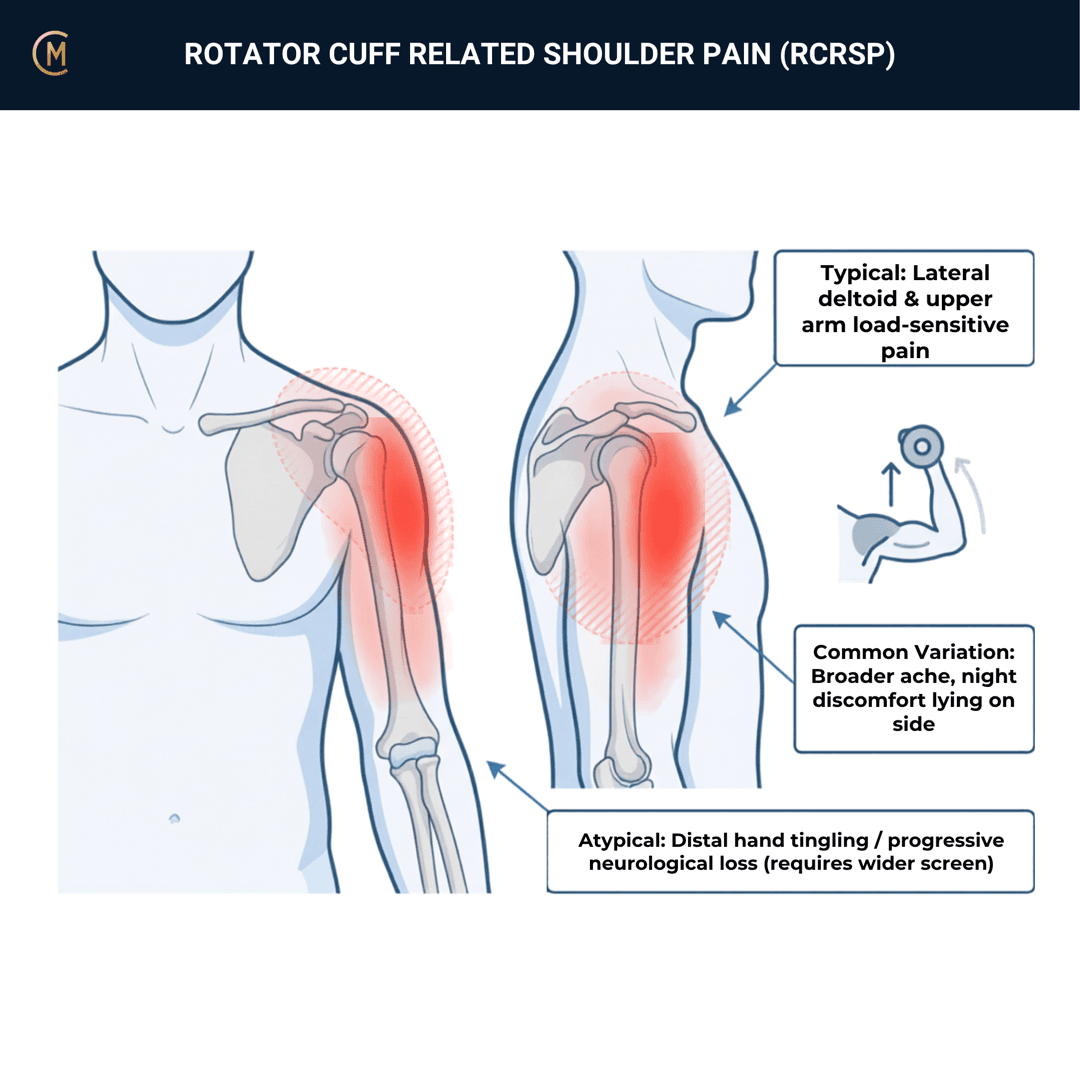
Who: Middle-aged adults and loaded overhead athletes. Atraumatic or load-related onset.
What: Lateral or anterior shoulder pain, often referring to the deltoid insertion. Rarely below the elbow.
How it behaves: Load-sensitive and mechanical. Painful arc roughly 70–120°. Worse overhead, reaching behind, lifting. Worse lying on that side.
The numbers that matter:
| Where it sits | Figure |
|---|---|
| Community prevalence of shoulder pain | median 16% (range 0.67–55.2%) |
| Primary care prevalence | 1.01–4.84% (median 2.36%) |
| New cases | median 37.8 per 1000 people per year |
([1]. Higher in women, and higher in high-income countries.)
The rotator cuff is the structure most often implicated in shoulder pain presenting to primary care [2]. On a five-week MSK block it will be your most common shoulder presentation, comfortably.
RCRSP is an umbrella, not a structure. Tendinopathy, subacromial pain, bursitis and symptomatic partial-thickness tears all sit under it, because we cannot reliably separate them clinically and separating them rarely changes what you do [3][4].
⚠️ The only Australian guideline is old: the RACGP- and APA-endorsed rotator cuff syndrome guideline, written for working adults and predating the trials below. Anchored to the JOSPT Rotator Cuff Tendinopathy Clinical Practice Guideline [5]. The closest Australian reference point is Crookes et al., Aust J Gen Pract 2023 [6] — a general-practice review, not a standard.
Pattern > Label. Nobody is grading you on whether you said "bursitis" or "tendinopathy". They're grading you on whether you sorted load-sensitive cuff pain vs tear vs stiff-and-global vs not-the-shoulder-at-all.
2 · SE — THE SUBJECTIVE PATTERN (the 70%)
Five stages, in the order your course teaches them. Insidious onset → run BEHAVIOUR before HISTORY. Traumatic onset → flip them, because the mechanism is the story.
MAIN PROBLEM
"What's the main problem for you today?" Then stop talking. You want the function they've lost, not the pain score. Reaching the top shelf. Washing their hair. Serving. Sleeping on that side.
BODY CHART
Chart interpretation: Upper-arm referred discomfort and distal neurological warning features are distinct. Prominent hand tingling or progressive neurological loss warrants broader assessment.
- Lateral and anterior shoulder, often pointing to the deltoid insertion with a whole hand rather than one finger.
- Rarely below the elbow. Pain into the hand is a cervical question until you've cleared it.
- Clear what you're not treating. Cervical spine, thoracic spine, elbow, and both upper limbs for neurological symptoms.
- Type: ache, catching, sharp on a specific arc. Usually intermittent early, more constant as it gets irritable.
BEHAVIOUR
- Aggs: overhead reaching, reaching behind (seatbelt, back pocket, bra strap), carrying, lifting away from the body, sustained arm-out postures, lying on it.
- Eases: arm supported and by the side, changing position, heat, unloading the arm. If nothing eases it, question the label.
- 24-hr pattern: stiff and sore first thing, easing with gentle movement, building again with a day of use. Morning stiffness < 30 min = M. > 30 min = In — a prompt to screen inflammatory, not a diagnosis.
- Night: wakes on rolling onto it, settles once they move off it. Position-easable night pain is mechanical. Unremitting night pain is not.
- Severity: VAS 0–10 at best / at worst / right now.
- Irritability: the vigour of the provoking activity, the severity of what's provoked, and the time to settle. All three. This decides whether your O/E is LIMITED or FULL, and it decides your starting exercise dose.
HISTORY
- Onset: gradual load change (new job, new program, painting the house, pre-season) or a specific event.
- The question that changes the pathway: was there trauma, and could they lift the arm afterwards? A fall or a heavy lift in someone over 40–50, followed by real weakness, is a different conversation (§3).
- Previous episodes, previous imaging, previous injection, what they were told it was. Half the fear in the room came from the word "tear".
- Work and sport demands — overhead load, repetition, and how much control they have over it ([7], which is the guideline that actually covers return to work).
SPECIAL / SCREENING QUESTIONS
General health, weight loss, night sweats, fever, malignancy history, inflammatory features, medications including corticosteroids, and any neurological symptoms in the arm. See §4.
Irritability — the bit that actually sets your plan
| Irritability | Looks like | Your O/E | Your starting dose |
|---|---|---|---|
| High | Pain at rest, provoked by little, slow to settle | LIMITED. Stop at P1 | Isometrics, short range, low load |
| Moderate | Provoked by real load, settles within minutes | Most tests, ± overpressure | Isotonic in tolerated range |
| Low | Needs vigorous or sustained load, settles fast | FULL, with overpressure | Load it properly |
Say out loud which one you chose and why. That sentence is what your educator is marking.
Assessing this region? Download the Shoulder assessment template →
3 · HYPOTHESIS RANKING
Top competing patterns, one discriminating feature each. Rank them — then rule out the dangerous one first.
| Competing pattern | The one discriminating feature |
|---|---|
| Full-thickness rotator cuff tear | Sudden onset after a fall or heavy lift (>40–50 yrs), then marked weakness. PROM preserved vs AROM. Positive drop arm / external rotation lag |
| Massive rotator cuff tear | "Can't lift the arm" rather than "it hurts". Pseudoparalysis <90°, scapular hitch, positive Hornblower, visible atrophy |
| Adhesive capsulitis | Global loss of AROM and PROM in a capsular pattern (ER > ABD > flexion), firm end-feel. RCRSP keeps near-full passive range |
| Cervical referral | Symptoms below the elbow, neck movement changes the shoulder pain, positive neurological findings. Shoulder loading may be near-normal |
| Not the shoulder at all | Doesn't behave mechanically. Unchanged by arm position or load → §4 |
Compare active and passive elevation to inform the differential. Preserved passive range does not establish an intact or torn cuff; pain inhibition, neurological findings and stiffness also matter.
Jones' hypothesis categories that actually change your plan here: sources of symptoms (cuff vs capsule vs neck), impairments (which is the load-sensitive direction), precautions (what irritability lets you do today), and contributing factors (work and sport load, and what they believe about their scan).
Consistency = confidence. If the history says load and the objective says load, you're done deciding.
4 · RED FLAGS — DON'T MISS THIS
This section is free, on every pattern, forever.
The honest position
There is no shoulder equivalent of the Downie red flag accuracy review. Our library holds no verified diagnostic accuracy data for shoulder red flags. What we have is a pattern rule and an Australian general-practice review that says the same thing: acute injuries and red flag presentations go to urgent specialist referral, and most of the rest is managed non-surgically [6].
So screen by behaviour and combination, not by checklist length.
What to actually screen
| Signs / symptoms | Implication |
|---|---|
| Trauma, then inability to elevate the arm, or marked weakness | Full-thickness or massive tear · fracture · dislocation |
| Progressive weakness, wasting, or dermatomal symptoms below the elbow | Cervical radiculopathy · peripheral nerve lesion |
| Fever, hot swollen joint, systemically unwell, recent injection or surgery | Septic arthritis / infection |
| Malignancy history, unexplained weight loss, night sweats, unremitting night pain not eased by position | Malignancy |
| Multiple joints, morning stiffness > 30 min, systemic features | Inflammatory arthropathy |
| Pain unchanged by arm position or load; varies with meals, exertion or breathing | Visceral or cardiac referral |
Act on
Trauma + can't lift the arm — do not treat this as a cuff. Assess for fracture, dislocation and full-thickness tear, and refer. An acute traumatic tear in an active patient is time-sensitive.
Systemically unwell with a hot, painful shoulder — same-day medical referral. Do not mobilise a possible septic joint.
Trauma + inability to elevate requires assessment for fracture, dislocation, cuff injury and other causes.
Right shoulder pain after a fatty meal? Think gallbladder.
Pain that doesn't behave mechanically isn't a mechanical problem.
Red flags shift probability. They don't diagnose. When in doubt, say it out loud to your educator — that is the correct move, every time.
5 · OE — THE OBJECTIVE
Members
Sections 5 to 7 are for members
The objective exam, management and pearls, plus the six-minute lesson and the debrief. Free with an account.
Sign in or join free6 · MX — MANAGEMENT ESSENTIALS
Members
Sections 5 to 7 are for members
The objective exam, management and pearls, plus the six-minute lesson and the debrief. Free with an account.
Sign in or join free7 · CLINICAL PEARLS + OPTIONAL RETRIEVAL
Members
Sections 5 to 7 are for members
The objective exam, management and pearls, plus the six-minute lesson and the debrief. Free with an account.
Sign in or join freeMembers
The 5-minute lesson is for members
Twelve slides on this pattern: what you'll hear, what to examine, what to do. Free with an account.
Sign in or join freeGuideline anchor
The only Australian guideline is old: the Clinical Practice Guidelines for the Management of Rotator Cuff Syndrome in the Workplace (UNSW Rural Clinical School, 2013; endorsed by RACGP, RANZCR, the APA and the ARA), for working adults.
More
Anchored to the JOSPT Rotator Cuff Tendinopathy: Diagnosis, Nonsurgical Medical Care and Rehabilitation Clinical Practice Guideline (Desmeules et al. 2025, PMID 40165544).
No Australian clinical care standard exists for rotator cuff-related shoulder pain. The closest Australian reference point is Crookes et al., Aust J Gen Pract 2023 — a general-practice narrative review, not a guideline. The page says this out loud.
Members
The evidence summary is for members
Verified diagnostic accuracy, where the evidence stands and what it doesn't settle. Free with an account.
Sign in or join freeSources · 23
ShowHide
Every source on this page resolves and title-verifies against PubMed. Newest first.
- 2022Lucas et al. (2022). A systematic review of the global prevalence and incidence of shoulder pain. BMC musculoskeletal disorders, 23(1), 1073. https://doi.org/10.1186/s12891-022-05973-8
- 2024Zhao et al. (2024). Evidence-based approach to the shoulder examination for subacromial bursitis and rotator cuff tears: a systematic review and meta-analysis. BMC musculoskeletal disorders, 25(1), 1028. https://doi.org/10.1186/s12891-024-08144-z
- 2020Doiron-Cadrin et al. (2020). Shoulder Rotator Cuff Disorders: A Systematic Review of Clinical Practice Guidelines and Semantic Analyses of Recommendations. Archives of physical medicine and rehabilitation, 101(7), 1233-1242. https://doi.org/10.1016/j.apmr.2019.12.017
- 2025Lewis et al. (2025). What's in a Name? The Case for Using "Rotator Cuff-Related Shoulder Pain" in Clinical Practice. The Journal of orthopaedic and sports physical therapy, 55(7), 1-3. https://doi.org/10.2519/jospt.2025.13405
- 2025Desmeules et al. (2025). Rotator Cuff Tendinopathy Diagnosis, Nonsurgical Medical Care, and Rehabilitation: A Clinical Practice Guideline. The Journal of orthopaedic and sports physical therapy, 55(4), 235-274. https://doi.org/10.2519/jospt.2025.13182
- 2023Crookes et al. (2023). Chronic shoulder pain. Australian journal of general practice, 52(11), 753-758. https://doi.org/10.31128/AJGP-04-23-6790
- 2022Lafrance et al. (2022). Diagnosing, Managing, and Supporting Return to Work of Adults With Rotator Cuff Disorders: A Clinical Practice Guideline. The Journal of orthopaedic and sports physical therapy, 52(10), 647-664. https://doi.org/10.2519/jospt.2022.11306
- 2024Silveira et al. (2024). Shoulder specific exercise therapy is effective in reducing chronic shoulder pain: A network meta-analysis. PloS one, 19(4), e0294014. https://doi.org/10.1371/journal.pone.0294014
- 2025Zhang et al. (2025). Effects of seven types of exercise in the treatment of rotator cuff-related shoulder pain (RCRSP): a systematic review and Bayesian network meta-analysis. Journal of orthopaedic surgery and research, 20(1), 1075. https://doi.org/10.1186/s13018-025-06514-4
- 2025Wu et al. (2025). Specific modes of exercise to improve rotator cuff-related shoulder pain: systematic review and meta-analysis. Frontiers in bioengineering and biotechnology, 13, 1560597. https://doi.org/10.3389/fbioe.2025.1560597
- 2025Lazzarini et al. (2025). Effectiveness of Additional or Standalone Corticosteroid Injections Compared to Physical Therapist Interventions in Rotator Cuff Tendinopathy: A Systematic Review and Meta-Analysis of Randomized Controlled Trials. Physical therapy, 105(3). https://doi.org/10.1093/ptj/pzaf006
- 2021Hopewell et al. (2021). Progressive exercise compared with best practice advice, with or without corticosteroid injection, for the treatment of patients with rotator cuff disorders (GRASP): a multicentre, pragmatic, 2 × 2 factorial, randomised controlled trial. Lancet (London, England), 398(10298), 416-428. https://doi.org/10.1016/S0140-6736(21)00846-1
- 2018Beard et al. (2018). Arthroscopic subacromial decompression for subacromial shoulder pain (CSAW): a multicentre, pragmatic, parallel group, placebo-controlled, three-group, randomised surgical trial. Lancet (London, England), 391(10118), 329-338. https://doi.org/10.1016/S0140-6736(17)32457-1
- 2021Paavola et al. (2021). Subacromial decompression versus diagnostic arthroscopy for shoulder impingement: a 5-year follow-up of a randomised, placebo surgery controlled clinical trial. British journal of sports medicine, 55(2), 99-107. https://doi.org/10.1136/bjsports-2020-102216
- 2019Vandvik et al. (2019). Subacromial decompression surgery for adults with shoulder pain: a clinical practice guideline. BMJ (Clinical research ed.), 364, l294. https://doi.org/10.1136/bmj.l294
- 2025Chepeha et al. (2025). A standardized criteria-based progressive shoulder exercise program is effective in managing rotator cuff-related shoulder pain: A prospective cohort study. PloS one, 20(7), e0328728. https://doi.org/10.1371/journal.pone.0328728
- 2021Clausen et al. (2021). Effectiveness of Adding a Large Dose of Shoulder Strengthening to Current Nonoperative Care for Subacromial Impingement: A Pragmatic, Double-Blind Randomized Controlled Trial (SExSI Trial). The American journal of sports medicine, 49(11), 3040-3049. https://doi.org/10.1177/03635465211016008
- 2013Hermans et al. (2013). Does this patient with shoulder pain have rotator cuff disease?: The Rational Clinical Examination systematic review. JAMA, 310(8), 837-47. https://doi.org/10.1001/jama.2013.276187
- 2017Gismervik et al. (2017). Physical examination tests of the shoulder: a systematic review and meta-analysis of diagnostic test performance. BMC musculoskeletal disorders, 18(1), 41. https://doi.org/10.1186/s12891-017-1400-0
- 2017Jain et al. (2017). The Diagnostic Accuracy of Special Tests for Rotator Cuff Tear: The ROW Cohort Study. American journal of physical medicine & rehabilitation, 96(3), 176-183. https://doi.org/10.1097/PHM.0000000000000566
- 2025Sanders et al. (2025). Rotator Cuff Imaging Abnormalities in Asymptomatic Shoulders: A Systematic Review. The Journal of orthopaedic and sports physical therapy, 55(12), 1-16. https://doi.org/10.2519/jospt.2025.13611
- 2020Liang et al. (2020). Diagnostic performance of ultrasound for rotator cuff tears: a systematic review and meta-analysis. Medical ultrasonography, 22(2), 197-202. https://doi.org/10.11152/mu-2352
- 2018Lewis (2018). The End of an Era?. The Journal of orthopaedic and sports physical therapy, 48(3), 127-129. https://doi.org/10.2519/jospt.2018.0102
Mapped to this pattern
- ASES
American Shoulder and Elbow Surgeons Standardized Shoulder Assessment Form
shoulder pain and function · 11 items · 5 min
- SPADI
Shoulder Pain and Disability Index
shoulder pain and disability · 13 items · 5 min
- SST
Simple Shoulder Test
shoulder function · 12 items · 2 min
- Penn
Penn Shoulder Score
shoulder pain, satisfaction and function · 6 min
- STarT MSK
STarT Musculoskeletal Tool
risk stratification across MSK regions · 10 items · 3 min
- WORC
Western Ontario Rotator Cuff Index
rotator cuff disease quality of life · 21 items · 8 min
Generic measures that also apply
- Borg RPE
Borg Rating of Perceived Exertion Scale (6-20)
perceived exertion · 1 items · 1 min
- DASH
Disabilities of the Arm, Shoulder and Hand
upper limb disability · 30 items · 8 min
- GROC
Global Rating of Change Scale
perceived change since baseline · 1 items · 1 min
- NPRS
Numeric Pain Rating Scale
pain intensity · 1 items · 1 min
- PGIC
Patient Global Impression of Change
perceived change since baseline · 1 items · 1 min
- PSFS
Patient-Specific Functional Scale
patient-generated function · 3 items · 2 min
- QuickDASH
QuickDASH
upper limb disability, short form · 11 items · 4 min
- SANE
Single Assessment Numeric Evaluation
patient-rated function as a percentage of normal · 1 items · 1 min
- UEFI
Upper Extremity Functional Index
upper limb function · 20 items · 5 min
- VAS
Visual Analogue Scale
pain intensity · 1 items · 1 min
- Borg CR10
Borg Category Ratio 10 Scale
perceived exertion or symptom intensity, ratio scale · 1 items · 1 min
- GAS
Goal Attainment Scaling
individualised goal achievement · 10 min
Did this page do its job?
CliniStudy is in beta. One tap is enough — it decides what gets fixed first.