
1 · SNAPSHOT
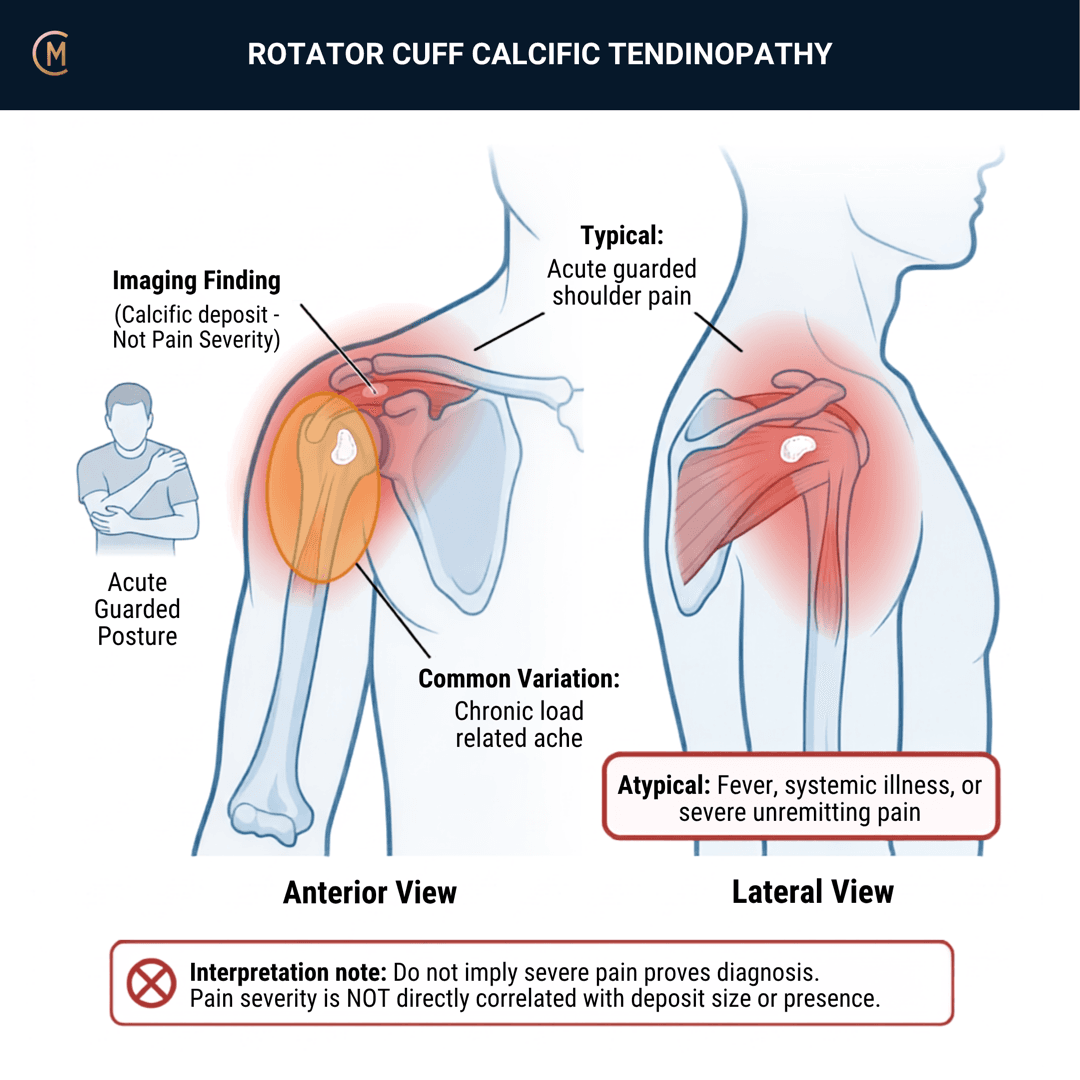
The most painful shoulder you will meet, and one of the few that gets better on its own.
Illness script in one line: severe lateral shoulder pain arriving over hours to days in a 30–60-year-old with no injury, so painful at rest and at night that they cannot lie on that side, holding the arm guarded against the body and flinching at small movements.
Caseload frequency: uncommon as a proportion of shoulders, unmistakable when it arrives, and frequently mislabelled as a bad impingement. Read further: clinical features [1].
The pain level is the diagnostic feature
The best line on this page is a classic description: "feels acutely worse than usual impingement-type pain."
That is not a throwaway description. It is the discriminator. Rotator cuff–related shoulder pain is load-related, tolerable at rest, and annoying at night. This is none of those things.
| Rotator cuff–related shoulder pain | Calcific tendinopathy, acute phase | |
|---|---|---|
| Onset | Weeks to months, load-related | Hours to days, often no trigger at all |
| Pain at rest | Mild or absent | Severe: very painful at rest and at night |
| Night | Rolls onto it and wakes | Cannot lie on that side at all |
| What they do with the arm | Uses it, guards end-range | Typical: often holds arm guarded by side |
| Your examination | Load tests provoke it | Typical: strong pain response to relatively small movements |
| Where it's going | Depends on what you do | It can resorb on its own |
The practical consequence: a shoulder that is far more painful than its story justifies is not a cuff you should be loading. It is a shoulder that needs a diagnosis before a programme.
2 · SE — THE SUBJECTIVE PATTERN (the 70%)
Main problem
"It came out of nowhere and it's the worst pain I've had." sudden or short-term history of severe lateral shoulder pain.
Listen for the absence of a mechanism. often 30–60 yrs; may be atraumatic. A severe shoulder with no injury behind it is unusual and it should make you slow down.
Body chart
Lateral shoulder, often referring to the deltoid insertion. very tender over supraspinatus region.
It should not go past the elbow, and there should be no numbness. If it does, or there is, that's a different page.
Behaviour
The classic line: very painful at rest and at night; can't lie on that side.
This is the section that carries the diagnosis. Ask about night specifically and take the answer seriously: can you lie on it at all? How many times are you up? What position gets you back to sleep? "I've been sleeping in the recliner" is a very different answer from "it wakes me if I roll onto it."
Aggs: everything, and small movements more than you'd expect. Reaching, dressing, the seatbelt, lying on it.
Eases: the arm supported against the body, sometimes ice, sometimes nothing.
24-hr pattern: in the acute phase there is no good time of day — constant, and worst at night. That constancy is the discriminator from a load-sensitive cuff, which has a pattern.
Severity: VAS 0–10 at best / at worst / right now. Expect the "at worst" to be the highest number you record on any shoulder this placement.
Irritability, using UniSA's three-part definition — resting symptoms, the vigour needed to provoke, and the time to settle — is high, and it should be recorded as high. That single judgement determines what you do in the first session more than any test.
History
Hours to days, from nothing to severe. Ask what they were doing when it started, and accept "nothing" as an answer — this is one of the presentations where that answer is genuinely informative rather than a failure of history taking.
Ask about previous episodes — in this shoulder or the other one.
Special / screening questions
- Any fever, feeling unwell, or systemic symptoms? Section 4, every time — severe pain plus warmth is not automatically calcific.
- Any trauma at all? If yes, this is probably a different page.
- Diabetes and thyroid disease. Worth asking on any painful stiff shoulder.
- Smoking history, weight loss, or a cough? The Pancoast page is free forever and exists for exactly this screen.
Assessing this region? Download the Shoulder assessment template →
3 · HYPOTHESIS RANKING
The stiff/painful shoulder differential is the source for the top three.
| Pattern | The one discriminating feature |
|---|---|
| Calcific tendinopathy (acute) | Pain wildly out of proportion to the story, arriving over hours to days, with no trauma and no stiffness pattern. |
| Adhesive capsulitis | Global loss of active AND passive range in a capsular pattern with a firm end-feel. Calcific limits range by pain, not by capsule. Its own page. |
| Glenohumeral osteoarthritis | Over 50, crepitus with passive rotation, bony end-feel, gradual over years. Its own page. |
| Rotator cuff–related shoulder pain | Load-related, tolerable at rest, responds to something. Its own page. |
| Septic arthritis | Systemically unwell, fever, and pain on any passive movement. Section 4 — and warmth can be part of the calcific picture too. |
| Pancoast tumour | Non-mechanical, unrelieved by rest or position, progressive, smoker, C8–T1 signs. Free-forever page. |
| Acute cuff tear | A traumatic event and loss of active elevation with preserved passive. Different story. |
The discriminator that does most of the work: is the range limited by pain or by a capsule — and is the patient systemically well.
4 · RED FLAGS — DON'T MISS THIS
Free forever. Never gated.
Three things belong, and the first one hides inside the usual objective description.
1. "May have warmth" — read that line carefully
may have warmth and strong pain response to relatively small movements.
That is an accurate description of an acutely resorbing calcific deposit. It is also an accurate description of a septic joint.
Escalate the same day if there is:
- Fever, rigors, sweats or feeling systemically unwell.
- Pain on every passive movement through the whole arc, rather than pain at particular ranges.
- Marked warmth or erythema over the joint — not just tenderness.
- Recent injection, aspiration or shoulder procedure.
- Immunosuppression, diabetes, IV drug use, or a prosthetic joint.
A calcific shoulder is agonising. It should not make the patient feel sick. If they feel unwell, that's a medical problem today — the same rule as the septic olecranon bursitis and gout pages.
2. Severe shoulder pain with no mechanism — screen once, properly
A shoulder that hurts this much with no injury deserves the screening questions asked out loud, not assumed.
Smoking history, weight loss, night pain that is not positional, a cough, hoarseness, or any C8–T1 neurological symptom → the Pancoast page, which is free forever. A student who screens once and documents it has done the job; a student who skips it because the pain "looks musculoskeletal" is relying on exactly the assumption that page exists to break.
3. It isn't always the shoulder
Calcific periarthritis has been reported at the hand, treated with barbotage [2], and reported causing carpal tunnel syndrome [3].
Why a student should know: an acutely, disproportionately painful small joint with no trauma is the same pattern in a different postcode — and it belongs with the gout page's reasoning, not with a mechanical diagnosis.
4. After a procedure
Acute calcific bursitis has been described as a complication of barbotage [4]. A patient who gets acutely worse in the days after a barbotage or injection goes back to the person who did it, not into a rehabilitation programme.
5 · OE — THE OBJECTIVE (the 30%)
Members
Sections 5 to 7 are for members
The objective exam, management and pearls, plus the six-minute lesson and the debrief. Free with an account.
Sign in or join free6 · MX — MANAGEMENT ESSENTIALS
Members
Sections 5 to 7 are for members
The objective exam, management and pearls, plus the six-minute lesson and the debrief. Free with an account.
Sign in or join free7 · CLINICAL PEARLS + RETRIEVAL CHECK
Members
Sections 5 to 7 are for members
The objective exam, management and pearls, plus the six-minute lesson and the debrief. Free with an account.
Sign in or join freeMembers
The 4-minute lesson is for members
Twelve slides on this pattern: what you'll hear, what to examine, what to do. Free with an account.
Sign in or join freeGuideline anchor
The only Australian guideline is old: the Clinical Practice Guidelines for the Management of Rotator Cuff Syndrome in the Workplace (UNSW Rural Clinical School, 2013; endorsed by RACGP, RANZCR, the APA and the ARA), which covers calcific tendonitis and calls non-surgical management the treatment of choice.
More
It is written for working adults and predates every study below. The comparison anchor is a study comparing physical therapy, corticosteroid injection and ultrasound-guided barbotage in Orthopaedic Journal of Sports Medicine (Gilbert et al. 2026, PMID 42052231). The conservative anchor is a meta-analysis of conservative approaches for pain relief and function in Orthopaedic Surgery (Moggio et al. 2025, PMID 41002287), with extracorporeal shockwave therapy meta-analysed in Physiotherapy Research International (Brindisino et al. 2024, PMID 38878302) and ultrasound-guided percutaneous lavage meta-analysed in the European Journal of Physical and Rehabilitation Medicine (Sconza et al. 2024, PMID 39382530). The clinical-picture anchor is a scoping review of clinical features in Shoulder and Elbow (Guido et al. 2025, PMID 39552687).
Apart from the 2013 workplace guideline, none of these is a clinical practice guideline. Two of the three headline syntheses are in physiotherapy or rehabilitation journals, which is unusual and worth noting — this is a shoulder condition where conservative care has actually been studied.
Members
The evidence summary is for members
Verified diagnostic accuracy, where the evidence stands and what it doesn't settle. Free with an account.
Sign in or join freeSources · 20
ShowHide
Every source on this page resolves and title-verifies against PubMed. Newest first.
- 2025Guido et al. (2025). Clinical features in rotator cuff calcific tendinopathy: A scoping review. Shoulder & elbow, 17(2), 121-129. https://doi.org/10.1177/17585732241244515
- 2025Pasion et al. (2025). Calcific periarthritis of the hand successfully treated with ultrasound-guided barbotage: A case report. Radiology case reports, 20(8), 4087-4091. https://doi.org/10.1016/j.radcr.2025.04.131
- 2024Ariyaratne et al. (2024). An Unusual Case of Calcific Periarthritis Causing Carpal Tunnel Syndrome and Its Management with Ultrasound-Guided Barbotage. The Indian journal of radiology & imaging, 34(3), 553-557. https://doi.org/10.1055/s-0043-1778650
- 2023Gokhan et al. (2023). Complication of barbotage, acute calcific bursitis treated successfully. Journal of radiology case reports, 17(8), 1-7. https://doi.org/10.3941/jrcr.v17i8.4603
- 2023Puel et al. (2023). Zero echo time MRI in shoulder MRI protocols for the diagnosis of rotator cuff calcific tendinopathy improves identification of calcific deposits compared to conventional MR sequences but remains sub-optimal compared to radiographs. European radiology, 33(9), 6381-6391. https://doi.org/10.1007/s00330-023-09602-3
- 2024Park et al. (2024). Imaging of Rotator Cuff Calcific Tendinopathy Using 18 F-NaF and 18 F-FDG PET/CT. Clinical nuclear medicine, 49(3), 270-271. https://doi.org/10.1097/RLU.0000000000004975
- 2026Bautista et al. (2026). Interpretable deep learning for rotator cuff calcific tendinopathy diagnosis: a multi-center study. Scientific reports, 16(1). https://doi.org/10.1038/s41598-026-51016-w
- 2025Moya et al. (2025). Therapeutic options in rotator cuff calcific tendinopathy. SICOT-J, 11, 9. https://doi.org/10.1051/sicotj/2025003
- 2026Gilbert et al. (2026). Comparison of Physical Therapy, Corticosteroid Injections, and Ultrasound-Guided Barbotage for Nonoperative and Operative Management of Calcific Tendinitis. Orthopaedic journal of sports medicine, 14(4), 23259671261434919. https://doi.org/10.1177/23259671261434919
- 2025Moggio et al. (2025). Efficacy of Conservative Approaches on Pain Relief and Function in Patients With Rotator Cuff Calcific Tendinopathy: Which Is the Best Option? A Systematic Review and Network Meta-Analysis. Orthopaedic surgery, 17(11), 3048-3066. https://doi.org/10.1111/os.70175
- 2024Caballero et al. (2024). Effectiveness of non-surgical management in rotator cuff calcific tendinopathy (the effect trial): protocol for a randomised clinical trial. BMJ open, 14(1), e074949. https://doi.org/10.1136/bmjopen-2023-074949
- 2024Brindisino et al. (2024). The effectiveness of extracorporeal shock wave therapy for rotator cuff calcific tendinopathy. A systematic review with meta-analysis. Physiotherapy research international : the journal for researchers and clinicians in physical therapy, 29(3), e2106. https://doi.org/10.1002/pri.2106
- 2024Sconza et al. (2024). Ultrasound-guided percutaneous lavage for the treatment of rotator cuff calcific tendinopathy: a systematic review with meta-analysis of randomized controlled trials. European journal of physical and rehabilitation medicine, 60(6), 995-1008. https://doi.org/10.23736/S1973-9087.24.08544-7
- 2024Forogh et al. (2024). Effect of extracorporeal shock wave therapy and ultrasound-guided percutaneous lavage in reducing the pain of rotator cuff calcific tendinopathy; an updated systematic review and meta-analysis. Journal of orthopaedics, 56, 151-160. https://doi.org/10.1016/j.jor.2024.05.023
- 2024Werry et al. (2024). Determining the efficacy of barbotage for pain relief in calcific tendinitis. JSES international, 8(5), 1039-1044. https://doi.org/10.1016/j.jseint.2024.06.005
- 2022Lee et al. (2022). Clinical and radiological outcomes of ultrasound-guided barbotage using a spinal needle and subacromial steroid injection for calcific tendinitis of the shoulder. Clinics in shoulder and elbow, 25(2), 140-144. https://doi.org/10.5397/cise.2021.00724
- 2025Pulsipher et al. (2025). Percutaneous Ultrasonic Barbotage: A Novel Approach for Persistent Rotator Cuff Calcific Tendinopathy Following Surgery. Current sports medicine reports, 24(1), 9-10. https://doi.org/10.1249/JSR.0000000000001221
- 2024Deschler & Galang (2024). Fluoroscopic-Guided Barbotage and Corticosteroid Injection for the Treatment of Symptomatic Calcification of the Lateral Collateral Ligament: A Case Report. Cureus, 16(7), e64407. https://doi.org/10.7759/cureus.64407
- 2024Sobel et al. (2024). Ultrasound-Guided Glucocorticoid Injection as a Treatment for Rotator Cuff Calcific Tendinopathy: A Case Report. Cureus, 16(9), e68934. https://doi.org/10.7759/cureus.68934
- 2023de Castro et al. (2023). Total Healing of a Partial Rupture of the Supraspinatus Tendon Using Barbotage Technique Associated with Platelet-Rich Plasma: A Randomized, Controlled, and Double-Blind Clinical Trial. Biomedicines, 11(7). https://doi.org/10.3390/biomedicines11071849
Mapped to this pattern
Generic measures that also apply
- Borg RPE
Borg Rating of Perceived Exertion Scale (6-20)
perceived exertion · 1 items · 1 min
- GROC
Global Rating of Change Scale
perceived change since baseline · 1 items · 1 min
- NPRS
Numeric Pain Rating Scale
pain intensity · 1 items · 1 min
- PGIC
Patient Global Impression of Change
perceived change since baseline · 1 items · 1 min
- PSFS
Patient-Specific Functional Scale
patient-generated function · 3 items · 2 min
- SANE
Single Assessment Numeric Evaluation
patient-rated function as a percentage of normal · 1 items · 1 min
- VAS
Visual Analogue Scale
pain intensity · 1 items · 1 min
- Borg CR10
Borg Category Ratio 10 Scale
perceived exertion or symptom intensity, ratio scale · 1 items · 1 min
- GAS
Goal Attainment Scaling
individualised goal achievement · 10 min
Did this page do its job?
CliniStudy is in beta. One tap is enough — it decides what gets fixed first.