
1 · SNAPSHOT
You will not treat this, and you may be the person who finally names it.
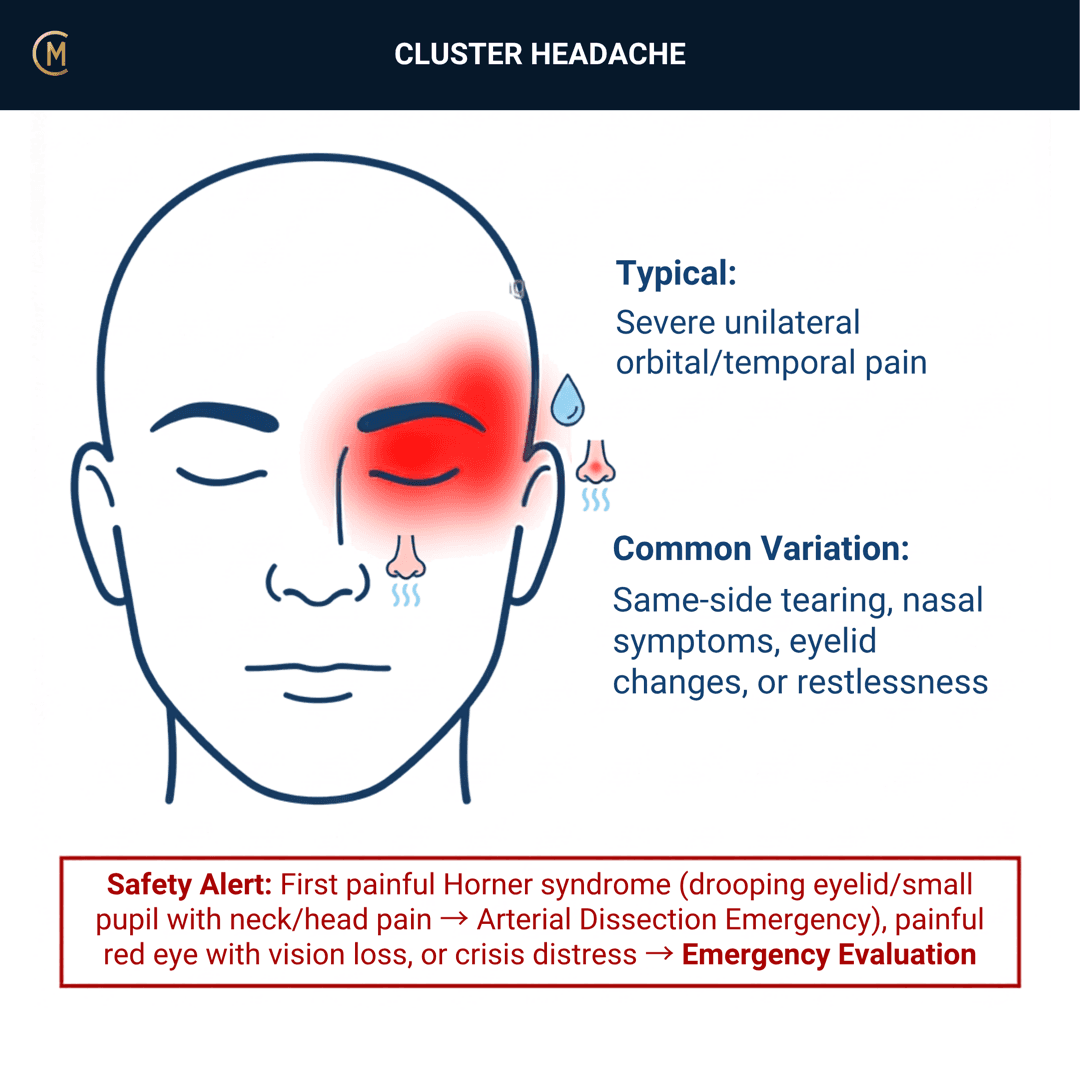
Illness script in one line: excruciating strictly unilateral orbital or temporal pain, 15 to 180 minutes, recurring daily in bouts lasting weeks to months, with tearing, nasal congestion and a drooping lid on the same side, and a patient who cannot sit still.
Caseload frequency: uncommon, and you will meet it. Read further: incidence and prevalence from population-based studies [1], a population-based time-trend study [2].
Why this page exists when you can't treat it
Because diagnostic delay is the norm. Read further: clinical characteristics and diagnostic delay [3], diagnostic and treatment approaches among family physicians [4]. "Misdiagnosed as migraine frequently" is the understated version of a well-documented problem.
And because two things on this page can change an outcome: spotting a secondary cause, and asking about mood.
Your three jobs: recognise it · screen it · refer it. Everything else is adjunct.
2 · SE — THE SUBJECTIVE PATTERN (the 70%)
MAIN PROBLEM
"Like a hot poker through my eye." They will use extreme language and they will be accurate. This is described as one of the most severe pains in medicine.
BODY CHART
- Strictly unilateral. Orbital, supraorbital, temporal. Side-locked within a bout.
- ± radiation to the jaw, teeth, neck. They may have seen a dentist first.
- Ipsilateral autonomic features: lacrimation, conjunctival injection, nasal congestion or rhinorrhoea, eyelid oedema, ptosis, miosis, facial sweating.
BEHAVIOUR — the clock is the diagnosis
| Feature | Cluster headache |
|---|---|
| Attack duration | 15 to 180 minutes untreated |
| Attack frequency | Every other day to eight a day |
| Bout pattern | Weeks to months, then remission. Often the same season each year. |
| Timing | Strikingly regular. Often at night, often the same hour. |
| Behaviour during an attack | RESTLESS. Pacing, rocking, cannot lie still. |
- Aggs: alcohol during a bout — and it doesn't provoke an attack outside a bout, which is diagnostically striking. Sleep, altitude, nitrates.
- Eases: almost nothing they can do themselves. Cold, movement, pressure.
HISTORY
- The bout pattern and the remission pattern. Episodic or chronic? Refractory chronic cluster headache has a consensus clinical definition [5].
- Age and sex. More common in men, typically starting in the twenties to forties. Not a rule.
- What they've been told and what they've been given. Many have been treated for migraine, sinusitis or dental pain for years.
- Smoking history. Strongly associated.
- Whether they have ever been to a neurologist. If the answer is no, that's your intervention.
SPECIAL / SCREENING QUESTIONS — and one of them is about mood
The full SNNOOP10 secondary headache screen.
Plus, on this page specifically: ask about mood, hopelessness and thoughts of self-harm during bouts. Cluster headache suicidality has been systematically reviewed with meta-analysis [6]. The association is established, and a student who knows it will ask.
**This is a sensitive area and it is also a clinical obligation. Ask plainly and listen. **If they have a plan or intent, or you don't think they are safe to leave: stay with them, call an ambulance (triple zero), and tell your educator now. If the answer worries you but they are not in immediate danger, get them to their GP or a mental health service the same day, with a warm handover rather than a phone number. Tell your educator.
Assessing this region? Download the Cervical Spine assessment template →
3 · HYPOTHESIS RANKING
Top three, and the one feature that separates each
| Pattern | The discriminating feature |
|---|---|
| 1. Cluster headache | 15–180 min · up to eight a day · in bouts · ipsilateral autonomic features · RESTLESS during attacks. |
| 2. Migraine | 4–72 hours · nausea · both photophobia and phonophobia · they want to lie STILL. The behaviour during the attack is the cleanest separator. |
| 3. Secondary trigeminal autonomic cephalalgia | A structural lesion. Systematically reviewed from published cases. Pituitary lesions are the classic. First presentation = medical referral, always. |
Also on the list
| Pattern | The discriminating feature |
|---|---|
| Internal carotid artery dissection | Unilateral head, face or neck pain with a partial Horner's. Reported mimicking a trigeminal autonomic cephalalgia. Escalate. |
| Trigeminal neuralgia | Electric-shock paroxysms of seconds, triggered by touch, chewing or cold air. Different clock entirely. |
| Other trigeminal autonomic cephalalgias | Paroxysmal hemicrania (shorter, more frequent) and SUNCT (seconds). The duration sorts them; a neurologist confirms. |
| Dental or sinus pathology | Where many of these patients spent their first two years. |
4 · RED FLAGS — DON'T MISS THIS
Free forever. Safety is never behind a paywall.
The structural ones
| Finding | What it means |
|---|---|
| A FIRST presentation of cluster-type headache | Medical referral, always. Read further: cluster headache due to structural lesions [7]. |
| Visual field loss, diplopia, endocrine symptoms, galactorrhoea | Pituitary lesion. Pituitary apoplexy has presented like a trigeminal autonomic cephalalgia [8]. Urgent. |
| Any focal neurological deficit between attacks | Urgent. Read further: structural imaging in cluster headache [9]. |
| Atypical duration, atypical age of onset, atypical pattern | Refer to a neurologist. |
| A partial Horner's — ptosis and miosis — with unilateral head, face or neck pain | INTERNAL CAROTID ARTERY DISSECTION until excluded. Reported mimicking a trigeminal autonomic cephalalgia [10]. Horner's in the cluster picture has been described [11] — which is exactly why you cannot assume it's the cluster. Do not manipulate. Escalate. |
The one that's easy to forget: mood
Cluster headache suicidality has been systematically reviewed with meta-analysis [6]. The association is established. Prevalence, sickness absence and disability pension in working ages have also been examined in Neurology [12] — this is a condition that takes people out of their working lives.
What that means for you, practically:
- Ask about mood and hopelessness during bouts, in plain words.
- Ask about thoughts of self-harm. Asking does not plant the idea.
- If they have a plan or intent, or you don't think they are safe to leave: stay with them, call an ambulance (triple zero), and tell your educator now.
- If the answer worries you but there is no immediate danger: same-day GP or mental health service, don't leave them to organise it alone, and tell your educator immediately.
- Undiagnosed and untreated is the worst version of this. Getting them effective medical treatment is a mental health intervention as much as a headache one.
The most valuable thing a student can do on this page is name the condition, get them to a neurologist, and ask how they're coping.
This is a sensitive topic. If you or someone you're treating is struggling, ask for help — your educator, a GP, a mental health service, or Lifeline on 13 11 14 (24 hours). In immediate danger, call triple zero (000).
5 · OE — THE OBJECTIVE (the 30%)
Members
Sections 5 to 7 are for members
The objective exam, management and pearls, plus the six-minute lesson and the debrief. Free with an account.
Sign in or join free6 · MX — MANAGEMENT ESSENTIALS
Members
Sections 5 to 7 are for members
The objective exam, management and pearls, plus the six-minute lesson and the debrief. Free with an account.
Sign in or join free7 · CLINICAL PEARLS + RETRIEVAL CHECK
Members
Sections 5 to 7 are for members
The objective exam, management and pearls, plus the six-minute lesson and the debrief. Free with an account.
Sign in or join freeMembers
The 4-minute lesson is for members
Twelve slides on this pattern: what you'll hear, what to examine, what to do. Free with an account.
Sign in or join freeGuideline anchor
No Australian treatment guideline. NSW's emergency care protocol for headache (Agency for Clinical Innovation) covers telling cluster headache apart from more serious headache, and acute high-flow oxygen.
More
The treatment anchor is the American Headache Society evidence-based guidelines for the treatment of cluster headache (Robbins et al. 2016, PMID 27432623), with a clinical practice guideline for non-invasive vagus nerve stimulation (Goadsby et al. 2025, PMID 41133770) and a Bayesian network meta-analysis of episodic cluster headache treatments (Pompilio et al. 2021, PMID 33629333). The clinical anchor is a Lancet Neurology review of recent advances in diagnosing, managing and understanding cluster headache (Petersen et al. 2024, PMID 38876749). The safety anchor is a systematic review with meta-analysis of cluster headache suicidality (Van Obberghen et al. 2025, PMID 41345548).
The AHS guideline is a pharmacological and interventional treatment guideline. There is no physiotherapy guideline for cluster headache, and there should not be — the physiotherapy role here is recognition, safety and adjunct management.
Members
The evidence summary is for members
Verified diagnostic accuracy, where the evidence stands and what it doesn't settle. Free with an account.
Sign in or join freeSources · 20
ShowHide
Every source on this page resolves and title-verifies against PubMed. Newest first.
- 2008Fischera et al. (2008). The incidence and prevalence of cluster headache: a meta-analysis of population-based studies. Cephalalgia : an international journal of headache, 28(6), 614-8. https://doi.org/10.1111/j.1468-2982.2008.01592.x
- 2026Møen et al. (2026). The Prevalence and Incidence of Cluster Headache: A Norwegian Population-Based Time-Trend Study. Neurology, 106(11), e214862. https://doi.org/10.1212/WNL.0000000000214862
- 2024Nada et al. (2024). Clinical characteristics and diagnostic delay in cluster headache in Egypt. Neurological research, 46(10), 925-932. https://doi.org/10.1080/01616412.2024.2367936
- 2025Hasirci Bayir et al. (2025). Cluster Headache Management: Evaluating Diagnostic and Treatment Approaches Among Family and Emergency Medicine Physicians. Medicina (Kaunas, Lithuania), 61(3). https://doi.org/10.3390/medicina61030437
- 2014Mitsikostas et al. (2014). Refractory chronic cluster headache: a consensus statement on clinical definition from the European Headache Federation. The journal of headache and pain, 15(1), 79. https://doi.org/10.1186/1129-2377-15-79
- 2025Van Obberghen et al. (2025). Cluster headache suicidality: a systematic review with a meta-analysis. The journal of headache and pain, 26(1), 281. https://doi.org/10.1186/s10194-025-02140-x
- 2021Long et al. (2021). Cluster headache due to structural lesions: A systematic review of published cases. World journal of clinical cases, 9(14), 3294-3307. https://doi.org/10.12998/wjcc.v9.i14.3294
- 2026Hsu & Lee (2026). Pituitary Apoplexy with the Initial Presentations Similar to Trigeminal Autonomic Cephalalgia: A Case Report. Acta neurologica Taiwanica, 35(2), 96-98. https://doi.org/10.4103/ant.ANT-D-24-00033
- 2014Naegel et al. (2014). Structural imaging in cluster headache. Current pain and headache reports, 18(5), 415. https://doi.org/10.1007/s11916-014-0415-6
- 2026Amiraslanova et al. (2026). Raeder's paratrigeminal neuralgia secondary to internal carotid artery dissection mimicking trigeminal autonomic cephalalgia: a case report. Neurological sciences : official journal of the Italian Neurological Society and of the Italian Society of Clinical Neurophysiology, 47(6). https://doi.org/10.1007/s10072-026-09137-7
- 2019Rozen & Kline (2019). Chronic persistent Horner's syndrome in trigeminal autonomic cephalalgia subtypes and alleviation with treatment: two case reports. Journal of medical case reports, 13(1), 60. https://doi.org/10.1186/s13256-019-1986-y
- 2019Steinberg et al. (2019). Cluster headache: Prevalence, sickness absence, and disability pension in working ages in Sweden. Neurology, 93(4), e404-e413. https://doi.org/10.1212/WNL.0000000000007787
- 2016Robbins et al. (2016). Treatment of Cluster Headache: The American Headache Society Evidence-Based Guidelines. Headache, 56(7), 1093-106. https://doi.org/10.1111/head.12866
- 2021Pompilio et al. (2021). Systematic literature review and Bayesian network meta-analysis of episodic cluster headache drugs. European review for medical and pharmacological sciences, 25(3), 1631-1640. https://doi.org/10.26355/eurrev_202102_24874
- 2022Akhter & Hashemi (2022). Intranasal treatment of cluster headache. Headache, 62(3), 395. https://doi.org/10.1111/head.14271
- 2025Goadsby et al. (2025). Non-Invasive Vagus Nerve Stimulation in Cluster Headache: A Clinical Practice Guideline. Pain practice : the official journal of World Institute of Pain, 25(8), e70084. https://doi.org/10.1111/papr.70084
- 2024Krymchantowski et al. (2024). Cluster headache and galcanezumab: the first real-world Brazilian study and an expert consensus on its use among other treatments. The journal of headache and pain, 25(1), 211. https://doi.org/10.1186/s10194-024-01909-w
- 2024Petersen et al. (2024). Recent advances in diagnosing, managing, and understanding the pathophysiology of cluster headache. The Lancet. Neurology, 23(7), 712-724. https://doi.org/10.1016/S1474-4422(24)00143-1
- 2019Ljubisavljevic & Zidverc Trajkovic (2019). Cluster headache: pathophysiology, diagnosis and treatment. Journal of neurology, 266(5), 1059-1066. https://doi.org/10.1007/s00415-018-9007-4
- 2025Lansbergen et al. (2025). 15. Cluster Headache. Pain practice : the official journal of World Institute of Pain, 25(5), e70050. https://doi.org/10.1111/papr.70050
Mapped to this pattern
Generic measures that also apply
- Borg RPE
Borg Rating of Perceived Exertion Scale (6-20)
perceived exertion · 1 items · 1 min
- GROC
Global Rating of Change Scale
perceived change since baseline · 1 items · 1 min
- NPRS
Numeric Pain Rating Scale
pain intensity · 1 items · 1 min
- PGIC
Patient Global Impression of Change
perceived change since baseline · 1 items · 1 min
- PSFS
Patient-Specific Functional Scale
patient-generated function · 3 items · 2 min
- SANE
Single Assessment Numeric Evaluation
patient-rated function as a percentage of normal · 1 items · 1 min
- VAS
Visual Analogue Scale
pain intensity · 1 items · 1 min
- Borg CR10
Borg Category Ratio 10 Scale
perceived exertion or symptom intensity, ratio scale · 1 items · 1 min
- GAS
Goal Attainment Scaling
individualised goal achievement · 10 min
Did this page do its job?
CliniStudy is in beta. One tap is enough — it decides what gets fixed first.