
1 · SNAPSHOT
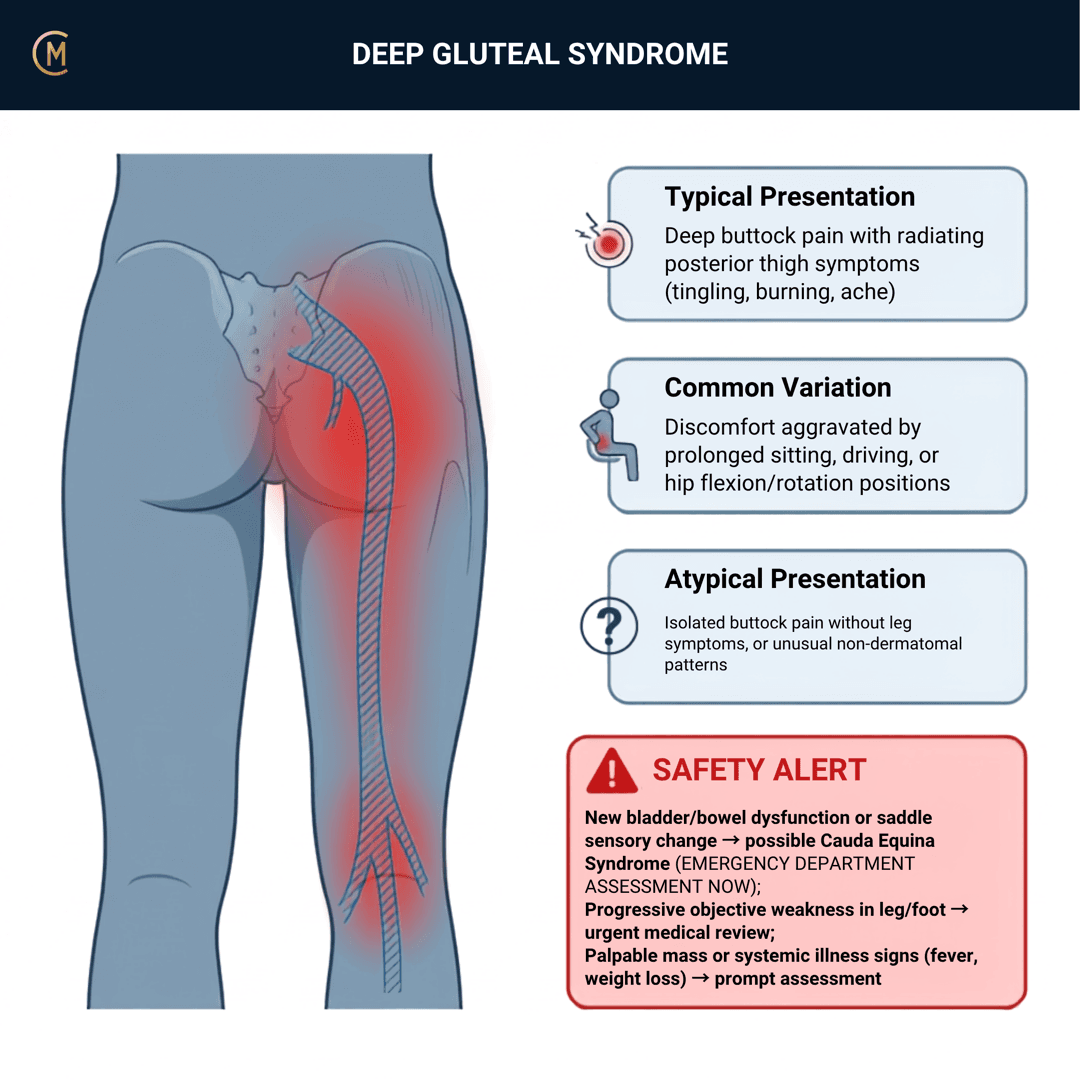
Who: Anyone with prolonged sitting or driving, a fall onto the buttock, an overload history, or post-surgical scarring.
What: Non-discogenic sciatic nerve entrapment in the deep gluteal space.
How it behaves: Deep buttock pain ± referral down the posterior thigh. Worse with prolonged sitting, driving, and hip flexion/adduction/internal rotation. Described as "sciatica" — often without a clear lumbar history.
The one thing to take from this page:
Name the space, not the muscle. The deep gluteal space holds the piriformis, the hamstring origin, fibrous bands and vessels — all around the nerve. "Piriformis syndrome" names one suspect out of several, and the current literature says so.
It stays a diagnosis of exclusion
| Clear this first | Because |
|---|---|
| Lumbar spine | This presentation IS the presentation of lumbar radicular pain |
| SIJ | Buttock pain with a provocation cluster |
| Hip joint | Groin-dominant, FADIR, restricted IR in flexion |
| Proximal hamstring tendon | Focal tenderness on the ischial tuberosity |
| Then | You are allowed to name the deep gluteal space |
⚠️ No guideline exists. A systematic review of this condition's literature is a systematic review of case reports. Everything below is a reasoned position, not a recommendation.
2 · SE — THE SUBJECTIVE PATTERN (the 70%)
Five stages, in your course's order. The subjective's whole job here is to decide whether this is the spine.
MAIN PROBLEM
"Deep in my backside, and it goes down my leg."
"Driving is unbearable."
"They said sciatica but my back's fine."
BODY CHART
- Deep in the gluteal region, over the sciatic pathway.
- Mark the referral — how far down, and does it pass the knee?
- Mark the ischial tuberosity separately. Focal tenderness there is the hamstring tendon.
- Is it dermatomal? That is the lumbar question, and it belongs on the chart.
BEHAVIOUR
| Fits deep gluteal syndrome | Points elsewhere | |
|---|---|---|
| Aggs | Prolonged sitting, driving, hip flexion/adduction/IR | Flexion, coughing, sneezing → lumbar |
| Referral | Posterior thigh, often non-dermatomal | Dermatomal, below the knee, with deficit → radicular |
| Eases | Standing up, walking, changing position | Unloading and extension → lumbar |
| Severity | VAS 0–10 at best / at worst / right now | — |
| History | Fall onto the buttock, overload, post-surgical | Lifting incident, back pain first → lumbar |
| Neuro | Usually normal exam | Deficit → spine or nerve |
HISTORY
- Sitting tolerance in minutes. Get it now — it is your outcome measure.
- Driving hours, desk hours, seat type.
- A fall onto the buttock? Previous hip or pelvic surgery?
- Any back pain history at all? Its absence is part of the pattern; its presence changes the order.
- What have they read? They have usually read something. Read further: quality and readability of online information about this condition [1].
SPECIAL / SCREENING QUESTIONS
- Any bowel or bladder change? Saddle numbness?
- Progressive weakness, foot drop, or numbness that is spreading?
- Night pain, rest pain, weight loss, cancer history?
- Bilateral symptoms?
Assessing this region? Download the Hip & Groin assessment template →
3 · HYPOTHESIS RANKING
| Competing pattern | The one discriminating feature |
|---|---|
| Lumbar radicular pain | Dermatomal distribution, neurological deficit, lumbar behaviour. Clear this first — always. |
| Proximal hamstring tendinopathy | Focal tenderness on the ischial tuberosity; load-related rather than position-and-compression related. |
| SIJ-related pain | Positive provocation cluster, no distal neural behaviour. |
| Hip joint pathology | Groin-dominant, FADIR positive, restricted IR in flexion. |
| Ischiofemoral impingement | Described alongside deep gluteal syndrome as a cause of posterior hip pain [2]. |
The two that outrank the table
Cauda equina syndrome. Bowel or bladder change, saddle numbness, bilateral symptoms. This presentation shares an address with the nerve roots. Ask every time.
Progressive neurological deficit from any cause. Spreading numbness, foot drop, worsening weakness. That is a referral, not a rehabilitation problem.
And the framing that keeps you honest
It stays a diagnosis of exclusion. You earn the label by clearing the lumbar spine, the SIJ, the hip and the hamstring tendon first — not by getting a positive FAIR test.
4 · RED FLAGS — DON'T MISS THIS
This section is free, on every pattern, forever. Safety is never gated.
| Finding | What it suggests | What you do |
|---|---|---|
| Bowel or bladder change, saddle numbness | Cauda equina syndrome | EMERGENCY |
| Sudden buttock pain with leg weakness, numbness or urinary retention after pelvic trauma — especially on anticoagulants | A haematoma compressing the sacral plexus can mimic cauda equina (Lodin et al. 2021) [21] | EMERGENCY — if the lumbar MRI is clear, the pelvis needs imaging; decompression is time-critical |
| Bilateral leg symptoms | Central cause | Urgent medical review |
| Progressive weakness or foot drop | Nerve or spinal compromise | Urgent medical review |
| Spreading or worsening numbness | Progressive neuropathy | Urgent medical review |
| Night pain or rest pain, unrelieved | Malignancy, infection | Medical review |
| Cancer history with new buttock pain | Metastatic disease | Medical review |
| Sciatica that persists with clear lumbar imaging | A tumour along the sciatic nerve in the pelvis — seven of 143 such patients in one series had one (Shah et al. 2019) [22] | Medical review — ask whether the pelvis has been imaged |
| Fever, unwell, systemic symptoms | Infection | Medical review, same day |
| Unexplained weight loss | Systemic disease | Medical review |
The rule: position- and compression-related deep buttock pain with a normal neurological exam and a cleared lumbar spine is yours. Any deficit, any progression, anything bilateral, and anything to do with bowel or bladder is not.
Cross-links: Proximal hamstring tendinopathy · Lumbar radicular pain · SIJ dysfunction · Gluteal tendinopathy
5 · OE — THE OBJECTIVE (the 30%)
Members
Sections 5 to 7 are for members
The objective exam, management and pearls, plus the six-minute lesson and the debrief. Free with an account.
Sign in or join free6 · MX — MANAGEMENT ESSENTIALS
Members
Sections 5 to 7 are for members
The objective exam, management and pearls, plus the six-minute lesson and the debrief. Free with an account.
Sign in or join free7 · CLINICAL PEARLS + RETRIEVAL CHECK
Members
Sections 5 to 7 are for members
The objective exam, management and pearls, plus the six-minute lesson and the debrief. Free with an account.
Sign in or join freeMembers
The 4-minute lesson is for members
Twelve slides on this pattern: what you'll hear, what to examine, what to do. Free with an account.
Sign in or join freeGuideline anchor
No guideline of any nationality exists.
More
Anchored to the review that defines deep gluteal syndrome as non-discogenic sciatic nerve entrapment in the deep gluteal space (Martin et al. 2015, PMID 27011826), to the systematic review of conservative and surgical treatments (Hopayian et al. 2023, PMID 37949567), and to the current work arguing that the space contains more than the piriformis (Sharma et al. 2023, PMID 36937215; Yoon et al. 2025, PMID 41095750).
There is no guideline and no Australian document. A systematic review of the condition's literature is a systematic review of case reports, which tells you the evidence level. Treat every management statement as a reasoned position, not a recommendation.
Members
The evidence summary is for members
Verified diagnostic accuracy, where the evidence stands and what it doesn't settle. Free with an account.
Sign in or join freeSources · 20
ShowHide
Every source on this page resolves and title-verifies against PubMed. Newest first.
- 2024Dede et al. (2024). Quality and readability of online information about piriformis syndrome. Journal of bodywork and movement therapies, 40, 2205-2210. https://doi.org/10.1016/j.jbmt.2024.11.009
- 2016Martin et al. (2016). Ischiofemoral Impingement and Hamstring Syndrome as Causes of Posterior Hip Pain: Where Do We Go Next?. Clinics in sports medicine, 35(3), 469-486. https://doi.org/10.1016/j.csm.2016.02.010
- 2025Kurková et al. (2025). Exploring non-invasive diagnostic tools for deep gluteal syndrome: a multimodal approach integrating clinical and imaging techniques. Quantitative imaging in medicine and surgery, 15(9), 8409-8422. https://doi.org/10.21037/qims-2025-241
- 2025Lim et al. (2025). Diagnosis of piriformis syndrome based on the piriformis muscle cross-sectional area on hip MRI. Medicine, 104(8), e41689. https://doi.org/10.1097/MD.0000000000041689
- 2024Lin et al. (2024). Posterior Hip Pain: Ultrasound Imaging/Guidance for Piriformis Syndrome. Journal of medical ultrasound, 32(4), 363-364. https://doi.org/10.4103/jmu.jmu_82_22
- 2023Hopayian et al. (2023). A systematic review of conservative and surgical treatments for deep gluteal syndrome. Journal of bodywork and movement therapies, 36, 244-250. https://doi.org/10.1016/j.jbmt.2022.12.003
- 2025Monteleone et al. (2025). Piriformis syndrome: a systematic review of case reports. BMC surgery, 25(1), 468. https://doi.org/10.1186/s12893-025-03202-2
- 2011Martin et al. (2011). The endoscopic treatment of sciatic nerve entrapment/deep gluteal syndrome. Arthroscopy : the journal of arthroscopic & related surgery : official publication of the Arthroscopy Association of North America and the International Arthroscopy Association, 27(2), 172-81. https://doi.org/10.1016/j.arthro.2010.07.008
- 2023Sun et al. (2023). Arthroscopic treatment of deep gluteal syndrome and the application value of high-frequency ultrasound. BMC musculoskeletal disorders, 24(1), 742. https://doi.org/10.1186/s12891-023-06863-3
- 2025Elzeiny et al. (2025). Endoscopy for sciatic nerve entrapment in deep gluteal syndrome. A systematic review of literature. European journal of orthopaedic surgery & traumatology : orthopedie traumatologie, 35(1), 223. https://doi.org/10.1007/s00590-025-04349-7
- 2025Garden et al. (2025). Evaluation of the Complications and Outcomes of Endoscopic and Open Surgical Treatment of Piriformis Syndrome: A Systematic Review. The Journal of the American Academy of Orthopaedic Surgeons, 33(15), e878-e887. https://doi.org/10.5435/JAAOS-D-24-01223
- 2026Warman et al. (2026). Endoscopic vs Open Surgeries for Piriformis Syndrome: A Systematic Review and Meta-Analysis. Advances in orthopedics, 2026, 5126019. https://doi.org/10.1155/aort/5126019
- 2015Martin et al. (2015). Deep gluteal syndrome. Journal of hip preservation surgery, 2(2), 99-107. https://doi.org/10.1093/jhps/hnv029
- 2023Sharma et al. (2023). Looking beyond Piriformis Syndrome: Is It Really the Piriformis?. Hip & pelvis, 35(1), 1-5. https://doi.org/10.5371/hp.2023.35.1.1
- 2024Geler Külcü (2024). Deep Gluteal syndrome: An underestimated cause of posterior hip pain. Turkish journal of physical medicine and rehabilitation, 70(1), 4-16. https://doi.org/10.5606/tftrd.2024.14668
- 2024Lo & Robinson (2024). Piriformis syndrome. Handbook of clinical neurology, 201, 203-226. https://doi.org/10.1016/B978-0-323-90108-6.00002-8
- 2025Batool et al. (2025). Prevalence of piriformis syndrome and its associated risk factors among university students in Pakistan: a cross-sectional study. BMJ open, 15(1), e092383. https://doi.org/10.1136/bmjopen-2024-092383
- 2025Yoon et al. (2025). Beyond Nerve Entrapment: A Narrative Review of Muscle-Tendon Pathologies in Deep Gluteal Syndrome. Diagnostics (Basel, Switzerland), 15(19). https://doi.org/10.3390/diagnostics15192531
- 2026Lopez Castellanos & Feipel (2026). Exploring the anatomical basis of piriformis syndrome: A systematic review. Morphologie : bulletin de l'Association des anatomistes, 110(369), 101114. https://doi.org/10.1016/j.morpho.2026.101114
- 2026Neal et al. (2026). Prevalence and Clinical Patterns of Piriformis Syndrome Among Actively Competing and Retired Elite Hockey Players. Sports (Basel, Switzerland), 14(3). https://doi.org/10.3390/sports14030095
Mapped to this pattern
Generic measures that also apply
- Borg RPE
Borg Rating of Perceived Exertion Scale (6-20)
perceived exertion · 1 items · 1 min
- GROC
Global Rating of Change Scale
perceived change since baseline · 1 items · 1 min
- NPRS
Numeric Pain Rating Scale
pain intensity · 1 items · 1 min
- PGIC
Patient Global Impression of Change
perceived change since baseline · 1 items · 1 min
- PSFS
Patient-Specific Functional Scale
patient-generated function · 3 items · 2 min
- SANE
Single Assessment Numeric Evaluation
patient-rated function as a percentage of normal · 1 items · 1 min
- VAS
Visual Analogue Scale
pain intensity · 1 items · 1 min
- Borg CR10
Borg Category Ratio 10 Scale
perceived exertion or symptom intensity, ratio scale · 1 items · 1 min
- GAS
Goal Attainment Scaling
individualised goal achievement · 10 min
Did this page do its job?
CliniStudy is in beta. One tap is enough — it decides what gets fixed first.