
1 · SNAPSHOT
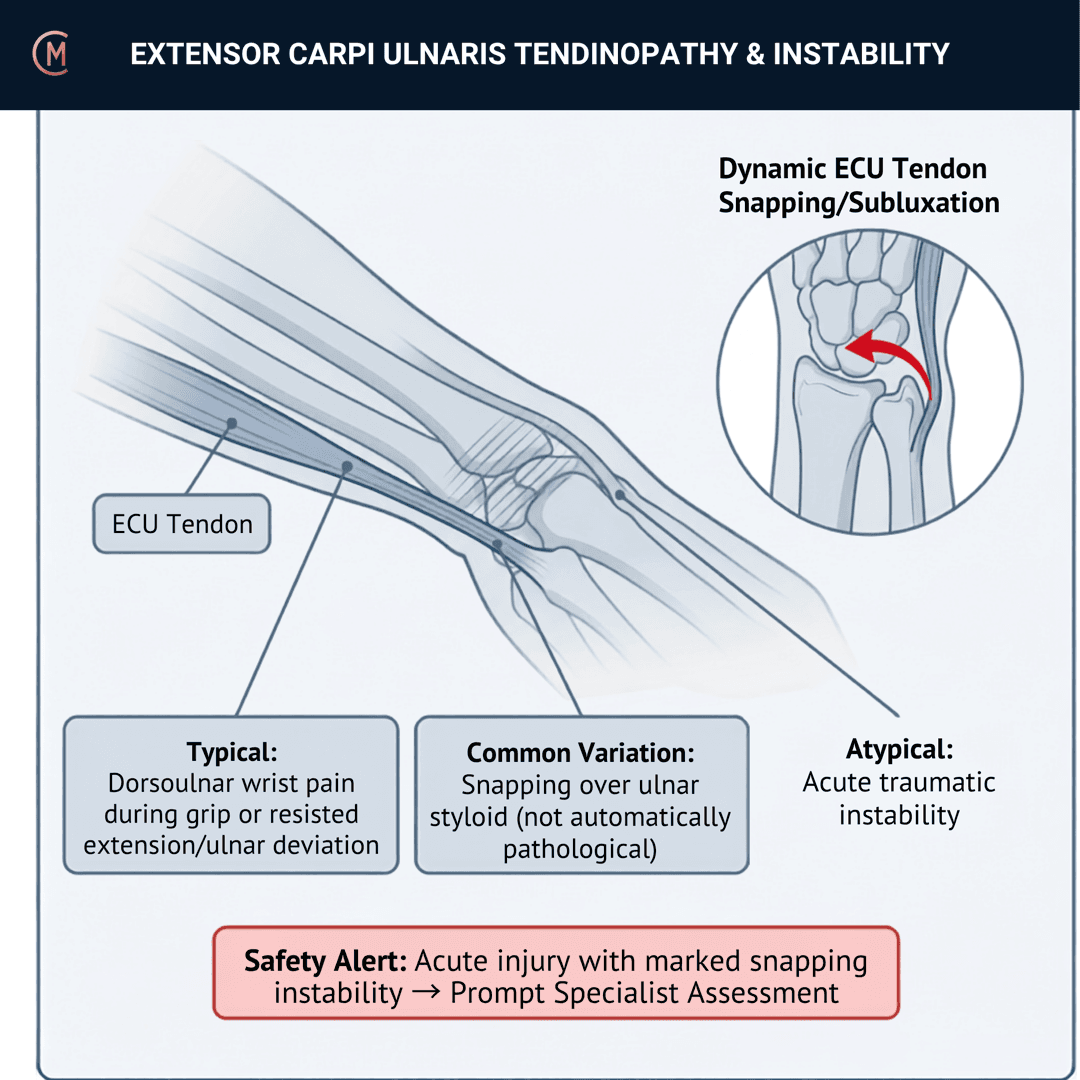
One of the ulnar-sided wrist problems, and the one you are most likely to feel under your fingers while you are examining something else.
Illness script in one line: ulnar-sided wrist pain along the dorsal ulna, with a snap or a slipping sensation on supination and ulnar deviation, worse with rotation and grip — in a racquet player, a golfer, a gymnast, or a wrist that was forced into supination in a fall.
Caseload frequency: uncommon as a referral, common as a coexisting finding. Read further: ECU pathology in patients having TFCC foveal repair [1]. The reason that paper exists is that these two travel together.
Snapping is normal. Painful snapping is not.
This is the organising idea.
Read further: ECU snapping in an asymptomatic population [2].
Why that matters to a student: a snap is dramatic. You feel it, the patient feels it, and it is enormously tempting to treat it as the diagnosis. Read further: ECU groove morphology and tendon instability [3], an accessory ECU tendon [4]. The anatomy varies between people, so what the tendon does is not automatically why it hurts.
| The finding | What it actually tells you |
|---|---|
| A palpable snap | Something about this wrist's anatomy |
| A snap that reproduces their pain | Something about this patient's problem |
| A snap on the other wrist too | Almost certainly nothing |
So examine both wrists, and ask the only question that matters: does that reproduce what you came in with?
2 · SE — THE SUBJECTIVE PATTERN (the 70%)
Main problem
"Something slips over the bone on the back of my wrist." That is the classic description of a slipping tendon.
That description is close to diagnostic on its own — patients do not usually invent it. The other version is duller and more common: ulnar-sided pain with rotation and grip, no slipping named, and a snap you find rather than one they report.
Body chart
Dorsal and ulnar, along the groove — over the back of the ulnar head and running distally. Ask them to point, and use the answer to sort the three candidates:
| Where they point | Which column |
|---|---|
| Along the dorsal ulnar groove | This page |
| Distal, into the fovea | TFCC |
| Over the DRUJ itself, dorsally, with giving way | DRUJ instability |
A finger tracing a line along the tendon is different from a fingertip in a hole. Watch which one you get.
Behaviour
The pattern: worse with rotation or grip. Snapping on supination / ulnar deviation.
Aggs: supination combined with ulnar deviation, a racquet backhand, wringing a cloth, opening jar lids, pushing up out of a chair, hammering, a golf swing through impact.
Eases: keeping the forearm pronated or neutral, a brace, avoiding rotation under load.
Severity: VAS 0–10 at best / at worst / right now.
The mechanical detail worth having: the tendon sits in a groove on the back of the ulna and is held there by its own subsheath, and supination with ulnar deviation is the position that loads that restraint. That is why the aggravating list is a list of supination tasks.
History
Two stories, and they are managed differently.
- The event. A fall or a forced supination with an immediate snap and a sensation of something jumping out. Section 4.
- The build-up. Weeks to months of gradual dorsal-ulnar pain in someone with a rotation-heavy sport or job, no single moment.
Then ask the wrist-and-hand question: have you ever broken this wrist or forearm? ECU tendinopathy has been reported following conservative treatment of a distal ulnar metaphyseal fracture [5]. It is the same lesson as the DRUJ page, from a different tendon.
Special / screening questions
- Any numbness over the back of the little-finger side of the hand? Dorsal ulnar cutaneous neuropathy has been described alongside ECU tendinopathy [6]. Section 4.
- Any hot, red, boggy swelling, or early-morning stiffness well past thirty minutes (UniSA coding: In), or other joints involved? Section 4.
- Sport, grip size and technique — racquet, golf, gymnastics, weight-bearing through the hand.
- Previous wrist surgery.
Assessing this region? Download the Wrist & Hand assessment template →
3 · HYPOTHESIS RANKING
A standard ulnar-sided wrist pain table gives the top three. This is the third of them.
| Pattern | The one discriminating feature |
|---|---|
| ECU tendinopathy / subluxation | A palpable snap over the ulnar groove on supination, pain on resisted ECU, tenderness along the sheath posterior to the ulna. |
| TFCC injury | Tender in the fovea rather than along the groove, provoked by ulnar deviation with axial load rather than by resisted extension. Its own page — and they coexist (Jung et al. 2025). |
| DRUJ instability | A sense of the forearm giving way on rotation, increased translation compared with the other side, weakness rather than a painful arc. Its own page. |
| Ulnocarpal impaction | Gradual, grip- and pronation-dominant, load-related, no snap. Covered on the TFCC page. |
| Dorsal ulnar cutaneous neuropathy | Numbness or altered sensation over the dorsal ulnar hand, not just pain. Described alongside ECU tendinopathy (Chang et al. 2017). Section 4. |
| Distal ulna or radius fracture sequelae | A fracture in the history and symptoms that started as the immobilisation came off (Kudo et al. 2024). |
The discriminator that does most of the work: where the finger goes, and whether resisted extension with ulnar deviation is the thing that hurts.
4 · RED FLAGS — DON'T MISS THIS
Free forever. Never gated.
1. The acute subsheath injury is a time-limited window, not a rehabilitation problem
A forced supination or a fall, an immediate snap, and a tendon that visibly or palpably jumps out of its groove on active supination is an acute subsheath injury.
Read further: ECU instability pathology and operative techniques [7], subluxation [8], operative management [9], retinacular sling reconstruction for subsheath injuries [10].
What that means for you: an acute one is immobilised early, in a position and for a duration decided by the treating team, and the decision is time-sensitive. A subsheath injury that is loaded through supination for six weeks first is a different — and worse — problem by the time it reaches you.
Action: same-week hand or orthopaedic opinion for a genuinely acute, traumatic, visibly dislocating tendon. Do not start a loading programme in the meantime.
2. Numbness is not tendon
Dorsal ulnar cutaneous neuropathy has been described with ECU tendinopathy [6].
Altered sensation over the dorsal ulnar hand, or numbness in the ring and little fingers, is a nerve question and needs a neurological examination recorded properly — power, reflexes and sensation, both sides. Ring and little finger numbness with weak intrinsics is Guyon's canal or a cervical source, not this page.
3. Hot, swollen, boggy, or more than one joint
A red, hot, exquisitely tender sheath is not a tendinopathy — that is an infection or crystal question and it goes today.
A boggy rather than firm swelling, early-morning stiffness well past thirty minutes (UniSA coding: In), and symptoms in other joints — particularly symmetrical small-joint involvement — is an inflammatory arthritis screen. The tenosynovial sheaths around the wrist are an early site, and the physiotherapist is often the first clinician to see the pattern across several joints. Referral is time-sensitive.
4. The forearm fracture nobody re-examined
ECU tendinopathy has been reported following conservative treatment of a distal ulnar metaphyseal fracture [5]. Ulnar-sided symptoms after a healed forearm fracture are not automatically stiffness — the same rule as the DRUJ page.
5 · OE — THE OBJECTIVE (the 30%)
Members
Sections 5 to 7 are for members
The objective exam, management and pearls, plus the six-minute lesson and the debrief. Free with an account.
Sign in or join free6 · MX — MANAGEMENT ESSENTIALS
Members
Sections 5 to 7 are for members
The objective exam, management and pearls, plus the six-minute lesson and the debrief. Free with an account.
Sign in or join free7 · CLINICAL PEARLS + RETRIEVAL CHECK
Members
Sections 5 to 7 are for members
The objective exam, management and pearls, plus the six-minute lesson and the debrief. Free with an account.
Sign in or join freeMembers
The 4-minute lesson is for members
Twelve slides on this pattern: what you'll hear, what to examine, what to do. Free with an account.
Sign in or join freeGuideline anchor
No Australian guideline and no clinical practice guideline of any kind.
More
The closest thing to a clinical anchor is a British Journal of Sports Medicine piece on ECU tenosynovitis (Postle et al. 2024, PMID 38050013). The one physiotherapy-facing document in our library is a review of the conservative and rehabilitative options in athletes (Zarro et al. 2024, PMID 36250572). The instability side is anchored to a comprehensive review of pathology and operative techniques (Thirumavalavan et al. 2024, PMID 37226412), a Hand Clinics review of ECU subluxation (Byrd et al. 2021, PMID 34602128) and a systematic review of operative management (Lari et al. 2024, PMID 38808191).
None of these is a clinical practice guideline. One is a short journal piece, one is a narrative review of conservative options, and the rest are surgical. There is no trial evidence for conservative management of this condition in our library.
Members
The evidence summary is for members
Verified diagnostic accuracy, where the evidence stands and what it doesn't settle. Free with an account.
Sign in or join freeSources · 20
ShowHide
Every source on this page resolves and title-verifies against PubMed. Newest first.
- 2025Jung et al. (2025). Incidence of extensor carpi ulnaris pathology in patients with triangular fibrocartilage complex foveal repairs. The Journal of hand surgery, European volume, 50(10), 1326-1332. https://doi.org/10.1177/17531934251335104
- 2021Erpala & Ozturk (2021). "Snapping" of the extensor carpi ulnaris tendon in asymptomatic population. BMC musculoskeletal disorders, 22(1), 387. https://doi.org/10.1186/s12891-021-04271-z
- 2024Shoap et al. (2024). An Analysis of Extensor Carpi Ulnaris Groove Morphology and Tendon Instability. Hand (New York, N.Y.), 19(3), 400-406. https://doi.org/10.1177/15589447221105539
- 2023Prusmetikul & Tawonsawatruk (2023). The Surgical Treatment of Bilateral Accessory Extensor Carpi Ulnaris: Case Report and Literature Review. Journal of wrist surgery, 12(4), 368-370. https://doi.org/10.1055/s-0042-1750873
- 2024Kudo et al. (2024). Extensor Carpi Ulnaris Tendinopathy Following Conservative Treatment of a Distal Ulnar Metaphyseal Fracture: A Case Report. Cureus, 16(10), e71027. https://doi.org/10.7759/cureus.71027
- 2017Chang et al. (2017). Ultrasound Imaging for Dorsal Ulnar Cutaneous Neuropathy With Extensor Carpi Ulnaris Tendinopathy. American journal of physical medicine & rehabilitation, 96(10), e191-e192. https://doi.org/10.1097/PHM.0000000000000786
- 2024Thirumavalavan et al. (2024). Extensor Carpi Ulnaris Instability: A Comprehensive Review of Pathology and Operative Techniques. Hand (New York, N.Y.), 19(7), 1090-1096. https://doi.org/10.1177/15589447231168908
- 2021Byrd et al. (2021). Extensor Carpi Ulnaris Subluxation. Hand clinics, 37(4), 487-491. https://doi.org/10.1016/j.hcl.2021.06.005
- 2024Lari et al. (2024). Operative Management of Extensor Carpi Ulnaris Instability: A Systematic Review. Journal of wrist surgery, 13(3), 272-281. https://doi.org/10.1055/s-0043-1764354
- 2023Mastroianni et al. (2023). Radially Based Extensor Retinacular Sling Reconstruction for Extensor Carpi Ulnaris Subsheath Injuries. Journal of hand surgery global online, 5(2), 133-139. https://doi.org/10.1016/j.jhsg.2022.11.003
- 2024Postle et al. (2024). Extensor carpi ulnaris (ECU) tenosynovitis. British journal of sports medicine, 58(7), 401-402. https://doi.org/10.1136/bjsports-2023-107479
- 2018Kaiser et al. (2018). Diagnosing extensor carpi ulnaris tendon dislocation with dynamic rotation MRI of the wrist. Clinical imaging, 51, 323-326. https://doi.org/10.1016/j.clinimag.2018.06.015
- 2018Santo et al. (2018). Magnetic resonance imaging analysis of the extensor carpi ulnaris tendon and distal radioulnar joint in triangular fibrocartilage complex tears. Journal of orthopaedic science : official journal of the Japanese Orthopaedic Association, 23(6), 953-958. https://doi.org/10.1016/j.jos.2018.05.009
- 2023Nevalainen et al. (2023). Extensor carpi ulnaris tendon pathology and ulnar styloid bone marrow edema as diagnostic markers of peripheral triangular fibrocartilage complex tears on wrist MRI: a case-control study. European radiology, 33(5), 3172-3177. https://doi.org/10.1007/s00330-023-09446-x
- 2024Hämäläinen et al. (2024). Automatic segmentation of extensor carpi ulnaris tendon and detection of tendinosis with convolutional neural networks. Acta radiologica open, 13(11), 20584601241297530. https://doi.org/10.1177/20584601241297530
- 2021Öztürk & Burtaç Eren (2021). Is it really safe to evaluate symptomatic extensor carpi ulnaris tendon instability by magnetic resonance imaging (MRI)?. Acta orthopaedica Belgica, 87(2), 227-234. PubMed 34529374
- 2024Zarro et al. (2024). Extensor Carpi Ulnaris Tendinopathy in Athletes: A Review of the Conservative and Rehabilitative Options. Hand (New York, N.Y.), 19(3), 407-413. https://doi.org/10.1177/15589447221127331
- 2022Lee (2022). Treatment of subacute/chronic ECU tendinopathy using wrist arthroscopy and open surgical repair. Journal of orthopaedic surgery (Hong Kong), 30(1), 23094990211067009. https://doi.org/10.1177/23094990211067009
- 2024Colberg et al. (2024). Treatment of Chronic Extensor Carpi Ulnaris Stenosing Tenosynovitis Using Ultrasound-Guided Retinaculum Release: A Case Report. JBJS case connector, 14(1). https://doi.org/10.2106/JBJS.CC.23.00461
- 2019Touloupakis et al. (2019). Detachment of Extensor Carpi Ulnaris and Anterior Branches of the Radial Collateral Ligament from the Epicondyle: A Modification of Kocher Lateral Approach for the Treatment of Radial Head Fractures. Joints, 7(2), 31-36. https://doi.org/10.1055/s-0039-1697613
Mapped to this pattern
Generic measures that also apply
- Borg RPE
Borg Rating of Perceived Exertion Scale (6-20)
perceived exertion · 1 items · 1 min
- DASH
Disabilities of the Arm, Shoulder and Hand
upper limb disability · 30 items · 8 min
- GROC
Global Rating of Change Scale
perceived change since baseline · 1 items · 1 min
- NPRS
Numeric Pain Rating Scale
pain intensity · 1 items · 1 min
- PGIC
Patient Global Impression of Change
perceived change since baseline · 1 items · 1 min
- PSFS
Patient-Specific Functional Scale
patient-generated function · 3 items · 2 min
- QuickDASH
QuickDASH
upper limb disability, short form · 11 items · 4 min
- SANE
Single Assessment Numeric Evaluation
patient-rated function as a percentage of normal · 1 items · 1 min
- UEFI
Upper Extremity Functional Index
upper limb function · 20 items · 5 min
- VAS
Visual Analogue Scale
pain intensity · 1 items · 1 min
- Borg CR10
Borg Category Ratio 10 Scale
perceived exertion or symptom intensity, ratio scale · 1 items · 1 min
- GAS
Goal Attainment Scaling
individualised goal achievement · 10 min
Did this page do its job?
CliniStudy is in beta. One tap is enough — it decides what gets fixed first.