
1 · SNAPSHOT
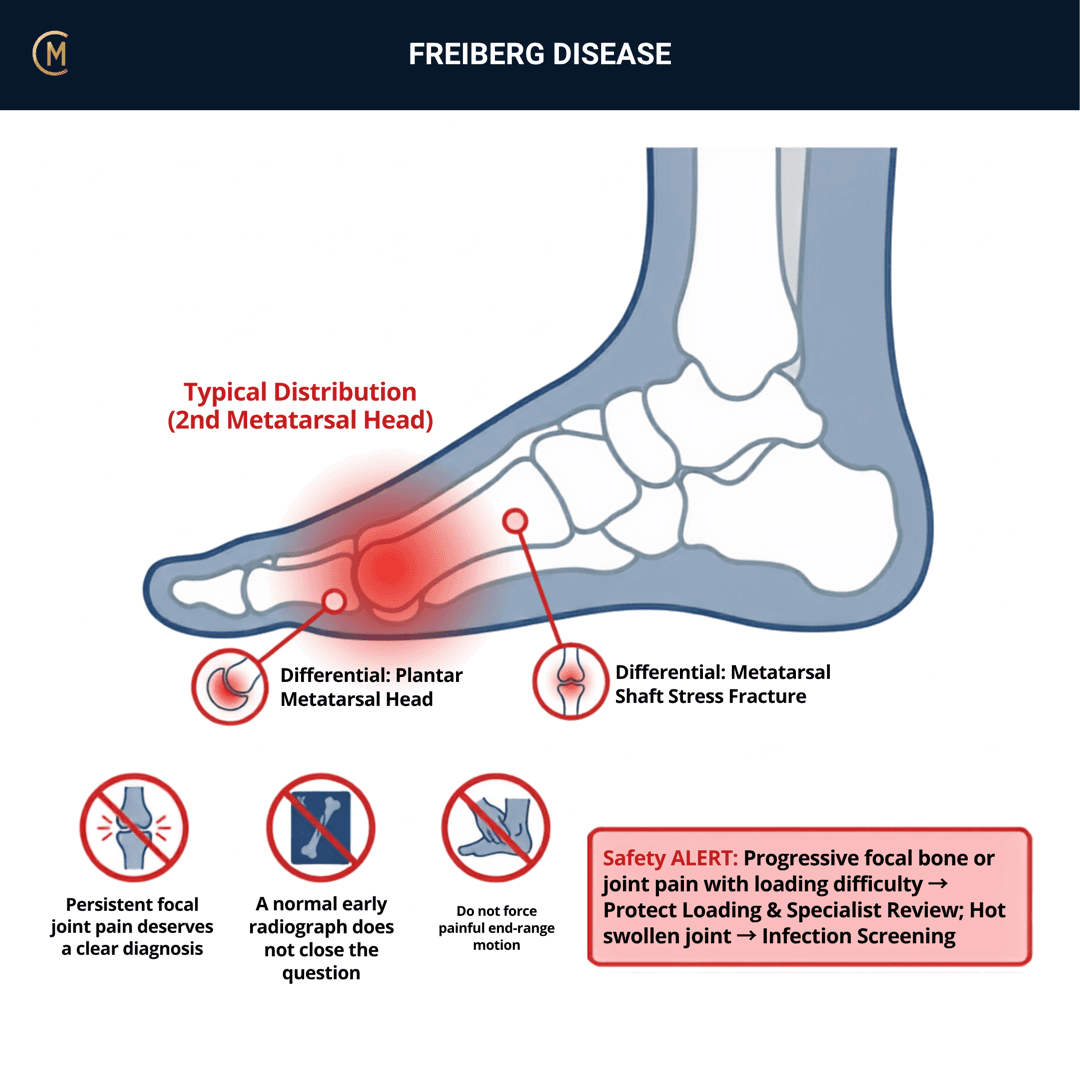
Rare, and the reason it is here is that getting it wrong means loading a dying bone.
Illness script in one line: dorsal forefoot pain over the second metatarsal head with local swelling and a stiffening MTP joint, in an adolescent or young adult — classically a female dancer — building over weeks to months without a single injury.
Caseload frequency: rare. You will meet far more metatarsalgia, stress fracture and Morton's neuroma — which is exactly the problem, because this one hides inside those labels.
Everything else in the forefoot gets loaded. This one gets offloaded.
This is the organising idea, and it is the single most important thing on the page.
Freiberg's is osteonecrosis of a metatarsal head — most often the second. The management line is offload + relative rest, then gradual reload once pain-free. That is the opposite instruction from almost every other page in this region, where the answer to a load-related problem is graded loading.
| The forefoot page you're used to | This page |
|---|---|
| Tendinopathy, plantar fasciopathy, metatarsalgia → load it, progressively | Bone that is losing its blood supply → take load off it |
| Pain is a guide to dosage | Pain is a signal to unload |
| Progress on the 24-hour response | Progress only once pain-free, and slowly |
A student who applies standard tendon reasoning here does real harm. That is why it is worth a page.
And it has a shape you can spot
Read further: bilateral disease in a young female dancer [1], a rare cause of chronic foot pain [2].
Adolescent and young female dancers. Add the mechanical version of that: repetitive high load through a dorsiflexed second MTP joint — dancing en pointe or demi-pointe, running, gymnastics, and a long second metatarsal.
2 · SE — THE SUBJECTIVE PATTERN (the 70%)
Main problem
"The ball of my foot hurts, on top, and my toe's getting stiff." Dorsal forefoot pain (2nd MT head), swelling.
Two features to hold onto: the pain is dorsal, and there is swelling — which separates it immediately from the two labels it usually arrives under.
Body chart
Ask them to point, and expect a fingertip on top of the second metatarsal head — the joint itself, not the web space and not the plantar fat pad.
| Where they point | What it points to |
|---|---|
| Dorsally, on the 2nd MTP joint | This page |
| Plantar, under the metatarsal heads | Metatarsalgia. Its own page |
| Into the 3rd/4th web space, with radiating numbness | Morton's neuroma. Its own page |
| Along the metatarsal shaft, exquisitely focal | Stress fracture. Its own page, and section 4 |
Behaviour
Aggs: push-off, running, jumping, dancing — especially en pointe or demi-pointe; walking barefoot on hard floors; going up on the toes; anything that dorsiflexes the MTP under load.
Eases: rest, a stiff-soled shoe, avoiding push-off, staying off the toes.
Severity: VAS 0–10 at best / at worst / right now.
The mechanical detail worth having: the second MTP joint is loaded hardest at the top of the joint in dorsiflexion under weight. That is why anything that dorsiflexes the toe under load is the aggravating list — and it is also why the first treatment is a stiff sole.
History
- Gradual, over weeks to months, without a single injury. That is the story.
- Age and activity. Adolescent and young female dancers. Read further: bilateral disease in a young female dancer (Katwal et al. 2023).
- What changed? New shoes, new pointe work, a jump in training volume, a change of surface.
- How long has this been going on, and what has been tried? The chronic foot pain framing matters (Oliveira et al. 2023).
- Is it getting stiffer as well as more painful? A joint that is losing motion is a different trajectory from one that just hurts.
Special / screening questions
- Any night pain, rest pain, or systemic symptoms? Section 4.
- Focal bony tenderness along the shaft rather than at the joint? Section 4.
- A dancer with training load, menstrual and nutritional questions unasked? Section 4.
- Any locking or catching? Section 4.
Assessing this region? Download the Ankle & Foot assessment template →
3 · HYPOTHESIS RANKING
| Pattern | The one discriminating feature |
|---|---|
| Freiberg's disease | Dorsal pain and swelling over the 2nd MTP joint with progressive loss of MTP range, in an adolescent or young adult, gradual onset. |
| Metatarsal stress fracture | Focal tenderness along the metatarsal shaft rather than at the joint, with a clear load spike. Its own page. Section 4 — and the two share an age group and a sport. |
| Metatarsalgia | Plantar pain under the metatarsal heads, no dorsal swelling, no progressive joint stiffness. Its own page — and the label this one usually hides inside. |
| Morton's neuroma | Web space, radiating, burning, numbness into the toes. Its own page. |
| MTP joint synovitis or instability (2nd MTP) | Dorsal swelling and a positive drawer at the MTP without the radiographic changes. |
| Lesser toe MTP osteoarthritis | Older, with joint-line changes. Considered together with Freiberg disease in a contemporary review [3] — the late stage of one becomes the other. |
| Inflammatory arthritis | Multiple joints, morning stiffness well past 30 minutes (UniSA coding: In), boggy swelling. Section 4. |
The discriminator that does most of the work: is it dorsal and swollen with a stiffening joint, or plantar and load-related with a normal joint?
4 · RED FLAGS — DON'T MISS THIS
Free forever. Never gated.
1. This is a bone problem, so it needs an x-ray — and a normal early film doesn't clear it
The diagnosis here is radiographic, not clinical. An adolescent with dorsal second MTP pain, swelling and progressive stiffness needs imaging, and the referral is not optional.
But the timing matters. Read further: bloodpool and late-phase SPECT/CT [4], a rare cause of chronic foot pain [2]. The point is that advanced imaging exists in this condition for a reason. A normal early x-ray in a forefoot that is not settling does not close the question. Say so in your referral rather than filing the normal film as reassurance.
2. The stress fracture sitting next to it
Same age group, same sports, same forefoot. Focal tenderness along the metatarsal shaft, a clear spike in training load, and night or rest pain point there instead. Its own page — and if there is any doubt, both questions are answered by the same referral. Wrong age for Freiberg's? A sedentary postmenopausal woman with forefoot bone pain is an insufficiency fracture question — metatarsals were the site in 89% of one case-control series, with chronic corticosteroid use and low bone density in the picture (Pereira Filho et al. 2021) [21].
3. The dancer, and the load behind the load
An adolescent dancer or runner with a bone problem in the forefoot is a whole-athlete conversation, not just a foot. Read further: bilateral disease in a young female dancer [1].
Ask about training volume and its recent change, footwear and pointe progression, and — carefully and appropriately — energy availability and menstrual history, escalating to the right clinician rather than managing it yourself.
4. Progressive stiffness, catching, or locking
A joint that is losing range, catching or locking has structural change in it. The Smillie classification of Freiberg's infraction has been in use since 1967 [5], and metatarsophalangeal joint osteoarthritis of the lesser toes and Freiberg disease have been considered together (Ottofaro et al. 2026). The late stage of this is a degenerate joint — which is why a stiffening MTP is an orthopaedic conversation: ortho review if non-resolving.
5. Hot, red, or systemically unwell
A hot, red, swollen forefoot without a mechanical story is an infection, crystal or inflammatory question and it goes today. Cross-links: gout at the first MTP, and the infection page.
One rare systemic link worth a question: Freiberg disease has been reported as the first sign of Sneddon syndrome, a vasculopathy that went on to cause strokes (Samanta & Cobb 2020) [22]. Livedo racemosa (a net-like skin rash) or migraines alongside the foot goes to the GP — single case report, so ask, don't alarm.
5 · OE — THE OBJECTIVE (the 30%)
Members
Sections 5 to 7 are for members
The objective exam, management and pearls, plus the six-minute lesson and the debrief. Free with an account.
Sign in or join free6 · MX — MANAGEMENT ESSENTIALS
Members
Sections 5 to 7 are for members
The objective exam, management and pearls, plus the six-minute lesson and the debrief. Free with an account.
Sign in or join free7 · CLINICAL PEARLS + RETRIEVAL CHECK
Members
Sections 5 to 7 are for members
The objective exam, management and pearls, plus the six-minute lesson and the debrief. Free with an account.
Sign in or join freeMembers
The 4-minute lesson is for members
Twelve slides on this pattern: what you'll hear, what to examine, what to do. Free with an account.
Sign in or join freeGuideline anchor
No Australian guideline and no clinical practice guideline of any kind.
More
The closest thing is an evidence-based treatment algorithm published in Cartilage (Yoshimura et al. 2024, PMID 37815268), with reviews of treatment (Seybold et al. 2018, PMID 29362030) and of diagnosis and treatment (Talusan et al. 2014, PMID 24319044). The physiotherapy-facing anchor is a report of conservative treatment using foot orthoses (Longworth et al. 2019, PMID 31704590), and the return-to-sport anchor is a study of provider-cleared return to sport after Freiberg infraction in adolescent athletes (Touban et al. 2026, PMID 42474446).
The Cartilage paper is an evidence-based treatment algorithm, not a clinical practice guideline, and it is written from a surgical perspective. The conservative literature in our library is a single orthotic report.
Members
The evidence summary is for members
Verified diagnostic accuracy, where the evidence stands and what it doesn't settle. Free with an account.
Sign in or join freeSources · 20
ShowHide
Every source on this page resolves and title-verifies against PubMed. Newest first.
- 2023Katwal et al. (2023). Bilateral Freiberg disease in a young female dancer: A case report. SAGE open medical case reports, 11, 2050313X231221464. https://doi.org/10.1177/2050313X231221464
- 2023Oliveira et al. (2023). Freiberg disease: A rare cause of chronic foot pain. Reumatologia clinica, 19(6), 348. https://doi.org/10.1016/j.reumae.2022.11.006
- 2026Ottofaro et al. (2026). Metatarsophalangeal Joint Osteoarthritis of the Lesser Toes and Freiberg Disease: A Contemporary Review. Foot & ankle international, 47(3), 324-332. https://doi.org/10.1177/10711007251401532
- 2026El Yaagoubi et al. (2026). Bloodpool and Late-Phase 3D-Ring CZT SPECT/CT in Freiberg Disease. Clinical nuclear medicine, 51(8), 712-713. https://doi.org/10.1097/RLU.0000000000006487
- 1967Smillie (1967). Treatment of Freiberg's infraction. Proceedings of the Royal Society of Medicine, 60(1), 29-31. https://doi.org/10.1177/003591576706000117
- 2014Talusan et al. (2014). Freiberg's infraction: diagnosis and treatment. Foot & ankle specialist, 7(1), 52-6. https://doi.org/10.1177/1938640013510314
- 2018Seybold & Zide (2018). Treatment of Freiberg Disease. Foot and ankle clinics, 23(1), 157-169. https://doi.org/10.1016/j.fcl.2017.09.011
- 2019Longworth et al. (2019). Conservative treatment of Freiberg's infraction using foot orthoses: A tale of two prescriptions presented as a case study to open debate. Foot (Edinburgh, Scotland), 41, 59-62. https://doi.org/10.1016/j.foot.2019.07.002
- 2024Yoshimura et al. (2024). Evidence-Based Treatment Algorithm for Freiberg Disease. Cartilage, 15(1), 58-64. https://doi.org/10.1177/19476035231205676
- 2015Schade (2015). Surgical Management of Freiberg's Infraction: A Systematic Review. Foot & ankle specialist, 8(6), 498-519. https://doi.org/10.1177/1938640015585966
- 2019Georgiannos et al. (2019). Osteochondral Autologous Transplantation Versus Dorsal Closing Wedge Metatarsal Osteotomy for the Treatment of Freiberg Infraction in Athletes: A Randomized Controlled Study With 3-Year Follow-up. The American journal of sports medicine, 47(10), 2367-2373. https://doi.org/10.1177/0363546519859549
- 2020Kim et al. (2020). Comparison of Osteochondral Autologous Transplantation and Dorsiflexion Closing Wedge Metatarsal Osteotomy for Late-Stage Freiberg Disease in Adults. Foot & ankle international, 41(5), 529-535. https://doi.org/10.1177/1071100720904363
- 2025Incesoy et al. (2025). Comparative study of dorsiflexion closing wedge osteotomy of the metatarsal head and osteochondral autologous transplantation for Freiberg disease treatment: A multicenter analysis. The Journal of foot and ankle surgery : official publication of the American College of Foot and Ankle Surgeons, 64(2), 113-119. https://doi.org/10.1053/j.jfas.2024.09.009
- 2024Kim et al. (2024). Short-Term Outcomes of Arthroscopic Treatment of Freiberg Disease. Journal of the American Podiatric Medical Association, 114(3). https://doi.org/10.7547/22-025
- 2019Lui & Fan (2019). Arthroscopic Dorsal Closing-Wedge Osteotomy of Metatarsal Head for Management of Freiberg Infraction. Arthroscopy techniques, 8(11), e1289-e1293. https://doi.org/10.1016/j.eats.2019.07.003
- 2020Çevik et al. (2020). Interpositional Arthroplasty With Extensor Digitorum Brevis Tendon in Freiberg Disease. Foot & ankle international, 41(11), 1398-1403. https://doi.org/10.1177/1071100720938769
- 2020Dhar et al. (2020). Surgical Management of Freiberg Disease by Dorsal Closing Wedge Osteotomy. Malaysian orthopaedic journal, 14(3), 161-165. https://doi.org/10.5704/MOJ.2011.025
- 2013Lee et al. (2013). Operative treatment of Freiberg disease using extra-articular dorsal closing-wedge osteotomy: technical tip and clinical outcomes in 13 patients. Foot & ankle international, 34(1), 111-6. https://doi.org/10.1177/1071100712460185
- 1993Sproul et al. (1993). Surgical treatment of Freiberg's infraction in athletes. The American journal of sports medicine, 21(3), 381-4. https://doi.org/10.1177/036354659302100309
- 2026Touban et al. (2026). Provider-Cleared Return-to-Sport After Freiberg Infraction in Adolescent Athletes. Journal of pediatric orthopedics. https://doi.org/10.1097/BPO.0000000000003420
Mapped to this pattern
Generic measures that also apply
- Borg RPE
Borg Rating of Perceived Exertion Scale (6-20)
perceived exertion · 1 items · 1 min
- GROC
Global Rating of Change Scale
perceived change since baseline · 1 items · 1 min
- NPRS
Numeric Pain Rating Scale
pain intensity · 1 items · 1 min
- PGIC
Patient Global Impression of Change
perceived change since baseline · 1 items · 1 min
- PSFS
Patient-Specific Functional Scale
patient-generated function · 3 items · 2 min
- SANE
Single Assessment Numeric Evaluation
patient-rated function as a percentage of normal · 1 items · 1 min
- VAS
Visual Analogue Scale
pain intensity · 1 items · 1 min
- Borg CR10
Borg Category Ratio 10 Scale
perceived exertion or symptom intensity, ratio scale · 1 items · 1 min
- GAS
Goal Attainment Scaling
individualised goal achievement · 10 min
Did this page do its job?
CliniStudy is in beta. One tap is enough — it decides what gets fixed first.