
1 · SNAPSHOT
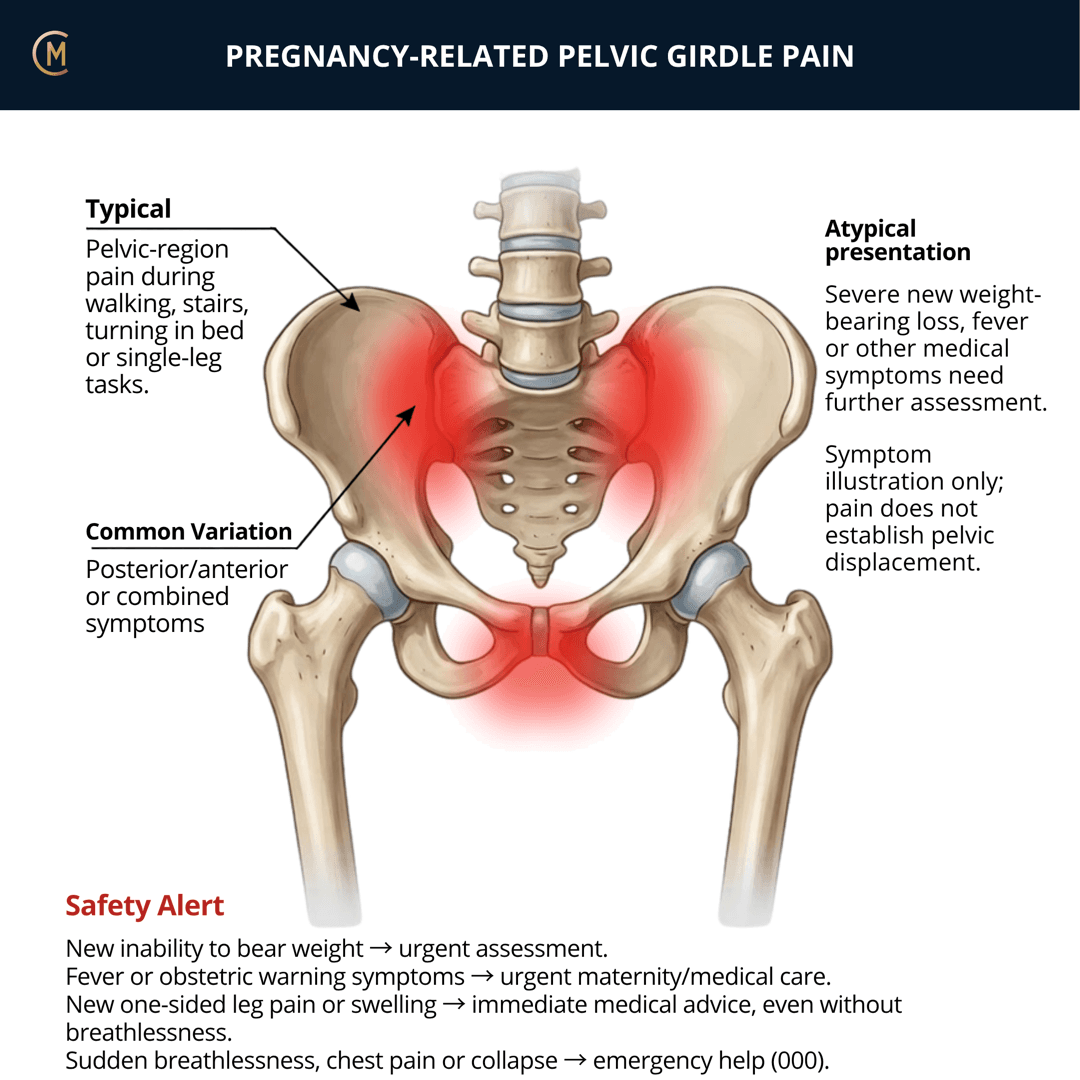
Who: During or after pregnancy.
What: Pelvic girdle pain — a clinical pain presentation around the posterior pelvis and/or pubic region (Vleeming et al. 2008; Pulsifer et al. 2022).
How it behaves: Pain over the SIJ, gluteal region or pubic symphysis. Aggravated by stairs, turning in bed, standing on one leg. Often described as sharp, unstable, or "giving way." Eased by rest or compression.
The one thing to take from this page:
Pain is real; its mechanism is not established by the pain map. Avoid displaced-pelvis explanations or assuming that laxity and failed load transfer explain every presentation. [1].
What she's been told vs what's happening
| What she's been told | What's actually happening |
|---|---|
| "Your pelvis is out" | Pain does not establish displacement or a single mechanical cause |
| "It needs putting back" | Manual therapy here is gentle and supportive — not corrective |
| "It'll go once the baby's out" | Usually settles. Persistence is a real outcome |
| "Rest it" | Graded re-exposure to single-leg loading |
⚠️ The European guideline is the only guideline, it is not Australian, and it is not recent. The structure is well founded; a 2026 systematic review is still asking what the exercise dose should be.
2 · SE — THE SUBJECTIVE PATTERN (the 70%)
Five stages, in your course's order. Two questions get skipped here every time: what has she been told, and how is she going.
MAIN PROBLEM
"My pelvis feels like it's coming apart."
"Rolling over in bed is agony."
"I can't stand on one leg to get dressed."
BODY CHART
- SIJ, gluteal region, pubic symphysis — often more than one.
- Mark the symphysis separately. Central pubic dominance changes the emphasis.
- Below the knee, dermatomal, or with weakness? That is a lumbar and neurological question.
- Mark anything that isn't musculoskeletal in behaviour.
BEHAVIOUR
| Fits PGP | Points elsewhere | |
|---|---|---|
| Aggs | Stairs, turning in bed, single-leg tasks, walking distance | Flexion-dominant, coughing → lumbar |
| Eases | Rest, compression, support | Nothing eases it → screen |
| Severity | VAS 0–10 at best / at worst / right now | — |
| Onset | During or after pregnancy | Non-pregnancy onset → SIJ dysfunction page |
| Weight-bearing | Painful but able | Unable to weight-bear → fracture question |
| Neuro | No deficit | Deficit → lumbar, neurological |
HISTORY
- Which pregnancy, what week, and was there PGP last time?
- Sleep. Turning in bed. Getting out of the car. These are the functions she has lost.
- Walking distance and single-leg tolerance. Your outcome measures.
- What has she been told, and by whom? This is the barrier, and it is usually the word "alignment."
- How is she going in herself? Ask it directly. Depression prevalence in this group has been systematically reviewed [2], and self-efficacy has been associated with regression from pregnancy-related pelvic girdle and back pain [3].
SPECIAL / SCREENING QUESTIONS
- Can she weight-bear? Inability is a fracture question, not severe PGP.
- Fever, feeling unwell, offensive discharge, calf pain or swelling? Postpartum, this list matters.
- Any bowel, bladder or saddle symptoms?
- Night pain unrelated to position, weight loss?
Assessing this region? Download the Hip & Groin assessment template →
3 · HYPOTHESIS RANKING
| Competing pattern | The one discriminating feature |
|---|---|
| SIJ dysfunction (non-pregnancy) | Same tests, different context. Pregnancy or postpartum onset is what defines this page. |
| Lumbar-related pain | Lumbar behaviour — flexion and extension pattern — and the pelvic provocation tests are negative. |
| Pubic symphysis–dominant pain | Central pubic pain, waddling gait, positive single-leg stance and squeeze. |
| Hip-related pain | Groin-dominant, FADIR, restricted internal rotation in flexion. |
| Coccydynia and pelvic floor–related pain | Different location and behaviour; worth naming because it coexists. |
The two that outrank the table
Pelvic or femoral neck stress fracture. Inability to weight-bear, night pain, and a low bone density or low energy availability risk profile. Pregnancy and lactation-associated bone changes make this a live question, not a theoretical one.
Postpartum medical complications. Fever, feeling unwell, offensive discharge, calf pain or swelling. Infection and venous thromboembolism present in this window, and this population under-reports.
And the differential that overlaps
Pelvic girdle pain, SIJ dysfunction and pubic symphysis pain are often taught as separate — and the honest answer is that they overlap. Describe the symptoms, assess meaningful function and consider competing explanations.
4 · RED FLAGS — DON'T MISS THIS
This section is free, on every pattern, forever. Safety is never gated.
| Finding | What it suggests | What you do |
|---|---|---|
| Unable to weight-bear | Pelvic or femoral neck fracture | Urgent imaging. Do not load |
| Acute hip or groin pain in the last trimester or just after birth | Transient osteoporosis of the hip — 12.1% went on to fracture (Hadji et al. 2017) [21] | Medical review and imaging before you load it |
| New thoracolumbar back pain in the last 3 months of pregnancy or first 3 months after delivery | Pregnancy- and lactation-associated osteoporosis with vertebral fracture — usually multiple levels (Qian et al. 2021) [22] | Medical review. Don't treat it as PGP until it's excluded |
| New unilateral leg pain, swelling or warmth in pregnancy/postpartum | Possible DVT | Contact maternity/medical services immediately; breathlessness is not required (RCOG) |
| Fever, feeling unwell, offensive discharge | Postpartum infection | Urgent medical review |
| Sudden unexplained breathlessness, chest pain, coughing blood or collapse | Possible PE | Emergency help now (RCOG) |
| Severe headache, visual change, swelling — late pregnancy or postpartum | Pre-eclampsia | EMERGENCY |
| Bowel or bladder change, saddle numbness | Cauda equina | EMERGENCY |
| Night pain unrelated to position, weight loss | Malignancy, infection | Medical review |
| Progressive neurological deficit | Neurological cause | Urgent medical review |
The rule: load- and position-related pelvic pain in a pregnant or postpartum woman who can weight-bear, with a clean systemic and neurological screen, is yours. Inability to weight-bear, anything systemic, and anything in the postpartum medical list is not.
Cross-links: SIJ dysfunction · Pubic-related groin pain · Non-specific low back pain · Hip / pelvic stress fracture
5 · OE — THE OBJECTIVE
Members
Sections 5 to 7 are for members
The objective exam, management and pearls, plus the six-minute lesson and the debrief. Free with an account.
Sign in or join free6 · MX — MANAGEMENT ESSENTIALS
Members
Sections 5 to 7 are for members
The objective exam, management and pearls, plus the six-minute lesson and the debrief. Free with an account.
Sign in or join free7 · CLINICAL PEARLS + RETRIEVAL CHECK
Members
Sections 5 to 7 are for members
The objective exam, management and pearls, plus the six-minute lesson and the debrief. Free with an account.
Sign in or join freeMembers
The 4-minute lesson is for members
Twelve slides on this pattern: what you'll hear, what to examine, what to do. Free with an account.
Sign in or join freeGuideline anchor
Australian anchor: the Australian Pregnancy Care Guidelines (Australian Government living guideline), whose pelvic girdle pain recommendation advises that pregnancy-specific exercises, physiotherapy, acupuncture or a support garment may provide some pain relief.
More
It is a weak recommendation and covers pregnancy only; no Australian guideline covers postpartum pelvic girdle pain. Anchored for diagnosis to the European guidelines for the diagnosis and treatment of pelvic girdle pain (Vleeming et al. 2008, PMID 18259783), which supply the diagnostic definition and the test battery this page uses, and to the contemporary reframing paper (Pulsifer et al. 2022, PMID 35948414) for the message.
The Australian Pregnancy Care Guidelines carry one weak, pregnancy-only recommendation; the European guideline is the only dedicated pelvic girdle pain guideline, and it is not Australian and not recent. The management evidence since then is systematic reviews and small trials, and a 2026 systematic review is still asking what the exercise prescription parameters should be — so the structure is well founded and the dose is not.
Members
The evidence summary is for members
Verified diagnostic accuracy, where the evidence stands and what it doesn't settle. Free with an account.
Sign in or join freeSources · 20
ShowHide
Every source on this page resolves and title-verifies against PubMed. Newest first.
- 2022Pulsifer et al. (2022). Reframing beliefs and instiling facts for contemporary management of pregnancy-related pelvic girdle pain. British journal of sports medicine, 56(22), 1262-1265. https://doi.org/10.1136/bjsports-2022-105724
- 2024Halliday et al. (2024). The prevalence of depression in women with pregnancy-related pelvic girdle pain: A systematic review and meta-analysis. Health science reports, 7(8), e2308. https://doi.org/10.1002/hsr2.2308
- 2023Chunmei et al. (2023). Self efficacy associated with regression from pregnancy-related pelvic girdle pain and low back pain following pregnancy. BMC pregnancy and childbirth, 23(1), 122. https://doi.org/10.1186/s12884-023-05393-z
- 2022Remus et al. (2022). Outcome Measurement Instruments and Evidence-based Recommendations for Measurement of the Pelvic Girdle Pain Core Outcome Set (PGP-COS): A Systematic Review and Consensus Process. The journal of pain, 23(12), 2052-2069. https://doi.org/10.1016/j.jpain.2022.08.003
- 2025Vesting et al. (2025). Educating women to prevent and treat low back and pelvic girdle pain during and after pregnancy: a systematized narrative review. Annals of medicine, 57(1), 2476046. https://doi.org/10.1080/07853890.2025.2476046
- 2018Almousa et al. (2018). The effectiveness of stabilising exercises in pelvic girdle pain during pregnancy and after delivery: A systematic review. Physiotherapy research international : the journal for researchers and clinicians in physical therapy, 23(1). https://doi.org/10.1002/pri.1699
- 2023Mamipour et al. (2023). Effect of Core Stabilization Exercises on Pain, Functional Disability, and Quality of Life in Pregnant Women With Lumbar and Pelvic Girdle Pain: A Randomized Controlled Trial. Journal of manipulative and physiological therapeutics, 46(1), 27-36. https://doi.org/10.1016/j.jmpt.2023.05.005
- 2023Santos et al. (2023). Prevention of low back and pelvic girdle pain during pregnancy: a systematic review and meta-analysis of randomised controlled trials with GRADE recommendations. Physiotherapy, 118, 1-11. https://doi.org/10.1016/j.physio.2022.09.004
- 2023Burani et al. (2023). Predictive Factors for Pregnancy-Related Persistent Pelvic Girdle Pain (PPGP): A Systematic Review. Medicina (Kaunas, Lithuania), 59(12). https://doi.org/10.3390/medicina59122123
- 2022Starzec-Proserpio et al. (2022). Prevalence and factors associated with postpartum pelvic girdle pain among women in Poland: a prospective, observational study. BMC musculoskeletal disorders, 23(1), 928. https://doi.org/10.1186/s12891-022-05864-y
- 2024Robinson et al. (2024). Pelvic girdle pain in pregnancy and early postpartum - prevalence and risk factors in a multi-ethnic cohort. BMC musculoskeletal disorders, 25(1), 21. https://doi.org/10.1186/s12891-023-07135-w
- 2026Ashrafi et al. (2026). Identifying risk factors for pregnancy-related pelvic girdle pain: A modified eDelphi study. Musculoskeletal science & practice, 82, 103528. https://doi.org/10.1016/j.msksp.2026.103528
- 2008Vleeming et al. (2008). European guidelines for the diagnosis and treatment of pelvic girdle pain. European spine journal : official publication of the European Spine Society, the European Spinal Deformity Society, and the European Section of the Cervical Spine Research Society, 17(6), 794-819. https://doi.org/10.1007/s00586-008-0602-4
- 2015Gutke et al. (2015). Treatments for pregnancy-related lumbopelvic pain: a systematic review of physiotherapy modalities. Acta obstetricia et gynecologica Scandinavica, 94(11), 1156-67. https://doi.org/10.1111/aogs.12681
- 2022van Benten et al. (2022). Differences in balance control despite self-reported resolution of pregnancy-related pelvic girdle pain. A cross-sectional study. Musculoskeletal science & practice, 62, 102620. https://doi.org/10.1016/j.msksp.2022.102620
- 2023Sward et al. (2023). Pelvic Girdle Pain in Pregnancy: A Review. Obstetrical & gynecological survey, 78(6), 349-357. https://doi.org/10.1097/OGX.0000000000001140
- 2024Hrvatin et al. (2024). Pregnancy-related pelvic girdle pain affects balance in the second and third trimesters of pregnancy. PloS one, 19(3), e0287221. https://doi.org/10.1371/journal.pone.0287221
- 2025Halliday et al. (2025). Evaluating the Management of chronic Pelvic girdle Pain following pregnancy (EMaPP): a randomised controlled feasibility trial. Pilot and feasibility studies, 11(1), 54. https://doi.org/10.1186/s40814-025-01638-0
- 2026Ekdahl et al. (2026). Individually tailored physiotherapy interventions for pregnancy-related pelvic girdle pain: functioning, physical activity, and treatment satisfaction four months postpartum. A cross-sectional study. BMC pregnancy and childbirth, 26(1). https://doi.org/10.1186/s12884-026-09617-w
- 2026Lu et al. (2026). Exploring exercise prescription parameters for pregnancy-related pelvic girdle pain: A systematic review and meta-analysis of effects on pain and function. The journal of pain, 106401. https://doi.org/10.1016/j.jpain.2026.106401
Mapped to this pattern
Generic measures that also apply
- Borg RPE
Borg Rating of Perceived Exertion Scale (6-20)
perceived exertion · 1 items · 1 min
- GROC
Global Rating of Change Scale
perceived change since baseline · 1 items · 1 min
- NPRS
Numeric Pain Rating Scale
pain intensity · 1 items · 1 min
- PGIC
Patient Global Impression of Change
perceived change since baseline · 1 items · 1 min
- PSFS
Patient-Specific Functional Scale
patient-generated function · 3 items · 2 min
- SANE
Single Assessment Numeric Evaluation
patient-rated function as a percentage of normal · 1 items · 1 min
- VAS
Visual Analogue Scale
pain intensity · 1 items · 1 min
- Borg CR10
Borg Category Ratio 10 Scale
perceived exertion or symptom intensity, ratio scale · 1 items · 1 min
- GAS
Goal Attainment Scaling
individualised goal achievement · 10 min
Did this page do its job?
CliniStudy is in beta. One tap is enough — it decides what gets fixed first.