
1 · SNAPSHOT
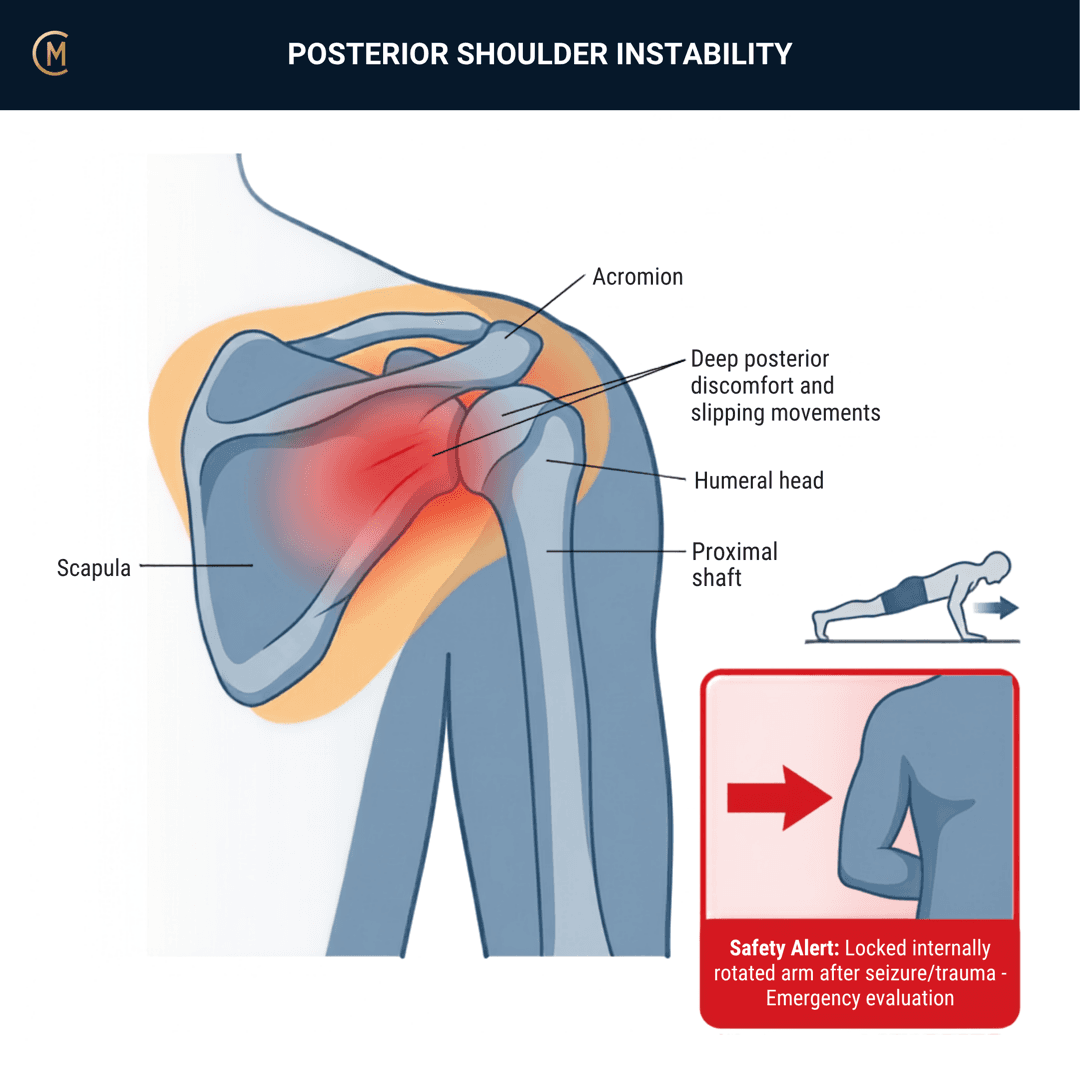
The shoulder diagnosis students miss most often.
Illness script in one line: deep posterior shoulder pain and a sense of the shoulder slipping backwards during pushing — bench press, blocking, a push-up, a hand on a car door — usually from repetitive overload rather than one big event.
Caseload frequency: more common than the textbooks suggest. Read further: risk factors in young athletes [1], incidence in the United States military [2], incidence and surgical trends over a 22-year period [3]. It is under-recognised rather than rare.
The first pearl is the whole page
Clinical pearl: "Commonly misdiagnosed as impingement/cuff pain — note push-specific Sx."
That sentence is the diagnosis, and it is one question long.
"What are you doing when it happens?"
Pushing, pressing, blocking, reaching forward and across. Not the cocking position, not overhead reaching. If the answer is a bench press and you're treating a cuff, you're on the wrong page.
Read further: biomechanics and pathoanatomy [4], diagnosis and management [5], epidemiology, examination and diagnostics [6], the condition in athletes [7].
2 · SE — THE SUBJECTIVE PATTERN (the 70%)
MAIN PROBLEM
"It slips when I push." Or: it gives way backwards · it clunks pressing · something shifts at the bottom of a bench press.
Many will say "my shoulder's been sore for months and physio hasn't helped." That sentence, plus a pushing sport or a gym history, should put this on your list before you examine anything.
BODY CHART
- Deep posterior, over the back of the joint. They reach across and press behind it.
- ± posterior deltoid and infraspinatus region.
- Rarely below the elbow. If it is, re-rank.
BEHAVIOUR
- Aggs: bench press (especially the bottom), push-ups, blocking, tackling, a hand planted forward, reaching across the body, lying supine with the arm forward. Flexion–adduction is the position.
- Eases: stopping the push. Arm by the side.
- The signature: it happens in the SAME movement every time, and that movement involves pushing.
- Irritability: usually low to moderate. They keep training around it, which is part of why it takes so long to diagnose.
HISTORY — and the mechanism sorts the group
Often microtrauma or overload rather than a single big event. That is the majority. Sort them anyway:
| Group | Story | What it means |
|---|---|---|
| Micro-traumatic / repetitive | Gym, blocking, pressing sports, no single event | The commonest. The conservative evidence is written for this group [8]. |
| Traumatic | A specific posteriorly directed force through a flexed, adducted, internally rotated arm | Imaging matters more. Structural lesion more likely. |
| After a seizure, electrocution or high-energy trauma | Different page. See section 4. | A locked posterior dislocation until excluded. |
Read further: diagnosis and treatment on the ABC classification [9], an international Delphi on classification, assessment and management [10]. Know the Delphi exists — it is in your own profession's journal.
SPECIAL / SCREENING QUESTIONS
Seizure history. Electrocution. Any episode where the arm was stuck. Generalised hypermobility — Beighton, because MDI has a posterior component and it is a different page.
Assessing this region? Download the Shoulder assessment template →
3 · HYPOTHESIS RANKING
Top three, and the one feature that separates each
| Pattern | The discriminating feature |
|---|---|
| 1. Posterior instability | Push-specific symptoms, deep posterior pain, slipping backwards in flexion–adduction. |
| 2. Rotator cuff–related shoulder pain / subacromial pain | The classic misdiagnosis. Lateral pain, painful arc, overhead-provoked, no push-specific story, no sense of slipping. |
| 3. Multidirectional instability | Atraumatic, often bilateral, hypermobile, loose in more than one direction. Sulcus sign, Beighton score. Its own page — and a posterior component is common. |
Also on the list
| Pattern | The discriminating feature |
|---|---|
| SLAP lesion | Deep, clicking, catching, throwing athlete. Coexists. |
| Anterior instability | Apprehension in abduction and external rotation — the cocking position, not the push. |
| Posterior labral tear without instability | Symptoms without the sense of slipping. The distinction is clinical, not imaging. |
| Locked posterior dislocation | Arm held internally rotated, cannot externally rotate past neutral. Section 4. |
| Fracture, or reverse Hill-Sachs after high-energy trauma | Persisting severe pain, mechanism, bony tenderness. |
The rule
Every "cuff pain that hasn't responded" gets one extra question: what are you doing when it hurts? If the answer is pushing, you are probably on this page.
4 · RED FLAGS — DON'T MISS THIS
Free forever. Safety is never behind a paywall.
This pattern has one of the classic missed diagnoses in all of orthopaedics attached to it.
The locked posterior dislocation
| Finding | What it means |
|---|---|
| A shoulder held in internal rotation that CANNOT be externally rotated past neutral | LOCKED POSTERIOR DISLOCATION until excluded. Do not mobilise. Urgent imaging. |
| The mechanism: a seizure, an electrocution, or a high-energy fall | The classic triad of causes. Ask about all three whenever the shoulder won't rotate out. |
| A posterior dislocation with no clear cause | Think first seizure, even without a clear history — posterior dislocations are often caused by one (Langenbruch et al. 2019) [21]. Medical referral for the seizure, not just the shoulder. |
| Loss of external rotation and loss of supination with the elbow at the side | The bedside sign. It is the reason it gets called a "frozen shoulder" and treated for months. |
| A flattened anterior shoulder with a prominent coracoid, and posterior fullness | Look at both shoulders from above. |
A shoulder that will not externally rotate past neutral after a seizure is not a stiff shoulder. It gets imaged, today.
The rest
| Finding | What it means |
|---|---|
| Severe unsettling pain, marked bony tenderness, or a high-energy mechanism | Fracture or reverse Hill-Sachs lesion. Image before you rehab. |
| Any neurological deficit | Escalate. Full screen after any dislocation. |
| Recurrent instability with progressively less force | Structural. Get an opinion — not a rehab dose problem. |
| A first traumatic posterior dislocation | Needs imaging and an opinion, not a home programme — more so if they're under 40, it happened in a seizure, or there's a large reverse Hill-Sachs: all predict recurrence (Brelin & Dickens 2017) [22]. |
Any red flag: stop, escalate, and check it with your educator.
5 · OE — THE OBJECTIVE (the 30%)
Members
Sections 5 to 7 are for members
The objective exam, management and pearls, plus the six-minute lesson and the debrief. Free with an account.
Sign in or join free6 · MX — MANAGEMENT ESSENTIALS
Members
Sections 5 to 7 are for members
The objective exam, management and pearls, plus the six-minute lesson and the debrief. Free with an account.
Sign in or join free7 · CLINICAL PEARLS + RETRIEVAL CHECK
Members
Sections 5 to 7 are for members
The objective exam, management and pearls, plus the six-minute lesson and the debrief. Free with an account.
Sign in or join freeMembers
The 5-minute lesson is for members
Twelve slides on this pattern: what you'll hear, what to examine, what to do. Free with an account.
Sign in or join freeGuideline anchor
No Australian guideline.
More
The anchor a physiotherapy student should know exists is an international Delphi study on the classification, assessment and management of posterior shoulder instability, published in JOSPT (Sadi et al. 2020, PMID 32349639), with a consensus statement on diagnosis, non-operative management and labral repair in Arthroscopy (Hurley et al. 2025, PMID 38735410). The rehabilitation anchor is a systematic review of evidence-based conservative rehabilitation for posterior glenohumeral instability in Physical Therapy in Sport (McIntyre et al. 2016, PMID 27665529), with the efficacy of conservative management of micro-traumatic posterior instability reported since (Watson et al. 2025, PMID 39898185) and non-operative treatment of isolated posterior instability examined in an active military population (Mescher et al. 2024, PMID 39503723).
The Delphi and the consensus statement are expert-agreement documents, not clinical practice guidelines. There is no guideline for this condition.
Members
The evidence summary is for members
Verified diagnostic accuracy, where the evidence stands and what it doesn't settle. Free with an account.
Sign in or join freeSources · 20
ShowHide
Every source on this page resolves and title-verifies against PubMed. Newest first.
- 2013Owens et al. (2013). Risk factors for posterior shoulder instability in young athletes. The American journal of sports medicine, 41(11), 2645-9. https://doi.org/10.1177/0363546513501508
- 2021Bokshan et al. (2021). Incidence of Posterior Shoulder Instability in the United States Military: Demographic Considerations From a High-Risk Population. The American journal of sports medicine, 49(2), 340-345. https://doi.org/10.1177/0363546520976143
- 2019Woodmass et al. (2019). Incidence of posterior shoulder instability and trends in surgical reconstruction: a 22-year population-based study. Journal of shoulder and elbow surgery, 28(4), 611-616. https://doi.org/10.1016/j.jse.2018.08.046
- 2024Testa et al. (2024). Biomechanics and Pathoanatomy of Posterior Shoulder Instability. Clinics in sports medicine, 43(4), 723-735. https://doi.org/10.1016/j.csm.2024.03.026
- 2020Sheean et al. (2020). Posterior Glenohumeral Instability: Diagnosis and Management. Arthroscopy : the journal of arthroscopic & related surgery : official publication of the Arthroscopy Association of North America and the International Arthroscopy Association, 36(10), 2580-2582. https://doi.org/10.1016/j.arthro.2020.05.018
- 2026Siegert et al. (2026). [Posterior shoulder instability : Epidemiology, examination, and diagnostics]. Orthopadie (Heidelberg, Germany), 55(8), 599-605. https://doi.org/10.1007/s00132-026-04775-3
- 2025Song et al. (2025). Posterior Shoulder Instability in Athletes. JBJS reviews, 13(9). https://doi.org/10.2106/JBJS.RVW.25.00098
- 2025Watson et al. (2025). The efficacy of conservative management of micro-traumatic posterior shoulder instability. JSES international, 9(1), 46-55. https://doi.org/10.1016/j.jseint.2024.09.016
- 2024Paksoy et al. (2024). Diagnosis and treatment of posterior shoulder instability based on the ABC classification. EFORT open reviews, 9(5), 403-412. https://doi.org/10.1530/EOR-24-0025
- 2020Sadi et al. (2020). Posterior Shoulder Instability Classification, Assessment, and Management: An International Delphi Study. The Journal of orthopaedic and sports physical therapy, 50(7), 373-380. https://doi.org/10.2519/jospt.2020.9225
- 2018Hines et al. (2018). Glenoid Bone Loss in Posterior Shoulder Instability: Prevalence and Outcomes in Arthroscopic Treatment. The American journal of sports medicine, 46(5), 1053-1057. https://doi.org/10.1177/0363546517750628
- 2024Knight et al. (2024). Radiographic and Advanced Imaging Evaluation of Posterior Shoulder Instability. Current reviews in musculoskeletal medicine, 17(5), 144-156. https://doi.org/10.1007/s12178-024-09892-0
- 2024Scanaliato et al. (2024). Establishing the Minimal Clinically Important Difference, Substantial Clinical Benefit, and Patient Acceptable Symptomatic State After Arthroscopic Posterior Labral Repair for Posterior Glenohumeral Instability. The American journal of sports medicine, 52(1), 207-214. https://doi.org/10.1177/03635465231210289
- 2025Hurley et al. (2025). Posterior Shoulder Instability, Part I-Diagnosis, Nonoperative Management, and Labral Repair for Posterior Shoulder Instability-An International Expert Delphi Consensus Statement. Arthroscopy : the journal of arthroscopic & related surgery : official publication of the Arthroscopy Association of North America and the International Arthroscopy Association, 41(2), 166-180.e11. https://doi.org/10.1016/j.arthro.2024.04.035
- 2016McIntyre et al. (2016). Evidence-based conservative rehabilitation for posterior glenohumeral instability: A systematic review. Physical therapy in sport : official journal of the Association of Chartered Physiotherapists in Sports Medicine, 22, 94-100. https://doi.org/10.1016/j.ptsp.2016.06.002
- 2021Bodendorfer (2021). CORR Insights®: Recurrent Instability and Surgery Are Common After Nonoperative Treatment of Posterior Glenohumeral Instability in NCAA Division I FBS Football Players. Clinical orthopaedics and related research, 479(4), 701-703. https://doi.org/10.1097/CORR.0000000000001485
- 2024Mescher et al. (2024). Nonoperative Treatment of Isolated Posterior Glenohumeral Instability in an Active Military Population: Effect of Glenoid and Acromial Morphology. The American journal of sports medicine, 52(13), 3349-3356. https://doi.org/10.1177/03635465241284647
- 2017Cruz-Ferreira et al. (2017). Posterior shoulder instability: Prospective non-randomised comparison of operative and non-operative treatment in 51 patients. Orthopaedics & traumatology, surgery & research : OTSR, 103(8S), S185-S188. https://doi.org/10.1016/j.otsr.2017.08.004
- 2021Fried et al. (2021). Return to Play After Arthroscopic Stabilization for Posterior Shoulder Instability-A Systematic Review. Arthroscopy, sports medicine, and rehabilitation, 3(1), e249-e256. https://doi.org/10.1016/j.asmr.2020.08.007
- 2018Dhir et al. (2018). Evidence-Based Review of Clinical Diagnostic Tests and Predictive Clinical Tests That Evaluate Response to Conservative Rehabilitation for Posterior Glenohumeral Instability: A Systematic Review. Sports health, 10(2), 141-145. https://doi.org/10.1177/1941738117752306
Mapped to this pattern
Generic measures that also apply
- Borg RPE
Borg Rating of Perceived Exertion Scale (6-20)
perceived exertion · 1 items · 1 min
- GROC
Global Rating of Change Scale
perceived change since baseline · 1 items · 1 min
- NPRS
Numeric Pain Rating Scale
pain intensity · 1 items · 1 min
- PGIC
Patient Global Impression of Change
perceived change since baseline · 1 items · 1 min
- PSFS
Patient-Specific Functional Scale
patient-generated function · 3 items · 2 min
- SANE
Single Assessment Numeric Evaluation
patient-rated function as a percentage of normal · 1 items · 1 min
- VAS
Visual Analogue Scale
pain intensity · 1 items · 1 min
- Borg CR10
Borg Category Ratio 10 Scale
perceived exertion or symptom intensity, ratio scale · 1 items · 1 min
- GAS
Goal Attainment Scaling
individualised goal achievement · 10 min
Did this page do its job?
CliniStudy is in beta. One tap is enough — it decides what gets fixed first.